

Every day across the Department of the Army, the work of service members and civilians is increasingly defined by a familiar tension: too much information, too little time, and too many administrative tasks competing with mission-critical duties. In that environment, the case for artificial intelligence is no longer theoretical. The real question is not whether AI belongs in the Army professional’s workflow, but whether it can be used in a way that reinforces judgment, preserves trust, and buys back time without eroding the human edge. The Army’s recent Microsoft Copilot Chat pilot, and the broader push behind it, suggest the answer is yes—if leaders understand AI as an amplifier rather than a substitute.
The Army has been wrestling with the promise and danger of AI for several years, and the debate has matured quickly. Early conversations focused on whether generative tools were useful at all; now they center on how to govern them, where to place them in workflows, and how to keep humans in charge. That shift is visible in Army publications that argue AI can help with decision-making, but should not supplant professional judgment. One Army article on artificial intelligence in decision-making explicitly frames technology as assistance, not replacement, and recent Army commentary has repeated the same caution in slightly different terms.
That evolution matters because the Army is not dealing with a niche software experiment. It is confronting a structural productivity problem. Staff officers, civilians, and communicators spend huge amounts of time on emails, summaries, presentation decks, drafts, timelines, and staff coordination. In a force defined by readiness and speed, those tasks are necessary but not decisive. The appeal of AI is that it can compress the routine work and leave people more time for the hard work: interpreting context, building relationships, and making judgment calls that no model can reliably make on its own.
The Army’s Copilot Chat pilot sits squarely inside that bigger story. It reflects a practical acknowledgement that generative AI is not going away, and that the institution must learn to govern what it cannot stop. Army articles over the past two years have increasingly framed AI as a force multiplier, a theme that appears not only in discussions of staff work and decision support, but also in professional military education, sustainment analytics, and future force design. The common denominator is not automation for its own sake; it is the offloading of repetitive work so people can spend more time on mission-specific thinking.
This is also why the article’s authorial voice resonates with many readers inside government. It is not written like a technologist trying to sell a platform. It is written like a practitioner who has tested the tool in the middle of real work and discovered that AI can be helpful, imperfect, and useful in exactly the way a first draft should be useful. That framing is important because it avoids two common traps: the hype that AI can do everything, and the cynicism that it can do nothing. The reality, as Army commentary increasingly suggests, sits in the middle.
The result is a broader institutional shift. The Army is moving from asking whether AI should exist in the workplace to asking where it should be embedded, how it should be supervised, and what kinds of work it should accelerate. That is a much more mature question, and it is the right one. It recognizes that technology changes labor, but does not erase the need for humans who can contextualize, verify, and decide. In an organization built on trust, that distinction is everything.
That matters in a military context because the Army does not merely value efficiency; it depends on it. Staff teams operate under suspense-driven conditions, often with incomplete information and competing priorities. If AI can compress a ten-email chain into a digest, turn rough notes into a briefing structure, or transform a pile of observations into a coherent timeline, it is not replacing thought. It is reducing the cost of getting to the starting line. That distinction is the difference between automation as a helper and automation as a decision-maker.
This integration is strategically important. A standalone chatbot can be useful for brainstorming, but embedded AI has a different power: it sits inside the work rather than outside it. That makes it easier to summarize documents, draft content, and shape outputs using the files and conversations already tied to the task. The Army has repeatedly emphasized that AI adoption improves when it is connected to existing data, doctrine, and workflow rather than treated as a novelty.
This is where the article is most aligned with the Army’s broader AI literature. Recent Army writing repeatedly warns that machine output can strengthen decision-making only if users retain the authority to challenge it. That principle is especially important when the tool is being used for policy summaries, regulatory interpretation, or leader updates. AI may accelerate the path to an answer, but it cannot certify the answer’s correctness.
In public-facing Army work, timing matters. Crisis communication often unfolds in minutes, not hours, which makes AI attractive as a rapid drafting tool. But the speed that makes AI useful also magnifies the risk of mistakes. A communication team that uses a model to assemble a first pass from templates and incident facts can respond faster, but only if human professionals still control the final language and the strategic intent behind it.
That said, shortening the search is not the same as deciding the answer. The article’s warning about checking the original sources is essential. AI can surface a likely regulation, but the user still has to verify it against the actual text, especially when the issue involves legal interpretation, command policy, or administrative action. The penalty for trusting a hallucination is simply too high.
That cultural tension is already visible across Army publications. Some authors emphasize augmentation and force multiplication; others emphasize the risks to creativity, critical thinking, and trust. Both instincts are valid. The challenge is not to pick one and dismiss the other, but to build a culture that uses AI aggressively for low-value work while preserving the human skills that make the Army profession distinct.
That means the institution should focus on three things at once: training, governance, and expectation management. Training ensures users know how to prompt, verify, and refine. Governance ensures sensitive data stays protected and outputs are checked. Expectation management ensures leaders do not confuse acceleration with intelligence. If the Army gets those three pieces right, AI can become an authentic force multiplier rather than a fashionable distraction.
Source: army.mil Opinion: How AI augments, not replaces the Army professional
 Background
The Army has been wrestling with the promise and danger of AI for several years, and the debate has matured quickly. Early conversations focused on whether generative tools were useful at all; now they center on how to govern them, where to place them in workflows, and how to keep humans in charge. That shift is visible in Army publications that argue AI can help with decision-making, but should not supplant professional judgment. One Army article on artificial intelligence in decision-making explicitly frames technology as assistance, not replacement, and recent Army commentary has repeated the same caution in slightly different terms.That evolution matters because the Army is not dealing with a niche software experiment. It is confronting a structural productivity problem. Staff officers, civilians, and communicators spend huge amounts of time on emails, summaries, presentation decks, drafts, timelines, and staff coordination. In a force defined by readiness and speed, those tasks are necessary but not decisive. The appeal of AI is that it can compress the routine work and leave people more time for the hard work: interpreting context, building relationships, and making judgment calls that no model can reliably make on its own.
The Army’s Copilot Chat pilot sits squarely inside that bigger story. It reflects a practical acknowledgement that generative AI is not going away, and that the institution must learn to govern what it cannot stop. Army articles over the past two years have increasingly framed AI as a force multiplier, a theme that appears not only in discussions of staff work and decision support, but also in professional military education, sustainment analytics, and future force design. The common denominator is not automation for its own sake; it is the offloading of repetitive work so people can spend more time on mission-specific thinking.
This is also why the article’s authorial voice resonates with many readers inside government. It is not written like a technologist trying to sell a platform. It is written like a practitioner who has tested the tool in the middle of real work and discovered that AI can be helpful, imperfect, and useful in exactly the way a first draft should be useful. That framing is important because it avoids two common traps: the hype that AI can do everything, and the cynicism that it can do nothing. The reality, as Army commentary increasingly suggests, sits in the middle.
The result is a broader institutional shift. The Army is moving from asking whether AI should exist in the workplace to asking where it should be embedded, how it should be supervised, and what kinds of work it should accelerate. That is a much more mature question, and it is the right one. It recognizes that technology changes labor, but does not erase the need for humans who can contextualize, verify, and decide. In an organization built on trust, that distinction is everything.
AI as Time Recovery
The strongest argument for AI in Army administration is also the simplest: it gives time back. Time is the one resource that cannot be replenished, and that fact matters in a bureaucracy where every minute spent formatting, summarizing, or hunting for the right paragraph is a minute not spent on analysis, coordination, or leadership. In that sense, generative AI is not an abstract productivity toy. It is a practical method for reclaiming the hours that administrative friction consumes.That matters in a military context because the Army does not merely value efficiency; it depends on it. Staff teams operate under suspense-driven conditions, often with incomplete information and competing priorities. If AI can compress a ten-email chain into a digest, turn rough notes into a briefing structure, or transform a pile of observations into a coherent timeline, it is not replacing thought. It is reducing the cost of getting to the starting line. That distinction is the difference between automation as a helper and automation as a decision-maker.
The practical effect on daily work
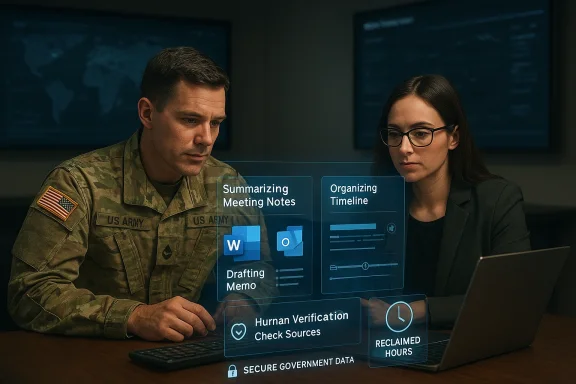
In the article, the author describes using Copilot Chat to draft memos, summarize meetings, build checklists, and generate talking points. Those are exactly the kinds of tasks that consume disproportionate time in the modern staff environment. They are also the kinds of tasks where the final product depends on tone, judgment, and context more than raw writing ability. AI can speed the first pass, but it cannot replace the professional who knows what the command needs to hear and what it needs to avoid.- It reduces repetitive drafting.
- It shortens research cycles.
- It helps organize messy notes.
- It supports faster brief preparation.
- It frees time for human review and refinement.
Why speed alone is not the point
A faster bad answer is still a bad answer, and Army professionals know that better than most. That is why the article’s caution about verification is so important. The technology can make work more efficient, but it does not excuse the user from checking the source material, correcting the tone, or ensuring that the product fits the mission. Efficiency without verification is just a faster way to be wrong.Copilot Chat and the Microsoft 365 Advantage
The article’s praise of Copilot is not just about AI in general; it is about AI in the right environment. Microsoft 365 is already where much of the Army’s administrative work happens, which means Copilot Chat can meet users in familiar applications instead of forcing them into a separate workflow. That matters because the lower the friction, the more likely people are to use the tool correctly and consistently.This integration is strategically important. A standalone chatbot can be useful for brainstorming, but embedded AI has a different power: it sits inside the work rather than outside it. That makes it easier to summarize documents, draft content, and shape outputs using the files and conversations already tied to the task. The Army has repeatedly emphasized that AI adoption improves when it is connected to existing data, doctrine, and workflow rather than treated as a novelty.
Why integration matters more than novelty
The best AI tools are often the least theatrical ones. Users do not need another flashy interface to manage; they need assistance that feels like a natural extension of the systems they already trust. When AI becomes an embedded capability in Word, Outlook, Teams, and Excel, it becomes easier to adopt, easier to train, and easier to govern. That does not make it perfect. It makes it operationally useful.- Familiar interfaces reduce training time.
- Existing permissions structures simplify control.
- Shared workflows make adoption less disruptive.
- Built-in access supports faster document handling.
- Integrated tools are easier to govern than shadow IT.
The enterprise logic behind the pilot
The broader enterprise lesson is that AI is most valuable when it becomes part of the operating system of work, not a separate destination. Army articles about AI in sustainment, decision-making, and PME all point in that direction. The institution is learning that usefulness depends less on the intelligence of the model in isolation and more on the way it is placed inside the process. That is the difference between a demo and a capability.Human Judgment Still Rules
The article makes its most persuasive point when it insists that AI generates a first draft, not a final answer. That may sound obvious, but it is the core safeguard that keeps productivity from turning into dependency. Generative systems can assemble, summarize, and suggest; they cannot supply experience, judgment, or moral responsibility. Those remain human duties, and in the Army they matter even more because the consequences of error can cascade quickly.This is where the article is most aligned with the Army’s broader AI literature. Recent Army writing repeatedly warns that machine output can strengthen decision-making only if users retain the authority to challenge it. That principle is especially important when the tool is being used for policy summaries, regulatory interpretation, or leader updates. AI may accelerate the path to an answer, but it cannot certify the answer’s correctness.
The verification burden is non-negotiable
The author is right to say that AI sometimes cites the wrong regulation, law, or policy, and sometimes invents one altogether. That is a classic risk of large language models: fluent language can create confidence where none is justified. In military work, that is more than inconvenient; it can be professionally dangerous. A polished but wrong answer can move faster through staff channels precisely because it sounds authoritative.- Users must confirm citations against source material.
- Commands should treat AI as assistive, not authoritative.
- Sensitive outputs need human review before distribution.
- Policy interpretation should never be outsourced wholesale.
- Final accountability must stay with the professional.
Experience is not data
Another important point is that AI can’t replicate the accumulated wisdom of service. It can process examples, but it does not live with consequences. It doesn’t know what it feels like to brief a commander under pressure, navigate a delicate personnel issue, or understand how a particular installation, unit, or community reacts to certain decisions. That kind of knowledge is embodied, not merely informational.Crisis, Communication, and the Limits of Automation
The article is especially compelling when it turns to public affairs and crisis communication. That is one of the areas where AI is helpful but also most constrained. It can draft a press note, outline key messages, or generate scenario-based questions, but it cannot conduct an interview, build trust, or handle a live crisis news conference. Those tasks depend on judgment under pressure, tone, credibility, and the ability to read a room.In public-facing Army work, timing matters. Crisis communication often unfolds in minutes, not hours, which makes AI attractive as a rapid drafting tool. But the speed that makes AI useful also magnifies the risk of mistakes. A communication team that uses a model to assemble a first pass from templates and incident facts can respond faster, but only if human professionals still control the final language and the strategic intent behind it.
What AI can do in crisis environments
In a crisis, the right use of AI is usually preparatory rather than decisive. It can help teams organize thoughts, compare prior templates, and surface likely questions before the briefing begins. It can also help turn rough facts into a structured product that a communicator can quickly refine. That is valuable because in crisis work, seconds matter and clarity is a competitive advantage.- Draft first-pass statements.
- Generate scenario-based questions.
- Organize timelines and talking points.
- Convert notes into task lists.
- Compare current facts against template language.
Why empathy cannot be automated
A machine can mimic a tone, but it cannot feel consequences. It cannot tell when a community is angry, frightened, or confused in the human sense that matters during an emergency. Nor can it adapt its message based on intuition built from years of lived experience. This is why AI should be treated as a drafting aid, not a substitute for the public servant who has to carry the message into the real world.The Regulatory and Doctrine Challenge
One of the most practical benefits of AI in Army work is its ability to help people navigate the sprawling universe of regulations, laws, policies, and doctrinal references that govern daily action. For many professionals, especially civilians and staff officers whose duties cross functional lines, it is impossible to remember every relevant rule. AI can shorten the search process and orient the user faster than manual digging through long documents.That said, shortening the search is not the same as deciding the answer. The article’s warning about checking the original sources is essential. AI can surface a likely regulation, but the user still has to verify it against the actual text, especially when the issue involves legal interpretation, command policy, or administrative action. The penalty for trusting a hallucination is simply too high.
Doctrine is a guide, not a prompt result
The Army’s doctrinal culture makes this distinction especially important. Professionals are expected to think in context, understand the hierarchy of authority, and apply rules to situations that are often messy and incomplete. AI can assist that process, but it cannot replace the judgment required to decide which source controls and how it should be applied.- AI can identify likely references.
- AI can summarize policy language.
- AI cannot certify legal correctness.
- AI cannot resolve conflicting authorities on its own.
- AI cannot absorb command intent without human guidance.
The danger of over-trusting polished language
The most serious risk is not that AI will scream “I am wrong.” The risk is that it will sound right while being wrong. In bureaucratic environments, that can be especially dangerous because polished prose often receives less scrutiny than rough prose. If a model can produce an elegant memo in seconds, the user may be less inclined to question the substance. That is why disciplined verification is not a box to check; it is the core of professional use.Culture Change Inside the Force
The article is ultimately about more than a productivity tool. It is about cultural adaptation. Military institutions are often judged by their ability to preserve tradition while incorporating new technologies without losing identity. AI is testing that balance now. The Army cannot ignore the tool, but it also cannot let the tool define the profession.That cultural tension is already visible across Army publications. Some authors emphasize augmentation and force multiplication; others emphasize the risks to creativity, critical thinking, and trust. Both instincts are valid. The challenge is not to pick one and dismiss the other, but to build a culture that uses AI aggressively for low-value work while preserving the human skills that make the Army profession distinct.
Adoption is a leadership issue
Leaders will determine whether AI becomes a useful teammate or an excuse for laziness. If commanders and supervisors frame it as a shortcut for eliminating thought, the culture will decay quickly. If they frame it as a way to free people from repetition so they can spend more time on judgment, training, and relationships, the institution can gain real advantage. Leadership tone will shape usage more than policy language alone.- Leaders set expectations for proper use.
- Supervisors determine whether verification is real.
- Training influences whether outputs are trusted appropriately.
- Command climate shapes whether experimentation feels safe.
- Ethical standards define the boundaries of adoption.
The older skills still matter
If anything, AI raises the value of the skills that machines lack. Good briefing discipline, context awareness, tone, persuasion, and interpersonal trust all become more valuable when the machine handles the first draft. The profession does not become less human; it becomes more dependent on the human traits that justify professional judgment in the first place.Strengths and Opportunities
The article’s central strength is that it treats AI as a practical tool for reclaiming time while insisting that judgment remains human. That balanced approach is exactly what the Army needs as it expands experimentation. It also reflects a broader institutional shift toward responsible, embedded AI rather than flashy, disconnected demonstrations.- Time savings on repetitive administrative work.
- Faster drafting of memos, briefs, and updates.
- Better summarization of long email threads and meetings.
- Improved focus on analysis, leadership, and relationships.
- Lower friction through Microsoft 365 integration.
- Stronger adoption because the tool fits existing workflows.
- More room for judgment once routine work is automated.
Risks and Concerns
The article is careful to note that AI is not a complete solution, and that caution is warranted. That caution is justified. The biggest risk is not futuristic rebellion by machines; it is everyday misuse by humans who trust outputs too quickly or fail to verify them. In government and military settings, that kind of error can have outsized consequences.- Hallucinated regulations or fake policy references.
- Overreliance on polished but incomplete output.
- Data handling mistakes if users share too much.
- False confidence created by fluent language.
- Cultural drift if AI starts replacing thought.
- Uneven adoption across units and offices.
- Training gaps that leave users underprepared.
Looking Ahead
The most likely future is not replacement, but layering. AI will handle more of the first draft, more of the search, more of the summarization, and more of the repetitive assembly work. Humans will remain responsible for interpretation, communication, ethics, and final decisions. That division of labor is already emerging in Army discourse, and it is likely to deepen as pilots become routine practice.That means the institution should focus on three things at once: training, governance, and expectation management. Training ensures users know how to prompt, verify, and refine. Governance ensures sensitive data stays protected and outputs are checked. Expectation management ensures leaders do not confuse acceleration with intelligence. If the Army gets those three pieces right, AI can become an authentic force multiplier rather than a fashionable distraction.
What to watch next
- Broader rollout of Copilot Chat inside Army workflows.
- New guidance on verification and source checking.
- Additional training for Army civilians and staff officers.
- More examples of AI use in sustainment, PME, and communications.
- Policy updates that clarify sensitive data handling.
- Commander-level expectations for responsible daily use.
Source: army.mil Opinion: How AI augments, not replaces the Army professional
