

AI is rewriting smallholder finance by turning satellite, weather, climate, and farm-activity data into risk signals that lenders and insurers can use, with eSusFarm’s Azure-backed platform bringing USSD registration, parametric insurance, mobile-money payouts, and credit-readiness tools to farmers across parts of Africa. That sounds like a tidy fintech story, but the real shift is more structural. The farmer is no longer being asked to look like a bank customer before being treated as one. Instead, the financial system is being asked to learn how farming actually works.
For decades, the financial exclusion of smallholder farmers has been explained as if it were a natural law. Farming is risky, harvests are seasonal, weather is unpredictable, and paper records are thin. Banks and insurers looked at that profile and saw a borrower who could not be priced, a policyholder who could not be verified, and a market too expensive to serve.
That diagnosis was never entirely wrong, but it was incomplete. The problem was not simply that smallholders lacked value. It was that the systems designed to measure value were built around formal records, stable collateral, conventional credit files, and branch-based distribution.
In that world, invisibility becomes destiny. If a farmer does not have a long banking history, digitized yield records, a formal land title, or a documented income stream, the institution sees absence rather than activity. The farmer may know the field intimately, but the lender sees a blank spreadsheet.
This is where AI’s role becomes more interesting than the usual automation pitch. The promise is not merely faster forms or cheaper call centers. It is the conversion of messy agricultural reality into something finance can underwrite.
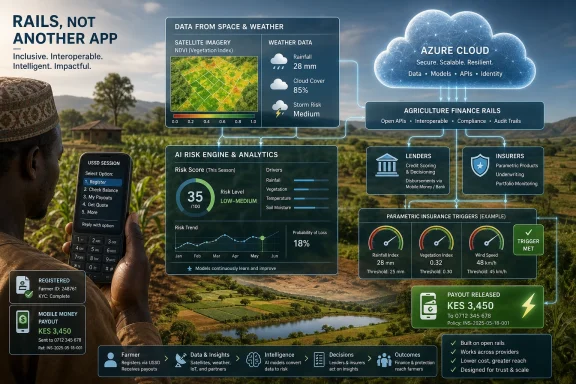
eSusFarm’s bet is different: build the rails that sit between farmers, insurers, lenders, mobile networks, climate data providers, and cloud infrastructure. The farmer-facing experience can be as humble as a USSD menu on a feature phone. The complexity sits behind the scenes, where satellite imagery, weather feeds, historical climate patterns, and AI models are stitched into a financial profile.
That is a more serious proposition than digitization for its own sake. The bottleneck in smallholder finance has never been the absence of technology in the abstract. It has been the absence of trustworthy, low-cost, scalable ways to evaluate risk at the level of farms that may be small, remote, informal, and highly exposed to climate shocks.
By focusing on credit, insurance, and climate risk as connected problems, eSusFarm is also pushing against one of the sector’s bad habits. Too often, agricultural finance treats loans and insurance as separate products. In reality, they are entangled. A farmer without insurance is a riskier borrower; a lender without climate visibility is more likely to retreat; an insurer without distribution cannot build a viable pool.
This is the sort of insurance that makes intuitive sense in climate-exposed markets. Traditional crop insurance requires claims paperwork, field inspection, loss assessment, and administrative overhead. For a large commercial farm, those costs can be absorbed. For thousands of small plots spread across rural areas, they can make the product uneconomic before the first policy is sold.
Parametric products compress that process. They do not need to prove every individual loss in the old way; they need to prove that the trigger was met. That is also why data quality is not a technical footnote but the entire business model. If the trigger is poorly designed, farmers can suffer losses without receiving payment, or insurers can pay out where loss was limited. The industry calls this basis risk, and it is the shadow that follows every index-based product.
AI does not abolish basis risk. It can, however, help reduce it by improving how rainfall, vegetation, soil moisture, crop stage, geography, and historical outcomes are interpreted. The better the model, the closer the insurance product can get to the real conditions experienced by farmers on the ground.
USSD keeps the front door wide. A farmer can register from a basic handset, interact through short codes, and receive payments through mobile money. That lowers the adoption barrier and avoids the trap of building elegant systems for the minority of users with the best connectivity.
This matters because financial inclusion often fails at the last meter. A cloud model may be powerful, an insurance product may be actuarially sound, and a lender may be willing to participate, but the system collapses if the farmer cannot practically enroll, pay, receive alerts, or cash out. In that sense, the old mobile rails are not an embarrassment. They are the bridge between advanced analytics and the daily reality of rural markets.
The combination of USSD at the edge and AI in the cloud is also a reminder that technological progress is not linear. The future does not always arrive as a shiny app. Sometimes it arrives as a text menu backed by satellite data, weather models, and an Azure workload.
That puts eSusFarm squarely inside Microsoft’s preferred narrative for AI in emerging markets: local founders, cloud-scale infrastructure, sector-specific models, and practical deployments rather than generic chatbot demos. It is a useful case study for Azure because the workload is not just compute-intensive; it is coordination-intensive. The system must ingest environmental data, support low-bandwidth user channels, connect to financial partners, and operate in jurisdictions with different regulatory and market conditions.
For Microsoft, the upside is clear. If AI infrastructure becomes the connective tissue for agriculture, health, education, and financial inclusion across Africa, cloud platforms become more than back-office utilities. They become foundational economic infrastructure. That is a powerful position, and it is one reason the company is eager to highlight startups that make cloud AI look socially useful as well as commercially scalable.
But the Microsoft angle should not distract from the more consequential question: whether these systems can earn trust in markets where trust is often the scarce resource. Farmers must trust that registration will lead to real benefits. Insurers must trust that the triggers and models are robust. Lenders must trust that insurance meaningfully reduces default risk. Regulators must trust that the data is handled responsibly.
A cloud platform can make the system scalable and secure, but it cannot by itself solve the political economy of rural finance. That work happens through partnerships, distribution, field education, transparent product design, and repeated proof that the service pays when it says it will.
Banks do not avoid smallholder agriculture only because they dislike farming. They avoid it because underwriting is expensive, collateral is uncertain, repayment is seasonal, and correlated climate shocks can damage many borrowers at once. In a drought, the problem is not one bad loan. It is a portfolio event.
Insurance faces a similar problem. Selling tiny policies across dispersed rural communities is expensive. Verifying claims is expensive. Educating customers is expensive. Fraud prevention, data collection, and product servicing all impose costs that can overwhelm the premium value.
AI-enabled risk scoring attacks this cost structure. It does not magically make every farmer profitable to serve, but it can reduce the expense of assessing risk, monitoring conditions, and triggering responses. If those savings are real, they can be passed into cheaper premiums, broader coverage, or more willingness from lenders to extend credit.
That is the economic hinge in the eSusFarm story. The platform is not simply giving farmers a digital identity. It is trying to give financial institutions a reason to believe that smallholder risk can be measured, pooled, insured, and financed.
A lender using static rules in a changing climate is effectively driving with an old map. Historical repayment behavior still matters, but it cannot fully describe future exposure. A farmer who was a good borrower for five seasons can be wiped out by a failed rainy season. A region that once looked stable may become more volatile.
That creates a brutal feedback loop. As climate risk rises, lenders retreat or raise prices. As finance becomes harder to access, farmers struggle to invest in resilience, such as irrigation, improved seed, storage, or soil management. As resilience remains underfunded, the next shock becomes more damaging.
Parametric insurance and AI risk analytics are attempts to break that loop. If a farmer has coverage against a defined weather event, the lender has more confidence. If the lender has more confidence, the farmer may access credit for productivity-enhancing inputs. If the farmer invests in better practices and infrastructure, the household is more likely to withstand volatility.
This is the optimistic version of the story, and it is plausible. But it depends on execution. Poorly priced insurance, opaque scoring, weak farmer education, or unreliable payouts would not build resilience. They would simply digitize disappointment.
If an AI model assigns a farmer, crop, or region a high-risk score, what recourse does that farmer have? If satellite data misreads conditions, if weather data is too coarse, or if a model penalizes a community for climate exposure it did not create, who is accountable? These are not theoretical objections. They are the governance questions that follow any automated scoring system moving into essential services.
The danger is that “unbankable” could be replaced by a more sophisticated version of the same label. Instead of a loan officer saying no because there are no records, a model says no because the risk score is too high. The outcome may look more scientific, but the farmer is still outside the gate.
That is why transparency matters. Farmers do not need to see every line of code, but they do need understandable products, clear terms, reliable grievance channels, and confidence that data collected for inclusion will not become a tool for extraction. Financial institutions, meanwhile, need model governance that goes beyond marketing claims.
The best version of AI-enabled smallholder finance is not one where algorithms rule unchallenged. It is one where better data widens access while human institutions remain accountable for the decisions made with that data.
The hard part of agricultural fintech is not launching a pilot. It is surviving the messy middle between pilot and infrastructure. That means managing customer support, local language needs, regulatory requirements, insurer relationships, mobile money integrations, agronomic variation, and the unglamorous work of keeping systems running through planting seasons and weather shocks.
Partnerships are therefore not optional. Mobile operators provide reach. Insurers provide balance sheet and product capacity. Lenders provide credit pathways. Development finance actors can help absorb early risk or support education. Governments and regulators shape what is allowed, trusted, and scalable.
This is also where regional expansion becomes complicated. “Africa” is not one market. Insurance regulation, mobile money penetration, crop calendars, weather patterns, farmer organizations, and lender appetite vary sharply across countries. A model tuned for one region may need serious adaptation in another.
That does not weaken the thesis. It makes the infrastructure argument stronger. If eSusFarm can abstract some of this complexity into reusable rails while respecting local differences, it becomes more valuable than a single-country product. If it cannot, it risks becoming another promising agritech company trapped by fragmentation.
There is also a classic enterprise lesson here: the interface is not the system. The farmer may interact through USSD, but the actual product depends on data pipelines, model monitoring, secure storage, partner APIs, payment integrations, and operational resilience. The visible simplicity is made possible by hidden complexity.
For IT pros, this is where the story becomes less philanthropic and more instructive. AI’s most durable business uses are likely to be found where it changes an economic process, not where it merely adds a conversational layer. In eSusFarm’s case, the process is underwriting and risk transfer. The chatbot era may get the headlines, but the more important AI deployments may be the ones that quietly change who qualifies for credit, insurance, and market participation.
That raises the stakes for cloud governance. When AI systems support financial identity and insurance payouts, uptime, security, privacy, auditability, and model quality are not nice-to-have enterprise features. They are the conditions under which households may receive money after a drought.
Still, the sector should resist the urge to treat AI as a moral solvent. Better data can reduce uncertainty, but it cannot erase poverty, climate injustice, weak infrastructure, volatile commodity prices, or land-tenure insecurity. A farmer who receives an insurance payout after a drought is better protected than one who does not, but the payout does not make the drought disappear.
There is also a risk that financial inclusion becomes too narrowly defined as access to debt. Credit can help farmers invest, but badly designed credit can deepen vulnerability. Insurance can reduce default risk, but only if the coverage is meaningful, affordable, and understood. Advisory services can improve decisions, but only if they reflect local agronomy and farmer constraints.
The most promising aspect of eSusFarm’s approach is that it treats these pieces as connected. The most dangerous version of the model would be one in which risk scoring becomes a way to push more financial products into rural markets without enough attention to farmer outcomes.
In other words, the rails matter. So do the rules of the road.
For now, the practical lessons are fairly concrete:
 The Old Definition of “Unbankable” Is Starting to Crack
For decades, the financial exclusion of smallholder farmers has been explained as if it were a natural law. Farming is risky, harvests are seasonal, weather is unpredictable, and paper records are thin. Banks and insurers looked at that profile and saw a borrower who could not be priced, a policyholder who could not be verified, and a market too expensive to serve.That diagnosis was never entirely wrong, but it was incomplete. The problem was not simply that smallholders lacked value. It was that the systems designed to measure value were built around formal records, stable collateral, conventional credit files, and branch-based distribution.
In that world, invisibility becomes destiny. If a farmer does not have a long banking history, digitized yield records, a formal land title, or a documented income stream, the institution sees absence rather than activity. The farmer may know the field intimately, but the lender sees a blank spreadsheet.
This is where AI’s role becomes more interesting than the usual automation pitch. The promise is not merely faster forms or cheaper call centers. It is the conversion of messy agricultural reality into something finance can underwrite.
eSusFarm Is Selling Infrastructure, Not Another Farm App
The most revealing line in Microsoft’s profile of eSusFarm comes near the end, when co-founder and CEO Watson Vuyo Matsa says the company is not building another app for farmers. That distinction matters. Africa’s agritech landscape is crowded with apps, dashboards, marketplaces, advisory tools, and pilots that work beautifully in investor decks but fail when they meet patchy connectivity, basic phones, low digital literacy, and the narrow margins of smallholder life.eSusFarm’s bet is different: build the rails that sit between farmers, insurers, lenders, mobile networks, climate data providers, and cloud infrastructure. The farmer-facing experience can be as humble as a USSD menu on a feature phone. The complexity sits behind the scenes, where satellite imagery, weather feeds, historical climate patterns, and AI models are stitched into a financial profile.
That is a more serious proposition than digitization for its own sake. The bottleneck in smallholder finance has never been the absence of technology in the abstract. It has been the absence of trustworthy, low-cost, scalable ways to evaluate risk at the level of farms that may be small, remote, informal, and highly exposed to climate shocks.
By focusing on credit, insurance, and climate risk as connected problems, eSusFarm is also pushing against one of the sector’s bad habits. Too often, agricultural finance treats loans and insurance as separate products. In reality, they are entangled. A farmer without insurance is a riskier borrower; a lender without climate visibility is more likely to retreat; an insurer without distribution cannot build a viable pool.
Parametric Insurance Turns Weather Into a Payment Trigger
The company’s most concrete use case is parametric insurance, a model that pays out when a predefined index or threshold is met rather than after a traditional loss-adjustment process. If rainfall falls below a defined level in a defined area, or another agreed weather condition is triggered, the payout can be made automatically. For farmers, that can mean receiving money when cash is needed most, not months after the damage has already pushed a household into debt.This is the sort of insurance that makes intuitive sense in climate-exposed markets. Traditional crop insurance requires claims paperwork, field inspection, loss assessment, and administrative overhead. For a large commercial farm, those costs can be absorbed. For thousands of small plots spread across rural areas, they can make the product uneconomic before the first policy is sold.
Parametric products compress that process. They do not need to prove every individual loss in the old way; they need to prove that the trigger was met. That is also why data quality is not a technical footnote but the entire business model. If the trigger is poorly designed, farmers can suffer losses without receiving payment, or insurers can pay out where loss was limited. The industry calls this basis risk, and it is the shadow that follows every index-based product.
AI does not abolish basis risk. It can, however, help reduce it by improving how rainfall, vegetation, soil moisture, crop stage, geography, and historical outcomes are interpreted. The better the model, the closer the insurance product can get to the real conditions experienced by farmers on the ground.
The Feature Phone Is Still the Most Important Interface
For readers used to Windows PCs, cloud dashboards, and smartphone-first services, USSD can look like yesterday’s technology. In smallholder finance, it may be one of the most important design choices in the entire stack. A service that requires a modern smartphone, a stable data plan, and app-store literacy has already excluded a large share of the farmers it claims to serve.USSD keeps the front door wide. A farmer can register from a basic handset, interact through short codes, and receive payments through mobile money. That lowers the adoption barrier and avoids the trap of building elegant systems for the minority of users with the best connectivity.
This matters because financial inclusion often fails at the last meter. A cloud model may be powerful, an insurance product may be actuarially sound, and a lender may be willing to participate, but the system collapses if the farmer cannot practically enroll, pay, receive alerts, or cash out. In that sense, the old mobile rails are not an embarrassment. They are the bridge between advanced analytics and the daily reality of rural markets.
The combination of USSD at the edge and AI in the cloud is also a reminder that technological progress is not linear. The future does not always arrive as a shiny app. Sometimes it arrives as a text menu backed by satellite data, weather models, and an Azure workload.
Microsoft’s Cloud Pitch Has a Real-World Test Case
Microsoft’s role in the story is unsurprising but important. eSusFarm uses Azure to run data and AI workloads, processing satellite, climate, and USSD data while supporting deployment across multiple markets. The company has also participated in Microsoft for Startups and the Microsoft and NVIDIA GenAI Accelerator.That puts eSusFarm squarely inside Microsoft’s preferred narrative for AI in emerging markets: local founders, cloud-scale infrastructure, sector-specific models, and practical deployments rather than generic chatbot demos. It is a useful case study for Azure because the workload is not just compute-intensive; it is coordination-intensive. The system must ingest environmental data, support low-bandwidth user channels, connect to financial partners, and operate in jurisdictions with different regulatory and market conditions.
For Microsoft, the upside is clear. If AI infrastructure becomes the connective tissue for agriculture, health, education, and financial inclusion across Africa, cloud platforms become more than back-office utilities. They become foundational economic infrastructure. That is a powerful position, and it is one reason the company is eager to highlight startups that make cloud AI look socially useful as well as commercially scalable.
But the Microsoft angle should not distract from the more consequential question: whether these systems can earn trust in markets where trust is often the scarce resource. Farmers must trust that registration will lead to real benefits. Insurers must trust that the triggers and models are robust. Lenders must trust that insurance meaningfully reduces default risk. Regulators must trust that the data is handled responsibly.
A cloud platform can make the system scalable and secure, but it cannot by itself solve the political economy of rural finance. That work happens through partnerships, distribution, field education, transparent product design, and repeated proof that the service pays when it says it will.
The Financing Gap Is Really an Information Gap
The frequently cited multibillion-dollar financing gap in African agriculture is usually discussed as a shortage of capital. That is partly true, but it understates the problem. Capital exists. What is missing is enough confidence to move that capital into smallholder markets at prices farmers can afford and institutions can defend.Banks do not avoid smallholder agriculture only because they dislike farming. They avoid it because underwriting is expensive, collateral is uncertain, repayment is seasonal, and correlated climate shocks can damage many borrowers at once. In a drought, the problem is not one bad loan. It is a portfolio event.
Insurance faces a similar problem. Selling tiny policies across dispersed rural communities is expensive. Verifying claims is expensive. Educating customers is expensive. Fraud prevention, data collection, and product servicing all impose costs that can overwhelm the premium value.
AI-enabled risk scoring attacks this cost structure. It does not magically make every farmer profitable to serve, but it can reduce the expense of assessing risk, monitoring conditions, and triggering responses. If those savings are real, they can be passed into cheaper premiums, broader coverage, or more willingness from lenders to extend credit.
That is the economic hinge in the eSusFarm story. The platform is not simply giving farmers a digital identity. It is trying to give financial institutions a reason to believe that smallholder risk can be measured, pooled, insured, and financed.
Climate Volatility Makes the Old Lending Model Look Obsolete
Climate change is not an abstract backdrop here. It is the force making traditional agricultural finance even less adequate. Rain-fed farming has always involved uncertainty, but more frequent droughts, floods, and irregular seasons make yesterday’s risk assumptions less reliable.A lender using static rules in a changing climate is effectively driving with an old map. Historical repayment behavior still matters, but it cannot fully describe future exposure. A farmer who was a good borrower for five seasons can be wiped out by a failed rainy season. A region that once looked stable may become more volatile.
That creates a brutal feedback loop. As climate risk rises, lenders retreat or raise prices. As finance becomes harder to access, farmers struggle to invest in resilience, such as irrigation, improved seed, storage, or soil management. As resilience remains underfunded, the next shock becomes more damaging.
Parametric insurance and AI risk analytics are attempts to break that loop. If a farmer has coverage against a defined weather event, the lender has more confidence. If the lender has more confidence, the farmer may access credit for productivity-enhancing inputs. If the farmer invests in better practices and infrastructure, the household is more likely to withstand volatility.
This is the optimistic version of the story, and it is plausible. But it depends on execution. Poorly priced insurance, opaque scoring, weak farmer education, or unreliable payouts would not build resilience. They would simply digitize disappointment.
Data Can Include Farmers or Discipline Them
There is a second edge to the AI story that deserves more attention. Turning farm activity into financial identity can unlock access, but it can also create new forms of exclusion. A farmer who was once invisible to finance may become visible in ways that are hard to contest.If an AI model assigns a farmer, crop, or region a high-risk score, what recourse does that farmer have? If satellite data misreads conditions, if weather data is too coarse, or if a model penalizes a community for climate exposure it did not create, who is accountable? These are not theoretical objections. They are the governance questions that follow any automated scoring system moving into essential services.
The danger is that “unbankable” could be replaced by a more sophisticated version of the same label. Instead of a loan officer saying no because there are no records, a model says no because the risk score is too high. The outcome may look more scientific, but the farmer is still outside the gate.
That is why transparency matters. Farmers do not need to see every line of code, but they do need understandable products, clear terms, reliable grievance channels, and confidence that data collected for inclusion will not become a tool for extraction. Financial institutions, meanwhile, need model governance that goes beyond marketing claims.
The best version of AI-enabled smallholder finance is not one where algorithms rule unchallenged. It is one where better data widens access while human institutions remain accountable for the decisions made with that data.
Scale Will Be Won Through Partners, Not Pilots
eSusFarm says it has engaged more than 380,000 smallholder farmers and more than 20,000 insurance and advisory users, with activity in parts of Southern and East Africa and expansion into West Africa. Its stated ambition is to support more than one million smallholder farming households. Those numbers move the story beyond proof of concept, though not yet into inevitability.The hard part of agricultural fintech is not launching a pilot. It is surviving the messy middle between pilot and infrastructure. That means managing customer support, local language needs, regulatory requirements, insurer relationships, mobile money integrations, agronomic variation, and the unglamorous work of keeping systems running through planting seasons and weather shocks.
Partnerships are therefore not optional. Mobile operators provide reach. Insurers provide balance sheet and product capacity. Lenders provide credit pathways. Development finance actors can help absorb early risk or support education. Governments and regulators shape what is allowed, trusted, and scalable.
This is also where regional expansion becomes complicated. “Africa” is not one market. Insurance regulation, mobile money penetration, crop calendars, weather patterns, farmer organizations, and lender appetite vary sharply across countries. A model tuned for one region may need serious adaptation in another.
That does not weaken the thesis. It makes the infrastructure argument stronger. If eSusFarm can abstract some of this complexity into reusable rails while respecting local differences, it becomes more valuable than a single-country product. If it cannot, it risks becoming another promising agritech company trapped by fragmentation.
WindowsForum Readers Should Recognize the Pattern
At first glance, smallholder finance may seem far from the usual concerns of Windows enthusiasts and IT administrators. But the architecture of the story is familiar. Legacy systems cannot see a new class of users. A platform layer emerges to translate messy real-world signals into machine-readable events. Cloud infrastructure provides scale. Identity, security, automation, and governance become the real battleground.There is also a classic enterprise lesson here: the interface is not the system. The farmer may interact through USSD, but the actual product depends on data pipelines, model monitoring, secure storage, partner APIs, payment integrations, and operational resilience. The visible simplicity is made possible by hidden complexity.
For IT pros, this is where the story becomes less philanthropic and more instructive. AI’s most durable business uses are likely to be found where it changes an economic process, not where it merely adds a conversational layer. In eSusFarm’s case, the process is underwriting and risk transfer. The chatbot era may get the headlines, but the more important AI deployments may be the ones that quietly change who qualifies for credit, insurance, and market participation.
That raises the stakes for cloud governance. When AI systems support financial identity and insurance payouts, uptime, security, privacy, auditability, and model quality are not nice-to-have enterprise features. They are the conditions under which households may receive money after a drought.
The New Rails Still Need Guardrails
The eSusFarm model is compelling because it tackles the right bottleneck: risk without visibility. It also avoids one of the most common mistakes in inclusive technology by meeting farmers through basic phones rather than assuming smartphone access. Those choices give the platform a credible path to scale.Still, the sector should resist the urge to treat AI as a moral solvent. Better data can reduce uncertainty, but it cannot erase poverty, climate injustice, weak infrastructure, volatile commodity prices, or land-tenure insecurity. A farmer who receives an insurance payout after a drought is better protected than one who does not, but the payout does not make the drought disappear.
There is also a risk that financial inclusion becomes too narrowly defined as access to debt. Credit can help farmers invest, but badly designed credit can deepen vulnerability. Insurance can reduce default risk, but only if the coverage is meaningful, affordable, and understood. Advisory services can improve decisions, but only if they reflect local agronomy and farmer constraints.
The most promising aspect of eSusFarm’s approach is that it treats these pieces as connected. The most dangerous version of the model would be one in which risk scoring becomes a way to push more financial products into rural markets without enough attention to farmer outcomes.
In other words, the rails matter. So do the rules of the road.
The Practical Meaning of eSusFarm’s AI Bet
The significance of this story is not that AI has arrived in agriculture; it has been moving into satellite analytics, crop monitoring, and supply-chain systems for years. The significance is that those capabilities are being pointed at one of the most stubborn problems in development finance: how to serve people whose economic activity is real but poorly documented.For now, the practical lessons are fairly concrete:
- eSusFarm is using AI, satellite imagery, weather data, and historical climate patterns to turn smallholder farm conditions into risk signals that insurers and lenders can use.
- The platform’s use of USSD matters because it keeps participation open to farmers with basic feature phones and limited connectivity.
- Parametric insurance can speed up payouts by tying them to predefined weather triggers rather than traditional claims assessments.
- Microsoft Azure gives the model a cloud platform for processing data, running AI workloads, and supporting deployment across multiple markets.
- The biggest unresolved challenges are not only technical; they include trust, regulation, model transparency, product design, and farmer protection.
- If the model scales responsibly, it could shift smallholder finance from a story about missing paperwork to one about measurable resilience.
References
- Primary source: Microsoft Source
Published: 2026-05-19T10:30:07.252922
How AI is rewriting the rules of smallholder finance
AI-powered platform eSusFarm is transforming smallholder finance by using data and cloud technology to unlock credit, insurance and resilience at scale. news.microsoft.com
- Related coverage: climatepolicyinitiative.org
Agriculture and Climate Risk Enterprise (ACRE) - CPI
The Agriculture and Climate Risk Enterprise (ACRE) is the largest input-linked, mobile-enabled index insurance programme in Africa. Smallholders buy agricultural inputs from agri-business business partners and are linked to the insurance program via a mobile application (by scanning a code). The... www.climatepolicyinitiative.org
- Related coverage: worldbank.org

Long-term Finance | World Bank Group
Strong financial sectors power inclusive growth. The World Bank Group mobilizes private finance to close long-term funding gaps and build resilient economies. www.worldbank.org
- Related coverage: blogs.worldbank.org
How can we help smallholder farmers seize opportunities in Africa?
Photo by: Dasan Bobo/World Bank Agriculture is at the heart of addressing poverty in Africa. I was reminded of that during my recent trip to Addis Ababa, Ethiopia, where different stakeholders had gathered to explore how to transform smallholder agriculture for growth. The recent End Poverty Day... blogs.worldbank.org
- Related coverage: globallandscapesforum.org

Bridging the Financing Gap: Unlocking the Impact Potential of Agricultural SMEs in Africa
Aceli Africa is designed as a “market incentive facility” to mobilize $700M in lending to agricultural SMEs in East Africa by 2025 www.globallandscapesforum.org
- Related coverage: agra.org
