

Nvidia CEO Jensen Huang’s blunt framing of Taiwan and Taiwan Semiconductor Manufacturing Company (TSMC) as the indispensable backbone of the advanced AI chip supply chain cut through months of “reshoring” rhetoric and put a spotlight on a harsh reality: you can subsidize fabs, but you cannot instantly recreate an ecosystem. His comments — delivered in a high-profile interview and echoed across industry appearances — are as much an operational truth as they are a strategic signal to governments, investors, and enterprise IT buyers that the path to resilient AI infrastructure is layered, capital‑intensive, and measured in years not quarters.
The strategic takeaway is straightforward: policy and capital can reshape industrial geographies, but ecosystem effects are sticky. Huang’s words provide a practical baseline — one that should guide procurement timelines, risk models, and the conversations enterprises have with vendors as they invest in the AI infrastructure necessary for the next decade.
Source: thestreet.com https://www.thestreet.com/technology/nvidia-ceo-sends-strong-message-on-taiwan-semiconductor/
 Background
Why Huang’s message matters now
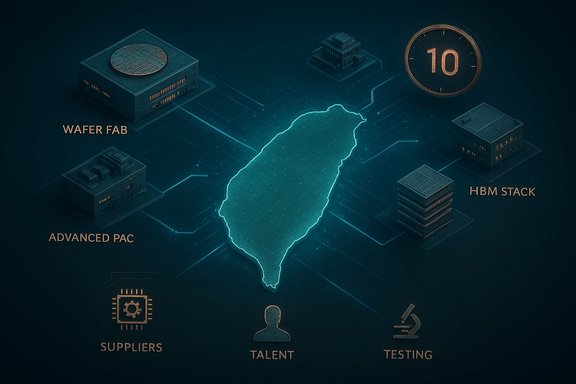
The conversation about semiconductor supply chains has shifted from scarcity to structure. The U.S., Europe, Japan, and others are pouring public incentives and private capital into wafer fabs, packaging facilities, and upstream materials — yet the tightest choke points for the highest‑end AI accelerators are not simply single fabs, but networks of suppliers, packaging houses, talent pools, and test flows clustered around Taiwan. Jensen Huang’s point distilled this complexity: reshoring is resilience insurance; it’s not a shortcut to instant parity with Taiwan’s decades‑old ecosystem.What Huang actually said
In a recent interview, Huang argued that Taiwan’s advantage isn’t merely node leadership — it is the surrounding ecosystem: suppliers, packaging capacity, specialized talent, and an operational rhythm tuned to advanced silicon production. He described Taiwan’s network as “unbelievable” and said it would take decades to replicate. Those comments landed amid a surge of U.S. and European announcements touting new fabs and funding, producing headlines but not erasing the operational dependencies that undergird advanced GPU production.The factual landscape: capacity, concentration, and capital
TSMC’s market position — scale you can measure
TSMC’s share of the global pure‑play foundry business and the revenue concentration at advanced nodes are not anecdotes; they are measurable facts. Multiple industry trackers reported TSMC commanding roughly 70–72% of global foundry revenue in recent quarters, with advanced nodes (7 nm and below) representing the lion’s share of its wafer revenue. The company’s 3 nm family contributed a notable slice of revenue as it ramped in 2025. Those figures underpin Huang’s assertion about structural centrality.The U.S. CHIPS‑era response: lots of projects, long timelines
The U.S. semiconductor ecosystem has responded with enormous announced investments: industry tallies show 100+ projects across more than two dozen states, totaling hundreds of billions of dollars in private investment and government incentives. The Semiconductor Industry Association (SIA) and partner studies project U.S. domestic fab capacity could triple by 2032, a remarkable rate of growth but one that still recognizes the multi‑year cadence of fab construction, equipment lead times, and workforce build‑out. In short: the money is flowing, but it buys a multi‑year runway — not immediate substitution.Nvidia’s valuation and demand signal
Nvidia’s market cap — which has vaulted into the multitrillion‑dollar range during the AI boom — and its prodigious order levels for advanced silicon are visible demand signals for foundries and packaging capacity. The company’s growth and capex appetite have pressured TSMC’s high‑density processes and advanced packaging lines, making Nvidia both a customer and a stress test for the entire ecosystem. Public market milestones and deal announcements illustrate how corporate demand can create structural strain at the industry’s chokepoints.The operational anatomy of advanced AI chips
Wafer fabrication versus packaging: two different beasts
A critical technical and strategic distinction often missed in headline cycles is that wafer fabrication (patterning transistors on silicon) and advanced packaging (assembling multiple dies, integrating HBM stacks, and building thermal/power subsystems) are distinct industrial processes with separate capacity constraints. Advanced packaging — particularly TSMC’s CoWoS family and the larger CoWoS‑L interposer approaches used for top‑end AI accelerators — requires specialized tooling, materials, and OSAT (outsourced assembly and test) expertise that are still heavily concentrated in Taiwan and neighboring regions. This is why moving wafer fabrication to the U.S. reduces one class of risk but does not instantly eliminate the downstream dependence on Taiwanese packaging expertise.Packaging constraints: CoWoS, interposers, and HBM integration
Modern accelerator modules demand huge, high‑bandwidth memory (HBM) stacks and multi‑die stitching across massive interposers. Those assemblies are not simple: they require yield‑sensitive processes like through‑silicon vias (TSVs), precision warpage control, and test flows that scale poorly if rushed. Industry reporting and TSMC’s own expansion plans (including new advanced packaging plants in Chiayi) confirm that advanced packaging capacity has been the bottleneck even as wafer capacity expands — a reality that makes Huang’s emphasis on ecosystem speed and supplier proximity especially salient.Economics and geopolitics: why Taiwan remains central
The ecosystem premium
Replicating an advanced‑node capability doesn’t just mean building a lithography‑intensive fab; it means:- A dense network of specialized suppliers (substrates, interposers, test houses),
- Experienced process and yield engineers who can tune complex multi‑die assemblies,
- Local packaging and assembly houses capable of high‑volume, low‑defect output,
- An educational and training pipeline that graduates the technicians and engineers for these roles.
Geopolitics amplifies the concentration risk
Taiwan’s centrality exposes global AI infrastructure to geopolitical risk — a theme governments have internalized and are attempting to hedge with onshore builds, allied supply chains, and investment incentives. But the policy response itself introduces second‑order risks: export controls, investment screening, and industrial policy fragmentation can inhibit the coordination that an interconnected semiconductor ecosystem requires. That tension — between defensive onshoring and the need for open, integrated supply chains — sits at the heart of why Huang’s call for realism resonated.What companies are doing: Nvidia and TSMC moves to manage risk
Nvidia’s multi‑pronged strategy
Nvidia has responded on several fronts:- Demand management and first‑principles checks — Huang emphasized that Nvidia evaluates every order to validate real demand rather than speculative purchasing.
- Geographic diversification — Nvidia is coordinating with TSMC’s U.S. fabs for wafer production while building DGX assembly lines and system assembly capacity in the U.S. to shorten logistic legs.
- Product architecture and packaging evolution — Nvidia and industry partners are pushing packaging innovations (e.g., CoWoS‑L) that increase integration but escalate technical complexity, which requires more coordination across suppliers.
TSMC’s strategic moves: capacity and packaging expansion
TSMC has publicly accelerated advanced packaging investments — notably the construction of multiple CoWoS/advanced packaging lines in Chiayi and expansions in Taiwan’s southern clusters. The company has also expanded U.S. wafer fabs (Arizona) and signaled a phased approach to bring more advanced nodes onshore. That combination preserves Taiwan’s role while starting the long, capital‑heavy journey toward geographic diversification of front‑end capability.Practical implications for IT buyers, procurement teams, and enterprise architects
Short‑term procurement reality (12–36 months)
- Expect continued lead times and premium pricing for highest‑end GPU modules.
- Prioritize procurement functional parity: specify workload requirements (throughput, latency, power profile) rather than absolute SKU names, and require vendor commitments on delivery timelines.
- Insist on portability where feasible: design model runtimes to be vendor‑agnostic (ONNX, containerized runtimes) to retain negotiation leverage.
Medium‑term planning (3–7 years)
- Factor packaging constraints and system‑integration timelines into budget cycles.
- Evaluate vendor roadmaps: ask for supply‑chain resiliency plans and the extent to which vendors are investing in local packaging and memory supply chains.
- Consider hybrid consumption models (burst capacity with hyperscalers, committed core capacity on‑prem or colocation) to smooth procurement risk.
Long‑term posture (7+ years)
- Public investments will yield additional capacity, but the ecosystem catch‑up — talent, OSATs, packaging tool suppliers — will trail wafer announcements. Plan strategy around resilience layering rather than a single pivot away from Asia.
Risks that could reshape the thesis
1. Export controls and fragmentation
Incremental tightening of export regimes or divergent allied policies could bifurcate supply chains, making it harder to operate global test and packaging flows. That could accelerate regionalization but also raise costs and reduce overall industry throughput.2. Packaging as the new bottleneck
Even as wafer capacity expands globally, advanced packaging — the “back end” — could remain the constraining resource for top‑tier accelerators. If CoWoS‑class capacity doesn’t scale fast enough, lead times and premiums will persist.3. Workforce and skills gap
Scaling fabs is not solely a CAPEX problem; it’s a labor and training problem. Studies projecting a shortfall in technicians and engineers underscore a nontrivial gap between announced projects and the human capital needed to operate them. The timeline for training and credentialing skilled labor is long and must be factored into resilience plans.4. Demand shocks and capex normalization
AI capex is large but cyclical. If hyperscalers temper spending or hyperscaler alternatives (TPUs, Trainium, other accelerators) materially take share, the dynamic that made TSMC and Nvidia the centerpieces of the boom could reprice quickly. Companies exposed to the high end must therefore model both upside and downside demand scenarios.Strengths in Huang’s message — and where it could be misunderstood
Strengths (what Huang got right)
- Precision about ecosystem effects: He focused attention on the networked nature of silicon manufacturing, not just on fabs.
- Operational realism: He framed diversification goals as resilience measures rather than a simplistic replacement strategy.
- Market discipline: Huang emphasized that Nvidia anchors procurement to first principles to avoid speculative inventory accumulation.
Potential misreadings to flag
- Not all Taiwan dependence is the same. Some chip families and less advanced nodes are already diversified globally. Huang’s comments specifically targeted the highest‑end AI accelerators where clustering matters most.
- The fastest route to resilience is not abandonment of allied policies. Onshoring and allied investment are real and necessary; they just require patience and complementary investment in packaging, memory, and workforce.
What to watch next: a practical watchlist for IT leaders and investors
- Advanced packaging throughput and lead times — track CoWoS capacity metrics and public statements about Chiayi, AP7/AP8 facilities, and U.S. OSAT timelines.
- TSMC’s Arizona ramp cadence — monitor wafer output, node family production claims (N4, N3, N2) and the practical timing for packaging localization.
- Hyperscaler capex guidance — public capex guidance from AWS, Microsoft, and Google remains a leading demand indicator for GPU supply cycles.
- Policy shifts on export controls — new restrictions or easing regimes will materially affect product availability and regional demand profiles.
- Talent and workforce programs — watch public–private initiatives aiming to close the technician and engineer gap; these are the long pole for industrial scaling.
Conclusion: pragmatic realism over slogans
Jensen Huang’s message is not an argument against onshoring or a defense of status quo geopolitics; it is a pragmatic call for nuance. Building robust, resilient AI hardware supply chains requires more than announcements — it requires sustained capital, decades of skill development, and a coordinated approach to packaging and memory ecosystems that currently cluster in Taiwan. For enterprise IT leaders and investors, the right posture is not to assume immediate substitution will arrive, but to plan for layered resiliency: diversified suppliers where possible, contractual safeguards on delivery, portability at the software layer, and an understanding that the most critical chokepoints are now as much about packaging and people as they are about lithography nodes.The strategic takeaway is straightforward: policy and capital can reshape industrial geographies, but ecosystem effects are sticky. Huang’s words provide a practical baseline — one that should guide procurement timelines, risk models, and the conversations enterprises have with vendors as they invest in the AI infrastructure necessary for the next decade.
Source: thestreet.com https://www.thestreet.com/technology/nvidia-ceo-sends-strong-message-on-taiwan-semiconductor/
