

Cloud adoption is no longer a question of "if" but "how" — and over the past two years businesses have decisively moved from single‑vendor experiments to hybrid and multi‑cloud strategies that let them match workload needs to the best available platform. Analytics Insight’s recent roundup noted that roughly 78% of businesses now use hybrid or multi‑cloud approaches to avoid vendor lock‑in and improve flexibility; that figure sits comfortably alongside industry research showing broad multi‑cloud penetration and a persistent three‑way dominance by AWS, Microsoft Azure, and Google Cloud in infrastructure spend. ://www.flexera.com/about-us/press-center/flexera-2024-state-of-the-cloud-managing-spending-top-challenge)
This feature examines which cloud platforms companies are switching to, why they’re making those choices, the practical migration patterns organizations follow, and the risks and trade‑offs that IT leaders must manage to capture value without multiplying complexity. The analysis cross‑checks vendor market share data, industry surveys, and real‑world conversations from enterprise IT communities to give a clear, actecision‑makers considering or executing cloud moves right now.
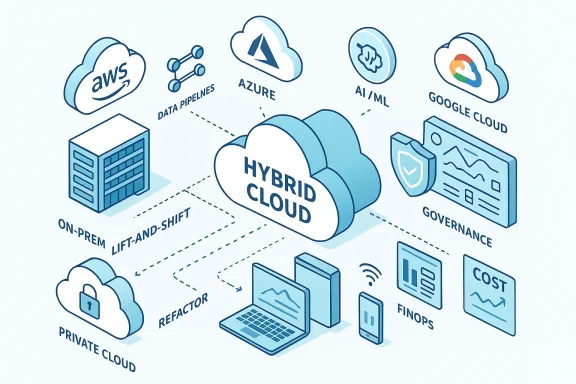
Cloud computing has matured beyond infrastructure cost savings. Today’s migration drivers are performance for AI workloads, developer velocity, geographic reach, regulatory compliance, and resilience. Enterprises increasingly adopt a mix of public cloud providers, private clouds, and on‑premises systems — the canonical hybrid cloud model — and often layer multiple public clouds to access best‑of‑breed services. Industry researcher Flexera’s annual State of the Cloud reporting shows multi‑cloud and hybrid patterns now represent the norm rather than the exception.
Concurrently, market dynamics remain concentrated. Independent market trackers report the Big Three — Amazon Web Services (AWS), Microsoft Azure, and Google Cloud — together control roughly two‑thirds of global cloud infrastructure spending. That concentration shapes vendor incentives, partner ecosystems, enterprise negotiation power, and the technical tradeoffs of choosing a primary cloud. The competition has intensified around platformized AI services, managed data platforms, and hybrid tooling that aim to make portability simpler — or to make it harder, depending on a provider’s strategic goals.
Market trackers support that picture: the combined market share of AWS, Azure, and Google Cloud has consistently been reported in the 60–70% range, underscoring why many firms opt for multi‑vendor strategies to avoid concentration risk while still leveraging hyperscaler capabilities.
For IT leaders planning a switch in 2026, the question is not merely which cloud to select, but how to build the organizational muscles to operate across multiple clouds reliably, safely, and cost‑effectively. Those who prioritize governance, measurement, and incremental migration wins will find cloud switching delivers not only modernization, but strategic advantage.
Source: Analytics Insight Top Cloud Computing Platforms Businesses Are Switching to
This feature examines which cloud platforms companies are switching to, why they’re making those choices, the practical migration patterns organizations follow, and the risks and trade‑offs that IT leaders must manage to capture value without multiplying complexity. The analysis cross‑checks vendor market share data, industry surveys, and real‑world conversations from enterprise IT communities to give a clear, actecision‑makers considering or executing cloud moves right now.
 Background / Overview
Cloud computing has matured beyond infrastructure cost savings. Today’s migration drivers are performance for AI workloads, developer velocity, geographic reach, regulatory compliance, and resilience. Enterprises increasingly adopt a mix of public cloud providers, private clouds, and on‑premises systems — the canonical hybrid cloud model — and often layer multiple public clouds to access best‑of‑breed services. Industry researcher Flexera’s annual State of the Cloud reporting shows multi‑cloud and hybrid patterns now represent the norm rather than the exception.Concurrently, market dynamics remain concentrated. Independent market trackers report the Big Three — Amazon Web Services (AWS), Microsoft Azure, and Google Cloud — together control roughly two‑thirds of global cloud infrastructure spending. That concentration shapes vendor incentives, partner ecosystems, enterprise negotiation power, and the technical tradeoffs of choosing a primary cloud. The competition has intensified around platformized AI services, managed data platforms, and hybrid tooling that aim to make portability simpler — or to make it harder, depending on a provider’s strategic goals.
Who businesses are switching to — the short list
While hundreds of providers fill niche roles, the platforms businesses most commonly move to (or increase spend with) are:- Amazon Web Services (AWS) — the broadest service catalogue, glo ecosystem for IaaS/PaaS and infrastructure‑level AI. AWS remains the market leader by revenue share.
- Microsoft Azure — the prime choice for enterprises with heavy Microsoft footprints. Azure’s growth has accelerated through hybrid tooling (Azure Arc, Azure Stack), Microsoft 365 integration, and packaged AI services, making it the top pick for Windows‑centric and regulated industries.
- Google Cloud Platform (GCP) — favored for analytics, data engineering, and AI/ML tooling (BigQuery, Vertex AI, TPUs). GCP gains often come from data‑first use cases and container/Kubernetes leadership.
- Oracle Cloud Infrastructure (OCI) — chosen by enterprises running Oracle databases or ERP stacks, offering competitive pricing and engineered performance for core business workloads.
- Alibaba Cloud and regional hyperscalers (Tencent Cloud, Huawei Cloud) — selected for APAC and China‑focused operations where local presence, compliance, or pricing matter.
- Specialist clouds and managed platforms — VMware Cloud, IBM/Red Hat OpenShift, Oracle Cloud, and managed service providers (MSPs) fill hybrid and migration roles where enterprises want lift‑and‑shift transitions or fully managed stacks.
Why companies are switching (and which strengths matter)
Migrating or rebalancing cloud footprints is driven by a handful of strategic needs. Each provider claims unique strengths, and enterprises pick platforms accordingly.1.nce compute
- Businesses training models or hosting inference at scale prioritize specialized accelerators (GPUs/TPUs), low‑latency networks, and managed ML platforms. GCP’s TPU lineage and Vertex AI, AWS’s Trainium/Inferentia and SageMaker, and Azure’s AI Foundry and OpenAI integrations pull AI workloads in different directions. These platform differences are often decisive for AI‑first initiatives.
2. Hybrid consistency and on‑prem integration
- Enterprises still operating sensitive datasets on‑prem choose platforms that make hybrid operation seamless. Azure has invested aggressively here; Azure Arc, Azure Stack, and partnerships with hardware vendors give Microsoft an advantage for businesses prioritizing hybrid parity.
3. Data gravity and analytics
- Data‑heavy applications cluster where storage, analytics, and query services are strongest. BigQuery and Google’s data stack pull analytical workloads to GCP; Snowflake, Databricks and their multi‑cloud integrations complicate, but don’t eliminate, that gravity.
4. Cost and commercial flexibility
- Vendor pricing models, sustained‑use discounts, reservation options, and effective TCO shape platform choice. Some migrations reflect a reaction to unexpected cloud bills; others are strategic hedges to diversify risk.
5. Compliance, sovereignty, and latency
- Local regulations or low‑latency edge use cases make regional providers or private cloud+public cloud meshes attractive. In some markets, Alibaba Cloud or regional players outperform global hyperscalers on regulatory and geographic fit.
The platforms in practice: strengths, tradeoffs, and common switching paths
Below wplatforms and the migration patterns organizations adopt when moving workloads.Amazon Web Services (AWS)
- Strengths: breadth of services, global footprint, mature partner ecosystem, specialized AI chips.
- Common switch patterns: startups and cloud‑native companies often start on AWS; enterprises with web‑scale services or intricate microservices use AWS for its deep operational tooling.
- Tradeoffs: cost unpredictability at scale, and for Microsoft‑centric enterprises, integration friction.
Microsoft Azure
- Strengths: hybrid tooling, Microsoft stack integration, enterprise agreements, packaged AI services.
- Common switch patterns: Windows Server, Active Directory, SQL Server customers migrate or expand to Azure for operational consolidation. Azure is also a primary destination for organizations pursuing hybrid modernization.
- Tradeoffs: some customers perceive slower innovation in certain open‑source stacks compared with AWS or GCP; commercial complexity can be high.
Google Cloud Platform (GCP)
- Strengths: data analytics, ML services, Kubernetes and containers, developer productivity.
- Common switch patterns: analytics pipelines, ML training, and containerized microservices are frequent candidates to move or originate in GCP.
- Tradeoffs: GCP’s enterprise sales motion historically trailed AWS/Azure, but growth in data/AI workloads is changing that dynamic.
Oracle Cloud, Alibaba, IBM/Red Hat, VMware and others
- Oracle and Alibaba are often chosen for vendor‑specific workloads (Oracle DB, China market). IBM/Red Hat and VMware play crucial roles in hybrid strategies where customers want to lift‑and‑shift VMs or containerized apps with familiar tooling.
- Managed service partners and MSPs are a common migration route for companies that lack in‑house cloud operational maturity.
How businesses execute switches — common migration patterns
Switching cloud providers is rarely a single “cutover.” Typical patterns include:- Lift‑and‑shift (rehost): Recreate existing VMs and applications in the new environment to reduce migration time. Useful for initial moves but often suboptimal for long‑term cost or performance.
- Replatform: Make small changes (e.g., switch to managed databases) to gain cloud benefits without full refactors.
- Refactor (re‑architect): Rewrite applications to use cloud‑native patterns (serverless, microservices, managed data services). Highest payoff but highest cost and complexity.
- Replace (SaaS): Replace custom apps with SaaS offerings when appropriate.
- Burst to cloud: Keep baseline workloads on‑prem and use cloud for peak demand or training massive models.
Challenges and risks enterprises must manage
Cloud migration unlocks agility but multiplies new risks. Some critical areas to watch:- Cost governance and sprawl: Without c FinOps practices, multi‑cloud environments amplify wasted spend. Most organizations report cost control as a top cloud challenge.
- Security and visibility: Hybrid/multi‑cloud increases the attack surface and complicates uniform policy enforcement. Recent vendor reports indicate large majorities of organizations now operate hybrid or multi‑cloud setups and are worried about security visibility gaps.
- Data gravity and latency: Moving data between clouds or between on‑prem and cloud can be expensive and slow; design decisions must account for where data will live long term.
- Vendor lock‑in vs. productivity tradeoff: Using managed, vendor‑specific services accelerates delivery but raises migration costs later. The strategic tradeoff — speed now vs. flexibility later — must be explicit.
- Operational complexity and talent: Multi‑cloud requires broader skill sets, stronger automation, and higher DevOps maturity. Many companies enlist MSPs or system integrators to bridge skills gaps.
Practical migration checklist — what IT leaders should do now
Below is a practical, prioritized checklist to guide migration decisions:- Inventory: Catalog applications, dependencies, and data gravity. Identify regulatory or latency constraints.
- Classify workloads: Tier apps by risk, complexity, and business value (test, non‑critical; medium; mission‑critical).
- Select migration pattern per workload: choose rehost/replatform/refactor based on cost/time/benefit.
- Build FinOps: Implement tagging, cost allocation, and a central cloud cost governance function before large migrations.
- Standardize security: Adopt cloud‑agnostic identity, least‑privilege IAM, encryption standards, and central logging across clouds.
- Pilot: Start with a bounded pilot (e.g., dev/test or analytics pipeline) to validate tooling, pipelines, and SLA assumptions.
- Automate and codify: Use infrastructure as code, CI/CD, and policy‑as‑code to reduce drift and operational errors.
- Plan exit and portability: Define export paths, use containers and open standards where portability matters.
- Train and staff: Invest in cross‑platform training and, if necessary, hire Managed Service support for initial phases.
- Measure outcomes: Track cost, performance, developer velocity, and operational metrics to validate migration ROI.
Real‑world signals from the field
Community discussions and vendor earnings commentary in 2024–2025 show a clear pattern: Azure’s hybrid play and packaged AI services drove a surge of enterprise interest, while AWS’s sheer service depth and global capacity kept it the default “safe” choice for many workloads. Google Cloud’s specialization in data and ML has made it the go‑to for analytics teams. These dynamics have driven enterprises to spread workloads strategically across providers rather than bet everything on one vendor.Market trackers support that picture: the combined market share of AWS, Azure, and Google Cloud has consistently been reported in the 60–70% range, underscoring why many firms opt for multi‑vendor strategies to avoid concentration risk while still leveraging hyperscaler capabilities.
Critical analysis — strengths and hidden weaknesses of current platform trends
The current cloud migration wave offers major strengths for businesses but also several systemic risks.Strengths
- Rapid innovation cadence: Hyperscalers rapidly productize advanced capabilities (AI, serverless, managed databases), allowing enterprises to prototype and scale quickly.
- Economies of scale: Large providers can amortize expensive hardware and specialized AI accelerators, making world‑class infrastructure accessible to many organizations.
- Ecosystem maturity: Vast partner networks and third‑party tooling simplify implementation, monitoring, and migration.
Hidden weaknesses and risks
- Concentration risk: Heavy reliance on the Big Three concentrates systemic risk — outages, regulatory coercion, or commercial shifts can cascade across many customers. Antitrust and sovereignty concerns are rising in multiple jurisdictions.
- Operational complexity: The more clouds you add, the harder consistent governance becomes. Tool proliferation (security point products, logging agents, connectors) increases overhead and can blunt the benefits of cloud agility.
- Portability illusions: Containers and standardized APIs help, but many value‑adding features are inherently proprietary (managed AI services, serverless execution models). Attempting portability without accepting tradeoffs leads to expensive rework.
- Talent and culture mismatch: Organizations with traditional on‑prem IT teams often underestimate the cultural and process changes required to realize cloud ROI.
Predictions and what to watch in the next 18 months
- Greater AI‑driven vendor differentiation: Expect providers to continue building vertically integrated AI stacks and managed model services, pushing more AI workloads into the hyperscaler where the necessary accelerators live.
- Neoclouds and specialized providers will proliferate: Niche providers optimized for AI training, high‑performance databases, or industry compliance will coexist with hyperscalers and capture specialized workloads.
- Stronger multi‑cloud tooling: Commercial and open‑source tooling that abstracts cloud differences (policy, networking, identity) will become more mature, reducing the operational tax of multi‑cloud.
- Regulatory fragmentation: Regional data‑sovereignty rules will push some workloads to local clouds or hybrid islands, reinforcing the need for flexible deployment choices.
Final verdict — how to decide which platform(s) to switch to
Choosing a cloud platform is a portfolio decision, not a one‑size‑fits‑all call. Use this rule set:- If you need the broadest service ecosystem and global capacity, AWS remains the strongest generalist.
- If your estate is Microsoft‑centric, or hybrid parity matters, Azure is the natural choice.
- If your priority is analytics, ML, or container orchestration driven by data‑centric workloads, GCP should be a first optionric enterprises, evaluate Oracle Cloud for transactional workloads and cost predictability.
- Use regional providers when sovereignty, localization, or market nuance requires it.
Conclusion
The migration patterns we see today are pragmatic: organizations choose the platform that best fits each workload rather than forcing monolithic vendor loyalty. That approach — hybrid architectures, multi‑cloud portfolios, and workload‑specific platform choices — explains why a majority of businesses now report hybrid or multi‑cloud setups and why the Big Three remain central to enterprise cloud strategy. The promise is substantial: agility, access to advanced AI, and resilience. But capturing that value demands sober attention to cost governance, security posture, and operational maturity.For IT leaders planning a switch in 2026, the question is not merely which cloud to select, but how to build the organizational muscles to operate across multiple clouds reliably, safely, and cost‑effectively. Those who prioritize governance, measurement, and incremental migration wins will find cloud switching delivers not only modernization, but strategic advantage.
Source: Analytics Insight Top Cloud Computing Platforms Businesses Are Switching to
