

Microsoft and NASA’s new Hydrology Copilot promises to put petabytes of hydrology data into plain‑language reach for planners, emergency responders, and researchers — but the platform’s potential depends on careful validation, transparent provenance, and governance if it is to move beyond research demos into operational decision support.
Hydrology — the science of water on land, including precipitation, runoff, soil moisture, snowpack, river flow, and groundwater exchanges — underpins many urgent public‑policy and operational decisions. From agricultural irrigation scheduling to urban flood‑response, reliable hydrologic insight reduces economic losses and saves lives.
Yet the most useful hydrology datasets are complex, large, and technically demanding. NASA and other agencies produce long historical archives and near‑real‑time model outputs that require specialized skills to query, reformat, and interpret. The North American Land Data Assimilation System, currently evolving into NLDAS‑3, is a prime example: it integrates satellite observations with land‑surface models to provide high‑resolution, continental‑scale estimates of soil moisture, snow, and other water‑cycle variables — but getting actionable answers from those datasets typically requires hydrologic expertise and heavy computing. In that gap between rich scientific datasets and pragmatic local decisions lies the problem Hydrology Copilot aims to address.
If Microsoft and NASA can balance usability with scientific rigor and governance, Hydrology Copilot could become a practical bridge between petabytes of hydrology science and the real‑world decisions that depend on it.
Source: Program Business Microsoft and NASA Introduce AI Tools to Improve Access to Flood and Water Risk Data - ProgramBusiness | Where insurance industry clicks
 Background: why hydrology data matters — and why it’s hard to use
Hydrology — the science of water on land, including precipitation, runoff, soil moisture, snowpack, river flow, and groundwater exchanges — underpins many urgent public‑policy and operational decisions. From agricultural irrigation scheduling to urban flood‑response, reliable hydrologic insight reduces economic losses and saves lives.Yet the most useful hydrology datasets are complex, large, and technically demanding. NASA and other agencies produce long historical archives and near‑real‑time model outputs that require specialized skills to query, reformat, and interpret. The North American Land Data Assimilation System, currently evolving into NLDAS‑3, is a prime example: it integrates satellite observations with land‑surface models to provide high‑resolution, continental‑scale estimates of soil moisture, snow, and other water‑cycle variables — but getting actionable answers from those datasets typically requires hydrologic expertise and heavy computing. In that gap between rich scientific datasets and pragmatic local decisions lies the problem Hydrology Copilot aims to address.
Overview: what Hydrology Copilot is (and what it isn’t)
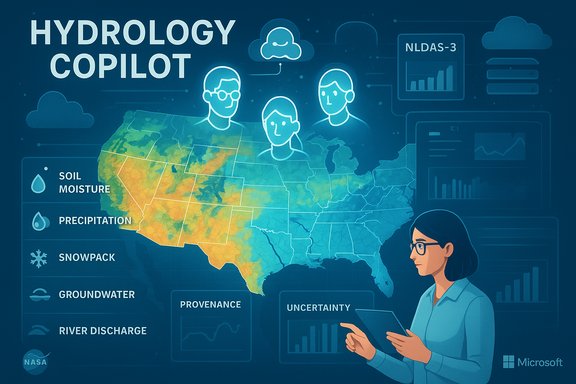
Hydrology Copilot is a suite of AI agents and workflows developed by Microsoft and NASA to simplify access, analysis, and visualization of large hydrology datasets. It builds on the cloud‑based architecture and concept of the earlier NASA Earth Copilot effort that couples NASA’s Earth science data with conversational AI to let users ask natural‑language questions about the planet. The toolset is intended to translate plain‑English queries — for instance, “Which regions may be facing elevated flood risk this week?” — into data retrieval, analysis, and visual output such as maps, hydrographs, and short narrative explanations. Key platform components reported by Microsoft and NASA include:- NLDAS‑3 as a core hydrology dataset (high‑resolution, satellite‑assimilated land‑surface estimates).
- Azure OpenAI Service for large‑language-model (LLM) and reasoning capabilities that power natural‑language understanding and generation.
- Microsoft Foundry (formerly Azure AI Foundry) for multi‑agent orchestration, tool management, and enterprise deployment of AI agents.
Technical foundations: NLDAS‑3, Earth Copilot, and Azure AI
NLDAS‑3 — the data backbone
NLDAS‑3 is the successor to prior NLDAS phases and seeks to offer higher spatial resolution (targeting ~1‑km grids across North America), improved forcing inputs, satellite assimilation, and low‑latency products for near‑real‑time analysis. It routinely assimilates a variety of remote sensing data streams (soil‑moisture missions, snow products, vegetation indices, and gravimetric changes) into the Noah‑MP land‑surface model framework to produce consistent hydrologic fields. NASA documentation and technical reports indicate NLDAS‑3 is explicitly designed for decision‑support use cases including drought monitoring and hydrologic forecasting. That makes it a suitable, scientifically rigorous foundation for an AI interface intended to broaden access.NASA Earth Copilot — the prototype and design principles
Earth Copilot is NASA’s earlier cloud AI prototype that demonstrated how conversational agents could index, search, and summarize complex Earth‑science datasets. The collaboration with Microsoft integrated Azure cloud services and language models to let users ask human‑friendly questions that map to scientific variables and data products. Hydrology Copilot extends those same design principles to hydrology‑specific datasets and workflows. Public descriptions emphasize trusted science, grounding responses in NASA metadata and documentation rather than free‑form model output alone.Azure OpenAI Service and Microsoft Foundry — agent orchestration and enterprise readiness
Azure OpenAI Service provides access to large foundation and reasoning models under Microsoft’s enterprise controls; Microsoft Foundry (Azure AI Foundry) offers a platform for multi‑agent orchestration, monitoring, and integration with enterprise data services. For Hydrology Copilot, those platforms enable pipeline patterns such as retrieval‑augmented generation (RAG), semantic indexing of scientific metadata, and multi‑agent execution where one agent identifies relevant variables, another runs geospatial queries, and a third produces visualization and narrative summaries. Microsoft’s developer documentation and technical briefings outline these capabilities and their role in production‑level AI systems.How Hydrology Copilot is meant to be used
Hydrology Copilot’s early use cases target groups that have historically struggled with direct use of raw hydrology datasets:- Local officials and emergency managers who need rapid situational awareness during flood or drought events.
- City planners and infrastructure managers tasked with long‑term resilience planning.
- Researchers and operational hydrologists seeking faster exploratory analysis across continental datasets.
- Agricultural advisors and water‑resource managers looking to combine seasonal outlooks with historical context.
Strengths: where this approach genuinely advances accessibility and utility
- Lowering the technical bar: Converting complex data queries into natural‑language interactions expands usage beyond specialist groups, potentially democratizing hydrology insight for local governments and NGOs.
- Speed and reproducibility: Semantic indexing and agent orchestration make it faster to execute repeatable queries across decades of data, an advantage in time‑sensitive emergency contexts.
- Proven scientific foundation: By anchoring the system to an academically and operationally respected dataset like NLDAS‑3 and to NASA metadata, the platform offers stronger scientific provenance than generic web search.
- Scalable cloud infrastructure: Using Azure services allows the platform to scale to continental datasets and to integrate with enterprise systems (e.g., GIS, data lakes, and APIs) that agencies commonly use.
- Human‑centered outputs: The multi‑modal presentation of maps, charts, and explainers is aligned with decision‑support needs: quick visuals plus bite‑sized text that non‑experts can act on.
Risks, limitations, and governance concerns
Despite clear potential, several structural and technical risks must be managed before Hydrology Copilot safely supports operational decisions.1) Model hallucination and explanation fidelity
Large language models can generate confident but incorrect natural‑language explanations. When translating model outputs into policy or emergency action, incorrect or poorly qualified language can have real consequences. Explicit provenance — showing which dataset, time window, and model run produced a chart — is essential, and the system must include conservative guardrails to avoid overstating certainty. Public descriptions emphasize grounding in NASA data, but user interfaces must surface provenance and uncertainty metrics prominently.2) Data latency and near‑real‑time constraints
Hydrology decisions often depend on near‑real‑time conditions. NLDAS‑3 and similar products offer varying latencies (real‑time vs. retrospective runs). Users should not assume Hydrology Copilot provides operational real‑time forecast replacements for agencies like the National Weather Service or the National Water Model; descriptions make clear it’s currently a research/development tool and not an official forecast service. Any operational deployment must clarify data refresh intervals and forecast horizons.3) Equity and access: cloud dependency and cost barriers
Because Hydrology Copilot runs on Azure and integrates Azure‑based services, access could be constrained for smaller jurisdictions, NGOs, or entirely offline communities without cloud budgets. Without low‑cost or open deployment pathways, the system risks widening existing technical divides. Plans for broader access or hosted public interfaces — or partnership models with regional governments — would mitigate this.4) Validation and regulatory liability
Using AI‑assisted products in emergency response raises questions about liability and the chain of custody for decisions. Agencies will require formal validation against operational hydrologic forecasts before accepting AI outputs for life‑critical decisions. Hydrology Copilot’s role should be framed as decision aid with human‑in‑loop verification, not as a sole source of truth.5) Data privacy and critical infrastructure exposure
Hydrology analyses can touch on critical infrastructure (dams, reservoirs, pumping stations). Access controls and secure deployment patterns are necessary to prevent inadvertent exposure of sensitive operational details. Microsoft Foundry and Azure provide enterprise controls, but implementers must intentionally configure RBAC, network isolation, and auditing.Practical validation checklist for agencies and planners
Before integrating Hydrology Copilot outputs into operational workflows, the following steps will help mitigate risk and build trust:- Verify data lineage: confirm exactly which NLDAS‑3 run (time stamp/version) and ancillary datasets were used for any output.
- Cross‑check with operational forecasts: compare Copilot outputs against National Weather Service / National Water Model products for overlapping windows.
- Review latency: document how up‑to‑date the underlying inputs are and what the refresh cadence is.
- Audit prompts and flows: capture the query history and agent steps to reproduce results for after‑action review.
- Establish human‑in‑loop gating: require credentialed hydrologist sign‑off for evacuation or infrastructure‑closure decisions.
Integration scenarios and recommended architectures
Hydrology Copilot works best as a component in a broader situational‑awareness architecture rather than a standalone decision engine. Suggested integration patterns include:- Linked dashboards: surface Copilot‑generated maps and narratives in existing emergency‑management dashboards with linked provenance and “compare” buttons against the National Water Prediction Service and local gauges.
- API‑first workflows: use Copilot agents for exploratory analysis, then pipeline quantified outputs through vetted APIs that feed existing GIS and asset‑management systems.
- Offline/exportable reports: generate short PDF or GIS products with embedded metadata so that jurisdictions with limited connectivity still receive authoritative artifacts.
- Data sovereignty and export controls: where local governance or legal frameworks require on‑premises data storage, consider private Azure deployments, hybrid architectures, or regional cloud options backed by strict RBAC and auditing.
Use‑case deep dive: flood preparedness in the Pacific Northwest
The Pacific Northwest’s recent succession of atmospheric rivers produced a string of damaging floods that highlighted the need for rapid, integrated hydrologic insight. Demonstrations of Hydrology Copilot emphasize how combining NLDAS‑3 soil‑moisture and runoff indicators with local gauge history could produce targeted maps that help emergency managers prioritize levee inspections, road closures, and sheltering. But real deployment requires aligning Copilot outputs with operational hydrograph forecasts from the National Water Prediction Service and with local gage metadata (e.g., King County’s Hydrologic Information Center). Agencies must treat Copilot outputs as complementary situational awareness and retain official forecast products for authoritative warnings.Governance, transparency, and community science
Long‑term adoption will depend on three governance pillars:- Transparency: full display of data sources, model versions, and uncertainty ranges in every output.
- Community validation: partnerships with academic hydrology groups, state agencies, and local utilities to co‑design evaluation benchmarks. Publicly documented comparisons and error analyses will be necessary.
- Access models: tiered access that includes free or low‑cost public interfaces for municipalities and NGOs, together with enterprise options for high‑availability mission partners.
What Hydrology Copilot does not (yet) do — and why that matters
- It is not an operational replacement for the National Water Model or official river forecasts. The National Water Prediction Service and NWM remain the authoritative operational forecasting systems with proven operational cadence and verification frameworks. Hydrology Copilot is positioned as an accessibility and analysis layer on top of scientific datasets, not as a regulatory forecast product.
- It does not eliminate the need for hydrology expertise. Outputs should be interpreted within established technical workflows and validated by subject‑matter experts.
- It does not automatically fix structural inequities in technical capacity. Without explicit provisioning for low‑resource users, cloud dependence could concentrate benefits among well‑funded agencies.
Recommendations for responsible rollout
- Publish a rigorous validation plan and open evaluation benchmarks comparing Copilot outputs to independent ground observations and operational forecasts.
- Expose provenance metadata and uncertainty statements in every result UI element.
- Provide a free, limited public tier (or hosted community portal) that allows local governments and NGOs to use the tool for planning and rehearsal.
- Enforce human‑in‑loop thresholds for any action that has life/safety implications.
- Create a public issues tracker and community forum so users can report discrepancies and track fixes.
Final assessment: promise tempered by the need for proof
Hydrology Copilot represents an important step toward democratizing access to the high‑value hydrology datasets that agencies and researchers have struggled to scale. Its combination of NLDAS‑3 scientific grounding, Azure OpenAI Service language capabilities, and Microsoft Foundry agent orchestration addresses a clear usability gap: translating scientifically rigorous but technically dense hydrology products into actionable situational awareness for a broader set of stakeholders. But promise alone is not enough. To be a durable and trusted tool for flood risk data and water‑resource decisions, Hydrology Copilot must demonstrate rigorous validation, transparent provenance, and equitable access pathways. Agencies and local governments should treat the system as a powerful decision‑support assistant — not an oracle — and insist on cross‑checks with operational forecasts and ground observations before committing to life‑critical actions. The next phase for Hydrology Copilot should therefore be a tightly governed transition from research demonstrations into governed operational partnerships, with explicit standards for accuracy, latency, and accountability.If Microsoft and NASA can balance usability with scientific rigor and governance, Hydrology Copilot could become a practical bridge between petabytes of hydrology science and the real‑world decisions that depend on it.
Source: Program Business Microsoft and NASA Introduce AI Tools to Improve Access to Flood and Water Risk Data - ProgramBusiness | Where insurance industry clicks
