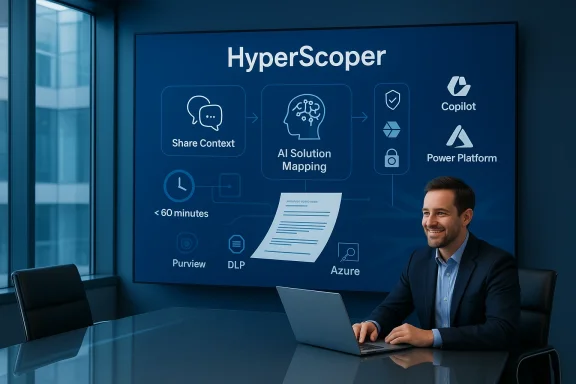
Aureus Intelligence AI this week unveiled HyperScoper™, an AI-powered instant estimator that promises to deliver expert-validated Microsoft Power Platform and Microsoft Copilot solution proposals — including cost ranges and a recommended approach — in under 60 minutes, a claim presented as a direct fix for the slow, uncertain scoping stage that stalls many enterprise AI and automation projects. ([globenewswire.com]swire.com/news-release/2026/03/05/3249917/0/en/Microsoft-Solutions-Partner-Aureus-Intelligence-AI-Launches-HyperScoper-First-AI-Powered-Instant-Estimator-for-Power-Platform-and-Copilot-Projects-in-the-UK.html)
HyperScoper™ is being launched by Aureus Intelligence AI, a consultancy that positions itself as a Microsoft Solutions Partner and advertises leadership that includes a Microsoft FastTrack Recognized Solution Architect (FTRSA). The vendor’s announcement frames HyperScoper™ as the UK’s first instant estimator targeted at Microsoft Copilot and Power Platform projects, able to generate a structured, discussion-ready proposal without a discovery call and to validate that output with in-house Microsoft-certified architects.
The public-facing narrative is consistent across the press release and Aureus’s own marketing pages: the tool takes a short contextual brief from the customer (industry, role, business challenge), maps a right-sized solution using Microsoft 365 Copilot, Copilot Studio, Power Platform components (Power Apps, Power Automate, Power BI) and Azure services, and returns a proposal plus an estimate range after a human review step by Aureus architects.
At the same time, Aureus claims a track record of “100+” Power Platform and AI solutions since 2019, more than £1 billion identified in revenue leakage opportunities via automation and analytics, and delivery of more than £500,000 in annual savings for select clients including NHS, Shell, and Johnson & Johnson. Those specific client and savings claims appear in the launch materials and company case-study pages; however, independent public verification of each client engagement and the exact savings figures is limited in the public record and therefore should be treated as vendor-declared metrics pending buyer due diligence.
Despite the platform momentum, many organisations report that projects stall early: procurement and IT teams struggle to convert interest into scoped, budgeted initiatives. Common causes include uncertain licensing and vendor-cost models for Copilot and Azure services, unclear integration effort for Dataverse/SharePoint/Dynamics data, and lack of internal governance readiness for grounding and securing agent access to enterprise data. These are real, recurring blockers that slow adoption even while Microsoft reports rapid seat growth and partner ecosystem investment.
HyperScoper™ addresses a practical problem: executives want credible, comparable proposals quickly so they can evaluate business value and budget. A short-cycle estimator — if accurate — can remove friction from procurement, accelerate pilot approvals, and let teams trial ideas before committing heavy resources.
Large enterprises increasingly expect pre-validated, repeatable solution patterns. That is the exact market niche HyperScoper™ is addressing: a catalog of tested patterns that can be tuned to a customer context and validated by an accredited architect. If the tool produces realistic line-item estimates and surface-level integration checks, it will help procurement conversations move from “what might work” to “how much and when.” The remaining question is accuracy: can an hour-long estimate correctly capture integration complexities and recurring cloud costs? That remains the crux of the buyer decision.
However, buyers should treat headline saving figures and “first-in-market” claims as vendor marketing until corroborated. Instant estimates are useful for triage and budgeting, but realistic procurement still requires a short discovery phase that captures integration risk, Azure consumption sensitivity, security and compliance work, and a clear plan for long-term maintainability. Demand transparent assumptions from the estimator and convert ranges into firm quotes only after targeted discovery.
Source: The Manila Times Microsoft Solutions Partner Aureus Intelligence AI Launches HyperScoper™ - First AI-Powered Instant Estimator for Power Platform and Copilot Projects in the UK
 Background / Overview
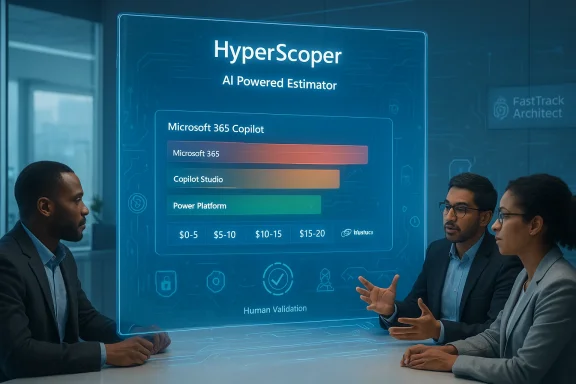
HyperScoper™ is being launched by Aureus Intelligence AI, a consultancy that positions itself as a Microsoft Solutions Partner and advertises leadership that includes a Microsoft FastTrack Recognized Solution Architect (FTRSA). The vendor’s announcement frames HyperScoper™ as the UK’s first instant estimator targeted at Microsoft Copilot and Power Platform projects, able to generate a structured, discussion-ready proposal without a discovery call and to validate that output with in-house Microsoft-certified architects.The public-facing narrative is consistent across the press release and Aureus’s own marketing pages: the tool takes a short contextual brief from the customer (industry, role, business challenge), maps a right-sized solution using Microsoft 365 Copilot, Copilot Studio, Power Platform components (Power Apps, Power Automate, Power BI) and Azure services, and returns a proposal plus an estimate range after a human review step by Aureus architects.
At the same time, Aureus claims a track record of “100+” Power Platform and AI solutions since 2019, more than £1 billion identified in revenue leakage opportunities via automation and analytics, and delivery of more than £500,000 in annual savings for select clients including NHS, Shell, and Johnson & Johnson. Those specific client and savings claims appear in the launch materials and company case-study pages; however, independent public verification of each client engagement and the exact savings figures is limited in the public record and therefore should be treated as vendor-declared metrics pending buyer due diligence.
Why this matters: friction in the Copilot + Power Platform era
Microsoft has pushed Copilot and Copilot Studio to the centre of its enterprise AI story, promoting agent-based automation and integration with Power Platform as the path to business-scale AI. Recent Microsoft communications emphasise Copilot’s enterprise features, agent flows and governance tooling — all of which position Copilot as an enterprise-grade platform rather than a one-off experiment.Despite the platform momentum, many organisations report that projects stall early: procurement and IT teams struggle to convert interest into scoped, budgeted initiatives. Common causes include uncertain licensing and vendor-cost models for Copilot and Azure services, unclear integration effort for Dataverse/SharePoint/Dynamics data, and lack of internal governance readiness for grounding and securing agent access to enterprise data. These are real, recurring blockers that slow adoption even while Microsoft reports rapid seat growth and partner ecosystem investment.
HyperScoper™ addresses a practical problem: executives want credible, comparable proposals quickly so they can evaluate business value and budget. A short-cycle estimator — if accurate — can remove friction from procurement, accelerate pilot approvals, and let teams trial ideas before committing heavy resources.
What HyperScoper™ claims to deliver (product profile)
- Fast, discussion-ready proposals in under 60 minutes based on a short context form submitted by the customer.
- AI-driven solution mapping that combines Microsoft 365 Copilot (including Copilot Studio custom agents), Power Platform (Power Apps, Power Automate, Power BI), Azure compute and storage patterns, and integration patterns.
- Expert validation: a final technical and commercial sanity-check performed by Aureus’s Microsoft-certified solution architects (human-in-the-loop).
- Estimate ranges rather than fixed fixed-price bids, plus a recommended approach and a proposal outline suitable for stakeholder review.
Verifiable credentials and independent checks
Aureus’s announcement highlights two lines of verification: Microsoft partnership credentials and the presence of a FastTrack Recognized Solution Architect on the team.- Microsoft FastTrack Recognized Solution Architect (FTRSA): Microsoft publishes lists of recognized solution architects associated with the FastTrack program. Independent Microsoft pages list professionals (including the name cited by Aureus) as FastTrack-recognized architects for Power Platform, which supports the company’s claim that senior technical expertise underpins their delivery capability.
- Microsoft Solutions Partner: Aureus’s website and the press release state the company is a Microsoft Solutions Partner. This is a standard partner designation within Microsoft’s partner program and is commonly used by consultancies specialising in the Microsoft ecosystem. The company’s site consistently promotes Microsoft capability across Power Platform, Azure and Copilot. Buyers should confirm badge designations directly in Microsoft’s partner directory or via vendor-provided tenancy evidence during procurement.
- Case study evidence: Aureus’s published case studies (for example, an automation for a client that tracks hundreds of thousands of daily document updates) show the team has delivered high-scale automation projects; the Trylon case study describes a SharePoint change-tracking solution able to process large volumes of updates, which corroborates claims of enterprise-scale experience though it is a vendor-hosted case study rather than an independent audit.
Strengths: where HyperScoper™ could genuinely help buyers
- Speed and momentum: By collapsing initial scoping into an hour-long, validated proposal, HyperScoper™ can reduce the calendar time between idea and budget conversation. This is a direct answer to a known procurement friction that costs organisations “lost momentum” and delayed outcomes. The market need for speed is well documented as Copilot adoption accelerates.
- Focus on Microsoft-native patterns: HyperScoper™ targets the Power Platform + Copilot + Azure stack — an architectural sweet spot for many enterprises already invested in Microsoft 365, Teams, SharePoint and Dataverse. That focus should improve estimate realism for integration and licensing line items if the tool models those costs correctly.
- Human validation: The vendor’s promise of a Microsoft-certified architect reviewing AI outputs mitigates the chief practical risk of automated scoping tools — hallucinated or unrealistic recommendations. The human-in-the-loop step is essential for any AI-generated technical plan to be credible.
- Standardised outputs for procurement: A consistent, structured proposal makes it easier to compare vendor options and set measurable acceptance criteria for pilot projects. For procurement teams that must compare multiple bids or justify pilot spend, a crisp template is valuable.
- Use-case coverage: The estimator explicitly lists common Copilot+Power Platform deliverables — Microsoft 365 Copilot deployment, Copilot Studio agents, Copilot for Sales/Service/Finance, custom Copilot extensions, and AI workflow automation — which align with the most requested enterprise scenarios seen in the market.
Risks, gaps and what buyers must validate
No automated scoping tool is a substitute for careful technical due diligence. Below are concrete risk areas and recommended validation steps.1) Marketing claims vs verifiable outcomes
Aureus’s press release repeats large, outcome-oriented numbers — “£1 billion in uncovered revenue leakage” and “£500,000+ in annual savings” — and lists household-name clients. These are plausible for an experienced partner, but the public record outside vendor-owned materials is limited. Buyers should treat such numbers as vendor-declared and require supporting evidence when procurement decisions depend on them. Ask for anonymised before-and-after metrics, named references, or third-party verification during the RFP process.2) “UK’s first” and other uniqueness claims
Calling HyperScoper™ the “UK’s first AI-powered instant estimator” is a positioning statement rather than a technical guarantee and is difficult to prove objectively. Competitive landscape checks will likely reveal other firms offering rapid scoping, templated proposals, or internal estimation tooling; the buyer benefit is the output quality, not the first-to-market label. Treat this as marketing.3) Estimate accuracy and hidden cost drivers
Quick estimates are valuable, but they can conceal high-variance items:- Licensing and seat-count costs for Microsoft 365 Copilot and Dynamics 365 add-ups can be material and change with Microsoft’s licensing evolution. Verify what assumptions the estimator uses for license tiers, concurrency, and future price changes.
- Azure consumption modeling (inference, storage, function invocations) can be the biggest unknown. The estimator should show which workloads drive Azure costs and provide sensitivity ranges (best / typical / worst case).
- Integration complexity (legacy systems, proprietary APIs, on-prem data) is often the single biggest scope escalator. HyperScoper™’s short-form input may not capture brittle integration edge cases; require a documented escalation path and a discovery phase before fixed-price engagement.
4) Data protection, grounding and security assumptions
Copilot projects depend on controlled access to enterprise data and robust grounding to avoid hallucination. Any estimate that pushes for rapid delivery must also show governance work: data classification, Purview/labels, Data Loss Prevention configuration, and a plan for safe grounding and prompt design. Ask what security templates and compliance evidence the proposal includes. Microsoft emphasises these governance primitives in its Copilot guidance; buyers should mirror that focus in vendor selection.5) Vendor lock-in, extensibility and handover
Instant proposals accelerate selection, but the buyer must ensure the recommended architecture is maintainable beyond the vendor’s involvement. Request:- A clear handover plan and documentation standards.
- A variable-cost forecast (3–5 year TCO) that includes vendor-managed vs. in-house support choices.
- Source-control and environment segregation details (dev/test/prod) for Copilot agents and Power Platform solutions.
How HyperScoper™ should be used in procurement and governance (practical checklist)
- Use HyperScoper™ for rapid ideation and budgetary planning — not as a signed technical specification. Treat the output as a validated proposal outline that triggers a short discovery phase.
- Validate assumptions: ask the estimator to expose license model, Azure consumption drivers, integration touchpoints, and data governance tasks in line-item form.
- Demand references and anonymised case metrics for comparable deployments (same industry, similar data volumes). Vendor case studies (e.g., the Trylon SharePoint example) are useful but should be corroborated by direct references where possible.
- Run a short technical discovery (2–5 days) to firm up unknowns: API contracts, data volumes, identity architecture, and performance SLAs. Convert ranges into firm estimates after discovery.
- Include security and compliance acceptance criteria in the procurement document: data residency, access governance, audit logs, and incident response obligations for agent runtime.
Governance, risk and compliance: Copilot-specific considerations
- Grounding fidelity: Copilot outputs must be grounded in authoritative data sources. The estimator’s proposal should identify grounding sources (Dataverse, SharePoint, Dynamics, enterprise data warehouse) and anticipated connectors. If the tool proposes external LLMs, verify the model selection and enterprise-grounding approach.
- Data exposure and privacy: Copilot agents accessing sensitive documents require DLP and conditional access controls. Ensure the proposed plan includes Microsoft 365 Compliance controls, tenant-level policies, and an approach for role-based access to agent capabilities.
- Auditability and traceability: Agent runtimes must produce interaction logs, feedback loops, and deterministic versioning for prompts and grounding artifacts. Ask for a versioned agent deployment model and runbook for prompt tuning and rollback.
- Responsible AI controls: Solutions should include a human-in-the-loop decision model for high-risk outcomes, bias testing for retrieval/ranking, and regular prompt audits.
Market context: are instant estimators the future?
We are seeing two intersecting forces in 2026: (a) Microsoft’s push to normalise Copilot and Copilot Studio as the enterprise standard for agentic workflows, and (b) buyer impatience with slow, manual scoping cycles. Microsoft’s product docs and partner programs emphasise governance, measurement and adoption tooling — all signals that vendors who deliver fast, grounded, governance-aware scoping will have an advantage.Large enterprises increasingly expect pre-validated, repeatable solution patterns. That is the exact market niche HyperScoper™ is addressing: a catalog of tested patterns that can be tuned to a customer context and validated by an accredited architect. If the tool produces realistic line-item estimates and surface-level integration checks, it will help procurement conversations move from “what might work” to “how much and when.” The remaining question is accuracy: can an hour-long estimate correctly capture integration complexities and recurring cloud costs? That remains the crux of the buyer decision.
Practical questions to pose to Aureus (or any vendor offering instant estimates)
- What specific licensing assumptions are used for Microsoft 365 Copilot, Dynamics/Copilot seat counts, and Power Platform per-user/per-app costs? Are those assumptions stated in the proposal?
- How does HyperScoper™ calculate Azure inference and storage costs? Does it model burst behaviour, cold storage and egress?
- Which data sources and connectors are assumed to be in-scope, and what is the escalation policy if undocumented APIs or on-prem systems are discovered?
- Does the proposal include a recommended discovery and mitigation plan for data governance, DLP, and Purview policies before agent rollout?
- Can Aureus provide anonymised reference deployments that match our industry and data scale, and can those references confirm the vendor’s claimed savings/efficiency numbers?
- What parts of the solution will be vendor-managed, and what will be handed over to internal teams? What are the support and documentation SLAs?
Readiness signals: when to use HyperScoper™ (recommended buyer profiles)
- Organisations with a defined business process and clear KPIs that need an initial budget for board-level approval. HyperScoper™ can produce a fast, comparable proposal to accelerate decision-making.
- Teams already on Microsoft 365 and using SharePoint/Teams/Dataverse where integration patterns are mostly standard and data residency rules are known — where a right-sized estimate is likely to be accurate.
- Businesses that want to run multiple scenario comparisons quickly (e.g., Copilot pilot vs. Power Platform automation vs. hybrid approach) to prioritise pilots.
Final assessment — measured optimism
HyperScoper™ is an example of how consultancies are productising domain knowledge to match the speed businesses now demand when evaluating AI and Copilot projects. The combination of an AI-driven mapper plus human validation addresses the twin risks of speed and credibility. Aureus’s published case studies and the presence of FastTrack-recognised architects add credibility to the announcement, and the product aligns with the practical needs of Microsoft-first customers.However, buyers should treat headline saving figures and “first-in-market” claims as vendor marketing until corroborated. Instant estimates are useful for triage and budgeting, but realistic procurement still requires a short discovery phase that captures integration risk, Azure consumption sensitivity, security and compliance work, and a clear plan for long-term maintainability. Demand transparent assumptions from the estimator and convert ranges into firm quotes only after targeted discovery.
How to proceed if you’re evaluating HyperScoper™
- Submit a typical use-case to HyperScoper™ and request the full assumptions table behind the estimate. Compare the output to an in-house worksheet or a second vendor’s rapid scoping output.
- Request one or two anonymised references for deployments similar in scale to yours (industry, data volume, number of Copilot users). Validate the realised savings and any scope changes that occurred in delivery.
- Insist on a structured follow-up: a short paid discovery (2–5 days) to firm up unknowns, produce a firm statement of work and convert the estimate into a fixed-price phase with acceptance criteria.
- Require explicit governance deliverables: an agent grounding and DLP plan, Purview classification tasks, and runbook for agent prompt/version control.
Conclusion
HyperScoper™ is a timely tool for a market that urgently needs faster and more credible ways to move from Copilot curiosity to scoped pilots. Aureus Intelligence AI combines an AI-driven mapping approach with human validation and Microsoft-aligned experience, which can materially shorten the time to procurement conversation. That said, fast proposals are not a substitute for targeted discovery; the real value will be measured by the estimator’s transparency about assumptions and by how reliably short-form outputs translate into accurate, deliverable scopes once integration and governance realities are explored. Treat the instant estimate as an accelerator for conversation — not the final contract — and insist on the evidence and handover guarantees you need to make Copilot and Power Platform projects sustainable and auditable.Source: The Manila Times Microsoft Solutions Partner Aureus Intelligence AI Launches HyperScoper™ - First AI-Powered Instant Estimator for Power Platform and Copilot Projects in the UK