

Aureus Intelligence AI this week unveiled HyperScoper™, an AI‑powered “instant estimator” that promises to compress the weeks‑long scoping cycle for Microsoft Copilot and Power Platform projects into a single, expert‑validated output delivered in under 60 minutes.
Microsoft 365 Copilot and the Power Platform sit at the centre of enterprise AI initiatives in 2026. Organisations are eager to shift from pilots and proof‑of‑concepts to measurable, production‑grade deployments that deliver productivity gains and cost savings. Yet a recurring bottleneck remains: the scoping and budgeting phase. Traditional discovery workshops, technical assessments, and procurement cycles can stretch for weeks or months, losing momentum and often stalling executive buy‑in.
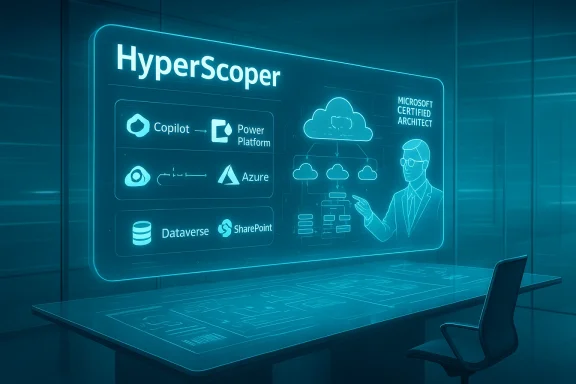
HyperScoper™ is Aureus Intelligence AI’s attempt to productise and accelerate that front end. Announced March 5, 2026, the product is described by its vendor as a short‑form intake + AI solution‑mapping engine + human review pipeline that outputs a structured proposal and an estimated cost range for Copilot and Power Platform work without an initial discovery call. Aureus positions HyperScoper™ as a tool to get projects “discussion‑ready” for procurement and executive approval far faster than conventional approaches.
That environment creates a practical opening for tools that can produce fast, credible, repeatable scoping outputs. If an estimate is transparent about its assumptions — especially licensing and Azure consumption drivers — it changes the procurement conversation from “how much might this cost?” to “what are we buying, and what trade‑offs will change the number?”
Do not use an instant estimate as the final contract document for high‑value or high‑risk projects. Instead, insist on a two‑stage procurement approach:
Many consultancies now offer rapid scoping templates or internal estimator tools; what separates a high‑value product in this space is transparency (explicit line‑item assumptions), governance completeness, and a credible human‑in‑the‑loop. Marketing claims such as “first in the country” are positioning statements; savvy buyers judge on output quality and traceability to real client outcomes.
Its two most notable credibility signals are the Microsoft‑native focus (Copilot + Power Platform + Azure) and the advertised human validation step. Those design choices address the two biggest buyer fears: unrealistic automated architectures and invisible assumptions.
That said, buyers must treat instant estimates as accelerators for conversation — not as final procurement artifacts. The real value of any estimator will be judged on three practical criteria:
HyperScoper™ is representative of how Microsoft‑aligned consultancies are turning domain expertise into a product: faster, repeatable decision artefacts that let organisations move from “could we?” to “should we?” with less calendar friction. The critical test for Aureus — and for any vendor offering an “instant estimator” — will be whether the speed comes with clarity, defensible assumptions, and a structured path to discovery and delivery that prevents the normal traps of AI project delivery: cost surprises, integration rework, and governance blind spots.
Source: Magzter MICROSOFT SOLUTIONS PARTNER LAUNCHES FIRST AI-POWERED INSTANT ESTIMATOR FOR COPILOT PROJECTS | Techlife News - technology - Read this story on Magzter.com
 Background
Microsoft 365 Copilot and the Power Platform sit at the centre of enterprise AI initiatives in 2026. Organisations are eager to shift from pilots and proof‑of‑concepts to measurable, production‑grade deployments that deliver productivity gains and cost savings. Yet a recurring bottleneck remains: the scoping and budgeting phase. Traditional discovery workshops, technical assessments, and procurement cycles can stretch for weeks or months, losing momentum and often stalling executive buy‑in.HyperScoper™ is Aureus Intelligence AI’s attempt to productise and accelerate that front end. Announced March 5, 2026, the product is described by its vendor as a short‑form intake + AI solution‑mapping engine + human review pipeline that outputs a structured proposal and an estimated cost range for Copilot and Power Platform work without an initial discovery call. Aureus positions HyperScoper™ as a tool to get projects “discussion‑ready” for procurement and executive approval far faster than conventional approaches.
Overview: what HyperScoper™ claims to do
- Intake a brief set of organisational inputs — industry, role, workforce size, Microsoft 365 usage patterns, business objectives.
- Use AI to map a right‑sized solution architecture across Microsoft 365 Copilot (including Copilot Studio and custom agents), Power Platform components (Power Apps, Power Automate, Power BI), and Azure services.
- Have a Microsoft‑certified solution architect perform a final technical and commercial validation.
- Deliver a structured proposal outline, a recommended delivery approach (pilot vs phased rollout), and an estimate range within 60 minutes.
Why this matters now
Copilot adoption is accelerating — but not uniformly
Microsoft’s Copilot family has driven a wave of interest in generative AI across enterprises. Market indicators in early 2026 show meaningful seat growth, and analyst notes highlight aggressive partner programs focused on Copilot and Copilot Studio. At the same time, many organisations report that most advanced AI projects remain in pilot phases because uncertainty around costs, integration effort and governance prevents budget sign‑off.That environment creates a practical opening for tools that can produce fast, credible, repeatable scoping outputs. If an estimate is transparent about its assumptions — especially licensing and Azure consumption drivers — it changes the procurement conversation from “how much might this cost?” to “what are we buying, and what trade‑offs will change the number?”
The scoping gap is a real business problem
Delays in scoping are not merely inconvenient; they translate into lost momentum and delayed ROI. Executives who approve pilots need defensible numbers to justify investment. Procurement teams need comparable documents to evaluate competing vendors. Technology teams need clarity on integration touchpoints and governance work before committing resources. A validated, standardised scoping output addresses all three audiences.How HyperScoper™ works — unpacking the pipeline
1. Short intake form
Customers provide a brief description: industry, role, the business challenge to solve, estimated number of seats or users, and an outline of existing Microsoft 365 investments (e.g., Teams, SharePoint, Dataverse).2. AI solution mapping
The engine matches the input to pre‑built solution patterns (e.g., Copilot for Sales, Copilot for Finance, Copilot Studio agents integrated with Power Automate) and produces an architecture sketch showing expected components: connectors to source systems, data grounding points (Dataverse, SharePoint, Dynamics), Power Apps/Power Automate flows, and likely Azure resources.3. Cost modelling
The estimator produces a cost range rather than a fixed price, layering in line items that typically drive cost: Copilot licensing assumptions, Power Platform per‑user/per‑app considerations, Azure inference and storage estimates, and professional services effort (design, governance, integration, testing).4. Human validation
Aureus says its Microsoft‑certified architects review the AI output for technical feasibility and commercial realism before delivery. That human‑in‑the‑loop step is central to the product’s credibility claim.5. Deliverable
The customer receives a concise package intended for internal review: a solution outline, assumptions table (seat counts, license tiers, integration scope), a recommended next step (short paid discovery vs pilot), and a cost range.Strengths — where HyperScoper™ could genuinely help
- Speed and momentum: The clearest, immediate benefit is faster decision velocity. A credible, validated estimate in less than an hour converts curiosity into actionable budget conversations with stakeholders and finance teams.
- Standardised procurement artefact: A consistent template helps procurement teams compare vendor offers more effectively and reduces subjectivity during vendor shortlisting.
- Microsoft‑native focus: By concentrating on Copilot + Power Platform + Azure patterns, the estimator can reuse proven deployment templates and governance checklists that are relevant for Microsoft‑first organisations.
- Human validation as risk mitigation: The human reviewer is the single most important control against automated hallucination. If the expert review is substantive — not a cursory checkbox — it materially raises the quality of the output.
- Scenario planning and sensitivity: A well‑designed estimator can deliver quick sensitivity analysis (different seat counts, concurrency models, Azure consumption tiers) which is useful for executive decisionmaking.
Risks and limits — what the tool cannot (and should not) do
1. “Instant” does not equal exhaustive
An hour‑long estimate trades depth for speed. It can produce defensible budgets for typical scenarios, but it cannot fully capture brittle integration edge cases: undocumented APIs, bespoke on‑prem systems, identity federation oddities, or multi‑tenant data residency constraints.2. Licensing and Azure consumption are fragile variables
Licensing assumptions (which Copilot product, how many seats, enterprise discounts) and Azure inference/storage models are the predominant cost drivers for AI projects. Small changes in assumed concurrency or inference cadence can produce large variations in total cost of ownership. Any instant estimator must make those assumptions explicit and provide sensitivity tables.3. Vendor‑declared outcomes require verification
Claims of prior client savings, “£1 billion+ identified in revenue leakage,” or high‑value client names are useful signals but remain vendor‑declared unless independently substantiated. Buyers should request anonymised case metrics, references, and contractual evidence where headline savings matter to procurement.4. Governance and compliance cannot be simulated away
Copilot deployments require explicit work on data classification, conditional access, DLP, Purview labels, and auditability. If the quick estimate neglects governance tasks or buries them as “assumed” effort, the downstream risk is non‑negotiable: data leakage, regulatory misalignment or a Copilot agent that returns ungrounded answers.5. Human validation must be robust
If human review is superficial, the estimator becomes little more than a polished marketing artifact. Procurement teams should require evidence of the reviewer’s credentials, the depth of the review, and whether the reviewer signs off on key assumptions such as integration complexity and governance deliverables.Practical questions IT leaders should ask when evaluating any “instant estimator”
- Which exact Microsoft licensing tiers and seat counts were assumed for Copilot in the estimate?
- What Azure consumption model underpins inference and data storage cost lines (throughput, batch sizes, caching assumptions)?
- Which connectors and data sources are assumed to be in scope? What is the escalation policy if undocumented APIs or on‑prem systems are discovered?
- Can the vendor provide anonymised references for comparable deployments (same industry, similar data volumes)?
- What governance deliverables are included in the scope (Purview classification tasks, DLP rules, conditional access updates)?
- Is the human validation step performed by a named, certified architect — and will that person be available for a follow‑up short discovery?
- Does the estimate include a recommended short paid discovery (2–5 days) to convert ranges into firm statements of work?
- What is the handover plan and documentation standard for maintaining Copilot agents after deployment?
- How does the vendor model incremental, multi‑phase rollouts versus producing a single large scope?
- What change control and escalation procedures are included if integration complexity exceeds assumptions?
Governance checklist that should accompany any Copilot estimate
- Explicit grounding sources identified (Dataverse, SharePoint, DWH).
- Data classification and sensitivity mapping included as a line item.
- DLP and conditional access configuration tasks specified.
- Audit logging and interaction traceability described.
- Human‑in‑the‑loop design for high‑risk decisions and escalation routes.
- Responsible AI testing and bias mitigation plan.
- Versioned prompt and agent deployment model (dev/test/prod segregation).
- Retention and access policy for training/feedback data.
Commercial and procurement implications
An instant estimate is most valuable as a triage and prioritisation tool. Use it to: accelerate budget approvals for low‑risk, Microsoft‑native pilots; produce comparable shortlists for procurement; and identify where a short paid discovery is essential to produce a fixed‑price SOW.Do not use an instant estimate as the final contract document for high‑value or high‑risk projects. Instead, insist on a two‑stage procurement approach:
- Use HyperScoper™ (or equivalent) to generate a validated, scenario‑aware estimate and proposal outline.
- Proceed to a focused discovery phase (2–5 days) that validates integration touchpoints, performance expectations, and governance controls — then convert to a firm SOW and fixed‑price delivery phase.
Competitive landscape and market positioning
The category HyperScoper™ occupies is where consultancies productise repeatable knowledge into self‑service tooling: a catalogue of deployment patterns, cost models, and governance templates tuned for Microsoft stacks. The core buyer question is not “who was first?” but rather “whose estimator produces the clearest assumptions, the most realistic Azure modeling, and the most rigorous human review?”Many consultancies now offer rapid scoping templates or internal estimator tools; what separates a high‑value product in this space is transparency (explicit line‑item assumptions), governance completeness, and a credible human‑in‑the‑loop. Marketing claims such as “first in the country” are positioning statements; savvy buyers judge on output quality and traceability to real client outcomes.
Case study realism: what to validate behind vendor claims
Vendors often publish case studies that show large savings and scale. When those figures drive procurement decisions, verify:- Which baseline metrics were used and how they were measured.
- Whether the savings were gross or net of new operational costs (e.g., Azure inference).
- How much of the savings came from process redesign versus automation alone.
- Whether the vendor’s role included change management and adoption work, which often account for a large share of realised value.
Final assessment — measured optimism
HyperScoper™ is a timely product for a market that needs faster, credible ways to move from Copilot curiosity to scoped pilots. The tool aligns with a larger trend: partners productising repeatable Microsoft deployment patterns and making them accessible through AI‑assisted tools.Its two most notable credibility signals are the Microsoft‑native focus (Copilot + Power Platform + Azure) and the advertised human validation step. Those design choices address the two biggest buyer fears: unrealistic automated architectures and invisible assumptions.
That said, buyers must treat instant estimates as accelerators for conversation — not as final procurement artifacts. The real value of any estimator will be judged on three practical criteria:
- Transparency: Are licensing, Azure, and integration assumptions explicit and line‑itemed?
- Validation: Is human review substantive and performed by named, certified architects?
- Handover: Does the output link to a short, mandatory discovery to convert ranges into fixed scopes, and does it include governance deliverables?
How to test HyperScoper™ in your organisation
- Choose a single, representative use case (e.g., automate monthly financial reporting, build a Copilot assistant for customer service).
- Run that use case through HyperScoper™ and request the full assumptions table.
- Compare the output to an internal scoping worksheet or a second vendor’s rapid scoping output.
- Request an anonymised case reference for a similar deployment.
- Insist on a 2–5 day paid discovery to convert the estimate into a fixed‑price SOW with acceptance criteria.
- Verify governance deliverables and a handover plan for the first three months of production support.
HyperScoper™ is representative of how Microsoft‑aligned consultancies are turning domain expertise into a product: faster, repeatable decision artefacts that let organisations move from “could we?” to “should we?” with less calendar friction. The critical test for Aureus — and for any vendor offering an “instant estimator” — will be whether the speed comes with clarity, defensible assumptions, and a structured path to discovery and delivery that prevents the normal traps of AI project delivery: cost surprises, integration rework, and governance blind spots.
Source: Magzter MICROSOFT SOLUTIONS PARTNER LAUNCHES FIRST AI-POWERED INSTANT ESTIMATOR FOR COPILOT PROJECTS | Techlife News - technology - Read this story on Magzter.com