

Microsoft and Iberdrola have expanded a quietly consequential partnership into Europe with two new long‑term power purchase agreements (PPAs) totaling 150 MW and an explicit roadmap to weave cloud, AI and energy infrastructure together across Iberdrola’s global operations. The deal links Microsoft’s accelerating demand for low‑carbon electricity with Iberdrola’s onshore wind pipeline in northern Spain, while formalizing broader collaboration on Azure migration, Microsoft Copilot and potential industrial deployments such as data‑centre waste heat reuse, hydrogen pilots, battery storage and carbon‑management initiatives. Taken together, the contracts mark the first direct Iberdrola–Microsoft PPAs in Europe and add to a transatlantic PPA portfolio that now approaches roughly 500 MW across both companies’ projects.
Iberdrola, one of Europe’s largest utilities and a major global renewable developer, and Microsoft have worked together in the United States through Iberdrola’s Avangrid subsidiary over the last several years. Those U.S. engagements included offtake agreements with solar and wind projects that supported Microsoft’s corporate renewable targets while providing predictable revenue streams for the developer. The December agreement announced in Spain deepens that relationship by moving the collaboration into European wind projects and explicitly tying digital transformation and AI deployment to energy procurement and sustainability objectives.
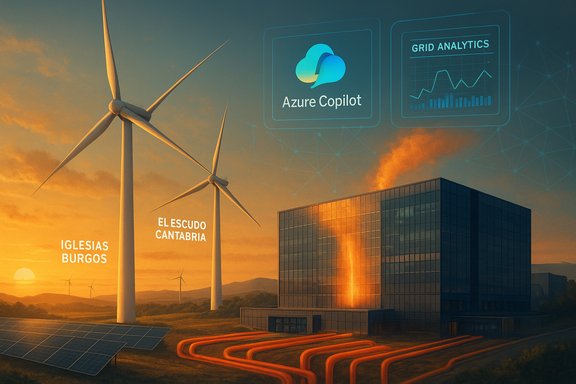
These new Spanish PPAs are structured around two onshore wind complexes located in northern Spain: the Iglesias project (Burgos/Castilla y León) and the El Escudo project (Cantabria). The arrangement is presented as a long‑term supply contract to underpin Microsoft’s renewable energy needs in Europe and to enable Iberdrola to accelerate digital and AI adoption across its business lines using Microsoft Azure and Copilot technologies.
Potential models include:
Realising the full potential of this partnership will depend on moving quickly from memoranda of intent to demonstrable operational projects: projects that show efficient renewable delivery, reliable data‑centre integrations, scalable heat‑reuse schemes and clear additionality in corporate sustainability claims. If both companies can operationalise those ambitions at scale, the agreement could serve as a blueprint for future collaborations between utilities and technology giants seeking to power the digital economy with truly clean energy.
Source: Renewable Energy Magazine Iberdrola and Microsoft Strengthen Partnership With Two Long-Term PPAs
 Background
Iberdrola, one of Europe’s largest utilities and a major global renewable developer, and Microsoft have worked together in the United States through Iberdrola’s Avangrid subsidiary over the last several years. Those U.S. engagements included offtake agreements with solar and wind projects that supported Microsoft’s corporate renewable targets while providing predictable revenue streams for the developer. The December agreement announced in Spain deepens that relationship by moving the collaboration into European wind projects and explicitly tying digital transformation and AI deployment to energy procurement and sustainability objectives.These new Spanish PPAs are structured around two onshore wind complexes located in northern Spain: the Iglesias project (Burgos/Castilla y León) and the El Escudo project (Cantabria). The arrangement is presented as a long‑term supply contract to underpin Microsoft’s renewable energy needs in Europe and to enable Iberdrola to accelerate digital and AI adoption across its business lines using Microsoft Azure and Copilot technologies.
Overview of the deal: what was announced
- Two long‑term PPAs in Spain, covering a combined contracted capacity of 150 MW.
- The PPAs are linked to the Iglesias wind farm (Burgos) and El Escudo wind farm (Cantabria).
- Expanded partnership scope to include:
- Increased use of Microsoft Azure cloud services and Microsoft Copilot across Iberdrola.
- Security and regulatory compliance tooling from Microsoft.
- Joint exploration of waste heat reuse (example cited: data centres in Zaragoza), electrified land, carbon credits, hydrogen, battery storage and other innovation projects across Iberdrola’s subsidiaries in Europe, the US, Brazil and Australia.
- These Spanish PPAs complement three prior Microsoft–Avangrid PPAs in the United States (projects in Ohio, California and Washington), bringing the combined PPA portfolio between Microsoft and Iberdrola/Avangrid to around 500 MW of contracted capacity.
Why this matters: strategic context
For Microsoft: securing low‑carbon power for a growing AI footprint
Microsoft’s infrastructure needs are shifting rapidly as AI workloads scale across the company’s cloud services and as new purpose‑built facilities come online. Long‑term PPAs are the preferred instrument for cloud providers seeking to align electricity consumption with renewable generation and to manage price exposure over decades of operation. By adding European onshore wind PPAs, Microsoft:- Advances regional renewable coverage that supports its public commitments to renewable operations.
- Secures predictable, contractually defined volumes to match future data‑centre and AI compute growth in Europe.
- Gains potential operational synergies via collaboration on heat reuse, carbon credits and energy storage.
For Iberdrola: anchoring demand and accelerating digital transformation
Iberdrola benefits from a strategic corporate customer that offers both revenue certainty for projects and a route into deeper technology partnerships:- The PPAs help monetize capacity from Iberdrola’s newly developed wind farms.
- A strengthened Azure relationship accelerates Iberdrola’s cloud migration and AI adoption—areas the company cites as essential to operational resilience and grid optimisation.
- Collaboration on waste heat and data‑centre ecosystems opens new value streams (e.g., district heating, industrial heat reuse) and supports Iberdrola’s ambition to be a preferred energy partner for hyperscalers.
For the market and the grid
This kind of cross‑sector partnership signals a maturing market where energy contracts are bundled with technology and industrial services. As hyperscalers consume increasing shares of grid capacity—especially for AI—long‑term PPAs provide a mechanism to coordinate renewable investment with anticipated demand. However, they also increase the importance of regional grid planning, storage deployment and flexible demand solutions to integrate high penetrations of variable renewables.The assets: Iglesias and El Escudo (technical snapshot and notes)
Both Iberdrola and industry press have tied the PPAs to specific wind projects in Spain. Project technical characteristics reported publicly include:- Iglesias wind farm (Burgos/ Castile and León): a project with roughly 94 MW of installed capacity, developed with Siemens Gamesa turbines and positioned as a modern onshore cluster in a region with strong wind resources.
- El Escudo wind farm (Cantabria): reported capacities vary across disclosures—public project documents and company statements reference around 101–105 MW, developed across multiple turbine types and phases.
Digital tie‑ins: Azure, Copilot and utility modernisation
The announcement makes clear this arrangement is not a pure commodity trade; it embeds a technology layer that will be deployed across Iberdrola:- Azure migration: Iberdrola has already migrated critical systems to Azure and expects further migration as part of this widened partnership. Cloud adoption promises faster deployments of analytics, grid modelling and operational software that benefit both renewable dispatch and asset management.
- Microsoft Copilot: the planned deployment of Copilot and other generative AI tools aims to accelerate internal productivity and augment engineering, operations and customer service—areas where generative assistants can streamline workflows or automate routine tasks.
- Security and compliance tools: utilities operate under tight regulatory and cyber‑security constraints; Microsoft’s security stack is positioned to help Iberdrola manage compliance, data governance and incident response across distributed assets.
Data centres, waste heat and industrial symbiosis
One of the headline exploratory areas is waste heat reuse, with a specific example cited around data‑centre heat in Zaragoza. The logic is straightforward: hyperscale data centres produce significant thermal loads; capturing and repurposing that heat to supply industrial processes or district heating can deliver local emissions benefits and new revenue models.Potential models include:
- Capturing server rack and chiller heat via heat‑pump systems and feeding recovered energy to nearby industrial sites or urban heating networks.
- Co‑locating battery storage and hydrogen electrolysers to balance generation and provide seasonal storage, enabling surplus renewable generation to be converted into renewable hydrogen.
- Electrifed land projects: pairing grid connections, renewables and data‑centre demand to architect campuses where energy flows are optimized for both compute and local communities.
Broader technology and market opportunities in the partnership
The companies listed several potential collaboration fields beyond PPAs and cloud services:- Battery storage: pairing wind output with battery systems to firm dispatch and supply ancillary services to the grid.
- Hydrogen: using renewables to produce green hydrogen for industrial use or for long‑duration storage.
- Carbon credits and offsets: structuring offtake and carbon solutions to manage corporate Scope 2/3 reporting needs.
- Electrified land: enabling highly electrified industrial or compute campuses with dedicated renewable supply.
Financial and contractual considerations (what PPAs do and don’t reveal)
Public announcements often present headline capacity and strategic intent, but leave important commercial details undisclosed:- Contract length, strike price, indexing mechanisms, and guarantees are typically confidential. These terms determine the economic viability of projects and the degree of bankability for developers.
- Congestion, curtailment risk and transmission constraints can affect the realized value of a PPA. In Europe’s increasingly congested electricity markets, location matters as much as capacity.
- Additionality and renewable attribution for corporate claims are governed by regional rules: the contractual instruments must support Microsoft’s accounting for renewable energy in Europe under accepted frameworks.
Risks and caveats
While the deal is strategically sensible for both partners, several risk vectors merit attention:- Market price dynamics: Spain’s renewables supply has grown rapidly, and there have been periods of depressed wholesale prices and negative price events. Low spot prices can erode the economics of new projects unless fixed PPA prices are negotiated advantageously.
- Grid integration and curtailment: As more renewables connect in a region, system operators must invest in transmission and flexibility (storage, demand response). Without those upgrades, curtailment or reduced capacity factors can hit project revenues.
- Regulatory uncertainty: European energy markets are undergoing regulatory adjustments—capacity mechanisms, grid charges and balancing rules evolve—and these can materially affect project returns and corporate procurement models.
- Carbon accounting and additionality: Corporate claims of “100% renewable in Europe” depend on how energy is contracted, matched and claimed under regional accounting standards. Scrutiny from stakeholders and auditors on additionality will intensify as companies make stronger net‑zero claims.
- Operational and integration risk: Embedding AI and cloud systems into mission‑critical utility operations introduces cyber‑security and reliability challenges that must be mitigated with hardened architectures and strong governance.
Market implications and competitors
The Iberdrola–Microsoft move is part of a larger pattern where hyperscalers sign PPAs directly with developers or utilities and then layer technology and industrial partnerships on top. The implications include:- More predictable demand signals for renewable developers, which improves project finance prospects.
- Increased competition for high‑quality renewable sites in regions with attractive connectivity to data centres and industrial demand.
- A shift from simple offtake to vertically integrated offerings: energy supply bundled with storage, grid services and technology solutions.
What to watch next: milestones and red flags
Key near‑term indicators to monitor that will signal whether this strategic relationship translates into tangible outcomes:- Project commissioning dates and operational performance from Iglesias and El Escudo—actual generation data will test the PPA’s delivery.
- Announcements of concrete pilots on waste heat reuse from Microsoft data centres in Zaragoza and whether heat‑offtake contracts are signed with local municipalities or industrial users.
- Publication of any joint pilots on hydrogen electrolysis or battery‑to‑power projects that demonstrate integrated energy‑tech products.
- Disclosure of additional PPA volumes or expansions in other European markets, which would show scaling beyond the initial 150 MW deal.
- Regulatory filings or local permitting developments that affect grid access, transmission upgrades or curtailment protections around these sites.
Assessment: strengths, limitations and long‑term outlook
This expanded alliance between Iberdrola and Microsoft has several notable strengths:- Strategic alignment: Both parties benefit—Microsoft by securing renewable supply and local cloud/AI support; Iberdrola by anchoring demand and accelerating its digital transformation.
- Industrial breadth: The scope goes beyond pure energy procurement to explore heat reuse, hydrogen and storage—areas that could produce systemic benefits if pilots scale.
- Portfolio diversification: Adding European PPAs complements existing U.S. contracts and diversifies Microsoft’s regional renewable mix.
- Economic opacity: Confidential PPA economics limit outside assessment of project viability and the deal’s market impact.
- Implementation complexity: Turning headline collaborations into functioning industrial symbiosis (heat reuse, hydrogen) requires cross‑sector engineering, long lead times and supportive regulation.
- Market headwinds: Regional oversupply or low wholesale prices can challenge developer economics unless contracts mediate those risks.
Practical takeaways for energy and IT professionals
- Utilities should view hyperscaler PPAs as opportunities to secure long‑term revenue and to co‑develop value‑added energy services—heat reuse and storage are differentiators.
- Tech companies will increasingly expect bundled offers: renewable supply, flexibility services and digital integration (cloud and AI) as a single package.
- Regulators and grid planners must accelerate investment in transmission and flexibility mechanisms to avoid bottlenecks as corporate demand concentrates near data centres and renewable hubs.
- Project teams must pay attention to measurable additionality, transparent carbon accounting and clear contractual protections against curtailment and imbalance exposure.
Conclusion
The Iberdrola–Microsoft expansion into Spain is more than a headline PPA: it signals a strategic fusion of energy procurement, cloud computing and AI enablement that aligns two powerful industrial trajectories—decarbonisation of electricity grids and the rapid growth of AI‑driven compute. The deal anchors hyperscaler demand to regional renewables while offering Iberdrola a route to monetise projects and modernise operations with cloud‑native tools.Realising the full potential of this partnership will depend on moving quickly from memoranda of intent to demonstrable operational projects: projects that show efficient renewable delivery, reliable data‑centre integrations, scalable heat‑reuse schemes and clear additionality in corporate sustainability claims. If both companies can operationalise those ambitions at scale, the agreement could serve as a blueprint for future collaborations between utilities and technology giants seeking to power the digital economy with truly clean energy.
Source: Renewable Energy Magazine Iberdrola and Microsoft Strengthen Partnership With Two Long-Term PPAs
