

The Iberian blackout of April 28, 2025 — an unprecedented, region‑wide loss of power that left trains halted, communications severed and banking services temporarily unusable — crystallised a stark lesson for utilities and energy operators: fragmented data, disconnected systems and weak instrumentation turn modern grids fragile. Caleb Northrop, IBM’s product leader for asset lifecycle management, uses that warning as the backdrop to argue that enterprise asset management (EAM) platforms — notably IBM Maximo Application Suite (MAS) running on Microsoft Azure with AI services such as watsonx.ai and optional Copilot integration — can help energy firms move from reactive firefighting to predictive, intelligent operations. Technology Record captured Northrop’s position and IBM’s pitch; this feature unpacks that claim, validates its technical foundations, weighs the benefits, and lays out a sober implementation checklist for utilities that want real resilience rather than vendor rhetoric.
Source: Technology Record Energising operations: Caleb Northrop reveals how IBM helps energy firms move to predictive, intelligent operations
 Background / Overview
The failure that framed the conversation
On 28 April 2025 a sudden loss of generation and subsequent voltage excursions triggered a cascading failure across the Iberian Peninsula’s power system, producing one of the largest blackouts in modern European history. Independent investigations and the ENTSO‑E Expert Panel identified cascading overvoltage and limited voltage control capability as central technical elements of the sequence; investigators also emphasised how incomplete, inconsistent telemetry made sequence reconstruction and root‑cause analysis difficult. Those findings were widely reported by EU technical authorities and major news outlets. That investigative conclusion is crucial because it reframes the technical debate: the problem was not simply a single equipment failure or a cyberattack, but a system‑level inability to observe, coordinate and control voltage in real time across a geographically distributed fleet of generators, substations and protection devices. Fragmented instrumentation, unsynchronised timestamps and siloed records hampered both the operational response and the post‑incident forensic work. The lesson for EAM vendors and utilities is blunt — analytics and AI cannot prevent what you cannot measure.What IBM and Caleb Northrop are proposing
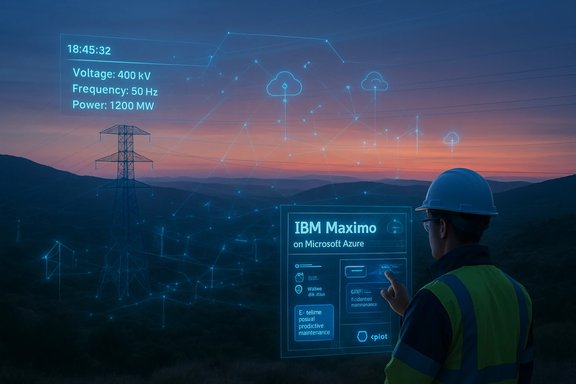
Caleb Northrop lays out a practical vendor view: unify asset records and telemetry into a modern EAM that runs in the cloud, combine it with embedded AI and analytics, and expose the intelligence to field crews through conversational and low‑code interfaces. Specifically, IBM positions Maximo Application Suite on Azure as the operational backbone that can ingest telemetry (via Azure IoT Edge, IoT Hub and Digital Twins), run analytics and AI with watsonx.ai, and optionally extend the user experience with Microsoft Copilot for conversational, hands‑free workflows. The claimed payoff is predictable maintenance, faster fault detection, improved crew scheduling and a unified view across renewables and traditional assets.Why an EAM + Cloud + AI architecture makes practical sense
A single pane for diverse assets
Energy companies run both conventional generation (gas, coal, nuclear) and rapidly expanding distributed renewables (wind, solar, battery storage, EVs). A modern EAM aims to provide a single source of truth that ties asset registers, maintenance histories, schematics, spare parts inventories and condition monitoring into one integrated model. MAS is designed to centralise that data and connect to external systems so operators can see equipment state and historical context in one place. That single‑pane capability matters for coordinated restoration, investigation and lifecycle decisions.Real‑time telemetry and digital twins
Collecting high‑fidelity telemetry — synchronized, time‑aligned, and persistent — is the foundation of any predictive capability. Azure services such as IoT Hub, IoT Edge and Azure Digital Twins provide standard, supported ways to ingest device telemetry at scale, perform edge preprocessing for latency‑sensitive logic, and build graph models of facilities for simulation. When these feeds are aligned into MAS, operators gain digital twins that let them run scenario analyses, detect anomalies and trigger work orders automatically. This is exactly the plumbing that can prevent the “we couldn’t see what happened” problem highlighted by the Iberian probe — but only if the telemetry and timestamp discipline are in place.Embedded AI: watsonx and evidence‑anchored assistants
IBM’s AI stack (watsonx) supplies the LLM‑based and machine‑learning services that MAS can use for conversational assistants, retrieval‑augmented generation (RAG), predictive models and automated job‑plan generation. Practical capabilities include:- Natural‑language queries for technicians (plain‑language access to work orders and sensor trends).
- Automated triage and prioritisation of work orders using historical failure patterns.
- Generative job‑plan creation that prepopulates steps and spare parts from manuals and previous repairs.
The technical anatomy: how MAS on Azure typically fits together
Core layers and data flows
- Data ingestion and edge preprocessing
- Devices and substations connect via Azure IoT Edge gateways; IoT Hub aggregates inbound telemetry.
- Edge nodes perform filtering, local ML inference for deterministic alarms and temporary buffering during outages.
- Canonical storage and digital twins
- Azure Data Lake or comparable stores keep raw telemetry; Azure Digital Twins model the physical system as an entity graph.
- MAS consumes normalized, time‑aligned telemetry for APM (asset performance management) models and historical analysis.
- Analytics and AI
- IBM watsonx (or Maximo AI Service) runs supervised ML and LLM‑based assistants; RAG pipelines ground generative outputs in asset records and telemetry.
- Model routing and governance determine whether a request is handled by a local model, watsonx, or a Copilot‑style runtime.
- Presentation, workflow and field UX
- Maximo Manage provides work‑order lifecycle workflows; dashboards and widgets display KPIs.
- Optional Copilot or Watsonx assistants give chat/voice interactions for hands‑free work logging and approvals.
Why the hybrid edge+cloud split matters
Not every function belongs in the cloud. Protection relays and primary safety interlocks must remain local (millisecond determination), while deeper analytics and trend detection — which can tolerate seconds to minutes of latency — can run in cloud. Real deployments therefore segregate deterministic OT functions to the edge and reserve the cloud for orchestration, long‑term model training and cross‑site correlation. This hybrid approach reduces risk and provides operational continuity during transient network outages.What MAS + Azure + watsonx actually delivers — and what it doesn’t
Real, measurable strengths
- Unified asset context: MAS centralises lifecycles, work orders and spare parts, reducing duplicate or conflicting records.
- Faster incident triage: With time‑synchronised telemetry and analytics, engineers can spot anomalous envelopes earlier and schedule condition‑based maintenance.
- Democratised analytics: AI assistants enable front‑line staff to query data without SQL or analytics expertise.
- Edge resilience: IoT Edge pre‑processing keeps basic monitoring and alarms local — improving uptime during connectivity loss.
- Operational extensibility: Prebuilt integrations (IBM and Microsoft documentation, GitHub examples) reduce the engineering lift required to connect Maximo to Azure services.
Important limitations and realistic caveats
- Instrumentation is the gating factor. Analytics cannot provide what sensors do not measure. Investigations into the Iberian blackout repeatedly emphasised missing or low‑quality telemetry as a key impediment to both prevention and forensic reconstruction. Investing in PMUs, consistent historian configuration and timestamp accuracy (IEEE‑1588/GNSS) is non‑negotiable.
- Latency and control separation. Cloud inference is unsuitable for millisecond protection logic. If architectural boundaries are not enforced, cloud‑centric systems can create dangerous expectations about the systems they can safely influence.
- Data governance and auditability. Generative outputs must be grounded in verifiable sources; every AI recommendation that could influence operations requires provenance, confidence scores and an immutable audit trail. Without these, liability and regulatory exposure rise sharply.
- Cybersecurity and OT segmentation. Connecting MAS to OT stacks expands attack surfaces. Zero‑trust segmentation, hardened gateways and rigorous IAM must be in place before any cloud‑facing agent accesses critical OT data.
- Vendor lock‑in and portability risk. Packaging capabilities across IBM watsonx, Maximo and Azure Copilot simplifies deployment but can increase long‑term dependency on a specific vendor stack; procurement must explicitly preserve exportability and data ownership.
Implementation checklist for energy leaders — a pragmatic roadmap
Phase A — Instrumentation and data hygiene (0–6 months)
- Ensure PMUs, SCADA historians and all telemetry sources have consistent, high‑precision timestamps.
- Audit telemetry retention policies and ensure raw telemetry is persisted for forensic needs.
- Replace or retrofit sensors where data quality is below threshold (calibration, sampling rate, noise floor).
Phase B — Pilot (6–12 weeks)
- Select a narrow, high‑value use case (one substation, a wind farm string, or a single plant turbine).
- Validate ingestion: connect IoT Edge → IoT Hub → Digital Twin → MAS flow and confirm latency/throughput.
- Build a minimal AI assistant for a single workflow (e.g., automated job‑plan creation from a failure log) and measure accuracy.
Phase C — Scale and governance (3–12 months)
- Codify governance: model versioning, provenance, SLAs, and human‑in‑the‑loop gates.
- Harden security: segmented OT/IT networks, signed identities for gateways, key rotation and incident playbooks.
- Institute MLOps: scheduled retraining, drift detection, red‑teaming and third‑party verification for critical models.
Procurement and contract essentials
- Require evidence‑anchored AI outputs: every generative recommendation must cite source telemetry and document references.
- Insist on raw data access and export rights to preserve forensic sovereignty.
- Define liability clauses and SLOs for model performance and availability.
- Budget ongoing operational costs: model retraining, data storage, edge maintenance and periodic security validation.
Risks that demand executive attention
Hallucination and misplaced trust
LLMs and generative assistants can produce plausible but incorrect recommendations. In safety‑critical energy workflows this risk is acute: a misinterpreted diagnosis could cause unnecessary or unsafe interventions. The mitigation is strict grounding (RAG), human‑in‑the‑loop confirmation for any action above a defined risk tier and transparent confidence metadata attached to every recommendation.Operational complexity and hidden project cost
MAS migrations often mean decades of legacy records must be normalised, integrated and validated. Underestimate the work of taxonomy alignment, historian ingestion and ERP/GIS integration at your peril — poorly planned migrations can disrupt maintenance operations and create data regressions. Use staged migration and robust testing.Security exposures in hybrid environments
The moment OT systems are connected to cloud services, the operator inherits new threat vectors. Attackers target poorly patched edge gateways, weak authentication or misconfigured APIs. Mitigation must be architectural: zero‑trust network segmentation, hardware root‑of‑trust for gateways, and continuous vulnerability scanning.Two concrete examples of what success looks like
- A regional utility pilots MAS on Azure for a set of high‑value transformers. After synchronising PMU data and applying APM models, the utility reduced unplanned downtime by measurable margins and shortened restoration windows during a severe weather event. The ability to reconstruct the event from time‑aligned telemetry also dramatically simplified regulatory reporting.
- A wind‑farm operator uses watsonx‑powered assistants to automate work order creation from SCADA alarms and inspection imagery. Field crews create and approve work orders hands‑free using Copilot voice commands, increasing first‑time‑fix rates and improving parts availability.
Practical vendor questions to insist upon during procurement
- Which model versions are you using (for example, watsonx model identifiers or Foundry model names), and how are updates governed?
- Will the vendor provide evidence‑anchored outputs with immutable audit logs? How are confidence scores presented?
- Which decisioning functions run on the edge versus the cloud? Provide a mapping of actions by latency and risk tier.
- What is the retention policy for raw telemetry, and who can export it in a forensic investigation?
- Provide independent customer references and measurable pilot KPIs (not just marketing percentages). Demand proof: before/after metrics, sample incident reconstructions and SLA definitions.
Conclusion — realistic optimism, not magic
The convergence of EAM, edge telemetry, digital twins and enterprise AI offers a credible technical path for energy operators to move from reactive maintenance to predictive, intelligent operations. IBM Maximo Application Suite on Azure, combined with watsonx and optional Copilot capabilities, provides many of the technical building blocks vendors promise: centralised asset records, time‑synchronised telemetry ingestion, AI‑assisted decision support, and conversational field interfaces. Public documentation, reference architectures and example integrations confirm that these components can be integrated in real projects. Yet the Iberian blackout provides a cautionary frame: technology alone does not substitute for instrumentation, disciplined integration and governance. Without precise sensors, synchronized time bases and rigorous security and audit controls, even the most sophisticated analytics will be of limited use. Utilities that treat MAS + Azure + watsonx as a program — starting with instrumentation, validating pilots, and hardening governance — can expect concrete gains in uptime, restoration speed and forensic capability. Those who treat it as a simple product swap risk adding complexity without improving resilience. The energy transition and the rise of distributed, inverter‑rich generation will complicate grid dynamics, but it also creates a rare opportunity: invest in data discipline now, and AI‑assisted EAM can become the practical backbone for a more resilient, lower‑carbon grid. The roadmap is straightforward, if rigorous: measure what matters, build auditable AI, enforce OT/IT boundaries, and scale only after independent verification. The companies that follow this path will find that predictive, intelligent operations are not a vendor catchphrase — they are operational reality.Source: Technology Record Energising operations: Caleb Northrop reveals how IBM helps energy firms move to predictive, intelligent operations
