

The Internet Computer’s 2025 sprint — anchored by the AI-focused Caffeine toolkit, the Chain Fusion cross‑chain architecture, and a raft of subnet and security upgrades — has reset the debate about whether an L1 can be both an enterprise-grade cloud and a true Web3 stack. Proponents point to rapid institutional interest, new on‑chain AI capabilities and growing tokenized BTC activity as evidence that ICP (Internet Computer Protocol) is moving from experimental architecture to production infrastructure. Skeptics point to sharply divergent telemetry — wildly different TVL figures, mixed dApp engagement, and heavy price volatility — and warn that narrative-driven flows can outpace real, sustainable user adoption. This feature unpacks the claims, verifies the technical advances, cross‑checks the most consequential numbers against independent trackers, and lays out practical implications for developers, enterprises and investors.
The Internet Computer (ICP) aims to host full web applications — front end, APIs, storage and compute — entirely on‑chain. In 2025 the project doubled down on two themes: (1) lowering developer friction with AI tooling that generates canisters and front‑ends, and (2) expanding interoperability so canisters can hold and operate assets across other chains without trusting centralized bridges.
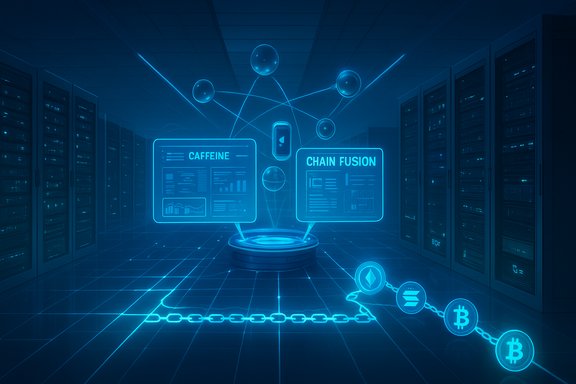
Key product names now core to the ICP narrative are Caffeine (an AI‑assisted, low‑code/no‑code development platform) and Chain Fusion (the chain‑key based cross‑chain protocol). Complementary milestones — marketed under names such as Flux, Magnetosphere, Fission and others in the 2025 roadmap — promise higher subnet capacity, TEE‑backed node protections, and AI worker nodes for on‑chain inference. These technical milestones are detailed in official ICP materials and the DFINITY roadmap postings.
For investors: ICP is a high‑risk, high‑reward infrastructure play. The technical roadmap and early institutional experiments justify a measured allocation for those who understand the product risks and tokenomics. But the headline numbers driving some market narratives are not yet supported by neutral, independent trackers and should be treated with caution.
The Internet Computer may indeed be reshaping a corner of decentralized infrastructure — particularly around on‑chain AI and bridgeless cross‑chain services — but the market will judge its lasting success on verified usage, clear monetization of compute, and an ability to convert enterprise pilots into sustainable, user‑facing adoption. Until that verification arrives in canonical dashboards and neutral trackers align with narrative claims, the smart approach is to separate the credible technical advances from the hype‑driven statistics and allocate capital and engineering effort accordingly.
Source: Bitget ICP Network's Swift Expansion: Could It Revolutionize Decentralized Infrastructure? | Bitget News
 Background / Overview
The Internet Computer (ICP) aims to host full web applications — front end, APIs, storage and compute — entirely on‑chain. In 2025 the project doubled down on two themes: (1) lowering developer friction with AI tooling that generates canisters and front‑ends, and (2) expanding interoperability so canisters can hold and operate assets across other chains without trusting centralized bridges.Key product names now core to the ICP narrative are Caffeine (an AI‑assisted, low‑code/no‑code development platform) and Chain Fusion (the chain‑key based cross‑chain protocol). Complementary milestones — marketed under names such as Flux, Magnetosphere, Fission and others in the 2025 roadmap — promise higher subnet capacity, TEE‑backed node protections, and AI worker nodes for on‑chain inference. These technical milestones are detailed in official ICP materials and the DFINITY roadmap postings.
What’s new technically (and why it matters)
Caffeine: AI + canisters
- What it claims to do: Caffeine is presented as an “AI‑first” developer stack that can accept natural language prompts, images and examples, then scaffold Motoko/Canister code, wire up front‑ends and deploy on‑chain canisters with minimal manual coding. Publicized demos and launch coverage put the event for the broader Caffeine debut in mid‑July 2025.
- Why it’s important: If robust, Caffeine addresses a persistent adoption barrier — the steep learning curve of canister development and canister lifecycle management. Lowering that barrier could accelerate the quantity of apps on ICP, but quantity alone does not guarantee retention, secure code, or monetized usage.
- Technical caveats: Generated smart‑contract code is not inherently safe. Automatic generation requires mandatory audit pipelines, static analysis, and CI gates; otherwise, subtle vulnerabilities will surface in production canisters. The DFINITY roadmap and community commentary explicitly call out the need for verification and secure CI/CD integrations as Caffeine moves out of alpha.
Chain Fusion: bridgeless interoperability
- What it claims to do: Chain Fusion uses ICP’s chain‑key cryptography so canisters can sign transactions and interact bi‑directionally with other blockchains (Ethereum, Solana, Bitcoin‑style ledgers), enabling “chain‑key tokens” such as ckBTC, ckETH and other wrapped native assets that are governed by canisters rather than centralized bridge contracts. Official developer documentation describes Chain Fusion as enabling trustless reads/writes across chains with native signing capabilities.
- Why it’s important: If Chain Fusion works as designed, it removes a large class of bridge risk by placing cross‑chain controls inside ICP canisters and the chain‑key signature model. That can support higher‑security tokenized BTC flows and more seamless UX for multichain DEXs and cross‑chain DeFi primitives.
- Limits to watch: Cross‑chain liveness and finality assumptions differ across blockchains. Bi‑directional operations still require careful design so that atomicity and reorg risk are handled correctly. Chain Fusion reduces trusted middlemen but does not eliminate consensus and economic attack surfaces of the underlying chains.
Flux, Magnetosphere, Ignition and the subnet story
- What’s been announced: The 2025 roadmap groups several capacity and security milestones — Flux (subnet scheduling and canister migration), Magnetosphere (TEEs for node integrity and verifiable API logs), and Ignition/Fission (AI worker nodes and practical subnet split/scale mechanics). According to DFINITY‑published roadmap materials these are designed to increase computational throughput, reduce canister migration friction and enable AI worker specialization.
- Claimed performance numbers: Public summaries circulating in press pieces state doubled subnet storage to 2 TiB and a ~50% boost in computational resources for application subnets. Those architectural targets appear in roadmap summaries and developer updates; they should be regarded as roadmap goals until telemetry from the running network proves sustained throughput improvements.
Adoption and on‑chain metrics — what’s solid and what’s not
The most attention‑grabbing numbers in late‑2025 coverage fall into two camps: (A) claims of explosive adoption and institutional inflows, and (B) independent tracker numbers that paint a far more measured picture.- The bullish narrative (as reported by exchange and crypto media pieces) credits Caffeine, Chain Fusion and enterprise pilots with producing 1.2 million active wallets and daily transactional volumes in the hundreds of millions to billions (figures such as $1.14B per day have been widely repeated). These claims appear across industry writeups and aggregator sites.
- Independent on‑chain trackers tell a different story on TVL: DeFiLlama and CoinGecko show ICP’s Total Value Locked in the tens of millions of dollars — not hundreds of billions. At the time of verification, DeFiLlama lists ICP TVL in the range of roughly $14–30 million, and CoinGecko’s chain page reports TVL in the same small‑to‑mid‑millions range. Those discrepancies are too large to be a simple reporting variance; they indicate a major reporting error or differing definitions in the bullish coverage.
- Reconciling the gap: The DFINITY/Foundation or some analytic vendors may report different TVL definitions (for example, counting off‑chain custody, tokenized positions, or enterprise assets not yet reflected on public DeFi trackers). That’s why independent verification matters — and the $237 billion TVL figure that appeared in some accounts is not corroborated by DeFiLlama or CoinGecko and should be treated as unverified or erroneous unless neutral trackers update their data.
- Active wallet figure (1.2M): This number is widely quoted in secondary coverage and in the Bitget analysis, but it lacks a clear canonical source using a standard analytics definition (funded vs. unfunded wallets, unique human users vs. address reuse). Independent analytics dashboards such as Nansen or Dune would be appropriate corroborators; as of this review, a straightforward, single‑source verification of 1.2 million unique human users is not available. Treat the 1.2M figure as directional but not definitively validated.
- dApp engagement drop: Reports that dApp usage declined ~22.4% while speculative trading rose sharply are plausible as short‑term behavioral signals, but the precise percentage changes have not been reproduced across independent dashboards in publicly accessible form, and should be considered claims requiring further telemetry access to confirm.
Cross‑checking the big claims (two independent sources)
- TVL: Bitget/AInvest reported an outsized figure (reported as high as $237 billion). Independent trackers DeFiLlama and CoinGecko show TVL in the $10–30 million range for ICP — a difference of four to seven orders of magnitude. Independent trackers are consistent with each other and diverge sharply from the large figure; the latter appears to be a reporting error or an apples‑to‑oranges aggregation. Use DeFiLlama and CoinGecko as neutral counters to the large TVL claim.
- Caffeine launch and capability: CoinDesk and other independent outlets reported the public Caffeine launch in mid‑July 2025 and documented demonstrations and market reactions. DFINITY/Internet Computer roadmap materials and developer docs outline the Caffeine design goals and the Chain Fusion feature set. Those two classes of sources — independent crypto press and the project’s own technical docs — corroborate the existence and intent of Caffeine and Chain Fusion even while questions remain about real‑world durability and security practices.
- ckBTC adoption: CoinDesk coverage and Internet Computer documentation both show a meaningful increase in tokenized BTC activity (ckBTC) on ICP in mid‑2025. While the raw number of ckBTC units and custody flow details differ between sources, multiple independent outlets note increased ckBTC supply as part of the 2025 narrative. This is a verifiable, load‑bearing trend that helps explain institutional interest in tokenized BTC rails on ICP.
Institutional adoption: partnerships, pilots and claims
Several late‑2025 reports emphasize ties between ICP/DFINITY and major cloud vendors (Microsoft Azure, Google Cloud) and highlight institutional pilots — including mentions of UN projects and institutional funds participating via ICP’s governance programs.- What’s documented: DFINITY’s roadmap, partner‑facing materials and ecosystem outreach describe hybrid cloud deployment models and integration patterns with traditional cloud stacks; they also emphasize enterprise pilots and regulated sector use cases. Chain Fusion and chain‑key tokens are positioned as the bridge between enterprise asset tokenization and on‑chain execution.
- Partnership claims vs. formal corporate press: Some coverage frames Azure (and occasionally Google Cloud) relationships as “partnerships.” That language can mean anything from technical integration pilots, to expectational roadmap alignment, to formal channel partnerships. At the time of writing, a formal global Microsoft press release explicitly announcing a strategic multi‑year Azure partnership with ICP is not present in major Microsoft channels; press accounts suggest roadmap signals and pilot expectations rather than a classic vendor‑level partnership announcement. That nuance matters for assessing enterprise validation. Treat “Azure involvement” as an important commercial signal that may be pilot or integration work, not definitive proof of a broad managed‑service partnership.
- Institutional pilots and the Neuron Fund: ICP’s governance and staking ecosystems — notably the Neuron Fund and the Network Nervous System (NNS) — have been used to channel institutional capital and incubate dApps. These mechanisms increase the plausibility of institutional activity, but they concentrate tokens and voting power in ways that can influence network economics and narrative momentum.
Practical use cases emerging in 2025
- Tokenized Bitcoin (ckBTC): Chain‑key tokens enable canisters to hold tokenized BTC (ckBTC), improving throughput and programmability for BTC‑backed DeFi products. Multiple trackers and press pieces documented an uptick in ckBTC issuance and flows in mid‑2025.
- On‑chain AI services and inference: Caffeine + Ignition/AI worker nodes are designed to allow canisters to host AI inference or provide model‑as‑a‑service with verifiable inputs and outputs. This can unlock transparent model serving, auditability and new privacy/policy patterns for enterprise inference. The roadmap explicitly describes AI worker nodes and orthogonal persistence as foundational to the Self‑Writing Internet vision.
- IoT and industrial telemetry: Projects described in press coverage (for example, IoT‑focused pilots) use on‑chain compute for provenance, automated audits and device identity. These are natural matches for ICP’s on‑chain storage and service‑level programmability, though they raise cost and latency considerations for high‑frequency edge telemetry.
Competitive positioning: ICP vs. Ethereum and Solana
- Differentiators: ICP sells a unique combination — on‑chain front ends + programmatic canisters + a reverse gas model that decouples end‑user meta from transaction economics. The ability to host full web apps (including front‑ends) on‑chain and to run on‑chain AI inference are core technical differentiators from canonical L1s. Chain Fusion’s bridgeless design also distinguishes ICP from bridge‑heavy cross‑chain approaches.
- Where Ethereum/Solana remain strong: Ethereum still dominates DeFi liquidity, developer mindshare and the composability network effect. Solana retains high throughput and growing institutional instrumentization (futures, ETFs). ICP’s on‑chain compute model is more akin to a Web‑scale serverless paradigm; it competes on a different axis (full stack on‑chain, enterprise hybrid scenarios) rather than a pure gas/DeFi primitives race.
- Practical competitive tradeoffs:
- Ethereum: unmatched liquidity, mature tooling, but higher fees and externally hosted front ends.
- Solana: high throughput and low latency, but different security and decentralization tradeoffs.
- ICP: powerful on‑chain UX, novel cross‑chain strategy and on‑chain AI — but it is still proving consumer retention and DeFi liquidity at scale.
Risks and unresolved technical/tokenomic questions
- Data transparency and measurement risk
- The dramatic discrepancy in TVL reporting demonstrates how narrative amplification can outpace independent verification. Where possible, rely on neutral trackers (DeFiLlama, CoinGecko, Nansen, Dune) and be skeptical of single‑outlet megaphone figures.
- Generated‑code security risk
- Auto‑generated canisters must be integrated into hardened audit pipelines. Without that, Caffeine could accelerate the rate at which insecure smart contracts reach production.
- Compute economics and burn sink dependence
- ICP’s model uses Cycles (generated by burning ICP) for execution. The deflationary angle depends on sustained monetized compute demand; if usage falls, the burn sink weakens and price becomes more speculative.
- Centralization tensions
- Dependence on hyperscaler integrations or private cloud on‑ramps can boost enterprise adoption but complicate the decentralization narrative. Hybrid deployments bring benefits and tradeoffs (governance, telemetry, vendor lock‑in concerns).
- Regulatory and AI policy uncertainty
- On‑chain AI features raise novel questions about model governance, data privacy, and cross‑border data flows. Changes in AI regulation could materially affect on‑chain inference use cases.
- Token concentration and market volatility
- Reported price swings (several articles cite large single‑day drops and year‑over‑year declines) underscore the sensitivity of token markets to narrative cycles. Token concentration among early holders and institutional pools can amplify systemic risk.
Investment lens: measured optimism with clear caveats
ICP presents a classic high‑beta infrastructure bet:- Upside drivers:
- Realization of on‑chain AI (Caffeine + AI workers) leading to predictable compute demand.
- Chain Fusion delivering secure, practical cross‑chain assetization at scale (ckBTC et al..
- Institutional pilots (hybrid cloud integrations) creating revenue and custody flows.
- Downside drivers:
- Failure to convert generated app volume into sustained, monetized usage.
- Regulatory rulings that classify token features in restrictive ways.
- Narrative‑driven price inflation followed by mean reversion when neutral trackers and on‑chain metrics lag.
- Size positions to reflect an infrastructure, not a consumer‑app, thesis: smaller, staged allocations are prudent while infra features prove out.
- Use neutral on‑chain trackers to validate adoption claims before scaling exposure. DeFiLlama and CoinGecko are immediate reference points for TVL and DeFi liquidity.
- Monitor developer retention and retention metrics (daily active canisters, recurring revenue per canister) rather than headline wallet counts alone.
- If investing via tokens, hedge for regulatory risk and token concentration by diversifying across custody solutions and protocols building on IPC’s primitives.
What ICP needs to do next to convert interest into durable value
- Ship verifiable telemetry: Publish canonical definitions and dashboards for “active wallets,” “canister invocations,” “TVL” (with methodology). Transparency closes the gap between marketing claims and neutral verification.
- Harden Caffeine workflows: Integrate automatic audits, formal verification toolchains and permissioned staging environments so generated code meets enterprise security standards.
- Productize killer consumer apps: Institutional pilots are valuable; mass adoption needs a few consumer‑facing killer apps that convert visitors into daily users and recurring revenue.
- Continue controlled hybrid patterns: Document clear patterns for when hyperscaler integrations are used strictly for underlay/performance vs. when they create centralization that undermines decentralization claims.
Bottom line
ICP’s 2025 product cadence is meaningful: Caffeine and Chain Fusion are not marketing fluff — they are real technical pushes toward lower‑friction on‑chain development and bridgeless interoperability, and they are backed by detailed roadmap documentation. Independent coverage from the crypto press documented Caffeine’s public debut and Chain Fusion’s design, while DFINITY’s own roadmap maps out Flux/Magnetosphere and AI worker milestones. However, the most consequential claims in that bullish narrative — especially the headline TVL numbers and precise active‑wallet counts — diverge sharply from neutral on‑chain trackers. DeFiLlama and CoinGecko show TVL in the millions, not hundreds of billions, and independent verification of the “1.2M active human users” claim is lacking. These mismatches matter because they distinguish speculative narrative from substantiated network utility. For enterprises and developers: ICP offers compelling primitives for hosting full‑stack apps on‑chain and experimenting with auditable, on‑chain AI. Those capabilities are worth pilot programs — but pilots should include rigorous security audits, cost modeling for on‑chain inference, and explicit runbooks that map hybrid cloud responsibilities.For investors: ICP is a high‑risk, high‑reward infrastructure play. The technical roadmap and early institutional experiments justify a measured allocation for those who understand the product risks and tokenomics. But the headline numbers driving some market narratives are not yet supported by neutral, independent trackers and should be treated with caution.
The Internet Computer may indeed be reshaping a corner of decentralized infrastructure — particularly around on‑chain AI and bridgeless cross‑chain services — but the market will judge its lasting success on verified usage, clear monetization of compute, and an ability to convert enterprise pilots into sustainable, user‑facing adoption. Until that verification arrives in canonical dashboards and neutral trackers align with narrative claims, the smart approach is to separate the credible technical advances from the hype‑driven statistics and allocate capital and engineering effort accordingly.
Source: Bitget ICP Network's Swift Expansion: Could It Revolutionize Decentralized Infrastructure? | Bitget News
