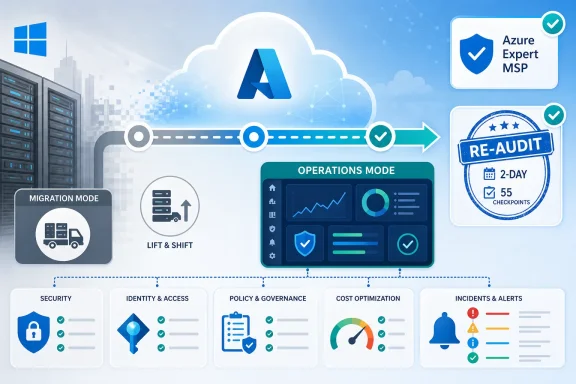
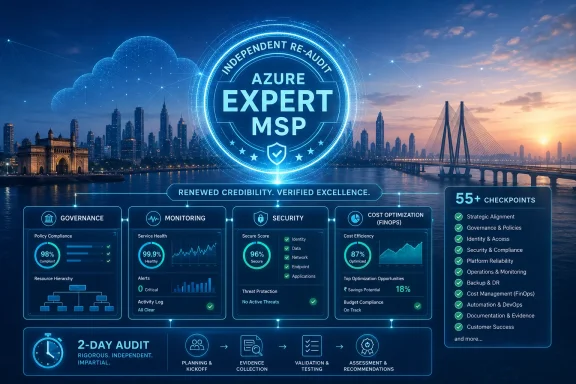
IFI Techsolutions Limited, a Mumbai-based Microsoft cloud partner, said on July 1, 2026, that it has renewed its Microsoft Azure Expert Managed Services Provider status for the fourth consecutive year after first earning the designation in 2023. The announcement is not a product launch, but it matters because partner badges are increasingly how Microsoft’s cloud ecosystem signals trust, scale, and operational maturity. For customers buying Azure services, the renewal says less about marketing polish than about repeatable delivery under audit pressure. For Microsoft, it shows how the Azure channel is becoming a governed supply chain rather than a loose federation of consultants.
The phrase Azure Expert MSP can sound like another partner-program trophy, the kind of logo that accumulates at the bottom of corporate websites until nobody knows what any of them mean. But Microsoft’s top Azure managed-services tier is designed to be harder to obtain than a standard competency badge. Partners must meet qualification requirements, submit evidence, and pass an audit before they can hold the status.
IFI Techsolutions says its latest renewal followed a two-day independent third-party re-audit covering more than 55 criteria. Those criteria reportedly spanned technical delivery, service operations, governance, and customer outcomes. That combination is important: Microsoft is not merely asking whether a partner can deploy Azure resources, but whether it can run customer environments with the discipline expected of an enterprise operator.
That distinction matters because managed cloud has moved well beyond virtual machines, migration scripts, and support tickets. Azure estates now include identity, networking, endpoint security, data platforms, AI services, cost governance, compliance boundaries, and hybrid dependencies. A provider that cannot prove process maturity may still be able to complete projects, but it becomes a risk once it is responsible for live operations.
The fourth-year renewal also gives the announcement a different weight than a first-time award. A first badge can reflect a concentrated certification push. A renewal streak implies the company has continued to meet Microsoft’s evolving expectations while maintaining customer evidence and operational controls.
That shift reflects Microsoft’s own commercial reality. Azure growth depends not only on hyperscale infrastructure but on a partner class that can move complicated customers onto the platform and keep them there. If a cloud migration fails, overruns budgets, or creates security exposure, the customer may blame the partner first — but the platform’s reputation takes the hit too.
The audit requirement is Microsoft’s answer to that problem. It creates a layer of quality control between Microsoft’s platform ambition and the messy reality of enterprise IT. In theory, the badge lets customers reduce vendor-screening friction by identifying firms that have already been tested against Microsoft’s expectations.
In practice, it also turns partner status into a recurring operational burden. A company cannot simply win the designation and coast. Microsoft’s renewal window and audit process mean the partner must maintain the machinery behind the badge: certified staff, support models, customer references, governance practices, documented procedures, and demonstrable Azure delivery.
For IT buyers, that is the useful part. A badge is never a substitute for due diligence, but a badge that can be lost is more meaningful than one that simply commemorates past sales.
The company’s own positioning leans heavily into that story. IFI describes itself as a Microsoft-focused cloud solutions and managed-services provider, with advanced Azure specializations and a growing international footprint. Founder Ankur Garg has framed the renewal as evidence of enterprise-grade delivery and pointed to revenue growth of 2.5 times since the company first achieved the status.
That growth claim should be read as company-reported, not independently audited public-market data. But the direction is plausible because Azure managed services are no longer confined to local infrastructure support. Customers in multiple regions now look for partners that can modernize applications, manage cloud spend, operate security controls, and support Microsoft 365, Dynamics, data, and AI workloads together.
This is where the India angle becomes more than geography. Providers based in India can combine Microsoft certifications, engineering depth, and global delivery models in a way that appeals to midmarket and enterprise customers trying to stretch cloud budgets. The competitive question is whether those providers can also demonstrate governance and accountability at the level required by regulated or mission-critical customers.
Azure Expert MSP renewal is designed to answer that question, at least partially. It does not prove perfection. It does show that IFI has repeatedly passed through a process Microsoft reserves for its more capable Azure managed-service partners.
That makes governance central. A cloud environment can be technically functional and still be poorly governed. Subscriptions sprawl, privileges accumulate, backups go untested, policies drift, costs rise quietly, and nobody notices until a budget review or incident response meeting turns into a forensic exercise.
The better MSP pitch is not “we know Azure.” Many firms know Azure. The stronger pitch is “we can repeatedly manage Azure under documented controls, across customers, with evidence that our process survives scrutiny.”
That is why the re-audit matters more than the congratulatory quote. A two-day audit cannot reveal everything about a provider, but it forces the provider to expose its operating model. It asks whether the company can show how it handles customer outcomes, service delivery, governance, and technical operations in a way that is repeatable rather than heroic.
For WindowsForum readers, this is the practical lens. If your organization is choosing an Azure partner, certifications and badges should be treated as filters, not final answers. The next layer is still customer references, contractual service levels, security posture, incident response maturity, escalation paths, and visibility into costs.
This is especially true in hybrid Windows environments. Many organizations still run Active Directory, Windows Server workloads, SQL Server, file services, endpoint management, and legacy line-of-business apps alongside Azure services. The migration path is rarely a clean jump from old to new; it is usually a long overlap where cloud and on-premises systems must coexist.
That overlap creates room for managed-service providers with Microsoft depth. They can translate between the language of traditional Windows administration and the newer patterns of Azure governance, policy, infrastructure as code, and cloud-native monitoring. The best partners do not merely migrate workloads; they help customers decide which workloads should move, which should modernize, and which should stay put.
The danger is that the MSP market can also blur accountability. When multiple vendors touch identity, endpoints, cloud infrastructure, applications, and security tooling, failure modes become harder to assign. A customer might have Microsoft, an MSP, a security provider, an app vendor, and internal IT all involved in the same incident.
That is why audit-backed managed services are valuable but not magical. They create a baseline of trust, but customers still need clear responsibility maps. In cloud operations, ambiguity is expensive.
Azure Expert MSP partners help Microsoft scale that last mile. They generate consumption, support migrations, reduce churn, and make Azure feel less intimidating to customers that lack deep cloud teams. In return, Microsoft offers recognition, referral advantages, co-sell alignment, and ecosystem credibility.
This relationship is not charity. Microsoft’s partner program is also a control system. By deciding which partners receive elite status, Microsoft shapes customer perception and channels demand toward providers that align with its platform strategy.
That creates incentives for partners to specialize deeply in Microsoft’s stack. IFI’s public positioning emphasizes Microsoft Solutions Partner designations, Azure specializations, Azure Virtual Desktop, migration capabilities, data and AI, modern work, and security. That breadth is attractive to customers who want one Microsoft-centric provider, but it also ties the partner’s growth to Microsoft’s platform direction.
For many customers, that is a feature rather than a flaw. A Microsoft-aligned partner can simplify vendor coordination. But it also means customers should understand whether they are buying neutral cloud advice or Azure-first execution.
That is where MSPs have a new opportunity. The next wave of Azure services will not simply be about moving servers to Microsoft’s cloud. It will be about making enterprise data usable, secure, and governed enough for AI systems to act on it.
The operational stakes are higher. A poorly governed virtual machine might waste money or create a security exposure. A poorly governed AI workflow can expose sensitive data, automate bad decisions, or generate compliance headaches at scale. Cloud management and AI governance are becoming inseparable.
IFI’s renewal does not automatically prove that it is a leader in enterprise AI delivery. But an MSP that can maintain Microsoft’s Azure Expert status has at least demonstrated a foundation that customers will increasingly expect before trusting a provider with more advanced workloads. In this market, the ability to operate boring infrastructure well becomes a prerequisite for doing exciting things safely.
Microsoft also benefits from partners that can package AI adoption into managed services. The company wants customers to use Azure AI, data services, Fabric, security tooling, and development platforms together. Partners that can turn those pieces into deployed business systems are central to the next phase of Azure growth.
The most important questions are often contractual and procedural rather than technical. A provider may have excellent engineers but weak reporting. It may have strong migration skills but limited 24/7 operations. It may offer impressive dashboards while hiding the fact that escalation paths depend on a few key individuals.
The Azure Expert MSP program tries to address those risks through evidence and audit, but no external program can fully replace customer-specific diligence. Regulated industries, public-sector customers, and companies with complex hybrid estates still need to test whether the partner’s model fits their own risk profile.
This is particularly true for organizations that have been burned by cloud overspend. Managed services can reduce waste, but they can also introduce another layer of opaque billing if the customer does not insist on clear reporting. A good MSP should make Azure consumption easier to understand, not harder.
The same principle applies to security. Outsourcing operations does not outsource accountability. Customers remain responsible for understanding who has access, what is monitored, how incidents are handled, and whether the provider’s controls align with their own compliance obligations.
IFI Techsolutions’ fourth-year renewal is therefore a modest announcement with larger implications. It shows a regional provider sustaining a global Microsoft credential at a time when Azure customers are demanding more proof from the companies that manage their environments. The cloud market is entering a phase where the winners will not be the firms with the loudest transformation slogans, but the ones that can document their work, survive audits, and keep complex systems boring in production.
That is good news for customers, provided they remain skeptical in the right way. A serious credential should earn attention, not blind trust. As Azure expands further into AI, security, data, and hybrid operations, the partners that matter most will be those that can make Microsoft’s sprawling platform feel less like an ever-growing menu and more like a reliable operating discipline.
 The Badge Is Small, but the Gatekeeping Is the Story
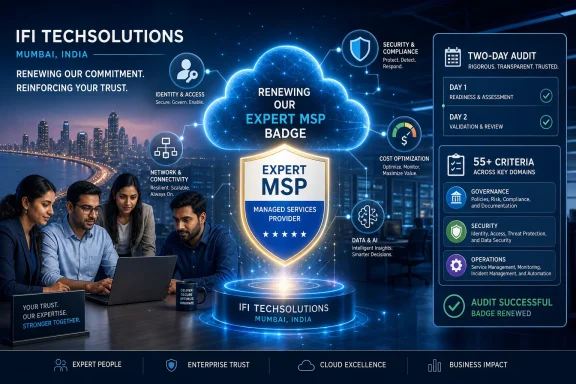
The phrase Azure Expert MSP can sound like another partner-program trophy, the kind of logo that accumulates at the bottom of corporate websites until nobody knows what any of them mean. But Microsoft’s top Azure managed-services tier is designed to be harder to obtain than a standard competency badge. Partners must meet qualification requirements, submit evidence, and pass an audit before they can hold the status.IFI Techsolutions says its latest renewal followed a two-day independent third-party re-audit covering more than 55 criteria. Those criteria reportedly spanned technical delivery, service operations, governance, and customer outcomes. That combination is important: Microsoft is not merely asking whether a partner can deploy Azure resources, but whether it can run customer environments with the discipline expected of an enterprise operator.
That distinction matters because managed cloud has moved well beyond virtual machines, migration scripts, and support tickets. Azure estates now include identity, networking, endpoint security, data platforms, AI services, cost governance, compliance boundaries, and hybrid dependencies. A provider that cannot prove process maturity may still be able to complete projects, but it becomes a risk once it is responsible for live operations.
The fourth-year renewal also gives the announcement a different weight than a first-time award. A first badge can reflect a concentrated certification push. A renewal streak implies the company has continued to meet Microsoft’s evolving expectations while maintaining customer evidence and operational controls.
Microsoft’s Partner Economy Is Becoming an Audit Economy
Microsoft has spent years reshaping its partner ecosystem around measurable outcomes rather than old-style sales recognition. The retirement of the legacy Gold and Silver competency model was not merely a branding exercise; it pushed partners toward designations, specializations, marketplace participation, consumption metrics, and verified technical evidence. Azure Expert MSP sits near the top of that hierarchy because it links business performance to operational proof.That shift reflects Microsoft’s own commercial reality. Azure growth depends not only on hyperscale infrastructure but on a partner class that can move complicated customers onto the platform and keep them there. If a cloud migration fails, overruns budgets, or creates security exposure, the customer may blame the partner first — but the platform’s reputation takes the hit too.
The audit requirement is Microsoft’s answer to that problem. It creates a layer of quality control between Microsoft’s platform ambition and the messy reality of enterprise IT. In theory, the badge lets customers reduce vendor-screening friction by identifying firms that have already been tested against Microsoft’s expectations.
In practice, it also turns partner status into a recurring operational burden. A company cannot simply win the designation and coast. Microsoft’s renewal window and audit process mean the partner must maintain the machinery behind the badge: certified staff, support models, customer references, governance practices, documented procedures, and demonstrable Azure delivery.
For IT buyers, that is the useful part. A badge is never a substitute for due diligence, but a badge that can be lost is more meaningful than one that simply commemorates past sales.
IFI’s Fourth Year Signals a Bigger Cloud Services Race in India
IFI Techsolutions’ renewal lands in a market where Indian cloud service providers are trying to move up the value chain. The country’s IT services sector has long been associated with scale, offshore delivery, and cost optimization. The Azure Expert MSP designation pushes a different message: that an Indian provider can compete in the elite managed-services layer of a global hyperscaler’s ecosystem.The company’s own positioning leans heavily into that story. IFI describes itself as a Microsoft-focused cloud solutions and managed-services provider, with advanced Azure specializations and a growing international footprint. Founder Ankur Garg has framed the renewal as evidence of enterprise-grade delivery and pointed to revenue growth of 2.5 times since the company first achieved the status.
That growth claim should be read as company-reported, not independently audited public-market data. But the direction is plausible because Azure managed services are no longer confined to local infrastructure support. Customers in multiple regions now look for partners that can modernize applications, manage cloud spend, operate security controls, and support Microsoft 365, Dynamics, data, and AI workloads together.
This is where the India angle becomes more than geography. Providers based in India can combine Microsoft certifications, engineering depth, and global delivery models in a way that appeals to midmarket and enterprise customers trying to stretch cloud budgets. The competitive question is whether those providers can also demonstrate governance and accountability at the level required by regulated or mission-critical customers.
Azure Expert MSP renewal is designed to answer that question, at least partially. It does not prove perfection. It does show that IFI has repeatedly passed through a process Microsoft reserves for its more capable Azure managed-service partners.
The Real Product Is Operational Confidence
Customers do not buy an MSP because they enjoy outsourcing complexity. They buy one because Azure has become too broad for many internal IT teams to run alone at the desired speed, security level, and cost profile. The partner is supposed to turn a hyperscale toolbox into something resembling an operating model.That makes governance central. A cloud environment can be technically functional and still be poorly governed. Subscriptions sprawl, privileges accumulate, backups go untested, policies drift, costs rise quietly, and nobody notices until a budget review or incident response meeting turns into a forensic exercise.
The better MSP pitch is not “we know Azure.” Many firms know Azure. The stronger pitch is “we can repeatedly manage Azure under documented controls, across customers, with evidence that our process survives scrutiny.”
That is why the re-audit matters more than the congratulatory quote. A two-day audit cannot reveal everything about a provider, but it forces the provider to expose its operating model. It asks whether the company can show how it handles customer outcomes, service delivery, governance, and technical operations in a way that is repeatable rather than heroic.
For WindowsForum readers, this is the practical lens. If your organization is choosing an Azure partner, certifications and badges should be treated as filters, not final answers. The next layer is still customer references, contractual service levels, security posture, incident response maturity, escalation paths, and visibility into costs.
Azure’s Complexity Has Turned MSPs Into Platform Interpreters
Azure has become a platform where the hardest problems are often not individual technical tasks. Spinning up a virtual machine, configuring a storage account, or deploying an app service is table stakes. The challenge is understanding how identity, networking, compliance, monitoring, backup, application architecture, and business continuity fit together over time.This is especially true in hybrid Windows environments. Many organizations still run Active Directory, Windows Server workloads, SQL Server, file services, endpoint management, and legacy line-of-business apps alongside Azure services. The migration path is rarely a clean jump from old to new; it is usually a long overlap where cloud and on-premises systems must coexist.
That overlap creates room for managed-service providers with Microsoft depth. They can translate between the language of traditional Windows administration and the newer patterns of Azure governance, policy, infrastructure as code, and cloud-native monitoring. The best partners do not merely migrate workloads; they help customers decide which workloads should move, which should modernize, and which should stay put.
The danger is that the MSP market can also blur accountability. When multiple vendors touch identity, endpoints, cloud infrastructure, applications, and security tooling, failure modes become harder to assign. A customer might have Microsoft, an MSP, a security provider, an app vendor, and internal IT all involved in the same incident.
That is why audit-backed managed services are valuable but not magical. They create a baseline of trust, but customers still need clear responsibility maps. In cloud operations, ambiguity is expensive.
Microsoft Benefits When Partners Carry the Last Mile
The renewal also illustrates a strategic truth about Azure: Microsoft cannot win the cloud market by itself. It can build regions, services, management tools, security products, and AI platforms, but enterprise adoption still depends on partners that understand customer environments in unglamorous detail. The last mile is where architecture meets procurement, politics, compliance, budgets, staff skills, and legacy debt.Azure Expert MSP partners help Microsoft scale that last mile. They generate consumption, support migrations, reduce churn, and make Azure feel less intimidating to customers that lack deep cloud teams. In return, Microsoft offers recognition, referral advantages, co-sell alignment, and ecosystem credibility.
This relationship is not charity. Microsoft’s partner program is also a control system. By deciding which partners receive elite status, Microsoft shapes customer perception and channels demand toward providers that align with its platform strategy.
That creates incentives for partners to specialize deeply in Microsoft’s stack. IFI’s public positioning emphasizes Microsoft Solutions Partner designations, Azure specializations, Azure Virtual Desktop, migration capabilities, data and AI, modern work, and security. That breadth is attractive to customers who want one Microsoft-centric provider, but it also ties the partner’s growth to Microsoft’s platform direction.
For many customers, that is a feature rather than a flaw. A Microsoft-aligned partner can simplify vendor coordination. But it also means customers should understand whether they are buying neutral cloud advice or Azure-first execution.
The AI Boom Raises the Bar for Cloud Operations
The timing of the renewal is notable because Azure’s center of gravity has shifted toward AI workloads, data platforms, and automation. Customers experimenting with copilots, agents, private data retrieval, and model integration often discover that their cloud foundations are not ready. Identity is messy, data is fragmented, governance is incomplete, and cost controls are immature.That is where MSPs have a new opportunity. The next wave of Azure services will not simply be about moving servers to Microsoft’s cloud. It will be about making enterprise data usable, secure, and governed enough for AI systems to act on it.
The operational stakes are higher. A poorly governed virtual machine might waste money or create a security exposure. A poorly governed AI workflow can expose sensitive data, automate bad decisions, or generate compliance headaches at scale. Cloud management and AI governance are becoming inseparable.
IFI’s renewal does not automatically prove that it is a leader in enterprise AI delivery. But an MSP that can maintain Microsoft’s Azure Expert status has at least demonstrated a foundation that customers will increasingly expect before trusting a provider with more advanced workloads. In this market, the ability to operate boring infrastructure well becomes a prerequisite for doing exciting things safely.
Microsoft also benefits from partners that can package AI adoption into managed services. The company wants customers to use Azure AI, data services, Fabric, security tooling, and development platforms together. Partners that can turn those pieces into deployed business systems are central to the next phase of Azure growth.
The Badge Should Prompt Better Questions, Not End Them
For customers evaluating IFI or any Azure Expert MSP, the designation should shorten the vendor list, not close the deal. The strongest buyers will use the badge as a starting point for deeper operational questions. How does the provider handle incidents? How transparent is cost reporting? How are privileged identities controlled? What happens when Microsoft service changes break assumptions?The most important questions are often contractual and procedural rather than technical. A provider may have excellent engineers but weak reporting. It may have strong migration skills but limited 24/7 operations. It may offer impressive dashboards while hiding the fact that escalation paths depend on a few key individuals.
The Azure Expert MSP program tries to address those risks through evidence and audit, but no external program can fully replace customer-specific diligence. Regulated industries, public-sector customers, and companies with complex hybrid estates still need to test whether the partner’s model fits their own risk profile.
This is particularly true for organizations that have been burned by cloud overspend. Managed services can reduce waste, but they can also introduce another layer of opaque billing if the customer does not insist on clear reporting. A good MSP should make Azure consumption easier to understand, not harder.
The same principle applies to security. Outsourcing operations does not outsource accountability. Customers remain responsible for understanding who has access, what is monitored, how incidents are handled, and whether the provider’s controls align with their own compliance obligations.
The Concrete Readout for Azure Buyers
IFI’s fourth consecutive Azure Expert MSP renewal is best understood as a signal of sustained Microsoft-aligned operational maturity, not a blanket guarantee. It gives customers a reason to look closely at the company, and it gives Microsoft another proof point for the partner ecosystem it has been building around Azure.- IFI Techsolutions says it has renewed Microsoft Azure Expert MSP status for the fourth consecutive year after first achieving the designation in 2023.
- The renewal reportedly followed a two-day independent re-audit covering more than 55 criteria across delivery, operations, governance, and customer outcomes.
- Microsoft’s Azure Expert MSP program matters because it requires recurring evidence and audit discipline, not just historical sales performance.
- For customers, the designation should function as a due-diligence accelerator rather than a replacement for reviewing security, cost, support, and contractual details.
- For Microsoft, partners such as IFI help turn Azure from a platform catalog into managed operating environments that customers can actually run.
- The next test for Azure MSPs will be whether they can extend cloud governance into AI, automation, and data modernization without losing control of cost and risk.
Partner Status Is Becoming Cloud Infrastructure
The deeper story here is that partner status has become part of the infrastructure of cloud adoption. Customers do not merely choose Azure regions, SKUs, and management tools; they choose an ecosystem of firms that will interpret, operate, secure, and optimize those choices. Microsoft knows this, which is why its highest partner tiers now look more like audited operating credentials than sales awards.IFI Techsolutions’ fourth-year renewal is therefore a modest announcement with larger implications. It shows a regional provider sustaining a global Microsoft credential at a time when Azure customers are demanding more proof from the companies that manage their environments. The cloud market is entering a phase where the winners will not be the firms with the loudest transformation slogans, but the ones that can document their work, survive audits, and keep complex systems boring in production.
That is good news for customers, provided they remain skeptical in the right way. A serious credential should earn attention, not blind trust. As Azure expands further into AI, security, data, and hybrid operations, the partners that matter most will be those that can make Microsoft’s sprawling platform feel less like an ever-growing menu and more like a reliable operating discipline.
References
- Primary source: Devdiscourse
Published: Wed, 01 Jul 2026 06:42:12 GMT
IFI Techsolutions Sustains Microsoft Azure Expert MSP Status for Fourth Year | Business
IFI Techsolutions has renewed its status as a Microsoft Azure Expert Managed Services Provider for the fourth consecutive year. This reflects the company's ongoing commitment to excellence, with notable growth since initially achieving the accreditation in 2023. The company continues to...www.devdiscourse.com - Related coverage: thecompanycheck.com
Ifi Techsolutions Limited - 2026 Insights
Explore Ifi Techsolutions Limited, a information technology public limited company in Ghaziabad, Uttar Pradesh, India. Est. 2017. FY 2026 financials,...www.thecompanycheck.com - Related coverage: prnewswire.com
IFI Techsolutions wird als Microsoft Azure Expert Managed Service Provider anerkannt
/PRNewswire/ -- IFI Techsolutions, ein führendes Unternehmen im Bereich der digitalen Transformation, gab heute bekannt, dass es von Microsoft als Azure Expert... www.prnewswire.com
- Related coverage: business-standard.com
- Related coverage: fr.benzinga.com
IFI Techsolutions reconnue comme fournisseur de services gérés Microsoft Azure Expert | Benzinga France
IFI Techsolutions reconnue comme fournisseur de services gérés Microsoft Azure Expert | %fr.benzinga.com
- Related coverage: es.benzinga.com
IFI Techsolutions reconocida como proveedor experto de servicios gestionados de Microsoft Azure | Benzinga España
IFI Techsolutions reconocida como proveedor experto de servicios gestionados de Microsoft Azure |es.benzinga.com
- Related coverage: prlog.org
PRLog - IFI Techsolutions Renews Key Microsoft Azure Specializations, Solidifying Advanced Cloud Expertise
PDF documentwww.prlog.org
- Related coverage: insight.com
- Related coverage: ifi.tech