

i-Genie.ai’s acceptance into Microsoft’s invite‑only Pegasus Program is more than a shiny line on a press release — it’s a practical accelerator for a data‑intensive startup that sells to global consumer brands, and it exposes a clear playbook for how hyperscalers are turning enterprise partnerships into commercial and technical leverage. Trevor Sumner, i‑Genie.ai’s CEO, told ERP Today that Pegasus has already unlocked marketplace listing, co‑sell eligibility, Azure consumption benefits and a named Microsoft success manager — a set of levers that, when combined with Azure’s modern AI stack, materially compress time‑to‑insight and go‑to‑market friction for enterprise deployments.
This feature unpacks what those claims mean for ERP insiders, product and data architects, and commercial leaders. I’ll verify the core platform and go‑to‑market capabilities Microsoft makes available to Pegasus participants, cross‑check the technical building blocks Sumner describes (agentic AI, Model Context Protocol, Azure AI Foundry), test the plausibility of the vendor’s performance claims, and map concrete risks and integration choices ERP teams must consider when connecting consumer intelligence to transactional systems.
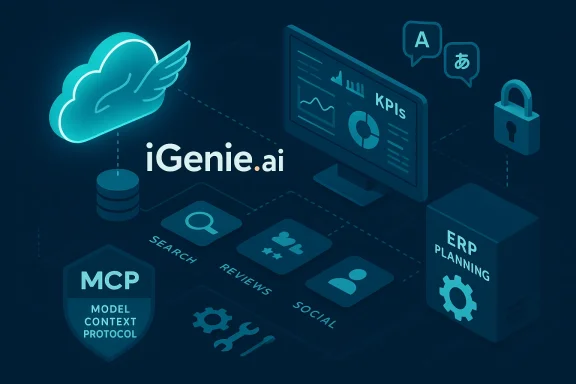
i‑Genie.ai is a consumer‑insights platform that ingests massive passive digital signals — search behavior, social posts, reviews, video and audio — to surface trend forecasts, attribute‑level sentiment and product innovation opportunities. ERP Today reports i‑Genie.ai was accepted into the Microsoft for Startups Pegasus Program and quotes CEO Trevor Sumner describing immediate operational benefits: Azure credits, a dedicated success manager, Azure Marketplace listing, co‑sell eligibility, promotion at major industry events, and access to Microsoft architectural resources and early product previews.
Microsoft’s Pegasus Program is an invite‑only growth track inside Microsoft for Startups that explicitly promises go‑to‑market enablement, technical support (including access to Cloud Solutions Architects), and prioritized paths to co‑selling with Microsoft sales teams. The Pegasus landing page and program materials describe exactly these types of benefits: technical guidance, prioritized Azure product access, and stronger commercial alignment with Microsoft’s enterprise accounts.
Taken together, the package aims to address the two most common scale blockers for AI startups selling to large brands: (1) enterprise readiness and governance for AI at scale, and (2) access to the sales channels and procurement pathways that enterprise accounts require.
Practical takeaway: the Pegasus pathway isn’t just PR. It materially reduces friction where many enterprise pilots die — security/compliance checks, procurement, and the Microsoft field sales funnel.
What that means for a data architect: Presto or an MCP server can act as the live intelligence bus you call from ERP workflows (for demand sensing, promotions simulation, launch forecasting), while governance and access control remain enforceable by standard enterprise controls.
Microsoft’s multilingual AI tooling and Foundry services provide the primitives (translation, speech‑to‑text, multilingual NLU) but the responsibility for dataset curation, taxonomies, and disambiguation lives with the vendor — exactly where i‑Genie.ai claims to invest effort. This is realistic and technically plausible; however, native support across 20+ languages with production‑grade accuracy requires continuous validation and sizable annotation/validation investments.
That said, Sumner’s performance claims — innovation cycles reduced from 12–18 months to 2–3 months and Brand Pulse refreshed monthly vs quarterly — are operational claims that should be treated as vendor performance metrics, not platform guarantees. ERP Today publishes these as Sumner’s statements; independent validation of those exact speedups requires access to customer‑level A/B data or third‑party measurement. Responsible buyers should ask for measurable KPIs tied to launches, SKU velocity, return rates and market share movement before taking headline percentages at face value.
For ERP vendors and systems integrators, this means:
Sumner’s narrative about co‑selling, marketplace enrollment and accelerated model access aligns with Microsoft’s documented partner benefits and the rapid industry adoption of agentic protocols. Those are verifiable infrastructure and go‑to‑market mechanics. The more dramatic outcome claims — precise speedups, dollar results and customer lists — are plausible but vendor‑level assertions that should be validated through contractually agreed KPIs and audited pilots before being treated as enterprise guarantees.
If your organization is evaluating i‑Genie.ai or another Pegasus‑backed consumer insights vendor, treat the Microsoft validation as a significant risk‑reduction signal — but pair it with rigorous measurement, security gating and contractual rights to ensure the promise of real‑time, AI‑native consumer intelligence becomes measurable business value inside your ERP and supply‑chain operations.
Source: ERP Today Sumner Explains Benefits of Microsoft's Pegasus Program for i-Genie.ai
This feature unpacks what those claims mean for ERP insiders, product and data architects, and commercial leaders. I’ll verify the core platform and go‑to‑market capabilities Microsoft makes available to Pegasus participants, cross‑check the technical building blocks Sumner describes (agentic AI, Model Context Protocol, Azure AI Foundry), test the plausibility of the vendor’s performance claims, and map concrete risks and integration choices ERP teams must consider when connecting consumer intelligence to transactional systems.
 Background / Overview
i‑Genie.ai is a consumer‑insights platform that ingests massive passive digital signals — search behavior, social posts, reviews, video and audio — to surface trend forecasts, attribute‑level sentiment and product innovation opportunities. ERP Today reports i‑Genie.ai was accepted into the Microsoft for Startups Pegasus Program and quotes CEO Trevor Sumner describing immediate operational benefits: Azure credits, a dedicated success manager, Azure Marketplace listing, co‑sell eligibility, promotion at major industry events, and access to Microsoft architectural resources and early product previews.Microsoft’s Pegasus Program is an invite‑only growth track inside Microsoft for Startups that explicitly promises go‑to‑market enablement, technical support (including access to Cloud Solutions Architects), and prioritized paths to co‑selling with Microsoft sales teams. The Pegasus landing page and program materials describe exactly these types of benefits: technical guidance, prioritized Azure product access, and stronger commercial alignment with Microsoft’s enterprise accounts.
Taken together, the package aims to address the two most common scale blockers for AI startups selling to large brands: (1) enterprise readiness and governance for AI at scale, and (2) access to the sales channels and procurement pathways that enterprise accounts require.
Why the Pegasus lift matters: technical acceleration and enterprise plumbing
From prototype to enterprise: the gap Pegasus targets
Many AI startups ship a working proof‑of‑concept but stall when required to meet corporate risk, procurement, and operational standards. Microsoft’s Pegasus Program targets precisely that gap. The program pairs startups with a technical resource — what Microsoft calls a Cloud Solutions Architect or similar success manager — who helps validate architecture, map to Azure best practices, and accelerate Marketplace publication and co‑sell readiness. For buyers, this matters because published Marketplace offers that meet co‑sell and technical validation requirements are easier to procure, can be flagged as Azure benefit eligible, and in many cases count toward corporate Azure Consumption Commitments. Those are tangible procurement frictions removed.Practical takeaway: the Pegasus pathway isn’t just PR. It materially reduces friction where many enterprise pilots die — security/compliance checks, procurement, and the Microsoft field sales funnel.
Azure’s role: compute, managed models, and Foundry tooling
Sumner credits early access to products and architectural resources — and that plays directly into Azure’s current product set. Microsoft’s Azure AI Foundry (also referenced in Microsoft’s developer and Foundry docs) provides a unified runtime for models, managed tools for speech, vision, language, and agent orchestration, and observability and governance features designed for production agent workloads. That means startups can leverage:- Managed model hosting and inference with SLA guarantees.
- Prebuilt tools for speech, translation and content understanding for multi‑language signal processing.
- Agent orchestration, monitoring and evaluation tooling that helps operationalize multi‑step AI workflows.
Model Context Protocol, agentic AI and Presto
i‑Genie.ai says its “Presto” agentic layer is built on the Model Context Protocol (MCP) standard — a protocol rapidly adopted across major AI vendors to standardize how agents call tools, query knowledge servers, and execute actions. Microsoft has integrated MCP support into Copilot Studio and related agent tooling; independent reporting shows MCP has become a cross‑industry connective standard for agentic AI. In practice, that lets a vendor like i‑Genie.ai expose discrete capabilities — data queries, model‑backed diagnostics, SKU mapping — as composable actions an enterprise agent can call in a governed way. For ERP integration, MCP‑backed services are attractive because they enable real‑time, authenticated access to agent actions without brittle bespoke connectors.What that means for a data architect: Presto or an MCP server can act as the live intelligence bus you call from ERP workflows (for demand sensing, promotions simulation, launch forecasting), while governance and access control remain enforceable by standard enterprise controls.
From insight to impact: the technical mechanics Sumner outlines
Native multilingual NLP and Master Data Management (MDM)
Sumner is explicit that i‑Genie.ai avoids naive translation pipelines and instead uses native language understanding libraries for more than 20 languages, combined with a rigorous Master Data Management (MDM) layer to disambiguate product references, ingredients, formats and benefits. This architecture — native language models + MDM grounding — is the current best practice for high‑integrity, cross‑market analysis because it reduces false positives introduced by literal translation and improves attribute‑level accuracy (ingredient vs. product vs. sentiment targets).Microsoft’s multilingual AI tooling and Foundry services provide the primitives (translation, speech‑to‑text, multilingual NLU) but the responsibility for dataset curation, taxonomies, and disambiguation lives with the vendor — exactly where i‑Genie.ai claims to invest effort. This is realistic and technically plausible; however, native support across 20+ languages with production‑grade accuracy requires continuous validation and sizable annotation/validation investments.
Passive signal processing vs survey bias: a faster but not automatic silver bullet
i‑Genie.ai positions passive digital signal processing — analyzing what people search for, post, and review — as a corrective to slow, biased surveys. There’s strong logic here: search behavior often reveals intent before people can or will report it, and continuous monitoring can surface emergent language faster than periodic surveys. Microsoft and other AI ecosystem players are explicitly building tooling to ingest and transform these external signals into structured data that agents and LLMs can act on.That said, Sumner’s performance claims — innovation cycles reduced from 12–18 months to 2–3 months and Brand Pulse refreshed monthly vs quarterly — are operational claims that should be treated as vendor performance metrics, not platform guarantees. ERP Today publishes these as Sumner’s statements; independent validation of those exact speedups requires access to customer‑level A/B data or third‑party measurement. Responsible buyers should ask for measurable KPIs tied to launches, SKU velocity, return rates and market share movement before taking headline percentages at face value.
Co‑sell, Marketplace and Azure Consumption: the commercial advantages
Azure Marketplace listing and co‑sell eligibility
Sumner emphasizes Marketplace listing and co‑selling as primary commercial benefits. Microsoft’s Partner Center and Marketplace documentation confirm that achieving co‑sell‑ready or Azure IP co‑sell eligible status exposes offers to Microsoft sellers and unlocks inventory and channel benefits, but there are well‑defined technical and revenue thresholds to cross (for example, trailing revenue thresholds and technical validation). Co‑sell eligibility also opens the door to being marked as Azure benefit eligible, which — when properly enrolled — allows a customer’s Marketplace purchase to count toward their Azure Consumption Commitment (MACC). Those procurement mechanics are real levers that remove sticker‑shock and make enterprise procurement smoother.Azure Consumption Commitment (MACC) and license retirement
Sumner’s comment that i‑Genie.ai licenses can be applied to a customer's minimum Azure spend commitments aligns with Microsoft’s MACC framework: eligible Marketplace purchases can be enrolled so that a customer’s Marketplace spend counts toward their contractual Azure consumption commitment. That is a meaningful commercial incentive for enterprise buyers and can materially reduce procurement friction for SaaS licenses sold through Marketplace. Microsoft’s documentation clarifies enrollment and eligibility rules and warns that free or BYOL offers are not transactable for MACC. Buyers should validate an offer’s MACC enrollment status in Partner Center or during procurement because it materially affects billing and account treatment.The co‑sell channel as a multiplier
Beyond procurement mechanics, the human element matters: Microsoft account teams maintain enterprise relationships that can accelerate introductions to Global 2000 procurement and category owners. Sumner’s description of Microsoft account executives being receptive mirrors the stated intention of Microsoft’s co‑sell program: joint sales planning, lead sharing, and incentive structures that tilt toward adoption. The commercial advantage for a startup is not only faster pipeline but also the credibility that comes from Microsoft vetting.What i‑Genie.ai claims — and what is verifiable
Sumner and ERP Today report several concrete customer wins and performance anecdotes: a $70m collagen product launch, a heat‑protectant hair care launch that became an Amazon best seller, and named enterprise clients including Kenvue, Unilever, Bayer, Coca‑Cola, Clorox, and Danone. These are cited directly in the ERP Today piece as customer success stories and partner mentions. Journalistic rigor demands two steps:- Treat these as vendor‑supplied success claims: valid as reported outcomes but requiring independent verification (case studies, data extracts, or client quotes).
- Ask for measurable artifacts during procurement: specific KPIs (revenue lift, speed‑to‑shelf, conversion lifts, return‑rate delta), data provenance, and legal consumability (can Microsoft‑linked procurement show MACC enrollment, co‑sell receipts, etc.?).
Risks, governance and enterprise considerations
No AI platform is plug‑and‑play. The same capabilities that speed insight can introduce new operational, legal and ethical risks if left unmanaged.- Data provenance and privacy. Ingesting billions of external signals raises immediate questions about data lineage, PII handling, and GDPR/CCPA compliance by collection channel. Enterprises must insist on transparent ingestion logs and demonstrable data handling policies.
- Model reliability and hallucination risk. Sumner acknowledges the hazards of confidently wrong AI outputs. Agentic systems that synthesize across signals must attach provenance traces to automated recommendations so downstream actors can audit why a decision was suggested.
- Prompt/agent security and MCP risks. MCP standardization accelerates integration — but published research has highlighted prompt‑injection and tool‑permission risk scenarios where agents can be misled to exfiltrate or perform unauthorized actions. Enterprises must treat MCP or agent endpoints as first‑class security boundaries with RBAC, tool whitelisting, and audit trails.
- Vendor lock‑in and commercial entanglement. Co‑sell and MACC benefits are powerful, but they can create dependency on a particular hyperscaler procurement model. Enterprises should model multi‑cloud contingency and insist on open protocols (MCP is helpful here) and documented export paths for their intelligence layer.
For ERP and supply‑chain architects: how to integrate consumer intelligence safely
If your organization is considering i‑Genie.ai or a similar AI‑native consumer insights platform, take a pragmatic integration checklist:- Map consumer signals to canonical SKUs: Ensure the vendor’s MDM maps to your SKU/PLU system with deterministic linkages. This is a prerequisite for accurate demand sensing.
- Define triggers and control loops: Specify which consumer‑signal thresholds auto‑trigger operational actions (inventory reallocation, price changes) and which require human approval.
- Require provenance and explainability APIs: Agents and LLM answers must include linked evidence (origin channel, timestamp, score) so downstream finance and operations teams can reconcile decisions.
- Contract for KPIs and audit access: Include success metrics (launch ARR, SKU velocity delta, forecast error reduction) and data access rights to allow post‑implementation verification.
- Enforce security posture: MCP endpoints and agent actions must be deployed into VNETs or equivalent isolation, use managed identities, and support centralized logging and SIEM integration.
What Microsoft’s validation signals for the wider ERP ecosystem
Microsoft’s Pegasus validation of i‑Genie.ai is emblematic of a larger architectural shift: enterprise systems will increasingly rely on best‑of‑breed AI services that augment — rather than replace — transactional ERP cores. Agentic AI, MCP, and Foundry tooling provide the integration fabric for real‑time consumer intelligence to become actionable in demand planning, product development and operations without bloating core ERP codebases.For ERP vendors and systems integrators, this means:
- Build or buy connectors that accept MCP‑backed actions and translate them into ERP events.
- Offer pre‑built “consumer signal ingestion” modules that normalize external insights to SKUs, supply nodes and financial dimensions.
- Treat AI outputs as first‑class data inputs in planning heuristics, exposing confidence and provenance so planners can grade signal quality automatically.
Strengths, weaknesses and strategic judgment
- Strengths
- Rapid enterprise route‑to‑market via Marketplace, co‑sell, and MACC advantages reduces procurement friction and speeds paid pilots.
- Azure Foundry and managed AI services reduce engineering ops overhead for multi‑modal and agentic workloads.
- MCP compatibility and an explicit agent layer make integration to ERP and planning systems far less brittle than bespoke APIs.
- Weaknesses / caveats
- Vendor performance claims (80% faster insights, 2–3 month innovation cycles, $70m launch figures) require independent validation; buyers should demand audit‑grade evidence.
- High‑integrity multilingual support requires ongoing annotation and validation; native NLP is expensive versus quick translation hacks.
- Agentic integration brings new security vectors; MCP standardization helps but does not eliminate risk.
Practical recommendations for ERP insiders and enterprise buyers
- During procurement, require a technical onboarding plan that includes: Marketplace listing verification, MACC enrollment proof, architecture review with Microsoft (if Pegasus‑backed), and an integration PoC to your ERP sandbox.
- Validate one commercial KPI during pilot (e.g., launch time reduction, SKU conversion lift) with a pre‑agreed measurement window and reporting cadence.
- Insist on exportable MDM mappings and an MCP or API‑level contract that lets you move the intelligence layer to alternate backends if needed.
- Treat agent outputs as decision support until proven at scale — build a staged automation runway from alerts → recommended actions → gated actions → automated actions.
Conclusion
i‑Genie.ai’s Pegasus acceptance illustrates how a well‑structured hyperscaler partnership can take an AI startup past the usual enterprise readiness hurdles: secure production infrastructure, procurement pathways, and in‑market visibility. Microsoft’s Pegasus Program — combined with Azure Foundry and emerging standards like MCP — gives startups a credible path to scale technical capabilities and commerce simultaneously. For ERP teams, this convergence is a call to action: embed consumer signals as first‑class inputs, require provenance and governance from AI vendors, and instrument a phased automation path so real‑time consumer intelligence improves planning without injecting new operational risk.Sumner’s narrative about co‑selling, marketplace enrollment and accelerated model access aligns with Microsoft’s documented partner benefits and the rapid industry adoption of agentic protocols. Those are verifiable infrastructure and go‑to‑market mechanics. The more dramatic outcome claims — precise speedups, dollar results and customer lists — are plausible but vendor‑level assertions that should be validated through contractually agreed KPIs and audited pilots before being treated as enterprise guarantees.
If your organization is evaluating i‑Genie.ai or another Pegasus‑backed consumer insights vendor, treat the Microsoft validation as a significant risk‑reduction signal — but pair it with rigorous measurement, security gating and contractual rights to ensure the promise of real‑time, AI‑native consumer intelligence becomes measurable business value inside your ERP and supply‑chain operations.
Source: ERP Today Sumner Explains Benefits of Microsoft's Pegasus Program for i-Genie.ai
