

Microsoft’s Ignite moved the conversation about cloud infrastructure from theory to traction this week, with Azure announcing a trio of infrastructure and agentic-AI updates that together signal a hard pivot toward network-first, security‑first AI operations. The headline technical changes — a preview of Azure Boost with dramatic storage and network throughput increases, a deepening of Microsoft Foundry as the agent runtime for enterprise agentic AI, and a direct integration between Palo Alto Networks’ Prisma AIRS and Microsoft Foundry for runtime AI security — create a new operational stack for AI at hyperscaler scale. Add Nutanix’s announcement that Azure Virtual Desktop will be supported on Nutanix Cloud Platform for hybrid VDI, and Ignite’s story becomes about choice: more vendor options at the virtualization layer, and tighter, platform-native controls where agents and models touch networks and sensitive data.
Microsoft used Ignite 2025 to position Azure not just as compute and storage, but as a networking and agentic‑governance platform. The Book of News and Azure product messages rolled out a set of interconnected moves:
The 400 Gbps network ceiling is equally important. It allows larger per‑host network aggregation, fewer oversubscription tradeoffs at the rack spine, and benefits for RDMA‑optimized frameworks like Horovod, MPI‑based training, or custom distributed data‑parallel solutions. Cross‑region RDMA and erasure‑coded RDMA attempt to address the perennial problem of wide‑area parallel training: how to keep bandwidth high while protecting against packet loss and regional failures.
This reduces the risk of agents acting unpredictably or leaking sensitive context, while accelerating deployment. In regulated industries, the combination of memory scoping, tool catalogs, and Entra governance will be the difference between pilot and production.
Cisco, meanwhile, maintains strong agent telemetry investments and has donated agent‑orchestration tooling to open ecosystems. Both vendors have strengths: Cisco in networking and telemetry; Palo Alto in runtime security and cloud posture. For enterprises, the most realistic outcome is multi‑vendor stacks where teams pick best‑of‑breed tools and expect interoperability.
For enterprises, the opportunity is real: faster training, more powerful agents, and safer deployments. The work to realize it is operational: validating vendor claims, building new observability into RDMA and agent calls, and enforcing rigorous identity and policy controls. Vendors will continue to compete to be the “agentic partner of choice,” but the customers who combine performance validation with rigorous security discipline will be the ones who turn these promising platform shifts into sustainable, production‑grade AI operations.
Source: SDxCentral Microsoft bets on network & shadow AI with Palo Alto agentic partner of choice
 Background
Microsoft used Ignite 2025 to position Azure not just as compute and storage, but as a networking and agentic‑governance platform. The Book of News and Azure product messages rolled out a set of interconnected moves:- Azure Boost (preview) raises server-attached throughput ceilings and adds advanced networking primitives such as RDMA and higher per-VM bandwidth targets.
- Microsoft Foundry (the “agent factory”) continues its transition from developer preview to an enterprise runtime and control plane for multi‑agent systems, with memory, observability, and a unified tool catalog.
- Palo Alto Networks announced Prisma AIRS integrations with Microsoft Foundry to deliver runtime protection, model and content safety, and automated policy enforcement for agentic systems.
- Nutanix announced support for running Azure Virtual Desktop on Nutanix AHV with Azure Arc brokering for hybrid VDI scenarios.
- Industry research commentary (reflected in analyst market guides) underlines that the virtualization landscape is fragmenting while VMware retains dominant parity in many enterprise workloads.
Azure Boost: What changed and why it matters
Technical leaps in the server subsystem
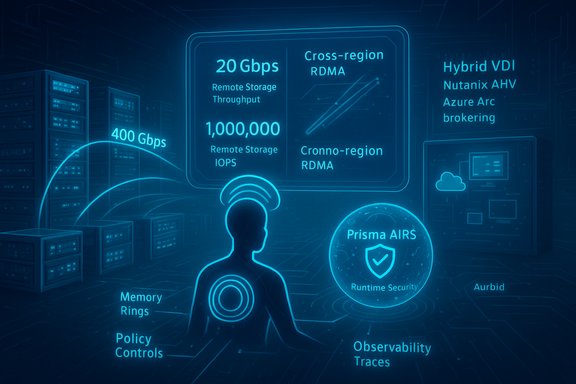
Azure Boost is presented as a server subsystem — software plus purpose-built hardware — that offloads virtualization duties traditionally handled by hypervisors and host operating systems. The preview includes three notable numbers that will shape architecture decisions for high-throughput and AI workloads:- Up to 20 Gbps remote storage throughput and up to 1,000,000 remote storage IOPS. These figures target remote NVMe and disaggregated storage patterns common in modern AI training and large‑scale inference.
- Network bandwidth up to 400 Gbps per host for both general‑purpose and AI VM families. Higher per‑host networking changes how providers design rack-level fabrics and how customers architect distributed training.
- New networking capabilities including RDMA, plus cross-region RDMA and erasure‑coded RDMA for resilience across longer distances.
Why those numbers change the calculus
For AI teams and infrastructure engineers, the 20 Gbps/1M IOPS combination is significant. It suggests Azure is tuning for workloads that traditionally lived on co‑located NVMe or on-prem high-speed fabrics. Training pipelines that stream large datasets can be built without collapsing into local GPU‑attached storage, and stateful inference architectures — where models must access large context stores quickly — can expect lower end‑to‑end latency.The 400 Gbps network ceiling is equally important. It allows larger per‑host network aggregation, fewer oversubscription tradeoffs at the rack spine, and benefits for RDMA‑optimized frameworks like Horovod, MPI‑based training, or custom distributed data‑parallel solutions. Cross‑region RDMA and erasure‑coded RDMA attempt to address the perennial problem of wide‑area parallel training: how to keep bandwidth high while protecting against packet loss and regional failures.
Caveats and realities
- Performance claims in preview are subject to change; real-world throughput depends on tenant configuration, network topology, and workload patterns.
- Erasure‑coded RDMA and cross‑region RDMA introduce complexity. They will require corresponding software support in distributed training frameworks and potentially new tooling for debugging network behavior.
- The security isolation promises are valuable, but they do not eliminate the need for tenant‑level hardening, secure image provenance, and supply‑chain controls.
Networking and RDMA: the new frontier for cloud AI
What RDMA brings to distributed AI
RDMA (Remote Direct Memory Access) removes kernel overhead and dramatically reduces latency by enabling direct memory-to-memory transfers between servers. Prior to this generation of cloud networking, RDMA was mostly a datacenter LAN optimization. Moving RDMA into cross‑region and cloud provider fabrics — while adding erasure coding for packet loss resilience — enables:- Low‑latency parameter exchange and gradient synchronization at larger geographic scope.
- Better support for data‑parallel and model‑parallel distributed training, especially for models that require tight coupling between GPUs across hosts.
- Reduced CPU overhead on hosts, which frees cycles for inference or model orchestration tasks.
Operational impact
Adopting RDMA at cloud scale implies changes across the stack:- Distributed training tools and frameworks must expose RDMA paths and be validated against Azure’s RDMA implementation.
- Observability and debugging become more complex; tools must handle RDMA telemetry and multi‑path routing visibility.
- Network engineers will need robust congestion‑control strategies to prevent large flows from stomping other tenants or services.
Microsoft Foundry and agentic AI: platformizing the agent lifecycle
From SDK to runtime to governance
Microsoft Foundry — sometimes described as the agent factory — is evolving quickly from a developer SDK and catalog into a full runtime that can host, govern, observe, and scale multi‑agent systems. Key platform capabilities highlighted at Ignite include:- Built‑in memory so agents can retain context and personalization without complex external stores.
- Foundry Tools and a unified MCP tool catalog, with connectors to business systems and prebuilt services (transcription, translation, document processing).
- Foundry Control Plane and observability with OpenTelemetry‑based tracing, continuous red‑teaming, and integrated evaluation dashboards.
- Interoperability with agent frameworks (the Microsoft Agent Framework, LangGraph, CrewAI, and others) and an open approach to models and tool providers.
Why enterprises care
Agents promise to automate multi‑step processes: orchestrating systems, invoking APIs, making decisions, and acting on behalf of humans. Foundry’s biggest value proposition is in its governance layer: identity for agents (Entra Agent ID), unified policy application across tool calls, observability and runtime guardrails, and an ability to publish agents into Microsoft 365 and Teams quickly.This reduces the risk of agents acting unpredictably or leaking sensitive context, while accelerating deployment. In regulated industries, the combination of memory scoping, tool catalogs, and Entra governance will be the difference between pilot and production.
Limits and unknowns
- Agent identity and provenance are useful but not a silver bullet; identity doesn’t prevent logic errors, malicious tool definitions, or compromised third‑party models.
- Foundry’s success will depend on a broad partner ecosystem and the willingness of enterprises to centralize agent lifecycles in Azure.
- Hosting agents at scale increases the attack surface for shadow AI risks — more on that below.
Prisma AIRS + Microsoft Foundry: runtime protection for agents
What the integration does
Palo Alto Networks has integrated Prisma AIRS with Microsoft Foundry to provide runtime security for agents and models. The integration targets a set of AI‑native threats:- Prompt injection and runtime manipulation attempts.
- Sensitive content and data leakage from model outputs or tool calls.
- Custom topic detection to keep agents from producing or spreading disallowed content.
- Automated policy enforcement and real‑time runtime protection across the agent lifecycle.
The security value proposition
- Real‑time blocking: Instead of post‑hoc forensics, Prisma AIRS aims to stop prompt injections and unauthorized tool calls during agent operation.
- Policy automation: Enterprises can codify what agents are allowed to access and do, and Prisma will enforce those rules across tool invocations and model outputs.
- Runtime observability: Continuous monitoring of agent behavior helps with compliance and enables security teams to spot anomalies quickly.
Practical limits
- Runtime controls are necessary but insufficient on their own. Secure model development, provenance, fine‑tuning hygiene, and supply‑chain integrity remain essential.
- Policy coverage must be comprehensive and maintained; misconfigured or overly permissive policies can give a false sense of security.
- Integration complexity: the efficacy of runtime protection depends on deep instrumentation across Foundry, agent frameworks, and upstream model providers.
Shadow AI and enterprise risk: containment and detection
What is shadow AI in this context?
Shadow AI refers to unauthorized, unmanaged, or unsanctioned AI systems — including consumer LLMs, bespoke agents, or models run outside IT control — that can exfiltrate data, generate harmful content, or bypass policy. At scale, agents accelerate shadow AI because they can call external models and tools automatically.Controls announced and remaining gaps
Microsoft’s platform announcements add multiple mitigations:- Entra‑backed agent identities and Foundry control planes help track who deployed what agent and which identities it assumes.
- Prisma AIRS provides runtime blocking and policy enforcement.
- The Microsoft Entra Internet Access and Secure Web + AI Gateway features aim to control network access to external model endpoints and scan in‑flight files.
- Detecting hidden agent activity in large, distributed environments is still challenging; telemetry collection and cross‑stack correlation are required.
- Preventing misuse by privileged insiders or compromised developer accounts relies on stringent identity and least‑privilege practices.
- Third‑party models and tools — especially those exposed as MCP servers — need rigorous vetting and provenance markers.
Nutanix + Azure Virtual Desktop: hybrid VDI without vendor lock
What was announced
Nutanix confirmed that Azure Virtual Desktop can run in hybrid environments on Nutanix AHV, with Azure Arc used for brokering and management. The move is explicitly pitched to organizations needing local data residency, low latency, and compliance controls while retaining Azure’s management and Teams/365 optimizations.Why it matters
- It expands choice for VDI: organizations weary of single‑vendor lock‑in now have a supported hybrid option that integrates with Azure’s brokering and policy stack.
- Regulated industries that require data to remain on‑prem can keep desktops local while still leveraging cloud management and bursting capabilities.
- It may blunt the narrative that Broadcom’s VMware strategy forces customers into particular cloud or subscription patterns.
Operational considerations
- Nutanix’s hybrid approach reduces migration friction, but customers must plan for monitoring, backups, licensing interplay, and user experience parity across on‑prem and cloud hosts.
- The Nutanix integration was positioned as "under development" at Ignite; timelines for GA and supported scale must be validated before procurement decisions.
The competitive picture: Palo Alto vs Cisco — and the larger security ecosystem
Why Palo Alto’s move is strategically timely
Palo Alto Networks is pushing AI security as a platform capability — integrating model and agent protection with its broader cloud and network security portfolio. The Foundry integration positions Prisma AIRS as a cross‑cloud runtime guard that can be favored by hyperscalers and large enterprises.Cisco, meanwhile, maintains strong agent telemetry investments and has donated agent‑orchestration tooling to open ecosystems. Both vendors have strengths: Cisco in networking and telemetry; Palo Alto in runtime security and cloud posture. For enterprises, the most realistic outcome is multi‑vendor stacks where teams pick best‑of‑breed tools and expect interoperability.
Market implications
- Security vendors that move fastest to secure the AI application lifecycle — from model development and data handling to runtime agent operations — will gain share.
- Hyperscalers will prefer partners that can operate inside their control planes (Microsoft’s Foundry, Google’s Vertex/Agents surface, etc., which creates a privileged channel for vendors that integrate early.
- Enterprises will look for consolidated controls that bridge identity, network, and model governance to avoid management fragmentation.
Practical guidance for IT leaders
- Validate Azure Boost on representative workloads. Benchmarks matter: schedule pilot tests to measure storage throughput, IOPS, and inter‑host RDMA performance for your training and inference pipelines.
- Treat Foundry as both opportunity and control point. Standardize agent lifecycle processes: templates, code review, continuous red‑teaming, and identity provisioning.
- Layer runtime monitoring tools like Prisma AIRS (or equivalent) into agent deployments to catch prompt injections and data exfiltration attempts during runtime.
- Expand threat hunting to cover agent telemetry and model interaction logs — these are new data sources for typical SOC timelines.
- If hybrid VDI or constrained‑data residency is required, test Nutanix + Azure Virtual Desktop setups for routing, Teams/Office optimizations, and authentication flows before production rollouts.
- Maintain a supply‑chain lens on models and tooling: insist on model provenance, signed artifacts, and contracted SLAs for third‑party MCP servers and model providers.
Risks and red flags
- Preview features and press claims can shift. Performance numbers announced in preview should be validated; roadmap changes are common.
- Increased platform complexity: RDMA, erasure coding, multi‑region training, and agent orchestration together add significant operational complexity and new failure modes.
- Over‑reliance on a single vendor for agent governance and runtime controls introduces concentration risk; multi‑cloud strategies that simply replicate the same mistakes across clouds are not a win.
- Security is an arms race: runtime blocking and policy enforcement reduce risk surface but do not eliminate model poisoning, prompt engineering misuse, or malicious agents launched by compromised developer accounts.
What this means for WindowsForum readers and enterprise Windows admins
Windows administrators and infrastructure architects should reframe their cloud migration and AI adoption plans around three themes:- Network as first‑class resource: bake bandwidth and RDMA capability requirements into procurement and deployment checklists. Don’t assume public cloud “just works” for large distributed training jobs.
- Governed agents: expect to manage agents like user identities. Enforce least privilege, CI/CD controls, and runtime guardrails for any agent that can take action.
- Hybrid choice: Nutanix’s hybrid AVD support reflects a broader trend: customers seeking to avoid single‑vendor lock‑in for desktops and virtualization will have more options, but integration and lifecycle management will matter more than raw feature parity.
Conclusion
Ignite 2025 crystallized two clear directions: hyperscalers are treating networking and low‑latency fabrics as a foundational requirement for cloud‑native AI, and security vendors are racing to operationalize protections for agentic systems where models act, not just answer. Azure Boost raises the performance bar; Foundry aims to organize and govern agent fleets; Prisma AIRS brings runtime security into the agent lifecycle; Nutanix’s hybrid AVD support underscores growing customer demand for choice.For enterprises, the opportunity is real: faster training, more powerful agents, and safer deployments. The work to realize it is operational: validating vendor claims, building new observability into RDMA and agent calls, and enforcing rigorous identity and policy controls. Vendors will continue to compete to be the “agentic partner of choice,” but the customers who combine performance validation with rigorous security discipline will be the ones who turn these promising platform shifts into sustainable, production‑grade AI operations.
Source: SDxCentral Microsoft bets on network & shadow AI with Palo Alto agentic partner of choice
