

Microsoft’s Ignite 2025 updates signal a definitive pivot: Windows is being repositioned from a productivity platform to an agentic operating system — an OS that not only helps you find answers but can meaningfully act on your behalf, under IT policy, across devices and Cloud PCs. The Ignite blog frames this as the next step in forty years of Windows evolution: native agent infrastructure, Ask Copilot and Agents on the taskbar, Windows 365 for Agents, Copilot+ device experiences, stronger cryptography and recovery tooling — all intended to let organizations adopt AI at scale with governance, security and manageability baked in.
Microsoft’s Ignite messaging ties together four converging trends: the spread of agent-style AI in productivity tooling, the emergence of device-level NPUs and local model runtimes for low-latency on-device AI, the need for enterprise-grade governance and auditability, and the strategic expansion of Cloud PC runtimes as managed execution fabrics for agents.
But the payoff requires operational discipline. Treat agents as production services: instrument them, govern them, and pilot them in low-risk domains before broader rollout. Expect to revise procurement specs (to include Copilot+ criteria where needed), update security playbooks, and build new telemetry/forensics practices to capture agent actions. Where preview features are cited without independent documentation, proceed conservatively and require vendor proof points.
Windows is becoming a platform that can act on behalf of users and organizations — and with that power comes responsibility. The organizations that combine careful governance with creative, focused pilots are the ones most likely to realize the productivity gains Microsoft describes while keeping control of risk and cost.
The net promise is compelling: faster workflows, fewer context switches, improved resilience and a managed place to run autonomous workloads. The net risk is equally real: more powerful automation raises security, privacy and operational stakes. The prudent path is clear: pilot deliberately, demand transparency and authoritativeness from vendors, instrument everything, and only scale once governance, provenance and cost controls are proven.
Windows has reached a new frontier — not because it added a feature, but because it reshaped the operating model. The next months will show whether enterprises can match that ambition with the discipline needed to deploy agents safely and effectively.
Source: Windows Blog Ignite 2025: Windows at the frontier of work
 Background / Overview
Microsoft’s Ignite messaging ties together four converging trends: the spread of agent-style AI in productivity tooling, the emergence of device-level NPUs and local model runtimes for low-latency on-device AI, the need for enterprise-grade governance and auditability, and the strategic expansion of Cloud PC runtimes as managed execution fabrics for agents.- The concept: make Windows the canvas for AI — not by bolting services on top, but by embedding agent primitives, connectors and runtime controls directly into the OS, taskbar and Microsoft 365 surfaces.
- The practical moves: previewing native agent infrastructure (agent connectors, agent workspace), surfacing Ask Copilot and Agents on the taskbar, extending Windows 365 with agent-optimized Cloud PCs, and broadening security/resiliency investments such as Post-Quantum Cryptography (PQC) and recovery tooling.
What Microsoft announced (concise summary)
Native agent infrastructure and MCP
- Agent connectors (preview): standardized connectors that let agents safely call apps, files and services.
- Agent workspace (preview): contained, policy-controlled runtime for agents with separate agent identity and auditable actions.
- Model Context Protocol (MCP) support: Windows adds native support to make agent-to-app integration standard and discoverable. Microsoft and independent reporting confirm MCP’s emergence as a cross-vendor interoperability layer.
Taskbar + Copilot surface changes
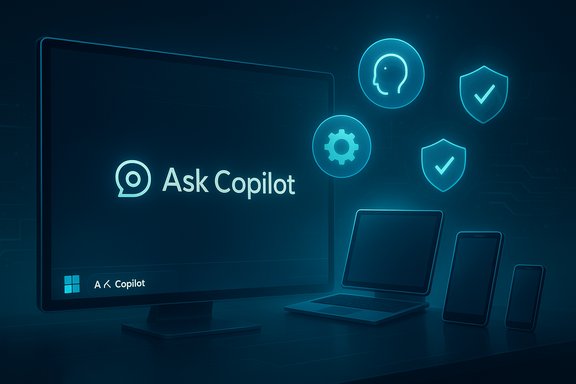
- Ask Copilot (preview): a unified taskbar entry that brings search, Copilot chats and agent invocation into the flow of work.
- Agents on the taskbar (preview): invoke agents, monitor progress with badges and hover cards, and receive secure notifications while continuing other work.
Cloud-first agent runtime
- Windows 365 for Agents (preview): Cloud PCs tuned for scalable agent execution under tenant policy and auditing — intended for high-volume or sensitive agent workloads separated from user endpoints.
Copilot+ PCs and local AI
- Copilot+ PC hardware tier: a class of Windows PCs with on-device NPUs designed to run lightweight models locally. Microsoft’s materials and independent reporting consistently reference a practical NPU floor around 40 TOPS for richer on-device Copilot experiences.
Security and resilience
- Post‑Quantum Cryptography (PQC): Microsoft has exposed PQC primitives in Windows (insider builds earlier in 2025) and ongoing updates show PQC APIs and library support rolling toward broader availability.
- Recovery advances: Quick Machine Recovery (QMR) improvements, Intune management of recovery, Point-in-time restore (preview), Cloud rebuild for Windows 11 (preview), and Windows 365 Reserve (temporary Cloud PC access) to improve business continuity.
Productivity features
- Writing assistance and offline support on Copilot+ PCs, Outlook summaries, Word alt-text, fluid dictation and expanded Click-to-Do actions are being rolled out in preview channels to bring AI into everyday tasks.
Verifying the load-bearing technical claims
When assessing vendor roadmaps and platform claims, public verification from multiple independent sources is essential. Below are key claims and the supporting evidence.- Model Context Protocol (MCP) on Windows: Microsoft documented Windows-level MCP support in Build/Windows dev materials and independent outlets reported on MCP’s growing adoption across vendors. Reuters and Microsoft developer blog coverage corroborate Microsoft’s public commitment to MCP as a standard for agent-tool communication.
- Copilot+ PC NPU guidance (40 TOPS): multiple vendor product pages, press coverage and Microsoft partners reference the 40+ TOPS NPU guideline as the practical performance floor for Copilot+ device features. Independent technology press and OEM spec pages reproduce this requirement, supporting the blog’s statements on device differentiation.
- Forrester TEI claims about Copilot+ PCs saving users time: Microsoft referenced a commissioned Forrester New Technology Projected TEI (July 2025) which quantifies projected efficiency gains, including average hours saved per week for Copilot+ PC users in multi-year scenarios. The Forrester study summary is publicly available and Microsoft quotes the study in their messaging. Use the Forrester report to model expected ROI — but treat the numbers as scenario-based projections derived from a composite organization, not guaranteed outcomes for every customer.
- PQC support in Windows: Microsoft exposed PQC capabilities in Windows Insider builds mid‑2025 and announced work to expand PQC across SymCrypt and CNG; support pages and security updates later in 2025 reflect PQC API additions. This confirms the blog’s assertion that PQC support is in Microsoft’s Windows roadmap and showing up in OS builds. Enterprises should test compatibility and follow Microsoft guidance for hybrid/hybridized PQC deployment approaches.
- Windows 365 Reserve and Cloud PC features: Microsoft’s Windows Experience Blog and product notes describe Windows 365 Reserve as a resilience/Reserve offering (public/limited preview in several writeups), and Windows 365 Link expansion to additional markets is documented by Microsoft. Availability windows vary by region and timing; the product blog describes staged rollouts.
Strengths: why this matters for IT and developers
- Platform-level governance for agents
By making agents a first-class OS concept — with agent identities, registries, connectors and workspaces — Microsoft is giving enterprises centralized controls for lifecycle, consent and auditing. This reduces ad-hoc deployments and helps security and compliance teams apply consistent policies. - Hybrid execution model reduces data movement
Copilot+ devices with local NPUs plus Cloud PC agent runtimes allow organizations to keep sensitive processing on-device or in tenant-controlled Cloud PCs, reducing the need to upload sensitive artifacts to third-party services. The combination of on-device inference and managed cloud execution is the right architectural tradeoff for many regulated industries. - Developer productivity and a consistent interoperability surface
MCP and the agent connector model lower integration friction: developers can expose app functions to agents in a standardized way rather than building bespoke integrations for each assistant variant. This should accelerate partner innovation and reduce brittle, one-off automations. - Resilience and recovery tools aimed at reducing downtime
Windows 365 Reserve, Quick Machine Recovery improvements and point-in-time restore are pragmatic tools for business continuity. Combined with Intune recovery controls, they reduce mean time to recovery (MTTR) in common disruption scenarios. - Clear hardware tiering gives procurement clarity
Defining Copilot+ hardware (NPU threshold, memory and storage minima) helps procurement teams plan fleet refreshes with clearer expectations about which devices deliver which AI features. This reduces the chance of surprise capability gaps during pilots or rollouts.
Risks, blind spots and operational concerns
The agentic OS vision brings benefits — but it also introduces novel risk surfaces and operational complexity. Every IT leader should weigh these before broad deployment.- New attack surfaces and automation hazards
Agents that can act across apps, email and services magnify the consequences of errors or compromise. Misconfigured connectors, revoked credentials, or flawed agent logic could cause data leaks, unwanted transactions or policy violations. This amplifies the importance of least-privilege connectors, agent signing and revocation, and human-in-the-loop review for high-risk flows. - Governance is necessary, not optional
The platform provides guardrails, but enterprises must actively define policies: what agents are allowed to do, who can publish agents, how agent actions are audited, and how costs are monitored. Without strong governance, agent sprawl and unexpected cloud consumption are real risks. - Fragmentation of user experience across hardware tiers
Copilot+ gating (40+ TOPS, RAM/storage minima) creates a two-tier experience. Users on older or lower-tier devices will see fallbacks to cloud processing — and that variation complicates support, training and fairness across teams. Procurement and BYOD policies must account for this. - Data residency and model routing complexity
Agents often need to call cloud services. Enterprises with strict data residency or regulated-data handling must verify which connectors route data where and insist on contractual protections, data minimization, provenance and retention policies. - Supply-chain and compatibility questions for PQC
PQC is evolving; NIST standards and implementation guidance will continue changing. Early PQC adoption brings trade-offs (message size, handshake latency). Enterprises should plan hybrid PQC strategies and avoid wholesale, untested migrations until interoperability across partners is assured. - Limited external verification on some platform pieces
Certain items called out in Ignite — for example some APIs in privacy preview — had limited third-party documentation at the time of the announcement. Treat preview-level features as pilots. The Windows team may change behavior, semantics or availability during the preview period.
Tactical guidance for IT leaders (recommended roadmap)
- Inventory and classify workflows by risk and ROI potential.
- Start with low-risk, high-frequency tasks (report generation, meeting summaries, repetitive admin tasks) to pilot agent workflows.
- Run a closed pilot for agents with strict connector governance.
- Use the agent workspace preview and Windows 365 for Agents (Cloud PCs) to keep agent activity separate from user endpoints. Require explicit approvals and recording of agent actions.
- Define an agent policy playbook: consent, least privilege, signing, revocation and telemetry.
- Ensure all agents are signed, recorded in an enterprise registry, and subject to role-based approvals.
- Prepare the device fleet for Copilot tiers.
- Decide which roles require Copilot+ hardware (40+ TOPS) and plan phased refreshes for those user groups. For everyone else, standard Copilot cloud-backed experiences are available.
- Test PQC impacts before broad rollout.
- Assess TLS handshake sizes, certificate workflows and AD/PKI compatibility in lab before enabling PQC primitives in production. Schedule rollback paths.
- Instrument cost monitoring and chargeback for agent compute.
- Agents consume cloud and (in some cases) local compute. Ensure IT and finance teams can forecast and charge usage appropriately.
- Maintain a human-in-the-loop policy for high-stakes outputs.
- For legal, financial, clinical or operational actions, insist on human verification before execution.
Developer and partner considerations
- Adopt MCP-compatible patterns early: Build connectors that expose clear, auditable actions and declarative capabilities so agent tooling can discover and call your service safely. Microsoft’s developer materials outline MCP server patterns and registry integration; start testing connector behavior in preview environments.
- Optimize for hybrid compute: If your app can run latency-sensitive features locally (image transforms or small SLMs), provide on-device fallbacks and clear feature-degradation paths when an NPU is absent.
- Preserve provenance and explainability: Agents’ multi-step actions require traceable logs and human-readable runbooks. Offer jump-to-evidence links so reviewers can audit how a result was produced.
Where the record needs caution: unverifiable or preview-only claims
Some Ignite statements are forward-looking or preview-level. These include product availability dates, GA declarations for specific APIs, or fine-grained security guarantees that depend on future documentation and telemetry. Two examples:- Windows Endpoint Security Platform (WESP) API: referenced in some Ignite materials as "privacy preview." At the time of writing, public technical references and independent sources are limited; treat this as a Microsoft preview commitment, not a finalized, widely supported standard. Seek official SDK docs and partner examples before planning migrations.
- Exact availability of Windows 365 Reserve and certain Copilot+ exclusives: Microsoft’s public blogs and product feeds show staged rollouts and region-by-region expansions. The blog’s wording about general availability reflects Microsoft’s timeline, but availability can vary by market and may be corrected in follow-up communications. Confirm tenant-level availability through Microsoft 365 admin channels before assuming GA status.
Bottom line: what IT and Windows communities should do next
Windows at Ignite 2025 is a clear architectural pivot: the company wants agents to be as discoverable and controllable as applications. That’s an important, defensible move for enterprises that want AI to do things with auditable governance. The technical primitives — MCP, agent workspaces, Cloud PC agent runtimes and Copilot+ hardware — are coherent and well-aligned with enterprise needs for isolation, scalability and latency control.But the payoff requires operational discipline. Treat agents as production services: instrument them, govern them, and pilot them in low-risk domains before broader rollout. Expect to revise procurement specs (to include Copilot+ criteria where needed), update security playbooks, and build new telemetry/forensics practices to capture agent actions. Where preview features are cited without independent documentation, proceed conservatively and require vendor proof points.
Windows is becoming a platform that can act on behalf of users and organizations — and with that power comes responsibility. The organizations that combine careful governance with creative, focused pilots are the ones most likely to realize the productivity gains Microsoft describes while keeping control of risk and cost.
Conclusion
Ignite 2025’s Windows announcements stake out a bold vision: an agentic OS where assistants are no longer just conversational aides, but auditable, identity-bound entities that can plan, act and be governed. Microsoft has delivered a bundle of platform-level choices — from MCP and agent workspaces to Copilot+ hardware and Windows 365 Cloud PC runtimes — that, taken together, create a plausible pathway from experimentation to production-scale agent deployments.The net promise is compelling: faster workflows, fewer context switches, improved resilience and a managed place to run autonomous workloads. The net risk is equally real: more powerful automation raises security, privacy and operational stakes. The prudent path is clear: pilot deliberately, demand transparency and authoritativeness from vendors, instrument everything, and only scale once governance, provenance and cost controls are proven.
Windows has reached a new frontier — not because it added a feature, but because it reshaped the operating model. The next months will show whether enterprises can match that ambition with the discipline needed to deploy agents safely and effectively.
Source: Windows Blog Ignite 2025: Windows at the frontier of work
