

Inductive Automation’s Ignition platform has been placed squarely in the spotlight after a coordinated advisory describing a deserialization of untrusted data vulnerability that can execute code during project import — an issue CISA links to CVE-2025-13913 and that affects Ignition installations older than 8.3.0; the vendor’s secure upgrade path and hardening guidance are the immediate mitigation, but the underlying class of flaw exposes persistent operational and supply‑chain risks for industrial control system operators and integrators. n.com]
Ignition by Inductive Automation is a widely deployed industrial application platform used for SCADA, HMI, IIoT integration, and enterprise data workflows. Its gateway‑centric architecture and scriptable Designer allow powerful, flexible automation solutions — and they also create attractive attack surfaces when user content is deserialized or executed with excessive privileges.
The advisory published through CISA (and shared by industry sources) characterizes the issue as a deserialization flaw: a privileged, authenticated Ignition user imports an external file or project with a specially crafted payload and — during deserialization — embedded malicious code runs under the Ignition service account. The vendor and government guidance mark Ignition versions older than 8.3.0 as affected and point administrators n 8.3.0 or higher as the primary remediation.
It’s worth noting that public reporting on closely related Ignition security issues has been active in recent months (for example, a script‑import vulnerability tracked as CVE‑2025‑13911). While multiple advisories have focused on project import and script execution vectors in Ignition, this new deserialization advisory amplifies a broader, well‑known category of Java/serialization risks that have impacted many enterprise and ICS products over the last several years.
Key technical points for industrial platforms like Ignition:
Inductive Automation also maintains a Security Hardening Guide with prescriptive steps for both Windows and Linux deployments. The guide includes best practices such as running the Ignition service under a dedicated, non‑domain, minimally‑privileged account, denying local logons for the service account, restricting file system permissions (including moving temp directories), and locking down import operations — guidance that maps directly to the mitigations called out in the advisory. If you cannot upgrade immediately, the vendor hardening guide is the practical second line of defense.
Caveat and verification: while the advisory you supplied ties the issue to CVE‑2025‑13913 and to Ignition versions <8.3.0, independent public databases and some vendor pages that were queried at the time of reporting prominently document related Ignition CVEs (for example CVE‑2025‑13911) and the vendor’s general hardening and patch guidance. If CVE‑2025‑13913 does not appear in your internal tracking or public CVE feeds, treat the advisory as authoritative but verify the CVE identifier and vendor patch correspondence in your change control records and with Inductive Automation support before concluding the remediation status. ([cvedetails.com](CVE-2025-13911 : The vulnerability affects Ignition SCADA applications where Python scripting is
Finally, a cautionary note on attribution and identifiers: the advisory provided to this newsroom names CVE‑2025‑13913 as the tracked identifier. While vendor release notes and public CVE repositories do document closely related Ignition issues (for example CVE‑2025‑13911 and historical deserialization advisories), organizations should verify the CVE‑to‑patch mapping in their change records and confirm remediation status with Inductive Automation support and your internal asset inventory before declaring systems remediated. Treat the CISA advisory as high‑priority operational guidance and use the vendor hardening guide as the practical blueprint for short‑term risk reduction while you schedule upgrades.
The rise of serialization‑based exploits is not new — but its recurrence in complex OT platforms shows that technical fixes must be paired with mature operational discipline. For Ignition administrators, the next 72 hours are about containment and clarity; the next three months are about reconfiguring workflows so that imports are treated with the same scrutiny as code deployments.
Source: CISA Inductive Automation Ignition Software | CISA
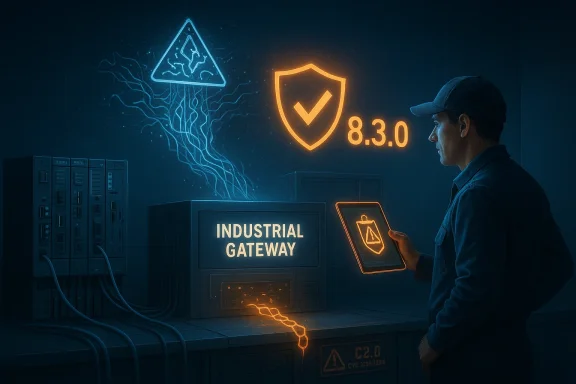 Background / Overview
Ignition by Inductive Automation is a widely deployed industrial application platform used for SCADA, HMI, IIoT integration, and enterprise data workflows. Its gateway‑centric architecture and scriptable Designer allow powerful, flexible automation solutions — and they also create attractive attack surfaces when user content is deserialized or executed with excessive privileges.The advisory published through CISA (and shared by industry sources) characterizes the issue as a deserialization flaw: a privileged, authenticated Ignition user imports an external file or project with a specially crafted payload and — during deserialization — embedded malicious code runs under the Ignition service account. The vendor and government guidance mark Ignition versions older than 8.3.0 as affected and point administrators n 8.3.0 or higher as the primary remediation.
It’s worth noting that public reporting on closely related Ignition security issues has been active in recent months (for example, a script‑import vulnerability tracked as CVE‑2025‑13911). While multiple advisories have focused on project import and script execution vectors in Ignition, this new deserialization advisory amplifies a broader, well‑known category of Java/serialization risks that have impacted many enterprise and ICS products over the last several years.
Technical anatomy: what “deserialization” means here
How deserialization vulnerabilities work
Deserialization vulnerabilities arise when an application accepts structured binary or textual data that encodes object state (i.e., serialized objects), then reconstructs objects from that data without sufficient validation. In Java and many JVM languages, the standard object serialization mechanism (or libraries layered atop it) can be tricked into instantiating unexpected classes or executing gadget chains that lead to arbitrary code execution. CWE‑502 — Deserialization of Untrusted Data — summarizes the core risk: untrusted input becomes an execution vector.Key technical points for industrial platforms like Ignition:
- Many automation platforms accept uploaded projects, modules, or resources that contain serialized metadata and code artifacts; importing those packages into a running system often triggers deserialization.
- If the import path allows unfiltered or *privin, a crafted payload can instantiate objects that run code during object construction or readObject() type hooks.
- Execution may occur with the privileges of the service or system account running the gateway — on Windows this can effectively be SYSTEM; on Linux, the local Ignition service account. That elevation amplifies operational impact.
Why Ignition’s design increases impact (but also allows pragmatic mitigations)
Ignition’s extensibility (scripting in Jython, project imports, and plugin modules) is a design strength for users but increases the attack surface for deserialization and script‑executiocker can convince a privileged administrator or designer to import a project (social engineering), or when import controls are too permissive, the resulting runtime can execute code that was never intended to run. The advisory emphasizes the need to treat imports as code execution vectors and to restrict them accordingly.Vendor response and patches — what you must verify now
Inductive Automation’s 8.3.0 release (and follow‑on updates) addresses multiple security hardening goals: moving away from insecure serialization pathways, improving transport formats, and offering administrative controls that reduce the chance of unintended code execution. The vendor’s release notes for 8.3.0 explicitly highlight security-focused changes — including moving some RPC/communications to Protobuf (reducing reliance on Java built‑in serialization), dependency upgrades, and key management improvements. Administrators are strongly directed to upgrade to Ignition 8.3.0 or later.Inductive Automation also maintains a Security Hardening Guide with prescriptive steps for both Windows and Linux deployments. The guide includes best practices such as running the Ignition service under a dedicated, non‑domain, minimally‑privileged account, denying local logons for the service account, restricting file system permissions (including moving temp directories), and locking down import operations — guidance that maps directly to the mitigations called out in the advisory. If you cannot upgrade immediately, the vendor hardening guide is the practical second line of defense.
Caveat and verification: while the advisory you supplied ties the issue to CVE‑2025‑13913 and to Ignition versions <8.3.0, independent public databases and some vendor pages that were queried at the time of reporting prominently document related Ignition CVEs (for example CVE‑2025‑13911) and the vendor’s general hardening and patch guidance. If CVE‑2025‑13913 does not appear in your internal tracking or public CVE feeds, treat the advisory as authoritative but verify the CVE identifier and vendor patch correspondence in your change control records and with Inductive Automation support before concluding the remediation status. ([cvedetails.com](CVE-2025-13911 : The vulnerability affects Ignition SCADA applications where Python scripting is
Immediate risk assessment for operators
- Exposure model
- Attack requires an authenticated, privileged Ignition user to import a malicious file. This means attackers are likely to rely on credential theft or social engineering to induce a privileged operator to perform the import.
- Once imported, malicious payloads run with the Ignition service account privileges, so consequences range from data exfiltration and lateral movement to full host compromise depending on service permissions and host OS.
- Likelihood and impact
- Likelihood: moderate — the prerequisite of an authenticated privileged user reduces purely remote, unauthenticated exploitation, but compromised admin credentials are not rare in real‑world incidents.
- Impact: high — code executing as the service account (often SYSTEM on Windows) can control backups, deploy ransomware, modify PLC programs indirectly, or pivot into enterprise networks. For OT environments the physical‑process risk is material.
- Attack vectors to prioritize for detection
- Suspicious project or module imports outside normal maintenance windows.
- Unexpected changes to the Ignition install directory, java temp directories, or the creation of new scheduled tasks and services.
- Outbound connections from gateways to unknown infrastructure, especially immediately following an import action.
Practical mitigations — a prioritized checklist
The advisory and the vendor hardening guide provide overlapping mitigations; combine them into a prioritized remediation sprint:- Patch or upgrade
- Upgrade to Ignition 8.3.0 or later as the primary fix strategy; treat the upgrade as high priority for all gateways exposed to non‑trusted user communities.
- Lock down service context and filesystem permissions
- Run Ignition under a dedicated, local (non‑domain if possible) service account with the minimum rights required. Remove the service account from Users and Administrators groups. Grant the account only the permissions needed for the Ignition install and any explicit I/O directories. ([inductiveautomationveautomation.com/resources/article/ignition-security-hardening-guide)
- Deny local interactive logons for the service aPolicy to enforce “Log on as a service” only. ([inductiveautomation.com](Ignition Security Hardening Guide to C:\Windows, C:\Users, and Program Files directories for the service account; set Ignition temp directories inside the Ignition install tree to simplify deny‑access rules. ([inductiveautomation.com](Ignition Security Hardening Guide?- Control imports and supply chain hygiene
- Restrict project imports to explicitly trusted authors and signed packages. Validate project checksums or digital signatures before import. Never import projects from unknown sources directly into Proded environments (Dev → Test → Prod) so projects are validated in non‑production environments before being moved to Production.
- Authentication and access control
- Enforce strong credential management, MFA for Designer/Config‑level users, and role sepaand runtime duties.
- Network segmentation and exposure reduction
- Isolate Ignition gateways from corporate networks and the Internet wherever feasible; treat them as OT assets behind firewalls or jump hosts. Only federate authentication (AD/LDAP/SAML/OIDC) when necessary and preserve least privilege.
- Runtime control and application whitelisting
- Implement application allowlisting (AppLocker or WDAC on Windoinaries and script hosts can execute on gateway hosts. Use directory whitelisting to reduce management overhead.
- Logging, detection and playbooks
- Log all import events, administrative actions, and script uploads. Integrate gateway logs with SIEM or centralized logging and alert on anomalous import activity and new scheduled tasks or services after an import.
Detection, residance
- If you detect suspicious activity:
- Isolate the affected gateway from the network (but preserve memory and disk artifacts for forensics).
- Forensically image memory and disk; look for evidence of newly started child processes, created accounts, scheduled tasks, or persistence mechanisms. These steps align with incident response best practice in ICS contexts.
- Rotate credentials for privileged Ignition users and any accounts accessed from the gateway; do so only after an investigation that identifies compromised credentials or persistence.
- Assess whether the Ignition service account or domain trust relationships were used as pivot points — treat domain objects and AD trust as potentially impacted if there’s evidence of credential theft.
- Evidence collection priorities
- Gateway event logs, Designer import logs, module install timestamps.
- Java process memory dumps (if safely collectible) and the Ignition data/config directories.
- Network captures showing outbound C2 or unexpected file transfers following an import.
Why this class of vulnerability keeps recurring — and what long‑term defenses look like
Deserialization vulnerabilities are common because object serialization is a convenient interprocess and persistence mechanism — and older libraries, legacy dependencies, or mixed serialization formats create gadget chains that attackers can abuse. The industry response has two veins:- Short‑term: vendor patches, configuration hardening, and runtime controls (application allowlisting, least privilege, MFA).
- Long‑term: architectural changes to reduce reliance on unsafe serialization (move to safer, strongly‑typed interchange formats like Protobuf or JSON schemas and enforce strict parsing and class whitelists). Inductive Automation’s 8.3.0 move toward Protobuf for certain gateway communications is a concrete example of this design approach.
Practical playbook for a 72‑hour remediation sprint
- Day 0–1: Triage and containment
- Identify all gateways running Ignition versions older than 8.3.0.
- Confirm whether those gateways are internet‑facing or reachable from enterprise networks.
- If possible, schedule an immediate maintenance window to isolate high‑risk gateways.
- Day 1–2: Mitigate without service disruptions
- Apply vendor hardening steps (run service under dedicated account, restrict filesystem access, deny local logon, restrict imports).
- Enforce multi‑factor authentication on Designer/Config accounts and temporarily restrict import privileges to a small, vetted admin set.
- Day 2–3: Patch and validate
- Upgrade gateways to Ignition 8.3.0 (or to the vendor‑recommended build) in a staged fashio
- Validate each upgrade by running automated test suites for connectivity to PLCs and key HMI screens; monitor logs for anomalies.
- Continuous
- Integrate Ignition logs into your SIEM and tune alerts for import activity, unexpected file writes, and new process execution.
- Conduct post‑mortem and update incident response runbooks to include Ignition import compromise scenarios.
Strengths in the vendor and community response — and where risks remain
What’s positive- Inductive Automatieted hardening guidance and an 8.3 platform that explicitly reduces reliance on Java serialization for gateway messaging — a pragmatic vendor response that improves the platform’s security posture. ([inductiveautomductiveautomation.com/downloads/releasenotes/8.3.0)
- The advisory model used by CISA and coordinated disclosures helps asset owners prioritize remediation around ICS‑focused risk models rather than generic CVE lists.
- Attackers frequently leverage social engineering to get privileged users to perform imports. Administrative processes that allow direct, ad‑hoc import of projects into Production remain a critical control weakness for many organizations.
- Systems running older Ignition releases in remote facilities or managed by third‑party contractors may remain unpatched for prolonged periods; patch management in OT environments is operationally non‑trivial and remains an exploitar upgrades, legacy project files or third‑party modules using insecure serialization patterns could reintroduce attack surface; supply‑chain validation and signed artifacts are not universally adopted.
Final recommendations (what security teams should do next)
- Treat Ignition upgrades to 8.3.0 or later as high priority for any gateway with privileged designers, corporate network access, or internet exposure. Validate the upgrade in a staged environment before production rollout. ([inductiveautomation.com] Security Hardening Guide immediately on all 8.1.x and 8.3.x instances when you cannot upgrade right away. Hardening addresses the privilege and filesystem containment vectors central to exploitation.
- Lock down import workflows: require signed projects, checksum verification, and staging validation. Use role‑based access to limit who can import or deploy projects in Production.
- Deploy application allowlisting, centralized logging, and SIEM correlation to detect atypical post‑import behaviors (new processes, outbound connections, file writes).
- Review third‑party module inventories and insist on vendor attestation for signed, verified modules; adopt a policy of rejecting unsigned modules from untrusted sources.
- If you detect compromise, follow ICS incident response best practices: isolate, image memory and disk for forensic analysis, rotate credentials after containment, and perform a full trust‑reconstitution if identity systems are suspected to be compromised.
Closing analysis
This advisory is an important reminder that powerful industrial platforms sit at the intersection of software flexibility and operational continuity. Ignition’s capability to accept user content and execute scripts is a geltiplier — and, without strict controls, it becomes an execution surface for attackers. Inductive Automation’s move in 8.3.0 toward safer serialization and dependency upgrades is a solid engineering response; practitioners must now match that engineering work with disciplined operational controls: least privilege, signed imports, staging workflows, and robust logging and detection.Finally, a cautionary note on attribution and identifiers: the advisory provided to this newsroom names CVE‑2025‑13913 as the tracked identifier. While vendor release notes and public CVE repositories do document closely related Ignition issues (for example CVE‑2025‑13911 and historical deserialization advisories), organizations should verify the CVE‑to‑patch mapping in their change records and confirm remediation status with Inductive Automation support and your internal asset inventory before declaring systems remediated. Treat the CISA advisory as high‑priority operational guidance and use the vendor hardening guide as the practical blueprint for short‑term risk reduction while you schedule upgrades.
The rise of serialization‑based exploits is not new — but its recurrence in complex OT platforms shows that technical fixes must be paired with mature operational discipline. For Ignition administrators, the next 72 hours are about containment and clarity; the next three months are about reconfiguring workflows so that imports are treated with the same scrutiny as code deployments.
Source: CISA Inductive Automation Ignition Software | CISA
