

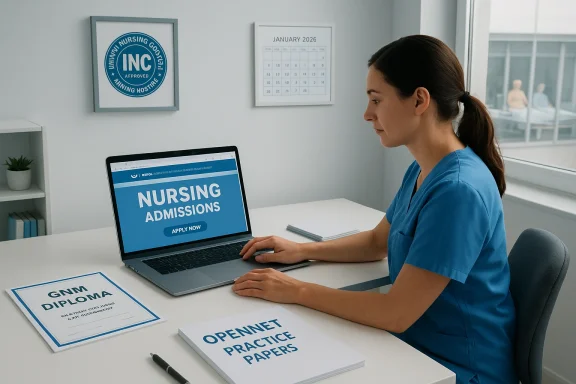
Indira Gandhi National Open University (IGNOU) has opened the registration window for the Post‑Basic B.Sc. Nursing programme for the January 2026 session, offering in‑service Registered Nurses and Registered Midwives an accessible pathway to convert a GNM diploma into a bachelor’s degree through open and distance learning — but applicants should move quickly and verify deadlines and centre approvals before they submit.
The Post‑Basic B.Sc. Nursing (B.Sc. Nursing — Post Basic) at IGNOU is a long‑established distance‑education pathway designed specifically for working nurses who already hold a General Nursing and Midwifery (GNM) diploma and want to upgrade to a degree without leaving their jobs. The programme has a minimum duration of three years and a maximum allowed duration of six years, and it combines theory delivered through the ODL (Open and Distance Learning) model with mandatory practicals and region‑wise counselling at Indian Nursing Council (INC)‑approved study centres.
This January 2026 admission cycle has been widely publicised across national education desks and regional IGNOU notices. Multiple outlets report that the application portal is hosted at the IGNOU nursing admissions portal (ignounursing.samarth.edu.in). However, prospective applicants should note that published deadlines vary between official regional notices and media reports — some communications indicate a late‑February cut‑off while others report an early‑March deadline — so confirming the final date on the official admission portal and the IGNOU prospectus is essential before acting.
These eligibility rules are common to the Post‑Basic B.Sc. Nursing intake historically; applicants must ensure their registration numbers and experience certificates align with the programme requirements and the dates on their registration documents.
Applicants must:
Actionable next steps:
Source: Education Times IGNOU begins admissions for Post-Basic BSc Nursing programme for January 2026 cycle, check details here - EducationTimes.com
 Background / Overview
The Post‑Basic B.Sc. Nursing (B.Sc. Nursing — Post Basic) at IGNOU is a long‑established distance‑education pathway designed specifically for working nurses who already hold a General Nursing and Midwifery (GNM) diploma and want to upgrade to a degree without leaving their jobs. The programme has a minimum duration of three years and a maximum allowed duration of six years, and it combines theory delivered through the ODL (Open and Distance Learning) model with mandatory practicals and region‑wise counselling at Indian Nursing Council (INC)‑approved study centres.This January 2026 admission cycle has been widely publicised across national education desks and regional IGNOU notices. Multiple outlets report that the application portal is hosted at the IGNOU nursing admissions portal (ignounursing.samarth.edu.in). However, prospective applicants should note that published deadlines vary between official regional notices and media reports — some communications indicate a late‑February cut‑off while others report an early‑March deadline — so confirming the final date on the official admission portal and the IGNOU prospectus is essential before acting.
What the programme offers
The Post‑Basic B.Sc. Nursing aims to achieve several key objectives for working nurses:- Upgrade professional qualifications from diploma to degree while allowing continued employment.
- Broaden clinical competence with updated theory in areas such as medical‑surgical nursing, maternal and child health, community health nursing, and mental health nursing.
- Support career mobility by improving eligibility for supervisory, administrative, and teaching roles within the healthcare system.
- Develop research, teaching, and administrative skills appropriate for hospital, community, and educational settings.
- Enable academic progression, making graduates eligible for postgraduate study (subject to recognition and further eligibility checks).
Who is eligible? Clear eligibility paths
IGNOU’s Post‑Basic B.Sc. Nursing is specifically designed for in‑service nurses and midwives. The eligibility criteria are focused on registered status and relevant work experience. There are two standard eligibility routes:- Option A (10+2 route)
- Educational: Senior secondary (10+2) plus a three‑year Diploma in General Nursing and Midwifery (GNM).
- Professional: Registered Nurse and Registered Midwife (RNRM).
- Experience: Minimum two years experience after registration as RNRM.
- Option B (Matriculation route)
- Educational: Matriculation (Class X) or equivalent plus a three‑year GNM diploma.
- Professional: Registered Nurse and Registered Midwife (RNRM).
- Experience: Minimum five years experience after registration as RNRM.
These eligibility rules are common to the Post‑Basic B.Sc. Nursing intake historically; applicants must ensure their registration numbers and experience certificates align with the programme requirements and the dates on their registration documents.
The admissions process — step‑by‑step
IGNOU conducts admissions and candidate selection for the Post‑Basic B.Sc. Nursing through a structured online process followed by an entrance test (OPENNET) and region‑wise counselling. Typical steps include:- Create a new account on the IGNOU nursing admissions portal and complete the New Registration.
- Fill the online application with personal, academic, and professional (nursing registration and work experience) details.
- Upload scanned documents:
- Educational certificates (10th/12th, GNM diploma)
- Nursing registration proof (RNRM registration)
- Experience certificates showing dates and employer details
- Photo and ID proof
- Any substitute midwifery certificate (for male nurses where applicable)
- Pay the application fee online using the portal’s payment gateway.
- Download and retain a copy of the submitted application form and payment receipt.
- Prepare for and appear in the OPENNET (the university’s Open Nursing Entrance Test) if required.
- Participate in region‑wise counselling and document verification at the allocated INC‑approved study centre, if shortlisted.
Important dates and a note on deadline discrepancies
Multiple media reports and regional IGNOU notifications around this intake have published slightly different last‑date figures for application submission. Reported dates across communications include:- End of February 2026 (late‑February extension mentioned in regional notices)
- Early March 2026 (some national outlets list March 5, 2026)
- Earlier January deadlines reported by older pages or misinterpreted notices
- Confirm the final last‑date for online submission on the official IGNOU nursing admission portal before paying any fees.
- Check regional centre announcements for any local extensions or late‑fee windows.
- Retain proof of submission and timestamps if applying close to a deadline to guard against portal or payment delays.
Fees, duration and mode of delivery — what to expect
- Duration: Minimum 3 years, extendable up to 6 years to complete the course under IGNOU’s flexible ODL rules.
- Mode: Open and Distance Learning with compulsory practicals at INC‑approved centres.
- Fee: Several publicly available admission summaries list the programme fee in the region of ₹23,000 per year (indicative). Application fees for the entrance/admission process have been reported around ₹1,000 in recent cycles.
The role of the Indian Nursing Council (INC) — approval and study centre recognition
The Post‑Basic B.Sc. Nursing offered through IGNOU’s School of Health Sciences has historically been tied closely with the Indian Nursing Council. INC approval is central for two reasons:- INC recognition determines whether a particular IGNOU study centre (where practicals and clinical assessments are held) is valid for statutory professional recognition and subsequent eligibility for higher education or registration benefits.
- INC‑approved centres are required to deliver practical components and host counselling/document‑verification for admitted students.
Entrance test and selection
Selection for the Post‑Basic B.Sc. Nursing is typically based on performance in the university’s OPENNET (Open Nursing Entrance Test) followed by region‑wise counselling and document verification. Key points applicants should know:- OPENNET assesses professional and foundational nursing knowledge appropriate for diploma‑holders seeking degree‑level education.
- Shortlisted candidates are called for region‑wise counselling where documents, nursing registration, and practical training arrangements are verified.
- Seat allocation is regionally managed and tied to seat availability at INC‑approved practical centres; passing the entrance test does not guarantee placement until counselling and seat allotment are complete.
- Candidates should download model papers and previous years’ question papers to prepare; IGNOU publishes sample papers and the university encourages applicants to use them for preparation.
Practical training: where you’ll attend in‑person work
Although the course is delivered via ODL for theory, practical learning and assessments are conducted in person at designated colleges and study centres that have been inspected and cleared by the Indian Nursing Council.Applicants must:
- Confirm the list of practical study centres for the January 2026 session and whether a centre in their region has available seats.
- Understand that practical schedules and term‑end practical exams are fixed by regional centres and may require short periods of in‑person attendance.
- Be prepared to travel for practicals or to relocate to a regionally approved centre if necessary.
Strengths of the IGNOU Post‑Basic B.Sc. Nursing pathway
- Accessibility: Designed for in‑service nurses who cannot leave employment to pursue full‑time study.
- Flexibility: Minimum/maximum duration rules give students time to pace learning around shift work and family commitments.
- Recognition: Programme historically aligned with INC and delivered through approved centres; degree awarded by a national open university.
- Career leverage: Degree holders are better placed for supervisory roles, hospital administrative positions, and eligibility for higher study (subject to university and INC rules).
- Support for continuing competence: Curriculum updates and practical components are intended to maintain and enhance clinical skills required by changing health needs.
Risks and points of caution — what applicants must watch
- Deadline and portal inconsistencies: Media reports and regional notices have shown differing last‑date figures for this intake; always verify on the official portal before submitting.
- Study centre recognition: Ensure the practical centre where you’ll be placed is INC‑approved for the session; a degree from an unrecognised centre can create problems for professional progression.
- Seat shortages and regional allocations: Even after passing OPENNET, the allocation depends on seats at approved centres; plan for alternative centres or counselling rounds.
- Documentation pitfalls: Incomplete or mismatched registration numbers, missing experience dates, or non‑standard experience letters can delay or invalidate admission — get employer letters on official letterhead with clear join/exit dates and duties.
- Quality of practical exposure: The standard of hands‑on clinical experience differs between centres; if practical competence is a priority, investigate centre facilities beforehand.
- Fee and refund policies: Confirm the exact programme fees, instalment options, and refund rules in the prospectus, since third‑party portals may show outdated or approximate numbers.
- Legal/recognition precedents: Past legal disputes over centre recognition demonstrate the need to ensure that the chosen study centre has received recent INC inspection and approval.
Practical checklist for applicants (before you apply)
- Verify final online application deadline on the official nursing admissions portal for the January 2026 session.
- Confirm INC recognition status of preferred study centres for practicals and counselling.
- Get a clear, signed experience certificate from your employer that lists exact dates and nature of duties.
- Locate your RNRM registration certificate and note the registration number and date.
- If you are a male nurse without midwifery training in GNM, obtain the required 6–9 month INC‑prescribed certificate.
- Scan and save high‑quality copies of all documents (PDF preferred) and verify portal upload limits and formats.
- Prepare the application fee and ensure your bank/card/UPI settings allow online payment to the university gateway.
- Download or print a copy of the filled application and payment receipt immediately after submission.
- Study the OPENNET model papers and IGNOU sample question sets; plan a study calendar.
- Inform your employer and secure any necessary permissions for day‑time attendance at counselling or practicals.
Preparing for OPENNET and the academic demands
- Study strategy:
- Consolidate foundational nursing subjects covered during GNM: anatomy, physiology, pharmacology basics, medical‑surgical nursing, community health, maternal and child health.
- Practice with previous OPENNET papers and model questions to adapt to the question format and time management.
- Revise clinical protocols and evidence‑based nursing practices that are frequently tested.
- Time management:
- Allocate regular study time around shifts; micro‑study sessions and weekend deep dives work well for working nurses.
- Practical preparation:
- Review clinical procedures and documentation formats; practical assessments frequently test both skill execution and record‑keeping.
Career impact and post‑degree pathways
- Promotions and pay scales: A B.Sc. Nursing (Post Basic) often improves eligibility for higher pay scales, supervisory designations, and administrative roles in hospitals and community health programs.
- Teaching and education: Graduates become eligible to teach in nursing diploma programmes (subject to additional qualifications and local council rules) and can pursue postgraduate studies in nursing disciplines.
- Specialisation: A degree opens doors to specialised nursing roles (critical care, community health leadership, mental health nursing) and certificate or postgraduate diploma programmes.
- Mobility: A formally recognised degree is typically more portable across states and national healthcare institutions compared to a diploma alone, but recognition depends on the INC‑status of the awarding study centre.
Frequently overlooked administrative tips
- Keep both soft and hard copies of every submission and make timestamped screenshots of payment confirmation pages.
- If your employer issues experience certification, ensure it contains stamp, signature, designation, and exact employment dates; vague descriptions weaken verification.
- Monitor regional centre notices post‑submission: counselling schedules and practical allocations are often published regionally.
- If you have past academic gaps or irregularities (e.g., distance between GNM completion and RNRM registration), prepare clarifying documentation in advance.
- If you rely on a substitute midwifery certificate (male nurses), verify the issuing institute’s recognition and that the certificate explicitly cites the INC‑prescribed course.
Final assessment: who should apply and when
This programme is an excellent fit for:- Working nurses committed to long‑term career growth who need a flexible, employer‑friendly route to obtain a degree.
- Diploma‑qualified RNRMs who want to increase clinical competence, eligibility for supervision, and academic progression.
- Nurses in community health roles who need formal degree recognition for promotion or specialist assignments.
- Candidates seeking immediate full‑time campus experience or those unwilling/unable to complete practicals in person at approved centres.
- Applicants who cannot obtain clear nursing registration or experience documentation.
- Those expecting a guaranteed seat solely based on entrance test performance without considering regional seat constraints.
Conclusion and next steps
IGNOU’s Post‑Basic B.Sc. Nursing intake for January 2026 represents a vital opportunity for in‑service nurses to secure a university degree while continuing employment. The programme’s strengths — flexible delivery, clinical skill focus, and historical alignment with the Indian Nursing Council — are compelling. However, applicants must be vigilant: confirm the final application deadline on the official nursing admissions portal, verify INC approval of the practical study centre they will attend, and prepare robust, verifiable documentation for registration and experience.Actionable next steps:
- Confirm the final last‑date for January 2026 online submission on the official IGNOU nursing admissions portal.
- Gather and scan all mandatory documents (registration, GNM, experience letters, substitute midwifery certificate if required).
- Pay the application fee and keep receipts and screenshots.
- Begin OPENNET preparation using official model papers and past question sets.
- Verify INC recognition of preferred practical centres and, if possible, contact the regional centre to clarify counselling and practical schedules.
Source: Education Times IGNOU begins admissions for Post-Basic BSc Nursing programme for January 2026 cycle, check details here - EducationTimes.com