

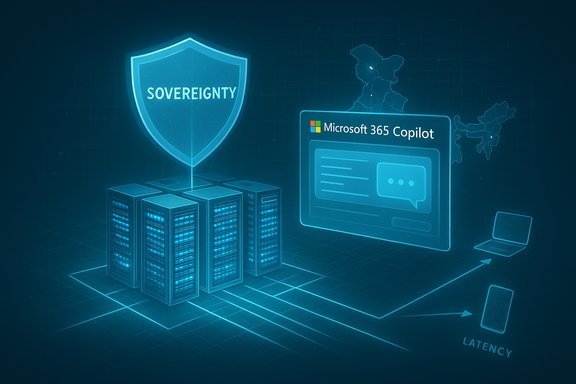
Microsoft’s announcement that it will offer in‑country processing for Microsoft 365 Copilot interactions in India by the end of calendar year 2025 marks a major milestone in the vendor’s long-running push to make generative‑AI tools compatible with regulated, public‑sector and enterprise procurement requirements. The company says this option — which routes Copilot prompts, responses and associated telemetry to datacenters inside a customer’s national borders during normal operations — will also be available in Australia, Japan and the United Kingdom by the end of 2025, with a broader expansion to a further set of countries in 2026. The move is positioned as both a performance optimisation (lower latency for interactive scenarios) and a governance control that reduces cross‑border data flows, but the public materials leave critical implementation and contractual details to be validated with Microsoft account teams.
Microsoft’s Microsoft 365 Copilot has been progressively folded into the company’s data‑residency commitments since 2024. That prior work established product‑level guarantees around where stored content (mailboxes, files, Teams artifacts) can reside. What’s different about in‑country processing is the operational routing promise: not only is content stored in a specified location, but the live processing of interaction data — prompt ingestion, model inference, response generation, and telemetry processing — is handled inside a national boundary during normal operations. This distinction matters legally and technically for organisations with data‑sovereignty, procurement, or regulatory constraints.
Microsoft’s regional roadmap as reported in contemporary press coverage and Microsoft regional releases identifies several waves:
Two practical consequences for Indian customers:
At the same time, the market opportunity will spur local partners and systems integrators to create compliance‑focused offerings: validated landing zones, managed connectivity with ExpressRoute, and attestation services. This partner ecosystem will be a crucial intermediary for organisations seeking independent verification and for governments wanting operational assurance.
However, the ultimate value for any organisation will depend on the implementation details and the strength of contractual commitments. The key questions customers must close before they can reasonably claim compliance advantages are concrete: exact day‑one feature inventories; GPU and instance availability; confidential compute and CMK support; explicit exception mechanics for cross‑border routing; and credible third‑party attestations for the local datacenters. Without those details in contract schedules and audit packages, the headline promise remains useful but not dispositive.
For enterprise IT teams and CIOs in India, the practical path forward is disciplined: validate day‑one capabilities, pilot conservatively, secure cryptographic controls and attestation, and negotiate clear exit mechanics. Those steps transform marketing‑level promises into operational assurances that regulators, auditors and customers will accept.
Microsoft’s step toward in‑country Copilot processing is real and consequential; whether it meaningfully reduces risk for regulated workloads will be decided in procurement rooms, contract schedules and datacenter audit reports rather than in press headlines.
Source: Zee Business Microsoft to enable in-country processing for Copilot data in India by end of 2025
 Background / Overview
Microsoft’s Microsoft 365 Copilot has been progressively folded into the company’s data‑residency commitments since 2024. That prior work established product‑level guarantees around where stored content (mailboxes, files, Teams artifacts) can reside. What’s different about in‑country processing is the operational routing promise: not only is content stored in a specified location, but the live processing of interaction data — prompt ingestion, model inference, response generation, and telemetry processing — is handled inside a national boundary during normal operations. This distinction matters legally and technically for organisations with data‑sovereignty, procurement, or regulatory constraints.Microsoft’s regional roadmap as reported in contemporary press coverage and Microsoft regional releases identifies several waves:
- By end of 2025: Australia, India, Japan, United Kingdom.
- 2026 expansion (published lists have included): Canada, Germany, Italy, Malaysia, Poland, South Africa, Spain, Sweden, Switzerland, United Arab Emirates, and the United States.
What “in‑country processing” actually changes
From residency to operational containment
- Data residency traditionally guarantees that data at rest (documents, mailboxes, SharePoint content) are stored in particular datacenters.
- In‑country processing extends that guarantee by routing live Copilot interaction workloads (prompts, responses, embeddings, and associated telemetry) to compute inside the customer’s country under normal conditions. This reduces routine cross‑border transfers of conversational records and inference traces.
Why that matters
- Regulatory compliance: For government agencies and regulated industries (finance, healthcare, critical infrastructure), the location of processing can be a procurement knockout criterion. Local processing addresses a significant portion of those concerns.
- Latency and user experience: Interactive Copilot experiences (meeting summarisation, real‑time Excel assistance, agentic flows) are latency‑sensitive. Local routing typically reduces round‑trip time and can materially improve responsiveness and perceived usefulness. Estimates in regional briefings indicate latency reductions in the tens to low hundreds of milliseconds for local processing compared with cross‑border routing.
- Procurement friction: The option of local processing can accelerate approvals and reduce legal pushback in markets where data sovereignty requirements were previously a barrier to AI pilots.
Technical contours organisations must verify before buying
The headline promise is useful, but the technical and operational mechanics determine whether in‑country processing actually meets an organisation’s legal, security and performance needs.Region and service inventory
Confirm which Azure regions and Availability Zones will host the Copilot processing plane on day one, and which Copilot features are supported locally. Microsoft’s rollouts are frequently phased: some Copilot features may be available immediately while others arrive later. Ask for a day‑one service inventory as a contract schedule.GPU families and VM SKUs
Generative AI inference is hardware‑sensitive. Local processing requires adequate local GPU capacity and the relevant VM SKUs. If the local region lacks the GPU families required for Copilot inference, Microsoft may route inference to other regions, defeating the in‑country promise for those workloads. Verify GPU SKU availability and a roadmap for additional capacity.Networking and predictable routing
Secure private connectivity options (ExpressRoute, private peering) and clearly documented routing maps. For interactive Copilot use cases, predictable latency and throughput are essential; public internet paths often lack the predictability necessary for production SLAs.Confidential compute and cryptographic control
Ask whether confidential compute options are available locally and whether you can use customer‑managed keys (CMKs) for encryption. The ability to retain cryptographic control over decryption rights is the single most powerful contractual protection against extraterritorial disclosure in many contexts. Get a written description of key custody, key‑escrow policies, and how lawful access requests are handled.Logging, retention, and definition of interaction data
Get an explicit definition of “Copilot interaction data” (prompts, responses, embeddings, telemetry, logs), the default retention windows, redaction options, and how Purview/Compliance tooling integrates for eDiscovery, legal hold and audit. If audit trails are not tamper‑evident or if retention controls are coarse, regulatory benefits are weakened.India: why Microsoft prioritised the market, and what the infrastructure picture looks like
India has been a strategic priority for hyperscalers. Microsoft announced multibillion‑dollar investments in Azure capacity for India and accelerated regional expansion through 2025. Those investments create the physical foundation for local Copilot processing: datacenters with AI‑ready infrastructure, network interconnects and private peering options. Independent industry estimates point to very rapid growth in India’s datacenter power capacity — one commonly cited projection moves from roughly 1.2 GW today to an estimated 8 GW by 2030, though that is a market estimate and should be interpreted as a projection rather than a contractual promise. These capacity trends make an in‑country processing option technically feasible and commercially sensible for Microsoft.Two practical consequences for Indian customers:
- Performance: local compute reduces latency for real‑time and near‑real‑time Copilot features.
- Procurement alignment: central and state governments, plus regulated industries, often require demonstrable local processing and control for sensitive systems; on‑shore Copilot processing reduces negotiation friction.
Strengths and immediate benefits
- Stronger procurement case for Copilot: Local processing neutralises a common legal objection from public‑sector buyers and regulated firms, enabling broader trials and pilots.
- Improved end‑user performance: Lower latency improves interactive scenarios in Teams, Office apps, and Power Platform. This can materially affect adoption and productivity metrics.
- Unified governance stack: When combined with Microsoft Entra identity, Purview classification, and DLP policies, local Copilot processing can be integrated into existing enterprise governance workflows, reducing integration complexity.
- Ecosystem opportunity for partners: In‑country processing encourages a local partner ecosystem — system integrators, managed service providers and sovereign cloud operators — to build validated solutions and provide attestations that regulated buyers will demand.
Risks, unresolved questions, and practical caveats
The announcement is significant, but several risks and limitations remain. Several of these are technical and others are contractual or legal.1. Public claims vs binding contract language
A headline residency promise is not a substitute for a contractual schedule that defines exceptions, fallbacks and notification processes. Microsoft’s public messaging is clear about intent, but some country timetables reported in the press are not yet consolidated in a single global Microsoft release. Customers must obtain written, sample contractual language that specifies the exact conditions under which processing may leave the country (security incident, disaster recovery, capacity limits), and an explicit notification and remediation process.2. Domestic lawful access remains real
In‑country processing reduces foreign jurisdiction exposure but increases exposure to domestic legal process. Local hosting does not remove lawful access risk; it merely relocates it. Organisations that require absolute third‑party immunity must retain cryptographic controls or alternative architectures. Negotiate key management and law‑enforcement handling in the contract.3. Feature parity and phased rollouts
Not all Copilot features (or supporting Azure services and instance SKUs) may be available at launch in each country. Missing GPU SKUs or the absence of confidential compute could force routing of some workloads outside the country for technical reasons, undermining the residency promise for those specific workloads. Demand a day‑one features inventory and a roadmap for parity.4. Vendor concentration and lock‑in
Moving the full productivity stack and AI processing onto a single hyperscaler simplifies operations but increases vendor lock‑in. Procurement should insist on data export mechanics, verifiable exit playbooks, and migration SLAs so exit is feasible without excessive disruption.5. False assurance about privacy and model risk
Local processing does not eliminate generative AI risks like hallucination, IP derivation, or inadvertent leakage. Organisations must pair residency controls with robust model governance — human‑in‑the‑loop checks, DLP integration, Purview classification, and explicit policy for sensitive connectors and agentic actions.Practical checklist for IT, procurement and legal teams
- Request a written day‑one service inventory that lists which Copilot features are guaranteed to be processed in‑country on day one and what fallback behaviours exist.
- Obtain a GPU and SKU availability matrix for the local Azure region and a roadmap showing when missing SKUs will arrive.
- Demand customer‑managed keys (CMKs) and confidential compute options; document who holds keys and how lawful access requests are handled.
- Insist on sample contractual schedules that specify exceptions (security incidents, failover routing), notification obligations, and remediation steps.
- Verify audit and attestation packages for the local datacenters (SOC 2, ISO 27001) and request third‑party penetration test summaries.
- Define a retention and redaction policy for Copilot interaction data (what gets stored, for how long, and where), and integrate those controls with Microsoft Purview.
- Start with constrained pilots using non‑mission‑critical data to validate latency, feature behaviour and governance integrations.
- Run red‑team tests against agentic Copilot workflows, and validate audit trails are complete and tamper‑evident.
- Negotiate exit and portability mechanics: data export playbooks, SLAs for export time, and independent verification of exported archives.
- Establish a cross‑functional Copilot Centre of Excellence (legal, security, procurement, business) to manage prompt engineering, connectors, DLP, and continuous auditing.
How this changes procurement and the market in India
For Indian public sector bodies and regulated enterprises, the availability of in‑country Copilot processing can unlock AI pilots and deployments that were previously stalled on residency grounds. That will likely accelerate adoption of Copilot‑based productivity and automation use cases — meeting summarisation for government meetings, automated drafting in legal/regulatory workflows, and citizen‑facing automation where tenant data grounding matters.At the same time, the market opportunity will spur local partners and systems integrators to create compliance‑focused offerings: validated landing zones, managed connectivity with ExpressRoute, and attestation services. This partner ecosystem will be a crucial intermediary for organisations seeking independent verification and for governments wanting operational assurance.
What organisations should do next (a short playbook)
- Hold a supplier risk review that treats Microsoft’s public timeline as informative but not definitive. Ask for written commitments and day‑one inventories.
- Map your highest‑risk Copilot use cases (legal, HR, procurement, citizen data) and block them from feeding Copilot until contractual and technical guarantees meet your policy baseline. Use Purview and DLP to enforce those boundaries.
- Commission a short pilot (4–8 weeks) that validates latency, feature parity and governance in the local region; measure both UX improvements and compliance telemetry.
- Negotiate key management and export mechanics early; these are often the hardest contract items to change after a program scales.
- Require ongoing attestation and audit reports as part of the commercial agreement — and insist on timely notifications when Microsoft invokes any routing exception that moves data outside the country.
Final assessment: promise vs implementation
Microsoft’s in‑country processing announcement for Microsoft 365 Copilot in India is an important step that aligns product capability with procurement realities in regulated markets. The move offers real benefits: reduced latency, a stronger procurement case for Copilot, and the potential to speed adoption across government and regulated industries. It also fits logically into Microsoft’s broader sovereignty strategy — local Azure regions, EU Data Boundary extensions, Azure Local and Microsoft 365 Local architectures — which together form a credible path toward containment and regional control.However, the ultimate value for any organisation will depend on the implementation details and the strength of contractual commitments. The key questions customers must close before they can reasonably claim compliance advantages are concrete: exact day‑one feature inventories; GPU and instance availability; confidential compute and CMK support; explicit exception mechanics for cross‑border routing; and credible third‑party attestations for the local datacenters. Without those details in contract schedules and audit packages, the headline promise remains useful but not dispositive.
For enterprise IT teams and CIOs in India, the practical path forward is disciplined: validate day‑one capabilities, pilot conservatively, secure cryptographic controls and attestation, and negotiate clear exit mechanics. Those steps transform marketing‑level promises into operational assurances that regulators, auditors and customers will accept.
Microsoft’s step toward in‑country Copilot processing is real and consequential; whether it meaningfully reduces risk for regulated workloads will be decided in procurement rooms, contract schedules and datacenter audit reports rather than in press headlines.
Source: Zee Business Microsoft to enable in-country processing for Copilot data in India by end of 2025
