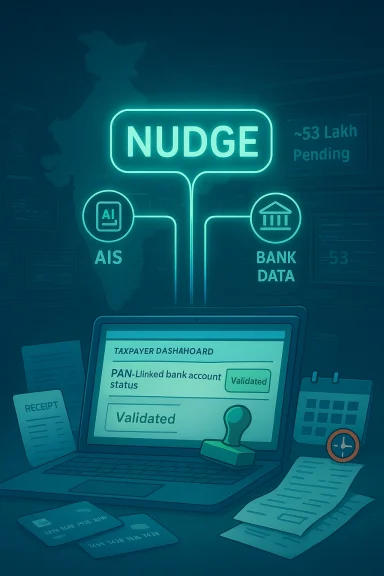
More than 50 lakh Indian taxpayers remain in limbo as their income tax returns for Assessment Year 2025–26 sit unprocessed and refunds are delayed, and the causes stretch from high-volume filing pressure to deliberate data-driven compliance checks that the Central Board of Direct Taxes has expanded this year.
The Income-tax Department recorded a record filing season for AY 2025–26, with filings running into crores. Officials and multiple public reports show that total ITR filings crossed the 8.8 crore mark in early January 2026, and while the majority of returns have been verified and processed by the Centralised Processing Centre (CPC), roughly 50–53 lakh returns remained pending for processing as of January 11–12, 2026. Many of those pending returns have associated refund claims, which has produced a large group of taxpayers awaiting refunds or status updates.
This backlog is not the result of a single cause. The department’s stepped-up use of cross‑matching, automated risk filters, and a targeted compliance campaign known as NUDGE (Non‑intrusive Usage of Data to Guide and Enable) have introduced additional verification lanes that remove certain returns from automated processing and route them for manual review or taxpayer-triggered correction. At the same time, statutory timelines, changes in filing windows, and technical rules around refund crediting (such as pre‑validated bank accounts and PAN–Aadhaar linkages) create practical gates that can stop refunds even when a return appears otherwise processed.
This feature article breaks down the numbers, explains the mechanisms that are slowing refunds, gives step‑by‑step practical guidance on how taxpayers can check status and resolve common problems, and provides a critical analysis of the trade-offs between higher compliance using data analytics and the operational risks that drive taxpayer frustration.
Key characteristics:
Common technical issues:
However, policy success depends on operational execution. The current situation—millions of returns processed but several lakh refunds delayed—illustrates a growing pains phase where data sophistication outpaces human and system capacity for rapid, transparent resolution. For taxpayers, delayed refunds are a clear negative outcome even if they result from well‑intentioned compliance improvements.
The practical roadmap for taxpayers is straightforward: verify your bank validation and PAN linkage, reconcile AIS/Form 26AS with your ITR before filing, respond quickly to NUDGE alerts, and use the portal grievance mechanisms proactively. For the department and policymakers, the priority should be to reduce the friction created by false positives, improve portal transparency, and scale verification resources so that the promise of data‑driven compliance does not come at the cost of excessive delay and taxpayer hardship.
Timely refunds are not merely administrative niceties—they affect household budgets, small business liquidity, and public trust in the tax system. The drive toward better compliance and the use of global financial information exchange are necessary steps in a modern tax ecosystem; the challenge now is to align capacity, communication, and safeguards so that enforcement yields both accuracy and fairness.
Source: ET Now Income Tax Refund News: Over 50 lakh taxpayers awaiting return processing; here’s what you should know
 Background
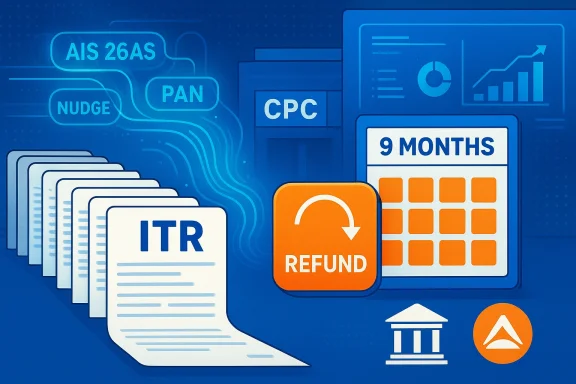
The Income-tax Department recorded a record filing season for AY 2025–26, with filings running into crores. Officials and multiple public reports show that total ITR filings crossed the 8.8 crore mark in early January 2026, and while the majority of returns have been verified and processed by the Centralised Processing Centre (CPC), roughly 50–53 lakh returns remained pending for processing as of January 11–12, 2026. Many of those pending returns have associated refund claims, which has produced a large group of taxpayers awaiting refunds or status updates.This backlog is not the result of a single cause. The department’s stepped-up use of cross‑matching, automated risk filters, and a targeted compliance campaign known as NUDGE (Non‑intrusive Usage of Data to Guide and Enable) have introduced additional verification lanes that remove certain returns from automated processing and route them for manual review or taxpayer-triggered correction. At the same time, statutory timelines, changes in filing windows, and technical rules around refund crediting (such as pre‑validated bank accounts and PAN–Aadhaar linkages) create practical gates that can stop refunds even when a return appears otherwise processed.
This feature article breaks down the numbers, explains the mechanisms that are slowing refunds, gives step‑by‑step practical guidance on how taxpayers can check status and resolve common problems, and provides a critical analysis of the trade-offs between higher compliance using data analytics and the operational risks that drive taxpayer frustration.
Overview: the numbers and what they mean
Snapshot of filings and processing (January 2026)
- Total ITRs filed for AY 2025–26: approximately 8.8 crore.
- Returns verified: roughly 8.68 crore.
- Returns processed: roughly 8.15 crore.
- Returns remaining unprocessed: roughly 53 lakh.
Statutory timeline context
Under Section 143(1) of the Income‑tax Act, the CPC has up to nine months from the end of the financial year to process returns and issue intimation orders under 143(1). For returns filed in FY 2024–25 (relevant to AY 2025–26), that statutory processing deadline runs until December 31, 2026. In plain language, a pending return in January 2026 is still within the legally permitted processing window; persistent delays beyond the statutory period raise different legal remedies for taxpayers.Why refunds are taking longer: the department’s playbook
1. Record filing volume and processing pressure
The 2025 filing season was unusually intense. Extended deadlines and a larger taxable base pushed many taxpayers to file close to the final dates, producing concentrated submission volumes that stress the CPC’s automated queues and manual verification teams.- High volume increases queue times even for routine verifications.
- Concentrated filing pockets (e.g., many returns filed in the last days of the extended window) create processing spikes that can cascade into backlogs.
2. Stricter cross‑verification with AIS and third‑party data
The Income‑tax Department now routinely cross‑matches ITR content with the Annual Information Statement (AIS), Form 26AS, bank reporting, employer TDS filings, mutual fund transaction reports, and other data reservoirs. This multi‑source reconciliation improves detection of mismatches but increases the number of returns flagged for further checks.- Small mismatches (e.g., missed bank interest, dividend reporting differences, or ESOP-related entries) can trigger holds.
- Automated flags are intended to detect underreporting; however, they also capture innocent errors, timing differences, and reporting lags.
3. NUDGE: voluntary correction with consequences
The CBDT’s NUDGE initiative is a proactive compliance mechanism that sends targeted SMS/email prompts to taxpayers whose returns appear to mismatch external data—especially foreign asset disclosures or other high‑value/ high‑risk items.Key characteristics:
- The campaign gives taxpayers a window to voluntarily revise returns and regularize disclosures.
- Returns flagged under NUDGE may remain on hold until the taxpayer either revises the return or confirms accuracy.
- NUDGE is deliberately non‑intrusive (initially) but opens the path to stricter action if ignored.
4. Data mismatches and risk filters driving manual intervention
During FY 2024–25 the department ramped up its use of risk‑based analytics and filters. Tens of thousands of returns were singled out for detailed scrutiny because they exhibited red flags—either as genuine discrepancies or false positives. Some returns are pulled for officer checks, document verification, or clarification requests.- Returns with unusually high refunds relative to taxable income are scrutinized more intensely.
- Mismatches between AIS and declared income/deductions are a leading cause of delays.
5. Bank account validation and PAN–Aadhaar technical gates
Even after a return is processed, the refund cannot be credited unless the taxpayer’s bank account is pre‑validated on the e‑filing portal and linked properly with PAN details. The department issues only e‑refunds, which are credited to pre‑validated accounts.Common technical issues:
- Missing or incorrect bank IFSC or account numbers.
- The taxpayer’s PAN not linked or mismatched with the bank account.
- Failure to pre‑validate the bank account on the income tax portal.
- Aadhaar–PAN discrepancies that stop certain automated processes.
How to check your refund status: practical step‑by‑step
If your ITR shows “processed” but no refund has arrived, or if your return remains unprocessed, follow these steps in sequence.A. Check status on the Income Tax e‑Filing portal
- Log in to the e‑Filing portal using PAN and password.
- Go to e‑File > Income Tax Returns > View Filed Returns.
- Select the relevant Assessment Year and click View Details.
- Look for the processing status field and the intimation/rectification messages.
- If an intimation under Section 143(1) has been issued, the details will list whether the refund was calculated and the refund amount.
B. Check bank account validation on the portal
- In the portal, go to Profile > My Bank Accounts.
- Confirm the bank account is Added and Validated; if not, click Add Bank Account and follow the pre‑validation process.
- Pre‑validation typically requires IFSC, account type, and an OTP/validation with the linked bank.
C. Check the NSDL/TIN e‑filing or TIN‑Centralized portal (if applicable)
- Some taxpayers also track refund status via NSDL’s services or the TIN portal used for TAN/TDS transactions.
- Follow the NSDL portal’s refund status tool if your return references NSDL for TDS credits or refund processing.
D. Search your email/SMS for NUDGE or query communications
- Watch for SMS or email from the Income‑tax Department that mentions NUDGE, AIS mismatches, or a request to revise.
- Communications will ordinarily include a deadline to revise and specific schedules (e.g., Schedule FA for foreign assets).
E. If everything looks correct but refund is missing
- Re‑confirm bank pre‑validation and PAN‑bank linkage.
- Check for any pending grievance raised against your PAN via the e‑Filing grievance mechanism, e‑Nivaran, or CPGRAMS.
- If your return remains unprocessed beyond the statutory window (nine months from FY end), you can escalate via grievance or legal remedies (detailed below).
Troubleshooting: common causes and fixes
- Bank account not pre‑validated: Pre‑validate and wait 48–72 hours for the system to refresh status.
- PAN–Aadhaar mismatch: Reconcile details and update either PAN or Aadhaar records; use the UIDAI/IT portals where necessary.
- AIS/Form 26AS mismatch (e.g., dividend or bank interest): Reconcile the amount with issuer statements; if the issuer reported incorrect figures, obtain corrected statements and request the issuer to file rectification.
- Refund held due to NUDGE: If you receive a NUDGE communication, act promptly—either revise your return within the window or prepare supporting documentation to show the declared figures are correct.
- Return selected for manual verification: Respond to departmental notices quickly and keep records ready (bank statements, TDS certificates, transaction proofs).
Legal remedies and escalation options
- Grievance redressal via e‑Filing grievance portal (e‑Nivaran/FO services).
- Lodge a grievance through CPGRAMS or the tax department’s online complaint mechanism if the e‑Filing grievance does not resolve the matter.
- Statutory deadline leverage: if CPC fails to process an ITR within the statutory processing timeline, the return may attain finality as filed and the taxpayer may have a stronger legal claim to the refund plus interest under Section 244A. Consult a tax professional for case-specific advice.
- Judicial or quasi‑judicial remedies are available for unresolved cases—approach the appropriate forum with professional representation and documentation.
Critical analysis: strengths, risks, and trade‑offs
Strengths of the department’s approach
- Higher detection of genuine non‑disclosures: Cross‑matching AIS and exchange of international information reduces stealthy foreign asset concealment and increases voluntary compliance via NUDGE.
- Data‑driven compliance: Analytics allow targeting rather than blanket enforcement, which is more efficient and scalable.
- Digital improvements: Real‑time PAN–bank linkage and pre‑validation reduce future processing failures and enable faster e‑refunds once set up correctly.
Significant risks and downsides
- False positives and taxpayer burden: Automated flags can catch legitimate timing differences, rounding differences, or delayed third‑party reporting. Taxpayers may be forced into time‑consuming reconciliation and revision cycles for minor mismatches.
- Operational friction: Routing flagged returns to manual review creates new human bottlenecks. The department’s ability to scale manual verification may lag data‑driven flagging rates, producing prolonged delays.
- Transparency and communication gaps: Taxpayers who are unaware of NUDGE or who miss SMS/email alerts can find their returns on hold with little immediate explanation. Lack of clear, timely dashboard-level indicators on the portal can feed angst.
- Privacy and data quality concerns: Reliance on inter‑jurisdictional exchange and complex third‑party reports means errors in source data can cascade. Taxpayers can be asked to prove a negative (that a foreign asset does not exist), which is practically difficult.
- Liquidity impact: Delayed refunds hit households and small businesses financially, which disproportionately affects lower-margin taxpayers who rely on refunds for working capital.
Operational example: the NUDGE trade‑off
NUDGE is conceptually attractive because it avoids heavy-handed enforcement initially and gives taxpayers an opportunity to voluntarily comply. But the practical outcome in many cases is a paused refund until either the taxpayer revises the return or the department completes additional checks. For taxpayers who legitimately have no discrepancy, the extra steps are still costly—time, stress, and potential banking delays—so the policy’s success depends critically on the accuracy of the initial analytical match.What the department could do to lower friction
- Implement clearer portal messaging that flags why a return is held (e.g., “Hold reason: AIS mismatch – bank interest not captured”) and provides a direct “next steps” action button.
- Introduce a fast‑track verification lane for low‑value mismatches (e.g., discrepancies under a de minimis threshold) that auto‑clear after basic confirmation.
- Extend pre‑notification and appeal windows for NUDGE communications, and add multichannel outreach (registered postal letters for high‑value cases).
- Provide a tax‑payer dashboard that lists pending holds, expected timelines, and contact/contactless resolution options.
- Increase automation for routine reconciliations while dedicating manual resources to genuinely complex or high‑risk matters only.
Practical checklist for taxpayers (digital and procedural)
- Ensure your bank account is pre‑validated on the e‑Filing portal and PAN is linked properly.
- Reconcile your income details with AIS/Form 26AS before filing; download AIS and compare.
- Keep electronic copies of bank statements, dividend advices, mutual fund consolidated statements, TDS certificates, and ESOP records for at least the current assessment year.
- Watch your registered email and mobile for NUDGE or AIS‑related alerts; act within the provided window.
- After filing:
- Check e‑Filing > View Filed Returns for processing status weekly.
- If flagged, follow the portal prompts or seek a CA/Tax consultant’s help to revise or respond.
- If a refund is delayed beyond the statutory window, raise a grievance and maintain all communications and evidence.
How to respond to a NUDGE communication
- Read the message carefully and identify the specific schedule and line items mentioned (e.g., Schedule FA, Schedule FSI).
- Reconcile your records with the AIS/AEOI data and confirm whether an omission exists.
- If an omission exists and you can voluntarily correct it, file a revised/updated return within the window specified to avoid penalties.
- If no omission exists, prepare supporting documentation and use the e‑filing grievance mechanism to request reprocessing; keep copies of all correspondence.
- If uncertain, consult a tax professional early—delays in response narrow options for voluntary correction and can increase penalties later.
Closing analysis: balancing compliance and operational fairness
The Income‑tax Department’s tightened focus on cross‑matching, NUDGE interventions, and risk‑based analytics is a logical evolution in a data‑rich environment. These measures will likely recover substantial revenue and blunt long‑running avenues for undeclared foreign income. For the fisc, they are compelling.However, policy success depends on operational execution. The current situation—millions of returns processed but several lakh refunds delayed—illustrates a growing pains phase where data sophistication outpaces human and system capacity for rapid, transparent resolution. For taxpayers, delayed refunds are a clear negative outcome even if they result from well‑intentioned compliance improvements.
The practical roadmap for taxpayers is straightforward: verify your bank validation and PAN linkage, reconcile AIS/Form 26AS with your ITR before filing, respond quickly to NUDGE alerts, and use the portal grievance mechanisms proactively. For the department and policymakers, the priority should be to reduce the friction created by false positives, improve portal transparency, and scale verification resources so that the promise of data‑driven compliance does not come at the cost of excessive delay and taxpayer hardship.
Timely refunds are not merely administrative niceties—they affect household budgets, small business liquidity, and public trust in the tax system. The drive toward better compliance and the use of global financial information exchange are necessary steps in a modern tax ecosystem; the challenge now is to align capacity, communication, and safeguards so that enforcement yields both accuracy and fairness.
Source: ET Now Income Tax Refund News: Over 50 lakh taxpayers awaiting return processing; here’s what you should know