

Indian Railways’ modest fare rationalisation that took effect for tickets booked on December 26, 2025, raises basic fares in small, uniform steps — but its practical impact depends on distance, class and the date you issue your ticket.
Indian Railways announced a targeted “fare rationalisation” that applies to tickets issued on or after December 26, 2025. The change is explicitly aimed at balancing passenger affordability with the Railways’ operational sustainability, and the ministry has framed it as a calibrated correction to basic fares rather than an increase in reservation fees or ancillary charges. The revision is narrow in form — measured in paise per kilometre or flat slabs for specific distance bands — yet broad in reach because it affects most long‑distance, mail/express and premium services. Three core policy points are decisive for travellers and analysts:
Source: ET Now Train travel becomes expensive from today, Dec 26: Know how much extra passengers will pay for Sleeper, 3A, 2A, 1A
 Background / Overview
Indian Railways announced a targeted “fare rationalisation” that applies to tickets issued on or after December 26, 2025. The change is explicitly aimed at balancing passenger affordability with the Railways’ operational sustainability, and the ministry has framed it as a calibrated correction to basic fares rather than an increase in reservation fees or ancillary charges. The revision is narrow in form — measured in paise per kilometre or flat slabs for specific distance bands — yet broad in reach because it affects most long‑distance, mail/express and premium services. Three core policy points are decisive for travellers and analysts:- The new fares apply by issue date — tickets issued on or after December 26, 2025, will use the revised rates; tickets issued before that date keep the older fares even if travel is later.
- Suburban services and season/periodic tickets are exempt from this rationalisation. That protects daily commuters and pocketbook-sensitive users of monthly/quarterly passes.
- Reservation charges, superfast surcharges, GST and other ancillary levies remain unchanged; the revision modifies the basic fare only.
What changed — the new fare structure explained
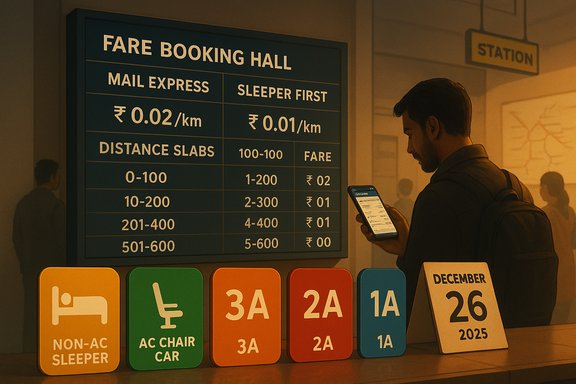
1) Mail & Express (including AC classes): uniform 2 paise per kilometre
- Across Mail/Express trains — for both non‑AC and AC classes including Sleeper, AC Chair Car, AC 3‑Tier (3A), AC 2‑Tier (2A) and AC First Class (1A) — the basic fare has been increased by 2 paise (₹0.02) per kilometre.
- Practical math: additional = distance (km) × ₹0.02. For a 500 km journey the addition is ~₹10; for 1,000 km it's ~₹20.
2) Sleeper Class Ordinary and First Class Ordinary: 1 paise per kilometre
- For non‑suburban journeys in Sleeper Class Ordinary and First Class Ordinary, the basic fare has been raised uniformly by 1 paise (₹0.01) per kilometre.
- Practical math: additional = distance (km) × ₹0.01. So a 500 km sleeper booking will see roughly ₹5 extra on the basic fare.
3) Second Class Ordinary (Ordinary Non‑AC) — slabbed flat increases beyond 215 km
- Second Class Ordinary fares are unchanged for journeys up to 215 km. For longer distances, a graded slab applies:
- 216–750 km: flat increase of ₹5
- 751–1,250 km: flat increase of ₹10
- 1,251–1,750 km: flat increase of ₹15
- 1,751–2,250 km: flat increase of ₹20
- This slabbed approach protects short‑distance passengers while adding a modest flat increment for increasingly long ordinary-class trips.
4) Premium / Special services
- The revised basic fares were also applied to a long list of premium and special services (Rajdhani/Shatabdi/Duronto/Vande Bharat/Tejas, Humsafar, Amrit Bharat, Garib Rath, Jan Shatabdi etc. in line with the class‑wise increases — i.e., the same per‑km or slab rules that apply to the corresponding class. AC MEMU/DEMU and certain suburban exceptions remain excluded where specified.
Quick reference examples for common journeys (basic fare delta only)
- 250 km
- Mail/Express (any class): 250 × 0.02 = ₹5 extra.
- Sleeper/First ordinary: 250 × 0.01 = ₹2.50 extra.
- Second Class Ordinary (216–750 km slab): ₹5 extra.
- 500 km
- Mail/Express (any class): 500 × 0.02 = ₹10 extra.
- Sleeper/First ordinary: 500 × 0.01 = ₹5 extra.
- 1,000 km
- Mail/Express: 1,000 × 0.02 = ₹20 extra.
- Sleeper/First ordinary: 1,000 × 0.01 = ₹10 extra.
- Second Class Ordinary slab (751–1,250 km): ₹10 extra.
- 2,000 km
- Mail/Express: 2,000 × 0.02 = ₹40 extra.
- Sleeper/First ordinary: 2,000 × 0.01 = ₹20 extra.
- Second Class Ordinary slab (1,751–2,250 km): ₹20 extra.
Verification and cross‑checks
The core numeric claims — 1 paise/km (ordinary sleeper/first class), 2 paise/km (mail/express across AC and non‑AC), the Second Class slab increases beyond 215 km, the effective date (tickets issued on/after Dec 26, 2025) and the ministry’s revenue estimate (~₹600 crore) — are corroborated by multiple independent national outlets and the ministry’s notification as published in the press. See reporting in The Times of India, The Economic Times and India Today for consistent figures and the same issue‑date clarification. The ₹600 crore figure is presented by the ministry as an estimated additional revenue for the current fiscal year; treat it as an official projection rather than an audited outcome. Independent media reports quote it as the department’s own estimate.What passengers must watch and practical booking guidance
Booking date matters — issue date vs travel date
- The decisive rule is issue date, not travel date. If a ticket is bought before December 26, 2025, that booking retains the older fare even if the travel occurs after the 26th. That makes when you buy often more important than when you travel. IRCTC and station fare boards should reflect the updated fares after midnight on December 26. Passengers should confirm the ticket‑issue timestamp on printed or e‑tickets.
Suburban commuters and season tickets are spared
- Monthly/quarterly season passes and suburban fares (both suburban and non‑suburban routes where listed) are exempt. That is the policy’s single strongest consumer protection and was highlighted repeatedly by the ministry to limit impact on daily commuters.
Small per‑ticket amounts can add up
- Individually the increases are small — often single‑digit rupees for medium distances — but family bookings and frequent travellers should multiply the per‑ticket increase across passengers and trips. Budget accordingly for holiday and peak‑season group travel.
Check the fare breakdown and keep records
- Check IRCTC’s fare breakdown before confirming a purchase; keep a copy of the e‑ticket showing issue date and fare details if you booked near the implementation date. If a discrepancy appears at purchase or at counters, use the Railway grievance channels.
Critical analysis — strengths, limitations and likely risks
Strengths and defensible design choices
- Targeted approach: The policy is narrowly calibrated — paise‑level increments and flat slabs — and spares suburban and short trips. That design reduces political heat while still widening the revenue base marginally.
- Predictable, low‑friction increases: Per‑km increments are easy for passengers to understand and simple to implement in ticketing systems (IRCTC fare tables and counters). They also avoid changing reservation or ancillary structures which would complicate ticketing.
- Revenue at scale: Small per‑ticket increases across a massive passenger base can yield meaningful receipts; the Railways’ official estimate for this revision is roughly ₹600 crore in additional revenue for the fiscal year, which the ministry says will support operations and maintenance. Treat this as the ministry’s projection.
Limitations and risks
- Distributional fairness: Although small in absolute terms, the increases are regressive if long‑distance travel is disproportionately used by lower‑income groups (migrant workers and seasonal travellers). The exemption for suburban commuters helps, but rural-to-urban long‑distance ordinary travel may face a relative burden that the notification does not directly address.
- Timing and visibility: Implementing the change in late December — a peak travel period in many parts of the country — increases public visibility and the chance of amplified complaints. Even modest fare rises can trigger negative attention on high‑volume corridors.
- Communication friction — issue date confusion: The policy’s reliance on ticket issue date (not travel date) is fair administratively but can confuse passengers who book months ahead. Clear, repeated public messaging and visible fare charts at booking points are essential to avoid complaint volumes.
- Unclear allocation of additional revenue: The ministry states the rationalisation is for sustainability, but independent transparency on how the extra receipts will be used (safety, maintenance, pension support, staffing) will determine public acceptance. The ₹600 crore figure must be followed up in audited accounts or subsequent budget statements to verify intent vs. outcome.
Wider ramifications: markets, policy and politics
- Financial markets reacted quickly: railway‑linked equities, including Rail Vikas Nigam Ltd (RVNL), Indian Railway Finance Corporation (IRFC) and other related stocks, recorded upticks on the news, signalling investor optimism that even modest fare adjustments can lift state‑owned enterprise revenues. This market response was documented on the same day as implementation.
- Policy precedent: This December move is the second fare rationalisation in the fiscal year (an earlier rationalisation took effect in July 2025). Together these incremental steps indicate a policy preference for predictable, small fare adjustments rather than one‑off large hikes. The pattern signals that the Railways sees paise‑level per‑km reforms as a low‑visibility but steady revenue stream.
- Political exposure: While the increases are designed to be minimally painful, they may become politically salient on busy long‑haul corridors or during election cycles if opposition parties or local actors frame them as a burden. The Railways will need to pair revenue messaging with visible service improvements to preempt or blunt such criticism.
Practical checklist for passengers (compact and actionable)
- If travelling soon and able to book before December 26, 2025, consider booking earlier to lock in the older fare. Confirm the ticket‑issue timestamp on your e‑ticket.
- For journeys of ~500 km, expect roughly ₹10 extra in Mail/Express classes and ₹5 extra in Sleeper/First ordinary basic fare. Multiply by the number of passengers.
- Suburban season‑ticket holders need not change plans; monthly/quarterly passes remain unaffected.
- Always review IRCTC’s fare breakdown before payment and keep a screenshot of the checkout page showing the issue date and fare details.
- If you find a discrepancy at the counter or online, use Railways’ grievance mechanisms and preserve receipts and e‑ticket copies for follow‑up.
What to watch next (metrics and indicators)
- IRCTC fare displays and counter practice: ensure online and offline systems consistently use the new fare rules and that counters do not apply the new fare to tickets issued earlier. Any systemic divergence should be reported promptly.
- Passenger complaints and social sentiment: monitor complaint volumes, social feedback on high‑traffic routes, and media coverage for emergent hotspots where even small increases trigger disproportionate distress.
- Revenue realisation and disclosure: check quarterly or interim Railways accounts to see whether the projected ~₹600 crore is realised and, crucially, how the receipts are allocated (maintenance, safety, staffing, pensions). Treat the ₹600 crore figure as the ministry’s estimate until verified via accounting statements.
- Any subsequent changes: the political and fiscal environment could prompt further rationalisations or reversals; watch for ministerial clarifications, parliamentary questions or state responses.
Conclusion
The December 26, 2025 fare rationalisation is deliberately modest and targeted: a paise‑level per‑kilometre nudge for long‑distance classes and flat slab rises for longer ordinary second‑class journeys, with clear exemptions for suburban and season tickets. At the ticket‑level the extra outlay is often minimal (single‑digit rupees for many trips), but multiplied across millions of passengers it is expected to generate material revenue for Indian Railways, which the ministry estimates at about ₹600 crore for the current year. Whether the measure will translate into visible improvements for passengers — faster maintenance cycles, safety upgrades, or better services — hinges on transparent allocation and follow‑through by the ministry. Travelers should note the decisive role of the ticket issue date, check IRCTC fare breakdowns carefully at purchase, and budget for small incremental costs for medium‑ and long‑haul travel.Source: ET Now Train travel becomes expensive from today, Dec 26: Know how much extra passengers will pay for Sleeper, 3A, 2A, 1A
