

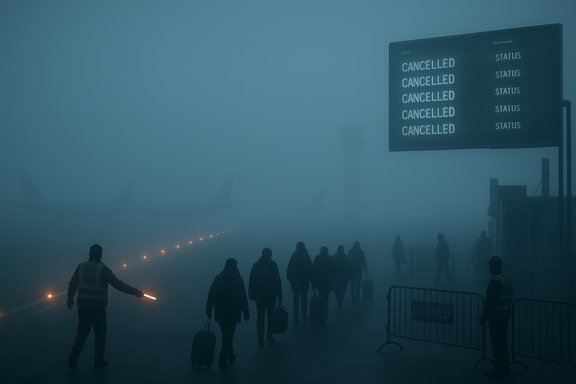
IndiGo’s network faced fresh disruption on December 15, 2025, as dense winter smog and low-visibility conditions across the Delhi‑NCR region forced dozens of domestic departures to be cancelled or diverted, compounding a turbulent month for the country’s largest carrier and leaving travellers scrambling for alternate plans.
Winter smog and morning fog are recurring hazards across northern India, but this week’s event was unusually severe: air quality indices in Delhi registered in the “severe-plus” band and visibility dropped to levels that routinely trigger low-visibility operations (LVO) at major airports. Those conditions directly affect landing minima and runway visual range (RVR), forcing airports and airlines to limit or suspend operations for safety reasons. The impact arrived against the backdrop of a larger operational crisis for IndiGo earlier in December, when crew rostering, regulatory friction and network recovery efforts led to mass cancellations at several airports. Regulators and central government offices have been closely monitoring the airline’s recovery, and airlines and airports are now operating under heightened scrutiny.
The airlines and airports involved followed safety protocols and issued advisories; that is the right priority. Yet the public record from mid‑December shows room for improvement in passenger communication, in network resilience design, and in the long‑term public policies that reduce the recurrence of hazardous smog. For travellers, the immediate takeaway is simple and practical: before departing for the airport, verify your flight on the airline’s official channels, be prepared for last‑minute changes during peak winter mornings, and document any expenses if you are forced to rebook or arrange emergency accommodation. Cautionary note: reported cancellation totals and route‑level lists published in fast‑moving news coverage can change as airlines reconcile operations. For confirmation of a specific flight number or to pursue refund and rebooking remedies, rely on the airline’s official status feed and customer service channels.
Source: ET Now IndiGo flight cancellation status Dec 15: Check full list of flights cancelled from Delhi, Chennai, Hyderabad
 Background
Winter smog and morning fog are recurring hazards across northern India, but this week’s event was unusually severe: air quality indices in Delhi registered in the “severe-plus” band and visibility dropped to levels that routinely trigger low-visibility operations (LVO) at major airports. Those conditions directly affect landing minima and runway visual range (RVR), forcing airports and airlines to limit or suspend operations for safety reasons. The impact arrived against the backdrop of a larger operational crisis for IndiGo earlier in December, when crew rostering, regulatory friction and network recovery efforts led to mass cancellations at several airports. Regulators and central government offices have been closely monitoring the airline’s recovery, and airlines and airports are now operating under heightened scrutiny. What happened on December 15: a concise timeline
- Early morning December 15: dense fog and hazardous smog enveloped Delhi-NCR; visibility fell sharply during peak pre-dawn hours.
- Delhi Airport and airlines moved to low‑visibility operations or suspended certain departures until conditions improved. Airport authorities reported cancellation and diversion figures while airlines issued travel advisories.
- IndiGo posted advisories asking customers to check flight status via official channels and confirmed ground teams were assisting impacted travellers. Official tallies of cancelled flights differed between outlets as the situation evolved.
Numbers — why tallies vary
Initial, on‑the‑ground counts reported by Delhi Airport and press agencies during the morning gave figures such as “40 flights cancelled and 4 diverted,” while aggregated press reporting later cited higher totals of IndiGo cancellations across multiple airports. These discrepancies are common in fast‑moving incidents: early airport statements represent a snapshot, and airline‑level reconciliations that follow can revise totals up or down as schedules are reconciled. Reported totals for the day ranged from several dozen cancellations at Delhi to more extensive disruption across the IndiGo network.Why fog and smog ground flights: the technical explanation
Aviation operations are governed by visibility minima tied to the equipment installed at the airport and the certification of the aircraft and crew. The Instrument Landing System (ILS) is categorized so higher categories (CAT II, CAT III) permit operations in lower RVR (Runway Visual Range); when RVR falls below the published minima, safe landings cannot be guaranteed and flights are delayed, diverted, or cancelled. Typical minima examples:- CAT I: RVR ≈ 550 m
- CAT II: RVR ≈ 300–350 m
- CAT III (A/B): RVR as low as 75–200 m, requiring autoland and certified crews
The operational picture: airports and routes affected
Local reporting and airline advisories on December 15 documented cancellations and delays not only at Delhi but at a handful of other cities in the IndiGo network where crew rotation and diverted aircraft created knock‑on effects.- Delhi (Indira Gandhi International Airport): morning disruptions were the worst; airport statements early in the day recorded dozens of cancellations and a small number of diversions.
- Secondary impacts were reported at other airports (Goa, Coimbatore, Chennai, Hyderabad, Coimbatore), where scheduled sectors were either delayed or cancelled due to aircraft and crew arriving late or being unable to operate into Delhi.
Important verification note: multiple outlets published route‑level lists during the disruption; where a passenger needs absolute confirmation for a specific flight number, the most reliable source is the airline’s live status page or the airport’s arrivals/departures board, because third‑party lists can change as the situation develops.
How IndiGo and Delhi Airport responded — promises, procedures, and gaps
IndiGo issued travel advisories advising passengers to check the airline’s mobile app and website, and said ground staff at affected airports were assisting travellers. The carrier emphasized safety protocols and said teams were coordinating with Delhi Airport to manage operations. Delhi Airport posted advisories on its public channels indicating that low visibility had affected operations and that cancellations/diversions were being recorded. From December’s broader context, there are a few operational measures the airline has used during earlier disruptions that reappeared as part of the response playbook:- Automatic refunds and waivers: During earlier December disruptions, IndiGo promised automatic refunds for cancelled flights and a full waiver on change/cancellation fees for certain affected travel windows. Passengers reported mixed success in receiving prompt refunds or rebooking assistance, reflecting the scale of the disruption and the strain on contact centres.
- Accommodation and care for stranded passengers: The airline has in the past arranged hotels and meals for passengers affected by long delays; such measures are typically applied on a case‑by‑case basis and depend on length of delay and regulatory guidance.
Critical appraisal of the response
IndiGo’s public messaging focused on safety and real‑time status checks, which is appropriate given the cause (weather). However, the airline’s ability to execute mass operational recovery — rebooking, refunds and passenger care — has been the subject of intensified scrutiny after earlier December cancellations. The principal criticisms centre on:- Scale of contact centre and ground resources: when hundreds of flights are affected, online systems and AI assistants can help scale responses, but passengers still need timely human support for refunds, missed connections and baggage retrieval.
- Consistency of passenger communication: varied reports across airports and news outlets show that some customers received clear instructions while others experienced confusion at check‑in counters.
- Network fragility: repeated disruptions in a short span expose how tightly coupled summer/winter schedules are to crew availability and aircraft rotations; severe weather that affects a hub like Delhi can cascade across the entire airline network.
Passenger rights and practical steps to manage disruption
Passengers affected by cancellations or long delays must know what they can reasonably expect. Practical, sequential steps for travellers caught in this disruption:- Check official live status — use the airline’s website or mobile app and the airport’s arrivals/departures board before leaving for the airport. These are the authoritative sources for gate and schedule information.
- Contact the airline — if your flight is cancelled, use the airline’s rebooking and refund tools online; use contact centre options (phone / chat) only if online remedies are insufficient. Expect longer than usual hold times during major disruptions.
- Document expenses — keep receipts for meals, accommodation and transport if you need to claim reimbursements under your fare rules or travel insurance. Airlines sometimes arrange accommodation for long ground holds, but policies vary.
- Explore alternatives — where time is critical, look for alternate carriers or ground travel options; be mindful that rebooking on other airlines may be costly and not always covered by your original carrier.
- Know your refund and re‑booking entitlements — airlines usually offer full refunds for cancelled flights and may waive change fees; check the airline’s published policy for the specific disruption window.
Systemic implications: why this matters beyond a single day
A one‑day spike in cancellations driven by weather is a known operational risk, but the December sequence of events raises larger questions about airline and infrastructure resilience in India:- Hub concentration risk: when a single hub like Delhi is heavily affected, cascading delays impact national networks. Airlines that operate dense point‑to‑point rotations from a single hub are more vulnerable to this cascade.
- Infrastructure preparedness: runway and ILS capability upgrades (for example, moving to CAT III B systems) reduce weather‑related cancellations, but such upgrades take time and must be paired with certified aircraft and crew. Delhi Airport has been upgrading infrastructure in recent months to improve low‑visibility capability, a positive step but not an immediate cure.
- Operational staffing and regulation: IndiGo’s earlier December difficulties centered on crew rostering and regulatory frictions over duty‑time limits; those problems increase vulnerability to subsequent, independently caused events like fog. When roster reserves are thin, even routine weather can cascade into mass cancellations.
Strengths observed in the response
- Clear safety‑first framing: both the airport and airline prioritised safety over schedule adherence, an appropriate stance given the nature of the hazard.
- Use of digital status channels: the airline pushed customers toward its app and website, which are the fastest ways to distribute updated flight information at scale.
- Regulatory attention: central agencies and the aviation ministry have been actively engaged during the wider December disruption, increasing transparency and accountability for recovery actions.
Risks, weaknesses and unresolved questions
- Data and communication gaps: early morning counts (airport vs media aggregates) diverged and route lists published by outlets can be out of date within hours; this creates passenger confusion. Real‑time, unified status feeds across airports and carriers would reduce this friction.
- Operational fragility after earlier disruptions: IndiGo’s earlier network instability in December suggests recovery buffers (standby crews, spare aircraft) may be insufficient for sustained, concurrent incidents. That fragility is a commercial and reputational risk.
- Health and wider public‑policy implications: the smog causing these disruptions is also a public health emergency, as hospitals reported increased respiratory cases. Tackling the root causes (crop residue burning, vehicular and industrial emissions) is a long‑term necessity to reduce the winter recurrence of such disruptive episodes.
What airlines and airports should do next (recommended best practices)
- Increase transparency with unified, timestamped cancellation and diversion feeds that passengers, travel agents and aggregators can use to provide consistent information.
- Build larger operational reserves: maintain additional crew and aircraft buffers during peak winter months and major holiday periods to prevent knock‑on cancellations.
- Fast‑track low‑visibility upgrades at high‑risk airports and expand crew and aircraft certification for CAT II/III operations where feasible.
- Coordinate with civil authorities on public communications when smog is forecast, including advance passenger advisories and alternate travel planning guidance.
- Implement post‑incident reviews with public summaries so travellers and regulators can see corrective actions and timelines.
How to check your IndiGo flight status right now
- Use the IndiGo mobile app or the airline’s official website for live updates on cancellations, re‑booking options and refund status.
- Monitor the airport arrivals/departures board or the airport’s official social and public notices for gate and runway information.
- If you are already at the airport, check with ground staff at IndiGo counters for immediate rebooking or accommodation assistance; keep receipts for any out‑of‑pocket emergency expenses that may be claimable.
Final assessment and conclusion
The December 15 disruptions to IndiGo’s schedule are a vivid reminder that weather‑driven operational risk and pre‑existing network fragility can interact to produce outsized disruption. On paper, the technical controls are straightforward — determine RVR, compare with runway minima and act — but in practice the human, logistical and communications dimensions determine how well customers are protected.The airlines and airports involved followed safety protocols and issued advisories; that is the right priority. Yet the public record from mid‑December shows room for improvement in passenger communication, in network resilience design, and in the long‑term public policies that reduce the recurrence of hazardous smog. For travellers, the immediate takeaway is simple and practical: before departing for the airport, verify your flight on the airline’s official channels, be prepared for last‑minute changes during peak winter mornings, and document any expenses if you are forced to rebook or arrange emergency accommodation. Cautionary note: reported cancellation totals and route‑level lists published in fast‑moving news coverage can change as airlines reconcile operations. For confirmation of a specific flight number or to pursue refund and rebooking remedies, rely on the airline’s official status feed and customer service channels.
Source: ET Now IndiGo flight cancellation status Dec 15: Check full list of flights cancelled from Delhi, Chennai, Hyderabad
