

This year’s ITAP 2025 in Singapore and Microsoft Ignite 2025 in San Francisco made one thing unmistakably clear: industrial AI is leaving the lab and becoming a production‑grade multiplier for manufacturing, and that transformation is being executed by a broad partner ecosystem working on top of Microsoft’s cloud, Copilot, and new agent governance constructs. Demonstrations ranged from simulation‑driven humanoid robotics and GPU‑accelerated digital twins to agentic integrations that bring OT (operational technology) data into the flow of work in Microsoft Teams — and Microsoft’s platform-level announcements, including Agent 365 and the new IQ layers, are designed to make those partner solutions operational and governable at scale.
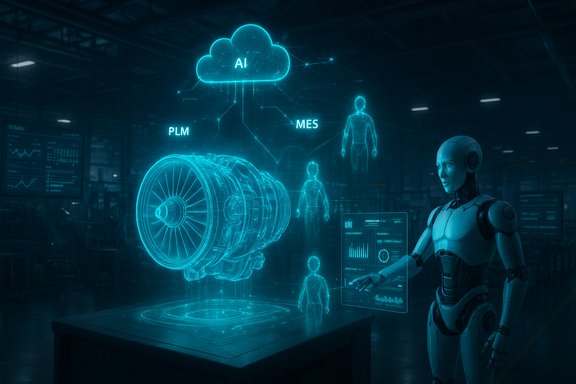
Manufacturers have spent the last decade building digital foundations — PLM, MES, ERP, historians, and basic IoT telemetry — but most projects stalled at pilots because data remained siloed and AI lacked enterprise context. The twin events of ITAP and Ignite showcased how vendors and systems integrators are now knitting those islands together with cloud scale, pretrained models, and agentic workflows that can act autonomously or with human oversight. This partner-led approach emphasizes three practical outcomes: faster time to value, governed agentic automation, and real‑time decisioning across engineering, operations, and service. Microsoft’s industry blog framed those outcomes with concrete examples: Siemens, SymphonyAI, Sight Machine at ITAP; Hexagon, Krones, and PTC on the Ignite Industry Hub; plus a set of platform announcements — Agent 365, Azure Copilot enhancements, and the Work/Fabric/Foundry IQ trio — intended to provide the data, knowledge, and control layers agents need. The demos were not abstract concept pieces; they connected to customer narratives and measurable KPIs.
Caveat: Realizing the full digital thread still requires disciplined data‑modeling, BOM governance, and rigorous integration with shop‑floor systems — work that many legacy manufacturers underestimate.
Risk: Surface‑level convenience must be matched with robust access controls and audit trails — telling Copilot to schedule a job is useful only if permissioning and maintenance workflows are enforced.
Caveat: The “complete stack” claim is only as good as the on‑site data quality and the speed of edge‑to‑cloud connectivity; brownfield sites often need months of cleanup and edge modernization.
Note: Achieving these speedups typically requires investment in validated physics models and a careful mapping of model fidelity vs. latency for real‑time use.
However, practical success will depend on disciplined data work, rigorous safety and security practices, and contractual clarity on outcomes and responsibilities. Vendors and platform providers can accelerate manufacturing modernization, but enterprise IT and OT teams must insist on governance, measurable pilots, and human‑centered operational design before scaling. In short: the technology is ready to change factories at scale — but only when the organization, the data, and the governance are equally prepared.
Source: Microsoft Partners powering AI transformation globally: Agentic solutions in action at ITAP 2025 and Microsoft Ignite 2025 - Microsoft Industry Blogs
 Background / Overview
Manufacturers have spent the last decade building digital foundations — PLM, MES, ERP, historians, and basic IoT telemetry — but most projects stalled at pilots because data remained siloed and AI lacked enterprise context. The twin events of ITAP and Ignite showcased how vendors and systems integrators are now knitting those islands together with cloud scale, pretrained models, and agentic workflows that can act autonomously or with human oversight. This partner-led approach emphasizes three practical outcomes: faster time to value, governed agentic automation, and real‑time decisioning across engineering, operations, and service. Microsoft’s industry blog framed those outcomes with concrete examples: Siemens, SymphonyAI, Sight Machine at ITAP; Hexagon, Krones, and PTC on the Ignite Industry Hub; plus a set of platform announcements — Agent 365, Azure Copilot enhancements, and the Work/Fabric/Foundry IQ trio — intended to provide the data, knowledge, and control layers agents need. The demos were not abstract concept pieces; they connected to customer narratives and measurable KPIs. Partner‑led innovation on the show floor
Siemens: digital threads and generative engineering
Siemens used NX X and Teamcenter X to show an end‑to‑end “digital thread” for a Rolls‑Royce engine component, threading generative design, engineering collaboration, and downstream manufacturing processes into a single data narrative. The demo illustrated how cloud‑native CAD/PLM can reduce handovers and accelerate iteration when AI is woven into design and PLM workflows. Siemens’ broader messaging at concurrent Realize events supports this direction: cloud‑hosted NX X and Teamcenter X are positioned explicitly as the foundation for AI‑augmented engineering and closed‑loop quality systems. Strength: Demonstrates a practical path to shorten NPI (new product introduction) cycles and preserve traceability across PLM and manufacturing operations.Caveat: Realizing the full digital thread still requires disciplined data‑modeling, BOM governance, and rigorous integration with shop‑floor systems — work that many legacy manufacturers underestimate.
SymphonyAI: industrial AI inside Teams and Copilot
SymphonyAI’s IRIS Foundry was shown integrated into Microsoft 365 Copilot and Microsoft Teams, enabling frontline users and operators to ask natural‑language questions about production performance, surface anomalies, and trigger maintenance workflows without leaving Teams. The integration leverages a Model Context Protocol (MCP) pattern to map OT data, knowledge graphs, and operator actions into Copilot experiences, turning conversations into operational steps. SymphonyAI’s own announcements and partner materials confirm the Teams and MCP integration. Strength: Lowers the adoption barrier for frontline workers, who rarely have time or training to use complex dashboards.Risk: Surface‑level convenience must be matched with robust access controls and audit trails — telling Copilot to schedule a job is useful only if permissioning and maintenance workflows are enforced.
Sight Machine: a complete industrial AI stack and Fabric integration
Sight Machine presented an “industrial AI stack” that combines real‑time data ingestion, Fabric integration, and NVIDIA Omniverse 3D visualization. The company positions its platform as an enterprise bridge that standardizes messy plant data into a queryable manufacturing data foundation, then exposes it to agents and digital twins. Recent Sight Machine announcements confirm expanded Fabric and Omniverse integrations and a focus on bringing 3D digital twins and real‑time KPIs into operator workflows. Strength: Converts high‑volume, noisy OT data into structured assets and events quickly — a prerequisite for any scaleable industrial AI.Caveat: The “complete stack” claim is only as good as the on‑site data quality and the speed of edge‑to‑cloud connectivity; brownfield sites often need months of cleanup and edge modernization.
Industry Hub highlights at Microsoft Ignite 2025
Hexagon: AEON humanoid, simulation‑first training, and Omniverse
Hexagon made a bold presentation with AEON, a humanoid built for industrial tasks and trained via simulation on NVIDIA Isaac and Omniverse with Azure as the development and deployment fabric. Hexagon’s materials and NVIDIA’s coverage describe a simulation‑first approach that compressed locomotion and manipulation training cycles and uses Omniverse/OpenUSD for digital twin creation and model refinement. The AEON narrative demonstrated how physical AI — robots trained in realistic simulated environments and orchestrated from the cloud — can move from prototypes to piloted factory deployments. Why it matters: AEON shows how physically capable robots can be developed more quickly and governed via cloud assets and model lifecycle management. The combination of on‑board compute (Jetson), Omniverse for digital twins, and Azure for orchestration is a repeatable pattern for other robotics efforts. Risk: Humanoid robotics still faces durability, safety certification, and total cost‑of‑ownership hurdles. Simulation reduces early risk but doesn’t eliminate integration complexity in live production environments.Krones (with SoftServe and Ansys): digital twins that run in minutes
Krones demonstrated an AI‑driven digital twin solution that collapses fluid‑dynamics and line‑level simulations from multi‑hour runs to near‑real‑time iterations — reportedly reducing simulation cycles from 3–4 hours to under five minutes by combining Ansys physics solvers, NVIDIA GPU acceleration, Omniverse, and Azure compute. This kind of speed enables live optimization, A/B scenario testing, and autonomous decisioning for beverage and bottling lines. The Krones press materials provide concrete metrics that underline the practical gains from GPU‑backed simulation on cloud infrastructure. Benefit: Real‑time simulations enable autonomous control loops and faster throughput optimization, which directly affect yield, quality, and energy consumption.Note: Achieving these speedups typically requires investment in validated physics models and a careful mapping of model fidelity vs. latency for real‑time use.
PTC: unifying the digital thread (reported by Microsoft)
Microsoft’s industry column listed PTC as a partner highlighting “unifying the digital thread across engineering, manufacturing, and service” on Microsoft’s cloud. PTC has a long history of ThingWorx, Windchill, and Creo integrations with Microsoft Azure, and the company frequently positions its suite as the backbone for engineering‑to‑service traceability. Independent, event‑specific reporting about a live Ignite demo is less extensive than for Hexagon or Krones; the Microsoft blog is the primary public record for PTC’s specific Ignite narrative at the time of writing. Readers should treat the PTC Ignite mention as a Microsoft‑reported showcase corroborated by PTC’s known Azure partnership history. Caveat: When partner demos are reported primarily by the platform vendor, independent verification of performance claims and deployment scope should be requested during vendor evaluation.Platform announcements that matter (technical verification)
Microsoft used Ignite to publish several platform‑level features designed to make agentic industrial AI practical and governable. These are important because they attempt to solve the three perennial enterprise problems: data context, model choice, and safe operations.- Agent 365: Described by Microsoft as a control plane for AI agents, Agent 365 offers a registry, access control, visualization and analytics, interoperability with apps and data, and security controls to monitor and remediate agent behavior. The feature is being made available in early access via Microsoft’s Frontier program and has been covered by major outlets for its enterprise governance approach to agents.
- Work IQ / Fabric IQ / Foundry IQ: Microsoft introduced these IQ layers to unify organizational context across Microsoft 365, Fabric, and Foundry. Work IQ is intended to power Copilot experiences with role‑ and workflow‑level context; Fabric IQ brings a semantic, generative AI layer to enterprise data; Foundry IQ is a managed knowledge system designed to ground agents with vetted knowledge sources. Together, Microsoft positions them as a universal context layer for agents.
- Azure Copilot enhancements: Microsoft detailed more agentic Azure Copilot capabilities to help design, deploy, and operate cloud infrastructure — generating scripts, debugging workloads, and automating repetitive cloud operations. These enhancements are framed as part of a larger “agentic cloud ops” vision.
Real‑world impact: what the metrics show
Concrete customer results are the strongest validator in industrial transformation. Several partner and Microsoft customer stories presented measurable outcomes:- DMG MORI (Tulip + Azure): Microsoft customer materials report a 66.6% reduction in product quality defects and a 60% cut in manufacturing preparation costs after deploying Tulip on Azure across 17 sites. The customer narrative cites Azure OpenAI usage in quality inspection agents and a move to digitized shop‑floor apps. These figures came from a Microsoft customer story that documents the scope and outcomes of DMG MORI’s deployment.
- Krones: Reported simulation cycle times falling from 3–4 hours to less than 5 minutes when GPU‑accelerated physics and Omniverse were applied to beverage line simulations — a shift that underpins real‑time digital twin control. Krones’ own press material contains the performance claim and the architecture partners (Ansys, SoftServe, NVIDIA, Microsoft).
- Hexagon AEON pilots: Hexagon reports pilots with industrial partners and has publicized the simulation‑first training model and platform stack (NVIDIA + Azure) that made faster iteration feasible. Documentation from Hexagon and NVIDIA confirm AEON’s cloud‑backed simulation approach.
Critical analysis — what’s genuinely new, and what’s incremental?
Notable strengths
- Partner ecosystems are maturing: The partner demos show commercial products that integrate PLM, MES, digital twins, and enterprise productivity tools, making cross‑discipline solutions more realistic to deliver at scale.
- Platform governance ambitions: Agent 365 and the IQ layers respond to a real enterprise need — governance, observability, and data grounding — and they align with regulatory and compliance requirements when implemented correctly.
- Simulation‑first robotics and GPU‑driven physics: By using Omniverse and GPU acceleration, partners like Hexagon and Krones turn previously expensive, time‑consuming simulations into actionable, near‑real‑time tools tied directly to operations.
- Flow‑of‑work integration: Surface‑level productivity gains — IRIS Foundry in Teams, Copilot access for frontline workers, and agentic ERP workflows — drastically lower the friction for adoption because they embed insights in tools people already use.
Material risks and blind spots
- Agent proliferation without rigorous governance: The very promise of agentic automation — deploy many small, task‑focused agents — can create an explosion of autonomous behavior vectors. Agent 365 addresses control, but successful governance requires disciplined cataloging, role‑based access, and security telemetry across CI/CD pipelines for agents. Without it, organizations risk runaway automation, misaligned actions, or compliance gaps.
- Data quality and lineage remain foundational hurdles: Claims that agents or digital twins will “just work” ignore months of data engineering in brownfield plants. The speedups shown by Sight Machine or Krones assume validated input data and mature model calibration; many manufacturers will still need significant prework.
- Operational safety and certification for robots: AEON’s simulation shortcuts accelerate development, but industrial humanoids carry a higher bar for safety certification and functional safety standards. Pilots must be coupled with risk assessments and clear rules for human‑robot interaction.
- Vendor and cloud lock‑in risk: The combined stacks (Azure + Foundry + Copilot + partner solutions) provide tight integration and speed, but buyers should weigh lock‑in against portability needs — especially when partners supply both the models and the hosting fabric. Designing escape ramps and data portability agreements is essential.
- Measurement transparency: Many showcased KPIs originate in vendor or platform case stories. Independent audits, reproducible benchmarks, or joint customer validations provide higher confidence than single‑vendor claims. Readers should require granular measurement plans from partners prior to procurement.
Practical guidance for manufacturers evaluating these solutions
- Start with a value map, not technology: Identify the top 3 processes (quality, maintenance, throughput) where measurable ROI is realistic within 6–12 months. Use those outcomes to define data requirements and integration scope.
- Insist on data contracts and an integration playbook: For each upstream system (PLM, MES, ERP, historian), define expected data format, latency, and ownership. Agents and Copilots must be governed by contracts that specify allowed actions and escalation paths.
- Pilot with production fidelity: Choose a pilot line that mirrors scale and variability of the plant, not a controlled lab environment. Validate both model accuracy and procedural readiness (e.g., spare parts, alerts, technician workflows).
- Require governance capability in RFPs: Demand features such as agent registries, telemetry dashboards, role‑based access, audit logs, and automated rollback. Agent 365 and other governance constructs can be referenced as architectural expectations.
- Plan human‑in‑the‑loop checkpoints: Even high‑confidence agents should operate under human supervision for the first N actions. Establish escalation rules and learning loops so agents improve safely.
- Negotiate production SLAs and model refresh cadence: Understand who is responsible for model drift mitigation, retraining, and patching — the partner, the cloud operator, or a joint model ops team.
- Protect industrial safety and cybersecurity: Incorporate safety standards and security testing (penetration tests, adversarial resilience) into vendor contracts. Ensure agents cannot bypass safety interlocks or change control logic without human review.
Where the next 12–24 months will matter
- Operationalization, not novelty, will determine winners. Partners that pair domain depth (PLM, MES, physics modeling) with robust model and data governance will win the earliest enterprise deployments.
- Cross‑vendor interoperability will be a differentiator. MCP‑style protocols and Foundry IQ‑like managed knowledge systems reduce bespoke engineering when partners adhere to common standards.
- Edge‑cloud orchestration must become routine. Real industrial use‑cases need low latency, robust edge inference, and secure sync to the cloud for agent governance, telemetry, and retraining.
- Outcome guarantees and measurement contracts will be more common. As vendors mature, expect more partners to offer money‑back or KPI‑tied SLAs for clearly scoped industrial transformations.
Final assessment
ITAP 2025 and Microsoft Ignite 2025 together signaled a decisive shift: industrial AI is scaling beyond experimentation into operational reality, and that shift is being driven by partner innovation married to platform governance. Demos from Siemens, SymphonyAI, Sight Machine, Hexagon, Krones, and others show that the pieces — digital twins, physics‑based simulation, agentic workflows, and cloud orchestration — are aligning. Platform announcements like Agent 365 and the IQ layers provide a necessary control plane and data context that enterprises asked for.However, practical success will depend on disciplined data work, rigorous safety and security practices, and contractual clarity on outcomes and responsibilities. Vendors and platform providers can accelerate manufacturing modernization, but enterprise IT and OT teams must insist on governance, measurable pilots, and human‑centered operational design before scaling. In short: the technology is ready to change factories at scale — but only when the organization, the data, and the governance are equally prepared.
Quick checklist for action (for manufacturing leaders evaluating agentic AI)
- Identify one high‑impact pilot with measurable KPIs and executive sponsorship.
- Require partners to demonstrate data lineage, test datasets, and MLOps cadence.
- Insist on agent governance: registry, RBAC, telemetry, rollback.
- Validate safety certification plans for robotics and physical automation.
- Negotiate SLAs tied to throughput, quality, or availability improvements.
- Build a three‑month training plan for frontline adoption that leverages Teams/Copilot integrations.
Source: Microsoft Partners powering AI transformation globally: Agentic solutions in action at ITAP 2025 and Microsoft Ignite 2025 - Microsoft Industry Blogs
