

Infinity Group’s sharp pivot to a pure‑play Microsoft strategy — built around Dynamics 365 Business Central, Power Platform, Microsoft Fabric and Copilot — has translated into rapid revenue expansion, operational leverage through intelligent automation, and growing recognition inside Microsoft’s partner ecosystem; the company says it delivered more than 30% growth in a year without increasing headcount and is now operating with repeatable, packaged delivery models that scale.
Since its founding in 2001, Infinity Group evolved from an infrastructure- and telco-focused managed service provider into a specialist Microsoft solutions partner. That repositioning accelerated during the pandemic when the company deliberately divested legacy telecoms operations and committed to a single‑platform strategy centred on Microsoft cloud and business applications. The move to concentrate on the mid‑market and to “use the same technology we sell to customers to make the business smarter” has been the public narrative from Infinity’s leadership. By re‑architecting internal operations on Dynamics 365 and surrounding Microsoft capabilities, Infinity reports it now runs finance, billing, project operations and service management on Business Central and Power Platform, and uses Microsoft Fabric for analytics and reporting. The company also highlights integration of Microsoft Copilot and Power Platform automations to speed marketing, proposals and delivery processes. What makes Infinity’s account interesting to customers and channel watchers is the claim that the business has scaled materially (management cites a multi‑fold revenue increase since the Microsoft-only decision) while keeping headcount flat — enabled by automation, AI assistants and repeatable packaged solutions. Those assertions, if accurate and repeatable, map closely to how Microsoft expects its partners to drive growth in an “AI‑first” era: deepen technical specialisation, productise IP, and embed customer‑facing AI workflow accelerators.
That said, the model is not without caveats. Vendor concentration, governance of AI systems, due diligence on claimed financial outcomes, and contractual protections remain critical considerations for buyers. Claims of awards, percentages and saving figures should be validated with hard evidence during procurement. When the product and delivery playbook are proven, however, Infinity’s approach — and the larger trend it exemplifies — points to a more automated, repeatable, and outcome‑oriented Microsoft channel where scaling is achieved through IP and orchestration rather than sheer headcount growth.
Source: IT Europa Infinity Group goes all in on Microsoft as 'intelligent automation' fuels growth
 Background
Since its founding in 2001, Infinity Group evolved from an infrastructure- and telco-focused managed service provider into a specialist Microsoft solutions partner. That repositioning accelerated during the pandemic when the company deliberately divested legacy telecoms operations and committed to a single‑platform strategy centred on Microsoft cloud and business applications. The move to concentrate on the mid‑market and to “use the same technology we sell to customers to make the business smarter” has been the public narrative from Infinity’s leadership. By re‑architecting internal operations on Dynamics 365 and surrounding Microsoft capabilities, Infinity reports it now runs finance, billing, project operations and service management on Business Central and Power Platform, and uses Microsoft Fabric for analytics and reporting. The company also highlights integration of Microsoft Copilot and Power Platform automations to speed marketing, proposals and delivery processes. What makes Infinity’s account interesting to customers and channel watchers is the claim that the business has scaled materially (management cites a multi‑fold revenue increase since the Microsoft-only decision) while keeping headcount flat — enabled by automation, AI assistants and repeatable packaged solutions. Those assertions, if accurate and repeatable, map closely to how Microsoft expects its partners to drive growth in an “AI‑first” era: deepen technical specialisation, productise IP, and embed customer‑facing AI workflow accelerators. How Infinity scaled: the mechanics of intelligent automation
Strategic focus: “going all in” on Microsoft
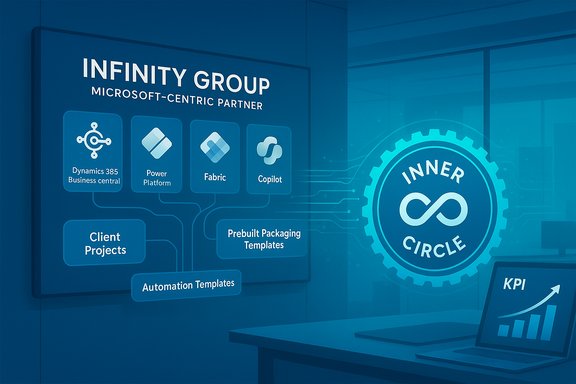
Infinity’s strategy is explicit: concentrate investment and go‑to‑market around Microsoft’s stack — Dynamics 365 Business Central for ERP, Dynamics 365 Sales/Service for CRM and customer service, Power Platform for automation and low‑code extensibility, Azure and Fabric for data, and Microsoft 365/Copilot for productivity and AI augmentation. That alignment has earned Infinity multiple partner badges, advanced specialisations and inclusion in Microsoft’s Inner Circle for Business Applications — a status reserved for top partners globally. Becoming a focused, single‑ecosystem partner enables closer commercial and technical collaboration with Microsoft product teams, faster access to roadmap information, and more credible co‑sell motions. For a mid‑market specialist, those benefits translate into earlier visibility on product changes and preferential enablement opportunities via programs such as FastTrack for Dynamics 365.Customer Zero: using the stack internally
Infinity’s “Customer Zero” journey — running their own operations on the same platform they sell — is a textbook example of internal use‑case validation. They report using Business Central for core finance and billing, Power Platform for workflow automation, and Fabric for reporting and analytics. Marketing and sales processes have been re‑engineered to generate automated proposals and accelerate deal cycles, while project delivery is driven by standardized packages that reduce tail‑latency in implementations. Benefits claimed include:- Faster proposal and delivery times through AI‑assisted content generation and templated implementations.
- Improved margins via headcount‑neutral throughput increases.
- Predictable outcomes for customers through fixed‑price, fixed‑scope packaged offerings (Infinity’s BCQuick deployment is cited as a rapid, lower‑cost Business Central on‑ramp).
Packaging, repeatability and pre‑built IP
Infinity has developed repeatable productised services — pre‑configured Business Central packages, delivery accelerators and automation templates — that reduce the bespoke engineering required on each customer engagement. This is an increasingly standard route for partners to scale: convert services into pre‑tested IP, reduce implementation variability, and lower time‑to‑value for customers. The partner‑to‑product shift mirrors trends across the channel where repeatable offerings become a force multiplier.AI and automation as throughput multipliers
Infinity’s public messaging credits AI — notably Microsoft Copilot integrations — with accelerating everything from customer insight to proposal drafting and project configuration. The company reports that AI and automation enabled a 35% revenue increase in a 12‑month period while keeping staff numbers effectively constant, and that automation delivered a reported £1m bottom‑line saving. Those figures portray a high operational ROI on automation investments, though they should be validated by prospective customers in contract discussions and reference checks.Recognition and partner credentials
Infinity’s partner progress has been visible in its Microsoft credentials and industry mentions:- Inner Circle membership (Business Applications) — Infinity states it is one of the top partners selected globally for the Inner Circle, a distinction that confers direct product‑team access.
- FastTrack partner for Dynamics 365 — the company reports FastTrack accreditation, enabling closer alignment on deployment best practices with Microsoft.
- Advanced Specialisations (Sales & Service, Copilot) — Infinity’s blog and press pieces document a growing list of Microsoft advanced specialisations that evidence technical capability in Dynamics 365 Sales, Customer Service and Copilot scenarios.
Why this matters to customers, prospects and other partners
Tangible benefits for buyers
- Faster deployments and predictable TCO: packaged Business Central offerings reduce customization risk and cap implementation times for common mid‑market scenarios.
- Better operational outcomes through automation: automated first‑ and second‑line processes and AI‑assisted workflows can reduce mean time to resolution and improve margin management for managed services.
- Access to Microsoft roadmap and early features: partners in the Inner Circle and FastTrack programs gain earlier visibility and sometimes early access to pilot or preview features, which customers can leverage for competitive differentiation.
What this says about the channel
Infinity’s story is emblematic of a wider market dynamic: Microsoft is favouring partners that both specialise deeply in its core solution areas and productise delivery. The economics of repeatable, automation‑driven services enable partners to scale revenue without linear headcount growth — a model that is attractive to private equity, investors, and corporate buyers looking for predictable margins.Critical analysis: strengths and credibility checks
Strengths
- Platform alignment delivers focus. Being vertically aligned to Microsoft streamlines investments in skilling, enablement and co‑sell, and reduces the overhead of supporting multiple vendor stacks. That focus is inherently efficient for mid‑market propositions.
- Repeatable IP reduces delivery risk. Fixed‑scope packages and pre‑built accelerators are predictable, which lowers project failure rates and speeds time‑to‑value. This is particularly important for Business Central migrations where customers fear legacy‑to‑cloud ERP projects.
- Operational leverage via automation. When implemented correctly, automation (Power Automate, Copilot, built agents) can shift routine work away from skilled staff, allowing them to focus on higher‑value tasks and thereby increasing realised utilisation and margins.
- Partner credentials matter. Inner Circle status, FastTrack and advanced specialisations materially affect buy signals; those credentials help Infinity appear in shortlists and Microsoft offers and co‑sell channels.
Areas requiring scrutiny or posing risk
- Vendor concentration risk. Committing fully to a single platform lowers product diversification and increases exposure to Microsoft’s product, licensing and pricing shifts. Customers should evaluate exit strategies and integration flexibility for multi‑cloud scenarios.
- Claims and metrics need verification. Infinity’s public claims — growth percentages, the precise year and category of Partner of the Year awards, employee count vs revenue, and the magnitude of automation savings — should be validated with documented evidence (financial summaries, customer reference ROI figures, MS Partner Centre confirmations). Where Infinity’s own press pages and industry write‑ups differ in phrasing or year, customers should request documentary proof.
- Operational maturity vs scale. Automation can scale throughput, but it introduces governance, model‑drift and security responsibilities. For example, agentic AI and email listeners that flag project risk must be governed, auditable and integrated into human escalation models to avoid overreliance on opaque signals.
- Data and compliance risks. Using Copilot and other LLM‑based assistants in service workflows raises questions about data residency, PII exposure, and contractual protections. Organisations must insist on clear data handling terms, model filtering, and guardrails before Copilot or external LLMs touch sensitive business data.
- Talent and change management. Upskilling existing teams to become “orchestrators of AI agents” is non‑trivial; it requires continuous learning, role redesign, and robust retraining pipelines to keep pace with evolving Microsoft features and security guidance.
Practical guidance for prospective customers and procurement teams
When evaluating Infinity Group (or any partner making similar automation claims), procurement, IT and finance teams should follow a structured diligence approach:- Ask for documented references. Obtain two or three customer case studies that match your sector and scale. Validate the reference projects for outcomes (timelines, costs, actual automation savings), not just quotes.
- Request proof of partner status. Ask the vendor to export Partner Centre statements or provide Microsoft confirmation of Inner Circle, FastTrack, Solutions Partner designations and any Partner of the Year awards. These items are verifiable and affect eligibility for co‑sell and support resources.
- Validate IP and package scope. Insist on clear product definitions, what’s configurable vs bespoke, and a documented migration runbook. Confirm rollback and cutover plans and who owns custom code and IP.
- Evaluate AI governance. Require documentation on how Copilot and model‑based agents are configured, what data is logged, how prompts are controlled, and how false positives are handled in automated risk‑flagging systems.
- Negotiate exit and portability terms. Ensure data export, configuration scripts, and code repositories are contractually accessible, and define responsibilities for knowledge transfer if you change vendors later.
- Run a short pilot. Start with a scoped pilot that proves the packaged delivery model and automation ROI before committing to a larger rollout.
The strategic implications for the Microsoft channel
Infinity’s trajectory — concentrating on Microsoft, productising services and embedding AI in delivery — is a microcosm of the channel’s evolution. Microsoft’s partner consolidation and emphasis on depth of expertise reward partners who invest in reproducible IP, strong customer success metrics, and Microsoft‑aligned specialisations.- For larger integrators: the lesson is to productise. Pre‑built IP shortens delivery cycles and reduces implementation risk for clients.
- For mid‑market partners: the lesson is to specialise and align with Microsoft’s solution areas where you can demonstrate repeatable outcomes.
- For customers: the lesson is to prioritize partners that can show both proven technical capability and strong program credentials (Inner Circle, FastTrack, advanced specialisations).
Conclusion
Infinity Group’s move to become a pure‑play Microsoft partner, then to automate and productise delivery around Dynamics 365 Business Central and the Power Platform, illustrates a viable scaling strategy for partners in 2025: invest in platform depth, convert services into repeatable packaged IP, and use AI and automation to boost throughput without linear headcount increases. The company’s credentialing in Microsoft programs and public claims of significant growth and margin improvement are consistent with broader market patterns where specialised partners are winning share.That said, the model is not without caveats. Vendor concentration, governance of AI systems, due diligence on claimed financial outcomes, and contractual protections remain critical considerations for buyers. Claims of awards, percentages and saving figures should be validated with hard evidence during procurement. When the product and delivery playbook are proven, however, Infinity’s approach — and the larger trend it exemplifies — points to a more automated, repeatable, and outcome‑oriented Microsoft channel where scaling is achieved through IP and orchestration rather than sheer headcount growth.
Source: IT Europa Infinity Group goes all in on Microsoft as 'intelligent automation' fuels growth
