

A stunning intraday jump in Infosys’s American Depositary Receipts (ADRs) on December 19, 2025 — an abrupt swing that briefly sent the U.S.-listed INFY to a 52‑week high before multiple NYSE volatility halts brought trading back under control — appears to have been driven by a data‑feed/ticker‑mapping anomaly amplified by algorithmic buying, rather than any material corporate development.
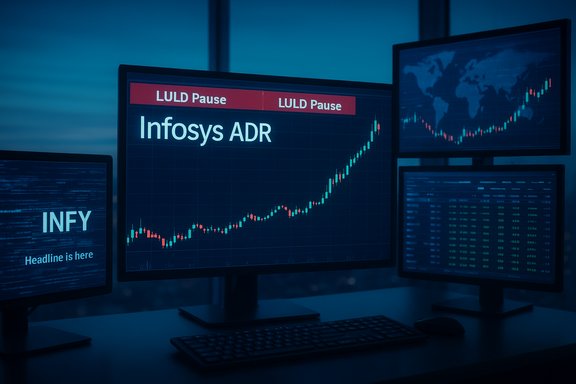
The episode unfolded on a year‑end Friday when liquidity was thin and algorithmic flows were active: U.S.‑traded Infosys ADRs leapt from roughly $19 in the prior session to intraday prints reported as high as $30, triggering several Limit Up–Limit Down (LULD) volatility pauses on the New York Stock Exchange within minutes of the opening bell. Market participants and subsequent press coverage painted a chaotic picture — frenetic volume spikes, options‑market dislocations, contradictory explanations from trading desks, and a company statement stressing that no material event had occurred that required disclosure. At least three distinct narratives emerged in immediate reporting: (1) a suspected ticker‑mapping or data‑feed glitch reported by The Chronicle Journal and relayed by other outlets; (2) an aggressive short‑covering / forced buy‑in or short squeeze hypothesis advanced by some Wall Street traders; and (3) standard market microstructure dynamics — thin liquidity, concentrated algorithmic order flow, and options expiry effects — that can transform modest signals into outsized price moves. Coverage has so far not landed on a single definitive cause, and regulatory and exchange reviews have been signalled.
Source: DT Next Ticker‑mapping error likely behind sudden spike in Infosys ADRs: Report
 Background / Overview
The episode unfolded on a year‑end Friday when liquidity was thin and algorithmic flows were active: U.S.‑traded Infosys ADRs leapt from roughly $19 in the prior session to intraday prints reported as high as $30, triggering several Limit Up–Limit Down (LULD) volatility pauses on the New York Stock Exchange within minutes of the opening bell. Market participants and subsequent press coverage painted a chaotic picture — frenetic volume spikes, options‑market dislocations, contradictory explanations from trading desks, and a company statement stressing that no material event had occurred that required disclosure. At least three distinct narratives emerged in immediate reporting: (1) a suspected ticker‑mapping or data‑feed glitch reported by The Chronicle Journal and relayed by other outlets; (2) an aggressive short‑covering / forced buy‑in or short squeeze hypothesis advanced by some Wall Street traders; and (3) standard market microstructure dynamics — thin liquidity, concentrated algorithmic order flow, and options expiry effects — that can transform modest signals into outsized price moves. Coverage has so far not landed on a single definitive cause, and regulatory and exchange reviews have been signalled. What happened, in plain terms
- The ADRs opened on December 19 with large, rapid buy prints that pushed the price substantially above the prior close (reported prior close levels around $19.18).
- The NYSE’s volatility controls were triggered multiple times (LULD pauses), pausing trading while the exchange assessed the situation.
- Intraday high prints vary by report — some outlets recorded spikes near $27 and others near $30 — while the security ultimately settled far below its peak, finishing the day modestly higher than pre‑open prices.
- Crucially, the price move in the U.S. ADRs was not matched by similar overnight or intraday moves in Infosys’s primary listing on Indian exchanges, which is a strong early signal that the U.S. move was technical in origin rather than fundamentally driven.
The core hypothesis: ticker‑mapping / data‑feed error
How a mapping error can look innocuous but be catastrophic
Financial data vendors and market‑data aggregators maintain large symbol‑mapping tables linking ticker symbols to company names, identifiers, corporate actions, and newsfeeds. If those mappings diverge — for example, if a ticker string is misattributed to the wrong legal entity while still carrying the news, metrics, and headlines of the intended company — automated trading systems can receive internally inconsistent signals: a name that does not match the attached fundamentals. Some trading algorithms are programmed to hunt for those anomalies, interpreting mismatches as an opportunity to buy “mispriced” instruments. When that happens in a thinly traded ADR, the result can be a self‑reinforcing buying loop. Multiple reports cite an instance where several data platforms allegedly mapped the symbol “INFY” to an unrelated issuer while continuing to display Infosys‑specific financial metrics and headlines — a mismatch that could plausibly confuse models that blend price, news and fundamental checks. Those reports emphasize that the problem was systemic (across multiple providers) rather than isolated to a single feed. That systemic nature is what allows rapid, multi‑venue algorithmic order entry and the feedback loops that created the extreme intraday move. This specific mapping claim remains reported, but not yet independently validated by exchanges or an official audit at the time of writing.Why ADRs are particularly vulnerable
- ADRs trade in U.S. hours while the home market is closed, removing a layer of cross‑market price discovery that would normally dampen anomalies.
- ADR volumes are often low relative to the underlying ordinary shares, creating liquidity cliffs where modest order flow quickly moves price.
- Hedging relationships between ADRs and ordinary shares depend on the ability to convert and settle positions across jurisdictions — a process that can be slow, especially near market close or holidays.
All of these factors multiply the impact of data errors, making ADRs a known weak link in cross‑border market structure.
Market evidence: numbers, halts and the final print
Reporting differs on exact figures — an unsurprising consequence of intraday reporting in a fast‑moving event — but several consistent facts emerge:- Prior session close levels were reported around $19.18 for the ADRs.
- Intraday highs were reported in the high‑$20s to $30 range by multiple outlets before LULD pauses intervened. The exact peak per feed varies by vendor and timestamp.
- Total intraday volume was extremely elevated compared with normal trading: outlets reported figures ranging from roughly 82 million to over 115 million shares traded — well above the ADR’s typical average. Those discrepancies reflect differing consolidation windows across prints and venue reporting.
- After trading resumed and washes cleared, the ADRs finished much closer to previous levels than to the intraday peak, consistent with a technical blip rather than a sustainable re‑valuation.
Alternative explanations and why they matter
Industry participants flagged other plausible mechanics that could have contributed:- Short squeeze / forced buy‑in: Some traders suggest a concentrated short position, paired with difficulties in delivering underlying shares for ADR creation/settlement, could have forced accelerated buy‑backs and created a squeeze. MarketWatch and other outlets reported traders pointing to options and stock‑loan dynamics as amplifiers. Short squeezes are real risks, but they typically leave a trace in related securities and borrow markets; the absence of coordinated price movement in India argues against a pure fundamental squeeze story.
- Options expiry dynamics: End‑of‑year options expiry and gamma squeezes can concentrate delta hedging flows, producing outsized moves in the underlying when boundary conditions are reached. These mechanisms can coexist with data errors and magnify their impact.
- Errant manual orders: A more mundane but occasional cause is a fat‑finger order or a misrouted large buy. Those events are often easy to spot in exchange audit logs but may be obscured if multiple venues route and reroute fills rapidly.
How exchange safeguards performed — and where questions remain
The NYSE’s Limit Up–Limit Down mechanism is designed precisely for episodes of rapid price movement: it pauses trading when a security’s price breaches a pre‑set percentage band, allowing market participants to reassess and preventing disorderly cross‑market cascades. In this incident, LULD halts were triggered multiple times and ultimately contained the extreme prints. That suggests the safety nets worked as designed in the short term. However, the event raises important questions:- Were the LULD thresholds and pause durations calibrated optimally for ADRs, whose cross‑market mechanics differ from U.S. domestic listings?
- Did market participants receive timely, coherent data during the pauses (e.g., consolidated tape clarity, identification of the mapping error), or did fragmented feeds prolong uncertainty?
- Will exchanges and regulators be able to trace the root cause in vendor logs and order‑level print data — and will their findings be shared publicly to restore confidence?
Why this is a systemic concern, not a one‑off curiosity
Two overlapping structural realities turn a single mapping error into a multi‑billion‑dollar phantom move:- Modern markets are heavily algorithmized. Many strategies run at millisecond timescales and rely on consistent, machine‑readable metadata. When that metadata breaks, machines amplify anomalies far faster than human monitoring can catch up.
- Cross‑border listings (ADRs) introduce latency and asymmetry into price discovery. When the home market is asleep, U.S. markets have limited ability to reconcile odd moves against the primary listing, increasing the reliance on data providers to maintain perfect correspondence.
What regulators and exchanges are likely to investigate
Regulators and self‑regulatory organizations will want concrete answers to the following, all of which feed into policy and enforcement outcomes:- Audit trail: complete order‑level and feed‑level logs to reconstruct exactly which systems received which mapping and at what timestamps.
- Vendor role: did one or multiple data vendors deliver incorrect symbol mappings? If so, for how long and to which clients?
- Algorithm responses: which algorithmic strategies were most active in the early minutes and how did they interpret inconsistent metadata?
- Cross‑market links: why did Indian‑listed shares not reflect the ADR volatility, and could conversion/creation mechanics for ADRs have been a bottleneck?
- Safeguard effectiveness: did LULD thresholds trigger in a timely manner and were pause‑duration and reopening procedures appropriate for this cross‑listed context?
Practical takeaways for traders, funds and data vendors
For traders and portfolio managers
- Assume ADRs can decouple from home‑market prices, especially during off‑hours. Use limit orders rather than market orders in thin ADRs to avoid unexpected fills.
- Check multiple data channels when you see odd moves (exchange site, company filings, local market print). A single feed should not be the only trigger for large, directional trades.
- Manage options and short exposure carefully around low‑liquidity names and during known market stress windows; forced buy‑ins and stock‑loan squeezes can be rapid and costly.
For fund operations and compliance teams
- Enhance monitoring for symbol‑mapping anomalies and add automated cross‑checks that reconcile company identifiers (CUSIPs/ISINs) to names and fundamentals before executing large blocks.
- Stress‑test hedging flows at portfolio level to understand how gamma and delta hedges might interact with illiquid ADRs.
For data vendors and feed operators
- Institute redundant mapping checks that compare multiple identifiers (ISIN, CUSIP, LEI) rather than relying on ticker string alone.
- Publish an incident response protocol and rapid notification channel to exchanges and clients in the event of mapping divergence.
- Offer a “data‑integrity health” feed that alerts institutional clients to symbol‑level inconsistencies in real time.
The Microsoft Copilot angle: coincidence or catalyst?
News of strategic partnerships between Microsoft and major Indian IT firms — including Infosys — to deploy Copilot and other agentic AI offerings at scale surfaced earlier in December 2025. Microsoft publicly announced collaborations in which each firm would deploy over 50,000 Copilot licenses, collectively exceeding 200,000 licenses, as part of a broader AI adoption push. While such corporate partnerships are meaningful for enterprise strategy and valuation, there is no evidence that the Copilot announcement was the proximate market trigger for the ADR spike: (a) the spike was a U.S. ADR event not mirrored in the Indian market; (b) Infosys itself filed a regulatory clarification denying any material event that required disclosure; and (c) the mapping‑error hypothesis explains the asymmetric U.S. move more directly. In short, the partnership story is important context for longer‑term sentiment but not a verifiable immediate cause of the December 19 ADR chaos.Potential legal, operational and reputational fallout
- Data vendors that fail to maintain rigorous symbol integrity risk regulatory scrutiny, contractual breach claims from clients, and reputational damage if errors cause significant trading losses.
- Brokers and algorithmic shops that executed large, automated buys based on corrupted inputs could face litigation or claims if losses are systemic, and counterparties may demand remediation.
- Exchanges may tighten listing‑level rules for ADRs (e.g., additional disclosure windows, tighter LULD bands for cross‑listed names, or mandatory reconciliation with primary exchange prints during extended volatility instances).
Recommended next steps for market participants and policymakers
- Exchanges should require vendors supplying consolidated tape data to include a cryptographic hash or verifiable identifier for symbol mapping to reduce confusion across clients and venues.
- Regulators should commission a cross‑market post‑mortem with participation from exchanges, major data vendors, top broker‑dealers and affected issuers to surface root causes and publish anonymized findings.
- Institutional investors should mandate vendor‑redundancy and data‑sanity checks as part of prime brokerage and market‑data contracts.
- Market participants should view LULD and other pause mechanisms as necessary but not sufficient — prevention at the data layer is equally important.
Final assessment: what this incident reveals about modern markets
The Infosys ADR episode is a high‑visibility case study in the brittle edges of an otherwise sophisticated market ecology. It demonstrates that:- Data integrity is a systemically material input. A seemingly small mapping error can cascade through automated strategies and produce outsized market outcomes.
- Algorithmic amplification is a double‑edged sword. The same velocity and precision that make markets efficient also make them vulnerable to feedback loops when inputs are faulty.
- Cross‑listing mechanics add complexity. ADRs are especially exposed because the underlying reference market is unavailable during U.S. trading hours, increasing the weight of third‑party data feeds.
Closing: immediate watchlist
- Expect formal inquiries and public post‑mortem commentary from exchanges and possibly securities regulators over the coming days.
- Monitor vendor bulletins and exchange notices for any admission of mapping errors or client advisories.
- Traders with exposure to ADRs should review execution protocols and ensure safeguards (limit orders, cross‑feed confirmation) are in place before entering large positions in cross‑listed securities.
Source: DT Next Ticker‑mapping error likely behind sudden spike in Infosys ADRs: Report
