

Infosys’ newly announced AI Agent for energy operations is a calculated attempt to move agentic generative AI from proof‑of‑concept demos into production workflows for drilling, pipelines, power generation and field maintenance, promising conversational multimodal analysis, automated reporting and predictive warnings designed to cut non‑productive time (NPT) and improve safety and reliability.
Infosys rolled out the energy‑sector AI Agent on November 6, 2025, positioning it as an industry‑specific workload built atop three complementary pillars: Infosys Topaz (an agent fabric and AI‑first runtime), Infosys Cobalt (cloud blueprints and accelerators for secure enterprise deployments) and Microsoft’s stack — notably Copilot Studio for low‑code agent creation and orchestration, plus Azure AI Foundry / Azure OpenAI hosted models (the announcement names GPT‑family models such as ChatGPT/GPT‑4o). The vendor messaging emphasizes conversational access to field data and automation of routine paperwork while surfacing predictive alerts for operations teams. That vendor narrative is consistent with contemporaneous industry analyses: the energy vertical is a natural fit for agentic AI because operations combine high volumes of heterogeneous telemetry (SCADA/time‑series), long technical documents (well logs, engineering reports), imagery (inspection photos, downhole images) and structured logs — all inputs that benefit from multimodal reasoning, retrieval grounding, and human‑in‑the‑loop controls. Early marketing positions the Agent to automate shift reports, extract structured data from logs and images, and provide ranked, prescriptive recommendations before incidents escalate into prolonged downtime.
For energy operators, the sensible path is incremental: pilot deliberately on low‑risk, high‑value workflows; instrument outcomes empirically; and only expand the agent’s remit once reliability, governance and security have been demonstrated in live operations. When those boxes are ticked, an AI agent for energy operations that combines Topaz, Cobalt and Microsoft’s Foundry/Copilot capabilities can become a reliable productivity multiplier — but only if the hard engineering, governance and safety work is done first.
Source: The Globe and Mail Infosys Develops AI Agent to Enhance Operations in the Energy Sector
 Background / Overview
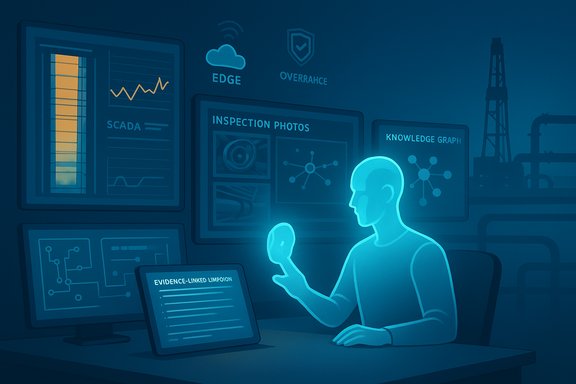
Infosys rolled out the energy‑sector AI Agent on November 6, 2025, positioning it as an industry‑specific workload built atop three complementary pillars: Infosys Topaz (an agent fabric and AI‑first runtime), Infosys Cobalt (cloud blueprints and accelerators for secure enterprise deployments) and Microsoft’s stack — notably Copilot Studio for low‑code agent creation and orchestration, plus Azure AI Foundry / Azure OpenAI hosted models (the announcement names GPT‑family models such as ChatGPT/GPT‑4o). The vendor messaging emphasizes conversational access to field data and automation of routine paperwork while surfacing predictive alerts for operations teams. That vendor narrative is consistent with contemporaneous industry analyses: the energy vertical is a natural fit for agentic AI because operations combine high volumes of heterogeneous telemetry (SCADA/time‑series), long technical documents (well logs, engineering reports), imagery (inspection photos, downhole images) and structured logs — all inputs that benefit from multimodal reasoning, retrieval grounding, and human‑in‑the‑loop controls. Early marketing positions the Agent to automate shift reports, extract structured data from logs and images, and provide ranked, prescriptive recommendations before incidents escalate into prolonged downtime.Why this matters now
The energy sector balances two pressing realities: enormous operational data flows that can overwhelm human analysts, and extremely high costs for failures or delays. A well‑engineered AI assistant that reliably reduces mean time to insight and shortens decision cycles can yield measurable savings. However, energy is also safety‑critical and heavily regulated, so any agent that influences operational decisions must meet strict requirements for governance, auditability, latency and OT network segmentation. Vendors and operators now want production patterns — not research demos — and Infosys frames this Agent as a way to package that production playbook.Architecture: how the stack is composed
The four technical layers (practical blueprint)
Infosys’ public description and partner documentation align on a standard enterprise agent architecture composed of these layers:- Data ingestion and governance: a governed lakehouse or knowledge graph to store sensors, well logs, lab reports, imagery and engineering documents.
- Retrieval and grounding: vector search and document retrieval layers to ground model outputs in concrete evidence.
- Agent fabric and orchestration: Topaz acts as the runtime that orchestrates prompts, tool calls, human‑in‑the‑loop gates, observability and lifecycle management.
- Model runtime and hosting: Azure AI Foundry and Azure OpenAI host multimodal and chat models (model routing and variants such as the GPT families), while Copilot Studio supplies a low‑code design surface for agents. Edge nodes are used where deterministic, low‑latency safety loops are required.
Model routing, multimodality and runtime realities
Azure AI Foundry provides a model‑router capability that can select among model variants at runtime to balance cost, latency and accuracy: smaller models for routine queries, powerful multimodal models for complex synthesis, and specialized reasoning models when needed. Microsoft’s documentation and platform blog posts confirm Foundry’s model routing and multimodal agent features — including support for image inputs, long context windows and structured output patterns — capabilities central to energy workflows that mix charts, downhole images and long engineering narratives. Copilot Studio complements the runtime by offering a low‑code/no‑code environment for building agents, testing flows, and publishing them into business channels such as Microsoft 365 or a field app. Copilot Studio’s pay model and deployment mechanisms are documented publicly and make Microsoft an execution partner for the model and agent runtime.Core capabilities claimed by Infosys
Infosys’ product messaging and the published press release highlight a consistent set of operational features:- Conversational multimodal assistant that accepts questions in natural language, plus image and document inputs, and responds with evidence‑grounded summaries.
- Automated report generation and template population (daily drilling reports, shift logs, regulatory narratives).
- Predictive insights and early warnings for anomalies that historically lead to NPT or safety incidents.
- Hybrid cloud + edge execution: heavy inference and model orchestration in Azure with deterministic edge nodes for immediate safety loops.
- Integration with existing operational systems, CMMS, SCADA and knowledge bases through Cobalt connectors.
Use cases — where the Agent adds near‑term value
Upstream oil & gas (drilling and well operations)
- Automated extraction of key parameters from well logs, time‑series telemetry and lab reports.
- Visual anomaly detection in downhole images or inspection photos to flag early signs of mechanical failure.
- Prescriptive checklists and step‑by‑step mitigation suggestions for friction‑inducing conditions like stuck‑pipe scenarios.
These applications can shorten troubleshooting cycles and reduce manual transcription errors — both contributors to NPT.
Midstream and downstream (pipelines, plants, refineries)
- Failure‑mode prioritization for maintenance based on cross‑correlation of vibration, pressure and historical incident logs.
- Automated compliance and inspection reports for regulators.
- Rapid incident triage in control rooms by surfacing probable causes and recommended investigative steps.
Utilities and power generation
- Field crew assistants that surface outage histories, network diagrams and safety procedures through a conversational interface.
- Condition‑based maintenance recommendations for transformers and switchgear to reduce outage windows.
Strengths: what the design gets right
- End‑to‑end packaging: pairing Topaz’s agent fabric with Cobalt’s cloud blueprints and Microsoft’s Copilot/Foundry runtime shortens the engineering lift required to move from pilot to production. That reduces integration complexity for large operators with legacy OT estates.
- Multimodal support: modern Foundry models and GPT family variants can accept images, tables and long documents, matching the heterogeneous inputs energy teams use daily. Microsoft’s model router helps manage costs by routing tasks to appropriate model sizes.
- Human‑in‑the‑loop and governance focus: the announced architecture emphasizes audit trails, model routing and observability — features that enterprise buyers must have for regulated, safety‑critical environments.
- Vendor scale and delivery capability: Infosys’ global footprint and Cobalt-managed services give it the resourcing capacity to run large, multi‑site rollouts when compared with smaller niche startups.
Risks, limitations and governance concerns
No agent is a silver bullet. The following are practical risks energy operators must address before rolling an agent into production.1. Verified outcome claims are currently limited
Infosys’ announcement lists improved safety, better wellbore quality and reduced NPT as expected outcomes, but the release does not publish independent pilot metrics or experimental methodologies. Operators should demand site pilots with clear KPIs, pre/post baselines and third‑party validation before accepting vendor impact claims as fact.2. Model hallucination and actionability
Generative models can produce fluent but incorrect outputs. When a recommendation could lead to a physical action — directing a crew, altering valve schedules, or changing drilling parameters — the cost of an incorrect recommendation is high. Mitigations must include conservative action gating, mandatory human sign‑offs for critical actions, and provenance logs that link recommendations to source documents.3. OT connectivity, air‑gapping and latency constraints
Many industrial environments are air‑gapped or use tightly segmented OT networks for safety. The vendor’s hybrid cloud + edge approach is sensible, but architecture must be clarified: which computations and inferences happen on‑premises or at an edge, what data is replicated to the cloud, and how are latency guarantees for safety loops enforced? Operators should insist on architecture diagrams and SLA commitments.4. Supply‑chain and model governance risk
Relying on third‑party hosted models increases supply‑chain exposure. Operators must understand which model variants and hosting regions are used, how data residency is enforced, and what contractual remedies exist if model behavior degrades. Azure AI Foundry’s model router and regional controls mitigate some risks, but buyers should require explicit model‑version pinning and drift monitoring.5. Security vulnerabilities in agent tooling
Recent security reporting has shown practical attack paths against agent platforms. Researchers have demonstrated token‑theft techniques targeting Copilot Studio workflows and other agent surfaces; these vulnerabilities highlight the risk of shared agent artifacts and malicious agent templates. Enterprises must harden tenant‑level protections, enforce strict app consent policies, monitor for suspicious agent behavior and apply the principle of least privilege.Procurement and deployment checklist (practical, sequential)
- Define clear KPIs and safety gates (e.g., measurable NPT reduction, mean time to detect, false‑positive rate for alerts).
- Start with high‑value, low‑risk pilots: automated reporting, document summarization, and non‑actionable decision support.
- Validate model provenance: require agents to cite linked evidence and preserve query‑to‑source mappings for audits.
- Confirm architecture for OT segmentation: require private connectivity options, edge inference patterns, and explicit data‑flow diagrams.
- Insist on model/version governance: model pinning, A/B testing, drift monitoring and an agreed rollback plan.
- Perform threat modelling for agent flows: test Copilot Studio artifacts, connector consent flows and token handling to prevent “CoPhish”-style attacks.
- Price and cost governance: understand model routing economics (how often heavy models are selected) and monitor Foundry billing and Copilot Credits consumption.
Implementation patterns that reduce operational risk
- Grounded retrieval: force the agent to answer with citations retrieved from the knowledge store; require a confidence score and a provenance link for any recommended operational action.
- Conservative automation: keep the agent’s automated actions to non‑critical workflows (report drafting, ticket creation, evidence aggregation) until reliability is independently validated.
- Edge‑first safety loops: enforce deterministic alarms and interlocks at the edge using small, validated models; use cloud models only for deep analysis and decision support.
- Operator training and human augmentation: retrain processes so operators treat the agent as a companion that speeds information retrieval, not as a replacement for domain judgment.
Pricing and commercial considerations
Copilot Studio offers low‑code agent building and a credit‑based pricing model for tenant deployments; organizations must account for Copilot Credits consumption, model‑router selection behaviour in Azure Foundry, and data egress or private link costs for VNet‑integrated deployments. Pricing variability will be driven by how often the model router selects large, high‑capability models (costly) versus smaller runtime‑efficient variants (cheaper). Budgeting exercises must simulate workload mixes to forecast Foundry and Copilot consumption accurately.Plausible near‑term outcomes and where to be skeptical
- Plausible: time savings from automated report generation, faster access to prior incidents via conversational search, and earlier detection of common failure precursors when telemetry and historical patterns are well‑instrumented.
- More aspirational: quantifying single‑digit percentage reductions in overall NPT across a heterogeneous asset base without extensive site‑specific tuning, and expecting the agent to autonomously resolve incidents without human verification.
In short: large operational wins are achievable, but they tend to be incremental and site‑dependent. Well‑scoped pilots with transparent measurement are essential to separate durable value from marketing claims.
How this compares to other vendor efforts
Infosys’ approach is notable because it packages system‑integration depth (Cobalt), an agent lifecycle fabric (Topaz) and a hyperscaler runtime (Copilot Studio + Azure Foundry) — a full stack that reduces the “integration tax” for large energy operators. Other suppliers may offer point solutions for OT analytics or model training, but Infosys’ differentiation is the managed, end‑to‑end enterprise posture: cloud templates, connectors to legacy systems, and agent patterns that aim to be production‑ready. That said, competitors and niche startups will still compete on model accuracy, domain‑specific feature sets and the cost of ownership for edge deployments.Practical recommendations for energy operators
- Treat vendor claims as hypotheses to be validated through measurable pilots with independent auditors.
- Design the pilot to scale: choose a narrowly constrained use case with clear KPIs, but ensure the underlying data plumbing, knowledge graph and retrieval layers are reusable for subsequent phases.
- Require a security attestation for Copilot Studio artifacts and insist on hardened consent models for any connectors that can access privileged enterprise data.
- Build a governance board that includes OT engineers, safety officers, legal and IT to review agent outputs before increasing the agent’s remit.
- Negotiate contractual remedies and model‑behavior SLAs: pinning model families, documenting allowed model updates, and agreeing thresholds for intervention.
Conclusion
Infosys’ AI Agent for energy operations is a pragmatic packaging of several well‑understood ingredients: a domain orchestration fabric (Topaz), cloud accelerators and compliance templates (Cobalt), Microsoft’s agent design surface (Copilot Studio) and Azure AI Foundry’s multimodal model runtime. Together they form a credible path to bring conversational, multimodal assistants into production for energy workflows — a move that can shorten decision cycles, automate repetitive reporting and surface pre‑emptive warnings that reduce non‑productive time. However, the promise comes with important caveats. Quantified outcome claims remain vendor‑reported until validated by transparent, third‑party audits. Operational safety and OT security require conservative gating, deterministic edge controls and rigorous provenance for any recommendation that could influence physical actions. Recent security research into agent platforms also shows that tooling such as Copilot Studio introduces new attack surfaces that enterprises must proactively defend.For energy operators, the sensible path is incremental: pilot deliberately on low‑risk, high‑value workflows; instrument outcomes empirically; and only expand the agent’s remit once reliability, governance and security have been demonstrated in live operations. When those boxes are ticked, an AI agent for energy operations that combines Topaz, Cobalt and Microsoft’s Foundry/Copilot capabilities can become a reliable productivity multiplier — but only if the hard engineering, governance and safety work is done first.
Source: The Globe and Mail Infosys Develops AI Agent to Enhance Operations in the Energy Sector
