
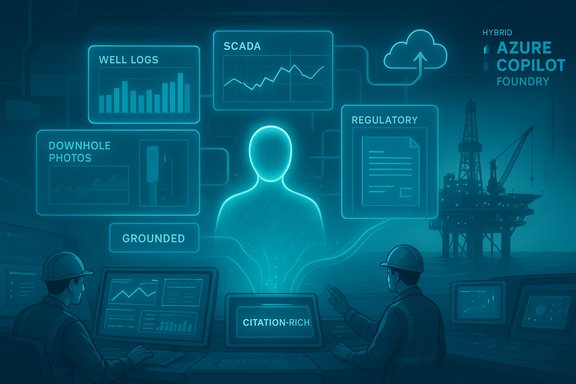
Infosys’ newly announced AI Agent for the energy sector aims to convert the industry’s sprawling, heterogeneous operational data — from well logs and SCADA telemetry to downhole images and compliance PDFs — into real‑time, conversational guidance for field crews and control‑room teams, packaging that capability on top of Infosys Topaz, Infosys Cobalt and Microsoft’s Copilot/Azure AI Foundry stack.
Infosys unveiled the energy‑sector AI Agent in a corporate release dated November 6, 2025, positioning it as a production‑oriented, verticalized offering that combines three core pillars: Infosys Topaz (an AI‑first agent fabric and orchestration layer), Infosys Cobalt (cloud accelerators, compliance blueprints and managed services), and Microsoft’s agent and model ecosystem — notably Microsoft Copilot Studio and Azure OpenAI hosted models in Azure AI Foundry (including references to GPT‑family multimodal models). The vendor frames the solution as a multimodal, conversational assistant that ingests well logs, images, plots and tables, automates routine reporting and surfaces predictive early warnings to reduce non‑productive time (NPT) and improve safety and wellbore quality. Microsoft’s partner leadership is quoted supporting the collaboration, and Infosys’ energy practice leadership outlines the operational pain points the product intends to address: data overload, slow access to context, and the safety and cost consequences of delayed decisions. These claims appear in the official Infosys release and in syndicated press postings.
Source: Analytics Insight Infosys Develops AI Agent to Enhance Operations in the Energy Sector
 Background / Overview
Infosys unveiled the energy‑sector AI Agent in a corporate release dated November 6, 2025, positioning it as a production‑oriented, verticalized offering that combines three core pillars: Infosys Topaz (an AI‑first agent fabric and orchestration layer), Infosys Cobalt (cloud accelerators, compliance blueprints and managed services), and Microsoft’s agent and model ecosystem — notably Microsoft Copilot Studio and Azure OpenAI hosted models in Azure AI Foundry (including references to GPT‑family multimodal models). The vendor frames the solution as a multimodal, conversational assistant that ingests well logs, images, plots and tables, automates routine reporting and surfaces predictive early warnings to reduce non‑productive time (NPT) and improve safety and wellbore quality. Microsoft’s partner leadership is quoted supporting the collaboration, and Infosys’ energy practice leadership outlines the operational pain points the product intends to address: data overload, slow access to context, and the safety and cost consequences of delayed decisions. These claims appear in the official Infosys release and in syndicated press postings. What the announcement actually says — the product in plain language
The public description of the AI Agent highlights several concrete capabilities:- Multimodal ingestion: process and ground outputs in well logs, streaming telemetry (SCADA/time‑series), inspection photos and engineering documents.
- Conversational interface: Copilot‑style chat (and implied voice) so field engineers can query state, retrieve evidence and obtain concise next‑step recommendations.
- Automated reporting: generate shift reports, NPT logs and regulatory summaries from raw notes and telemetry.
- Predictive insights and early warnings: anomaly detection and ranked alerts designed to surface issues before they escalate into downtime.
- Hybrid cloud + edge deployment: heavy inference and orchestration in Azure Foundry with deterministic safety loops and low‑latency checks at edge nodes as needed for OT constraints.
Technical anatomy — how the stack is composed
Data ingestion and grounding
The solution rests on a governed data layer — commonly a lakehouse or knowledge graph — that ingests telemetry, logs and files, applies schema alignment and stores source‑of‑truth artifacts for retrieval. Reliable retrieval and vector search are explicitly cited as prerequisites to reduce model hallucinations and to provide evidence for outputs.Agent fabric (Infosys Topaz)
Topaz is positioned as the orchestration and lifecycle layer: agent flows, prompt orchestration, tool calling patterns, model routing and human‑in‑the‑loop gates. Infosys has separately publicized Topaz Fabric as a composable stack for enterprise agents, designed to package reusable patterns and vertical adapters.Cloud posture and security (Infosys Cobalt)
Infosys Cobalt supplies the hardened cloud templates, identity and compliance scaffolding — a central requirement for regulated energy customers concerned about data residency, OT/IT segmentation and auditability. The Cobalt layer aims to accelerate secure deployment and management on hyperscalers.Model runtime (Microsoft Copilot Studio + Azure AI Foundry)
Copilot Studio provides a low‑code design surface and governance controls for agents, while Azure AI Foundry supplies enterprise‑grade, Foundry‑hosted multimodal models and routing capabilities. The announcement cites GPT‑family capabilities (e.g., GPT‑4o / ChatGPT‑4o variants) as examples of models that can be used in the runtime, although the specific model choices in customer deployments will vary by cost, latency and governance needs.Cross‑checking and verification
Key architecture and product claims are corroborated by multiple vendor materials:- Infosys’ official press release details the Topaz + Cobalt + Microsoft stack and quotes Microsoft and Infosys leadership.
- PR distribution outlets (PR Newswire / Nasdaq) republished the same release verbatim, confirming the official messaging.
- Infosys’ earlier product announcements — notably the May 2025 launch of the Agentic AI Foundry and November 3, 2025 launch of Topaz Fabric — provide context that the energy Agent is an instantiation of a broader, reusable agent playbook.
- Company metrics cited elsewhere (for example, Infosys’ employee counts and global footprint) are verifiable in its SEC Form 20‑F for fiscal 2025. That filing records 323,578 employees as of March 31, 2025, a figure frequently used when assessing vendor delivery scale.
- Any precise, auditable performance metrics (e.g., “X% reduction in NPT” or “Y hours saved per rig per month”) were not published with independent methodology in the initial release and remain company‑reported until validated by customer case studies or third‑party audits. These impact claims should be treated as directional until external verification.
Why this matters to energy operators
Energy operations are uniquely well suited to retrieval‑grounded, multimodal agents because their workflows combine:- High‑frequency telemetry (SCADA/time‑series) that requires fast interpretation.
- Long, complex documents (well logs, engineering reports) that demand contextual retrieval.
- Visual inspection artifacts (images, downhole photos) that benefit from vision‑enabled models.
- Safety‑critical decision-making where small delays or mistakes have outsized cost and environmental consequences.
Strengths — what looks credible and valuable
- Production‑oriented architecture: The announcement follows established enterprise agent patterns (governed lakehouse, retrieval/embedding layer, orchestration fabric, and model runtime with edge safety loops). That architecture is well aligned with industry best practices for regulated workloads.
- Ecosystem partnership: Pairing Infosys’ domain engineering and cloud practice (Cobalt) with Microsoft’s Copilot and Foundry gives customers access to mature agent orchestration tooling and enterprise model hosting, which reduces the integration burden for large operators.
- Vertical tailoring: Prebuilt connectors and templates for common energy workflows — if actually delivered as described — lower time‑to‑value compared with one‑off internal builds.
- Governance primitives: The Topaz and Foundry combination emphasizes observability, model routing and human‑in‑the‑loop gates, features vital for auditable decision support in safety‑critical environments.
Risks, gaps and the hardest problems to solve
Despite the promise, moving agentic systems into energy operations surfaces several non‑trivial risks and open questions:- Provenance and hallucination risk: Large models are prone to confident but incorrect outputs. Without strict retrieval grounding and verifiable citations tied back to ingested artifacts, operators risk acting on flawed recommendations. Vendor materials stress grounding, but operators must validate this in controlled pilots.
- OT/IT segmentation and latency: Energy sites often require deterministic, low‑latency safety loops. Heavy inference in the cloud is incompatible with some safety use cases; correct hybrid architectures (edge inference, air‑gapped controls, and clear escalation rules) are essential. The announcement mentions hybrid deployment, but specific latency guarantees are not published.
- Regulatory and liability exposure: If an agent recommendation contributes to an incident, contract language and operational procedures must clearly define decision authority, audit trails and liability. Public materials do not detail legal frameworks. Treat operational autonomy cautiously.
- Model selection and drift: The release names GPT‑family models and Azure Foundry as runtime options, but model choice, fine‑tuning practices, data retention and drift mitigation strategies are implementation details that determine performance and compliance exposure. Expect negotiation on model hosting, weights, and logging.
- Sustainability and cost: Continuous multimodal inference on large models can be expensive. Operators should quantify compute cost versus operational savings carefully. The release outlines the architecture; it does not publish TCO models.
- Operationalization maturity: The most valuable gains come from embedding AI into daily workflows and rhythms of work — not as an isolated tool. Successful deployments require change management, retraining, and careful KPI design. Infosys pitches repeatable agent patterns but measurable customer outcomes are still pending public case studies.
Implementation checklist for energy operators (practical steps)
- Determine target use cases and risk tiering:
- Start with low‑risk, high‑value tasks (report automation, data extraction, evidence summarization).
- Reserve prescriptive, action‑triggering recommendations for later phases after exhaustive validation.
- Build the data foundation:
- Ingest telemetry, logs and documents into a governed lakehouse or knowledge graph.
- Define data contracts, retention, and access controls.
- Require retrieval‑augmented reasoning and evidence citations:
- Demand that the agent provide explicit source references for every assertion used to make a recommendation.
- Design hybrid cloud/edge topology:
- Identify deterministic safety loops that must run at the edge and ensure proper model routing and failover.
- Insist on human‑in‑the‑loop workflows:
- Define who can override agent recommendations and embed approval gates for safety‑critical decisions.
- Negotiate SLAs, logging and auditability:
- Include model‑level SLAs (latency), logging guarantees, and forensic access into contracts.
- Run phased pilots and third‑party validation:
- Pilot in controlled environments; commission third‑party audits or red‑team exercises for model behavior under edge cases.
- Measure and iterate:
- Track NPT, mean time to decision, false positive/negative rates for warnings, and worker satisfaction as primary KPIs.
Procurement and contracting: the clauses to insist on
- Model provenance and control: Specify which models will be used, how they’ll be updated, and rules for fine‑tuning on customer data.
- Data residency and segregation: Clear clauses about where telemetry and PII are stored and processed, including edge/cloud boundaries.
- Explainability and evidence tracing: Mandatory evidence links for all operational recommendations and the right to audit retrieval indices and embeddings.
- Liability and indemnity: Define responsibility if agent outputs materially contribute to incidents; ensure appropriate insurance and indemnity terms.
- Performance SLAs: Include latency, availability, and accuracy thresholds for critical workloads.
- Change management and training: Vendor commitment to operator training, documentation and a transition plan for sustaining the solution over time.
Market context and competitive posture
The energy vertical is attracting multisource activity: systems integrators, oilfield service companies and hyperscaler partnerships are all packaging domain‑specific agent solutions. Infosys’ strategy — productizing Topaz and Cobalt while leveraging Microsoft’s Copilot/Foundry runtime — is a familiar enterprise pattern: combine domain expertise with cloud and agent tooling to accelerate adoption while offering governance scaffolding. The key differentiator for vendors will be demonstrable customer outcomes, explainability, OT integration experience and the ability to operate safely under regulatory scrutiny.Practical recommendations for IT and Ops leaders
- Treat the announcement as a credible vendor offering that merits pilot evaluation, not as turnkey proof of immediate ROI.
- Prioritize governance, retrieval transparency and hybrid deployment test cases over flashy autonomous capabilities.
- Run pilot scopes that measure concrete operational KPIs (NPT, MTTR, report generation time) and insist on third‑party validation before widening deployment.
- Build a cross‑functional steering committee (IT, OT, legal, safety, field operations) to govern pilot scope, risk tolerance and handovers between human and agent decisions.
Conclusion
Infosys’ energy‑sector AI Agent is a structurally sensible and timely play: it packages a vetted enterprise agent architecture (Topaz Fabric + Agentic AI Foundry) with cloud accelerators (Cobalt) and Microsoft’s Copilot/Foundry runtime to address a very real industry pain point — the need to turn mountains of multimodal operational data into fast, evidence‑backed action. The announcement is credible on architecture and partnership; however, the most important claims — the degree to which the agent reduces non‑productive time, improves wellbore quality or prevents incidents — remain vendor‑reported and require independent, auditable validation. Energy operators evaluating the offering should pursue carefully scoped pilots, insist on explicit provenance and audit features, and design hybrid edge/cloud topologies that keep safety‑critical controls local and fully auditable. If the product delivers as architected — consistent retrieval grounding, deterministic safety loops, clear human oversight and transparent KPIs — it can materially shorten decision cycles and reclaim engineering time across drilling, production and field maintenance. The right path forward is measured: pilot fast, prove rigorously, and scale only when governance, resilience and performance thresholds are met.Source: Analytics Insight Infosys Develops AI Agent to Enhance Operations in the Energy Sector
