

Intel’s 12th Gen “Alder Lake” CPUs—the generation that put Intel back on many enthusiasts’ radar with a hybrid core design, DDR5 and PCIe 5.0 support—have officially entered the company’s Product Discontinuance Program, with a clear timetable that terminates shipments in early 2027 and phases out new orders through 2026.
Alder Lake was launched in late 2021 as Intel’s first mainstream hybrid architecture, pairing high-performance P-cores with power-efficient E-cores, bringing features previously uncommon on x86 desktops: hardware-guided thread scheduling, DDR5 memory support, and PCIe 5.0 connectivity. The architecture was manufactured on Intel’s renamed Intel 7 node (formerly marketed as 10nm Enhanced SuperFin), a technical shift away from the long-lived 14nm era. For many DIY builders and OEMs, Alder Lake was notable for three reasons:
That said, the discontinuance does force concrete decisions:
Conclusion
The formal discontinuance of Intel’s 12th Gen Alder Lake is a milestone in the product lifecycle: precise dates give manufacturers, integrators, and consumers time to plan, and the architecture itself leaves a lasting legacy in hybrid design and platform features. For builders, it’s an opportunity—buyers can still find well-priced Alder Lake parts for capable systems—but for planners and enterprises, the message is clear: use the 2026 windows to close orders and secure spares, and treat January 22, 2027 as the definitive endpoint for Intel shipments of these SKUs.
Source: Windows Central Intel's last CPU generation that got me excited has reached end-of-life
 Background
Alder Lake was launched in late 2021 as Intel’s first mainstream hybrid architecture, pairing high-performance P-cores with power-efficient E-cores, bringing features previously uncommon on x86 desktops: hardware-guided thread scheduling, DDR5 memory support, and PCIe 5.0 connectivity. The architecture was manufactured on Intel’s renamed Intel 7 node (formerly marketed as 10nm Enhanced SuperFin), a technical shift away from the long-lived 14nm era. For many DIY builders and OEMs, Alder Lake was notable for three reasons:- It introduced hybrid core scheduling at the consumer desktop level, which required OS-awareness to fully exploit.
- It brought platform modernization—the first mainstream Intel CPUs to support DDR5 and provide PCIe 5.0 lanes.
- It delivered strong single-thread and competitive multi-thread performance at launch, making chips like the Core i9‑12900K still relevant years later for gaming and content creation workloads.
What Intel announced (the timeline)
Intel’s discontinuance move is formalized through its Product Change Notification (PCN) / Product Discontinuance Program notices. The timeline that matters to OEMs, retailers, and builders is precise and should be treated as binding for planning purchases and support:- January 6, 2026 — The Product Discontinuance Program for 12th Gen Alder Lake began; PCNs were published covering boxed and tray (OEM) SKUs.
- April 10, 2026 — Last day for OEM new demand for tray SKUs; after this date Intel will not accept new tray demand requests.
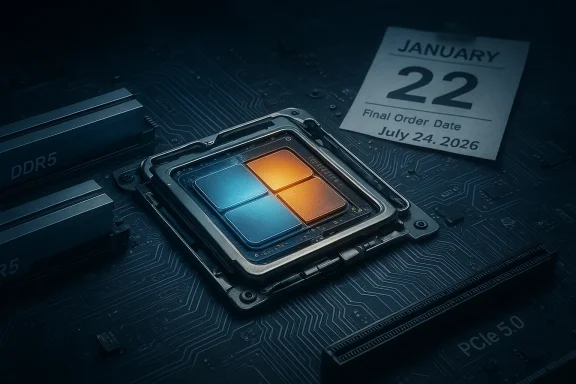
- July 24, 2026 — Final order date for both tray and boxed SKUs; orders placed by this date become non-cancelable and non-returnable.
- January 22, 2027 — Final shipment day. After this date Intel will have completed all outbound shipments of Alder Lake processors.
Why this matters: immediate and long-term impacts
For PC builders and enthusiasts
The dates above carry practical consequences for anyone planning new builds, upgrades, or buying used Alder Lake parts.- Short-term buys: Retailers will continue to sell boxed Alder Lake CPUs while stocks last. However, once distributors cease replenishment (final order date July 24, 2026), prices can become volatile—either discounts to clear inventory or premiums for scarce SKUs—depending on demand.
- Replacement and RMA considerations: After final shipments, Intel’s ability to provide warranty replacements and spare parts eventually diminishes. While warranty windows are contract-dependent, suppliers increasingly tie replacement availability to product lifecycle milestones. Buyers should confirm RMA policies with retailers and integrators before purchasing late in a product’s lifecycle.
- Second-hand market: Alder Lake still offers attractive performance per dollar in 2026; the used market will likely sustain demand, particularly for mainstream SKUs (Core i5, Core i7) that balance cost and performance. Expect a steady aftermarket, but buyer caution is advised regarding warranty and legitimacy of boxed/“like-new” claims.
For OEMs and system integrators
OEMs and integrators must plan shipments, acceptance, and inventory draws against the exact cutoff dates.- Final demand for tray SKUs stops on April 10, 2026—this affects new system designs that were intending to ship later in 2026.
- The July 24, 2026 cutoff converts outstanding orders into firm commitments—no cancellations or returns—so forecasting accuracy becomes critical.
For enterprises and long-life deployments
Enterprises that use Alder Lake in servers for edge/embedded appliances, or in specialized desktops, must map out maintenance windows and spares provisioning. While Alder Lake’s discontinuance does not immediately end support for deployed systems, sourcing spare CPUs later in the aftermarket can be difficult and expensive. Intel traditionally makes separate arrangements for long-life products in industrial/embedded lines; standard consumer Alder Lake parts do not receive the same guarantees.Technical legacy: what Alder Lake brought—and what remains relevant
Alder Lake’s lasting technical contributions are non-trivial and continue to shape modern x86 CPU design.- Hybrid architecture: Alder Lake made hybrid P/E cores mainstream on desktops, pairing high-frequency Golden Cove P‑cores with efficient Gracemont E‑cores and relying on Intel Thread Director plus OS schedulers to assign work efficiently. This design philosophy persists across later Intel generations.
- Platform modernization: Support for DDR5 and PCIe 5.0 placed Alder Lake at the forefront of platform capabilities in 2021, and those compatibility choices have continued to influence motherboard and peripheral design.
- Process node shift: Alder Lake’s use of what Intel calls Intel 7 signaled a move away from the 14nm treadmill and into a more modern process node for client CPUs, enabling competitive clock/power characteristics.
Competitive context: did Alder Lake push Intel past AMD?
Alder Lake’s launch provoked a realignment in the CPU market. AMD’s Ryzen 5000 lineup had been strong pre‑Alder Lake, and Intel’s move closed gaps in single-threaded and platform features. But the market response was mixed and dynamic.- At launch, benchmarks showed Alder Lake recovering ground in gaming and single-threaded workloads, helped by modern memory and I/O capabilities. Many reviewers and builders praised the Core i9‑12900K and siblings for returning competitive performance.
- AMD’s rapid follow-ups—particularly the 3D‑stacked Ryzen 7 5800X3D and later Zen 4 products—kept pressure on Intel, forcing a cadence of iterative improvements from both vendors. The end result has been sustained competition rather than a decisive long-term lead for either side.
Practical guidance: purchasing, upgrading, and shelf-life decisions
If you’re weighing Alder Lake hardware in light of these discontinuance notices, here are practical recommendations.Buying new (today through July 2026)
- If you require official Intel warranty support for several years, buy earlier in the discontinuance window rather than later; distributors’ inventories are first-come, and warranty/resale support is easier with retail channels.
- For system integrators, place tray (OEM) demand requests before April 10, 2026, or plan to pivot to newer CPU families for designs expected to ship late 2026 and beyond.
Upgrading existing systems
- Alder Lake to later Intel generations generally requires BIOS updates and potentially a platform change; migrating from DDR4 Alder Lake systems to DDR5-focused platforms involves both motherboard and memory upgrades.
- If your current Alder Lake system meets your needs, there is no immediate technical reason to upgrade simply because of the discontinuance notice. The chips function normally and will continue to run Windows and Linux while you maintain security and driver updates.
Long-term planning for enterprise/deployment
- Inventory spare CPUs and spare motherboards if your deployment requires identical replacements over a multi-year horizon.
- Negotiate RMA and spares contracts early; vendors and distributors usually adjust business terms as products approach end-of-life.
Risks and caveats
While the discontinuance is routine, several risks are worth calling out explicitly.- Support window ambiguity: Discontinuance does not equal end of software or security updates. Intel’s publications on PCNs and discontinuance primarily affect ordering and logistics; OS and driver support timelines are separate and can change. Enterprises should verify support commitments with their OS vendors and hardware partners.
- Aftermarket fraud and gray-market hazards: As inventory tightens, the likelihood of counterfeit or misrepresented “new” boxed CPUs rises. Buyers should favor reputable retailers and be wary of unusually low prices on marketplaces.
- Warranty and RMA limits: Once Intel final shipments complete, warranty handling—particularly cross-shipment spares—can be restricted by component availability. OEMs frequently maintain limited spares inventories for predefined periods; beyond that, replacements rely on secondary markets.
- Perception risk for OEMs: Companies branding new systems as “Alder Lake-based” late in the discontinuance window may face marketing or support confusion; label your SKUs clearly and communicate support timelines to customers.
What Alder Lake’s retirement tells us about Intel’s roadmap
Alder Lake’s EOL is both predictable and revealing. Intel has moved its mainstream focus forward to newer microarchitectures and node improvements while pruning older SKUs to streamline supply and SKUs.- Intel has continued the hybrid approach in subsequent generations and pushed new mobile and desktop families that reapply lessons from Alder Lake. Roadmap announcements indicate Panther Lake and Nova Lake (and the Core Ultra renaming) as Intel’s next steps for mobile and desktop lines, respectively. The discontinuance signals a shift in channel focus toward these newer parts.
- The lifecycle also reflects a broader industry rhythm: three to five years of active availability followed by orderly service and inventory wind-down, giving manufacturers and the channel predictable planning horizons.
Quick reference: key dates (explicit)
- Product Discontinuance Program announced: January 6, 2026.
- Last date to submit new tray (OEM) demand: April 10, 2026.
- Final order date (boxed and tray): July 24, 2026 — orders placed by this date are non-cancelable and non-returnable.
- Final Intel shipment date: January 22, 2027.
Final verdict: natural progression, not panic
Intel moving Alder Lake into end-of-life is a natural and expected lifecycle event, not a surprise or emergency for most users. Alder Lake’s architecture and platform contributions continue to influence newer CPU families, and the chips remain technically sound for many real-world tasks.That said, the discontinuance does force concrete decisions:
- OEMs and integrators must finalize demand or pivot product roadmaps before the stated cutoffs.
- Enthusiasts and buyers should be mindful of warranty and RMA timelines and expect market-driven price behavior as inventories contract.
- Enterprises and long-life deployments should plan spares and support now rather than later.
Conclusion
The formal discontinuance of Intel’s 12th Gen Alder Lake is a milestone in the product lifecycle: precise dates give manufacturers, integrators, and consumers time to plan, and the architecture itself leaves a lasting legacy in hybrid design and platform features. For builders, it’s an opportunity—buyers can still find well-priced Alder Lake parts for capable systems—but for planners and enterprises, the message is clear: use the 2026 windows to close orders and secure spares, and treat January 22, 2027 as the definitive endpoint for Intel shipments of these SKUs.
Source: Windows Central Intel's last CPU generation that got me excited has reached end-of-life
