

Intel’s latest push into edge and embedded compute is both familiar and striking: the company has quietly expanded its client and embedded portfolio with two targeted families — Core Series 2 “Bartlett Lake” for LGA‑1700 edge/embedded desktop deployments and Core Ultra Series 3 “Panther Lake” for mobile, consumer, and vertical edge platforms — delivering a mix of raw single‑thread clocks, P‑core density, integrated XPU (CPU+GPU+NPU) compute, and extended lifecycle commitments for industrial customers. (download.intel.com)
Intel announced Panther Lake (Core Ultra Series 3) at CES and positions it as the first client SoC built on Intel’s 18A node, with marketing emphasizing improved efficiency, larger integrated graphics, and on‑chip NPU capacity for local AI inference. The company has also pials describing Bartlett Lake S as a specialized, P‑core only product line targeted to industrial and edge uses, emphasizing longevity, ECC memory support, and OEM distribution rather than broad retail DIY availability. (download.intel.com)
Those two messages serve different buyers but the same strategic goal: give systems integrators, robotics OEMs, and IT purchasers an x86‑based single‑platform option that can run mainstream AI stacks locally — from OpenVINO and ONNX runtimes to PyTorch and WinML — while reducing system complexity compared with multi‑box CPU+accelerator architectures. Intel’s marketing materials pair performance claims with long availability windows and Windows IoT/Server readiness, explicitly targeting 24×7 and regulated deployment scenarios. (download.intel.com)
Intel has put more of its x86 capability on the table for edge computing: Bartlett Lake pushes raw P‑core performance and long life for industrial customers, while Panther Lake bets on integrated XPU convenience and AI readiness across consumer and vertical markets. Both are pragmatic plays for a market that increasingly values local inference, predictable lifecycles, and simplified hardware stacks — but every buyer should treat the vendor numbers as a starting point and validate performance, power, and total cost in their own environment before committing.
Source: Wccftech Intel Launches Bartlett Lake & Panther Lake CPUs For Edge: Up To 12 P-Cores At 5.9 GHz
 Background / Overview
Intel announced Panther Lake (Core Ultra Series 3) at CES and positions it as the first client SoC built on Intel’s 18A node, with marketing emphasizing improved efficiency, larger integrated graphics, and on‑chip NPU capacity for local AI inference. The company has also pials describing Bartlett Lake S as a specialized, P‑core only product line targeted to industrial and edge uses, emphasizing longevity, ECC memory support, and OEM distribution rather than broad retail DIY availability. (download.intel.com)Those two messages serve different buyers but the same strategic goal: give systems integrators, robotics OEMs, and IT purchasers an x86‑based single‑platform option that can run mainstream AI stacks locally — from OpenVINO and ONNX runtimes to PyTorch and WinML — while reducing system complexity compared with multi‑box CPU+accelerator architectures. Intel’s marketing materials pair performance claims with long availability windows and Windows IoT/Server readiness, explicitly targeting 24×7 and regulated deployment scenarios. (download.intel.com)
Bartlett Lake: Pure P‑Core LGA‑1700 for Edge
What Bartlett Lake is, in plain terms
- Bartlett Lake‑S is a family of P‑core‑only Intel Core processors aimed at embedded, industrial, and edge server use cases.
- The line removes E‑cores entirely and focuses on higher per‑core performance, higher single‑thread boosts, and extended lifecycle support for commercial customers.
Key technical highlights (what Intel and independent outlets report)
- Up to **12 Performance‑cores (P‑coreing (24 threads) in the flagship SKUs.
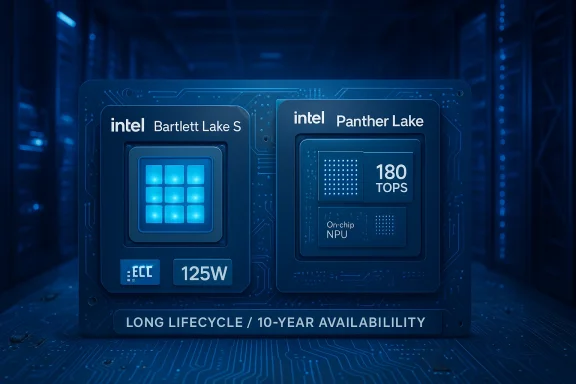
- Flagship model listed as Core 9 273PQE with boost up to 5.9 GHz, all‑core boost around 5.3 GHz, and a 125W TDP; 65W and 45W variants exist for the same core counts at lower power envelopes.
- Memory: support for DDR5‑5600 speeds and ECC in supported OEM platforms, with Intel stating platform memory capacities up to 192 GB for these SKUs. PCIe: up to 16 PCIe Gen5 lanes and 4 PCIe Gen4 lanes on‑chip in select parts. Integrated graphics are present in most SKUs.
- Compatibility: Bartlett Lake‑S is physically LGA‑1700 and Intel’s materials and multiple outlets indicate backwards compatibility with existing Q/H/B series motherboards in principle — but practical firmware support will be OEM/motherboard vendor dependent. At least one large board vendor has already stated it will not enable Bartlett Lake on consumer boards, signaling limited DIY support.
SKU breakdown (representative)
Intel and third‑party reporting show three thermal tiers — PQE (125W), PE (65W), and PTE (45W) — across Core 9/7/5 class numbers, with 12‑, 10‑, and 8‑P‑core configurations respectively. The 12‑core 273PQE sits at the top with 36 MB L3 reported; lower models trade cores and frequency for TDP and price.Panther Lake: Consumer SoC that Markets to Edge
What Panther Lake brings
- Core Ultra Series 3 (Panther Lake) is Intel’s 18A‑based family that integrates CPU, Xe3 Arc GPU, and an on‑chip NPU into a single platform aimed at AI PCs, laptops, and edge appliances.
- Intel’s messaging stresses AI model compatibility (900+ models claimed), up to 180 TOPS available for certain platform configurations, and support for ISVs and libraries targeting vision and LLM workloads. (download.intel.com)
Architecture and capabilities
- Panther Lake introduces larger integrated GPU configurations (Xe3), higher NPU TOPS counts in selected X‑class SKUs, and platform optimizations Intel says reduce power for comparable CPU performance versus the prior generation. Intel also highlighted extensive ISV and model support for on‑device inference. (download.intel.com)
- Availability: Intel pushed Panther Lake into OEM laptops in January 2026 with broader OEM designs and edge module plans rolling into Q1/Q2 2026; systems from mainstream OEMs were slated from late January onward. Intel’s positioning explicitly includes robotics, smart city and retail edge use cases in addition to consumer PCs.
Performance claims — what Intel says and why to be cautious
Intel is making aggressive performance and TCO claims for both families; those claims are important but should be read as vendor‑supplied data pending independent validation.- Bartlett Lake: Intel (and subsequent reporting) quotes up to 50% higher multi‑threaded performance versus the prior generation for certain Bartlett SKUs. Separate slides and partner materials show the new 12 P‑core SKUs targeted at deterministic embedded workloads with predictable frequencies.
- Bartlett vs AMD: Intel’s messaging (repackaged by press) compared a 65W Bartlett Lake 12‑core part against an AMD 65W Ryzen 7 9700X (8‑core) and reported up to 3.8× better deterministic chip performance and improvements in PCIe latency and response times. That comparison needs a strong caution flag: it’s an apples‑to‑apples power envelope comparison created by Intel to highlight platform choices, but the architectural differences, board/firmware tuning, and workload selection make vendor benchmarks a starting point — not a purchasing proof point. Independent tests are necessary to confirm real‑world gains.
- Panther Lake vs Jetson Orin and dual‑system TCO claims: Intel’s Panther Lake marketing asserts up to 4.5× improvement on certain vision/vision‑language‑action (VLA) model throughputs compared with a NVIDIA Jetson AGX Orin 64 GB solution, and estimates up to $5,549 TCO savings when moving from a dual‑system discrete approach to Panther Lake SoC designs for robotics. Those are platform marketing figures pulled from Intel slides and press materials; they are plausible in specific edge scenarios where an integrated NPU and GPU reduce host overhead and simplify software stacks, but they are highly workload, configuration, and deployment dependent. Expect independent benchmark suites (robotics SLAM/vision stacks, VLA tests, end‑to‑end latency/load systems) before accepting the dollar savings claim at face value. (download.intel.com)
Why Intel built these lines — practical use cases
- Robotics and vision systems that need predictable low latency and long availability.
- Retail/POI and immersive AI experiences (real‑tytics and recommendations).
- Factory automation / defect inspection where on‑device inference and local management are required.
- Edge servers and appliances where reduced BOM complexity (single SoC vs CPU+accelerator) lowers integration time and potential points of failure.
Intel’s product briefs and Panther Lake marketing emphasize the full stack (OS, runtime, ISV support) to sell the platform as an easier path for integrators.
Strengths — what’s genuinely interesting
- P‑core density with high clocks: For workloads that favor single‑thread and predictable per‑core performance (real‑time signal processing, certain inference kernels), a 12‑P‑core part with high single‑thread boost across a platform is compelling. That’s Bartlett Lake’s value proposition.
- Integrated XPU approach on Panther Lake: Combining a bigger integrated U simplifies system design, reduces power when properly utilized, and shortens validation cycles for ISVs who can target a single silicon platform. (download.intel.com)
- Longevity and LTSC support: Intel explicitly markets Bartlett Lake with up to 10 years of availability and compatibility with Windows IoT Enterprise LTSC channels, which matters in regulated verticals (medical, industrial automation) where long product lifecycles are contractually required. This is a clear advantage over consumer‑grade silicon that shifts every generation.
- Backwards socket compatibility (in principle): Using LGA‑1700 reduces the integration shock for OEMs that maintain in‑house chassis and motherboards, though firmware support will ultimately determine practical reuse.
Risks, unknowns, and practical caveats
- Vendor benchmark bias: Many of the head‑line multipliers (3.8×, 4.5×, $5,549 TCO) are Intel’s internal figures presented to highlight platform advantages. Such claims are useful directional signals but not replacements for reproducible, third‑party benchmarks across real deployment stacks. Treat them as marketing until independent testing arrives.
- Motherboard / firmware support is not guaranteed: LGA‑1700 compatibility does not equal motherboard enablement; several motherboard vendors have signaled limited or no support for Bartlett Lake on consumer boards. In practice, Bartlett Lake will be OEM/OEM‑board focused, not retail DIY, making it less attractive to hobbyists and more targeted at system integrators who want validated, long‑life platforms. Plan procurement with that channel reality in mind.
- Power efficiency vs. dedicated accelerators: Integrated NPU and GPU are attractive for system simplicity, but discrete accelerators (NVIDIA, AMD, specialist NPUs) still often win on raw TOPS/Watt in many scenarios. The real advantage of Panther Lake is systems simplification and TCO for specific workloads — not an across‑the‑board performance dominance. Quantify with your workload.
- Software and driver maturity: Edge AI depends heavily on runtime support (ONNX, TensorRT‑like stacks, vendor‑optimized kernels). Intel touts OpenVINO, PyTorch and ONNX runtime support for these platforms, but integrators must validate that the exact models and quantization/pathways they rely on are fully supported and performant on Arc‑NPU/Xe3 stacks compacosystems. Real‑world inference often trips on driver maturity and model porting.
- Supply and pricing unknowns for long‑life SKUs: While long availability is appealing, the practicalities of pricing, volume allocation, and long‑term OS/firmware support (patch cadence, driver retention) are administrative risks. Clarify SLAs and upgrade paths with OEMs before committing to multi‑year rollouts.
How systems integrators and IT teams should evaluate these processors
- Inventory and map workloads: identify the exact inference models (type, size, quantization) and CPU/GPU/NPU operations you run today.
- Request vendor‑supplied, reproducible benchmark artifacts: require the datasets, model versions, and test harnesses Intel/OEMs used to make TCO and throughput claims.
- Run an A/B validation: test identical workloads on a current baseline (existing CPU+accelerator) and on Panther Lake / Bartlett Lake reference hardware in your environment.
- Validate software compatibility: confirm that your toolchain (OpenVINO, ONNX Runtime, custom libraries) runs at the desired performance and that driver/firmware updates are managed under contract.
- Negotiate lifecycle and support terms: insist on long‑term firmware/driver support commitments if you’re buying into the 10‑year availability narrative. Ask for a BIOS/firmware update schedule and rollback procedures before signing multi‑year purchase orders.
Short checklist for procurement (quick, actionable)
- Confirm the SKU, power envelope, and thermal requirements for your enclosure.
- Ask OEM whether Bartlett Lake will be supported on the intended motherboard revision and whether BIOS/firmware updates are included in the purchase.
- Request explicit, reproducible benchmark artifacts for your models (not just slides).
- Verify support for the OS and runtime versions you use (Windows IoT LTSC, WinML, OpenVINO, ONNX runtime).
- Include clauses for driver/firmware support and security patching for the product lifecycle you require.
The market context — competition and what it means
Intel’s moves come as competition at the edge intensifies: NVIDIA continues to push Orin/Thor for high‑performance robotics and inference, AMD is packaging CPU+GPU combos and selling to OEMs, and Arm‑based vendors and SoC designers continue to push highly efficient NPU‑centric designs. Intel’s strategic bet is to offer a familiar x86 experience plus a single‑platform XPU that reduces engineering complexity for integrators who prefer x86 toolchains and Windows/Linux server ecosystems. Whether that bet pays off depends on software migration costs, price/performance in deployed workloads, and the ability of Intel and its partners to deliver validated, production‑ready systems at competitive price points.Final analysis — who should care, and what to watch next
- Systems integrators building robotics, retail, healthcare, or industrial automation appliances should take Panther Lake and Bartlett Lake seriously now: the combination of integrated AI features, long lifecycle promises, and OEM pathways solves real engineering headaches. But they must validate Intel’s performance and TCO claims against their actual workloads before committing.
- Hardware architects and procurement teams should treat Bartlett Lake as a commercial/embedded option, not a consumer DIY part. That means procurement through OEM channels, firmware SLAs, and acceptance testing for long‑term deployments.
- Enthusiasts and DIY builders will find the specs intriguing — 12 high‑clock P‑cores on LGA‑1700 is an attention‑grabbing spec — but practical constraints (motherboard enablement, OEM‑only distribution) will likely keep Bartlett Lake out of mainstream retail builds for the time being.
- Independent benchmarks from reputable labs that test the claimed Jetson/Orin and Ryzen comparisons in published, reproducible workloads.
- OEM announcements and product briefings that confirm which vendors will ship validated Bartlett Lake boards and Panther Lake edge systems.
- Driver/firmware support cadence and ISV adoption for Panther Lake’s Arc/NPU stacks — the ecosystem is the multiplier that determines real adoption.
Intel has put more of its x86 capability on the table for edge computing: Bartlett Lake pushes raw P‑core performance and long life for industrial customers, while Panther Lake bets on integrated XPU convenience and AI readiness across consumer and vertical markets. Both are pragmatic plays for a market that increasingly values local inference, predictable lifecycles, and simplified hardware stacks — but every buyer should treat the vendor numbers as a starting point and validate performance, power, and total cost in their own environment before committing.
Source: Wccftech Intel Launches Bartlett Lake & Panther Lake CPUs For Edge: Up To 12 P-Cores At 5.9 GHz