

The Linux kernel’s graphics stack received a surgical but important fix addressing a potential use‑after‑free (UAF) in the Intel i915 driver: gem_context_register() could make a newly created context visible to userspace before the kernel had finished using the context pointer, opening a race where a second thread could issue I915_GEM_CONTEXT_DESTROY and free the context while the register path still referenced it. The result is an availability‑first vulnerability that can produce driver oopses, GPU hangs or a wider kernel instability that requires reboot or remediation. This article explains the technical root cause, the scope and exploitability, how the upstream patch addresses the issue, practical mitigation and detection steps for operations teams, and residual risks administrators must consider when managing GPU‑enabled Linux hosts.
The Direct Rendering Manager (DRM) subsystem in Linux handles how user space interacts with GPU hardware for rendering, mode setting, and buffer management. The Intel i915 driver implements much of the DRM interface for Intel integrated GPUs and exports device nodes and ioctls that user‑space graphics stacks (compositors, rendering engines, containerized workloads with device access) rely on.
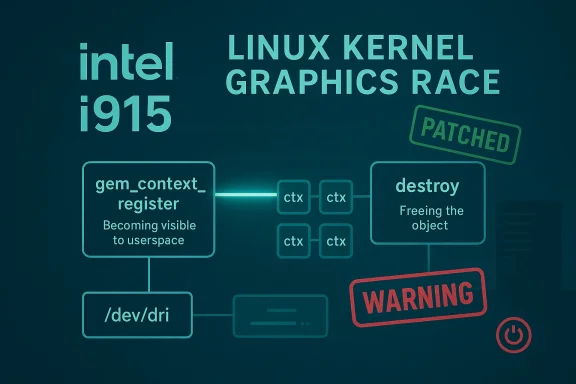
A graphics context in i915 is a kernel object representing a GPU execution context — user‑space obtains and manipulates contexts to submit command streams, configure state, and control execution. The function gem_context_register() is responsible for registering a freshly created context so that it becomes visible to userspace and can be referenced by subsequent ioctls. If that function performs the registration (making the object visible) before the kernel completes all use of the local ctx pointer, there is a narrow race: another thread can call the destruction ioctl and free the object while the original register path still expects it to be valid. That is the classic recipe for a use‑after‑free.
Though the code paths are local (they require local access to the DRM device nodes), modern deployment models — multi‑user servers, CI runners, container workloads with GPU passthrough, and cloud GPU images — expand the practical attacker surface. A low‑privileged local user or untrusted container with access to /dev/dri/* can trigger the vulnerable sequence on a mispatched host. The primary impact is availability; there is no public evidence that confidentiality or integrity are affected by this CVE alone. Public scoring and vendor guidance record a medium base severity with the availability impact rated high.
This is a clear case of a lifecycle/race bug rather than a parsing or input‑validation error. It is common in systems that expose objects via shared registries while background threads or user‑space can concurrently modify lifecycle state. The correct engineering pattern is to complete internal initialization, arrange reference counts or temporary holds to prevent premature free, and only make objects discoverable after they are fully initialized.
Note: Microsoft’s MSRC update guide has been used by some organizations for attestation or impact mapping in the cloud context — Microsoft’s product‑level attestations are artifact‑specific and do not automatically imply exclusivity of affected upstream code across all Microsoft products. Operators should consult per‑artifact advisories to determine which Microsoft images or artifacts include the vulnerable i915 code. An example of guidance about artifact attestation and scope is discussed in advisory analyses and vendor mappings.
However, its operational importance is higher than the patch size suggests: kernel drivers execute with full kernel privileges, and a small lifecycle race can reliably produce host instability. In environments where GPUs are exposed to untrusted actors — cloud GPU VMs, shared CI runners, container hosts — a local availability primitive becomes an effective denial‑of‑service tool.
This CVE also illustrates broader maintenance lessons:
From an operations perspective the practical guidance is simple and urgent for exposed hosts: inventory, patch, and if you cannot patch immediately, reduce the attack surface by restricting device access. Longer term, teams should continue to invest in static analysis, stricter device isolation in multi‑tenant architectures, and robust kernel telemetry so the next lifecycle bug is found before it becomes a fleet‑wide outage.
Conclusion: treat CVE‑2023‑52913 as a patch‑now priority for any host that exposes Intel GPU device interfaces to untrusted code or multiple users, validate the kernel package includes the i915 context‑registration fix, and harden device controls to reduce the likelihood of local actors weaponizing availability primitives while you complete your rollouts.
Source: MSRC Security Update Guide - Microsoft Security Response Center
 Background / Overview
The Direct Rendering Manager (DRM) subsystem in Linux handles how user space interacts with GPU hardware for rendering, mode setting, and buffer management. The Intel i915 driver implements much of the DRM interface for Intel integrated GPUs and exports device nodes and ioctls that user‑space graphics stacks (compositors, rendering engines, containerized workloads with device access) rely on.A graphics context in i915 is a kernel object representing a GPU execution context — user‑space obtains and manipulates contexts to submit command streams, configure state, and control execution. The function gem_context_register() is responsible for registering a freshly created context so that it becomes visible to userspace and can be referenced by subsequent ioctls. If that function performs the registration (making the object visible) before the kernel completes all use of the local ctx pointer, there is a narrow race: another thread can call the destruction ioctl and free the object while the original register path still expects it to be valid. That is the classic recipe for a use‑after‑free.
Though the code paths are local (they require local access to the DRM device nodes), modern deployment models — multi‑user servers, CI runners, container workloads with GPU passthrough, and cloud GPU images — expand the practical attacker surface. A low‑privileged local user or untrusted container with access to /dev/dri/* can trigger the vulnerable sequence on a mispatched host. The primary impact is availability; there is no public evidence that confidentiality or integrity are affected by this CVE alone. Public scoring and vendor guidance record a medium base severity with the availability impact rated high.
What went wrong — a concise technical explanation
At a code level the bug is about timing and object visibility. The register path for a new GEM (Graphics Execution Manager) context performs several operations:- allocate and initialize a context object in kernel memory,
- perform any required kernel-side initialization,
- add the object to an internal lookup (an xarray or similar) so user space can refer to it via a handle,
- return control to caller, allowing user space (or another thread) to issue further ioctls such as destroy.
This is a clear case of a lifecycle/race bug rather than a parsing or input‑validation error. It is common in systems that expose objects via shared registries while background threads or user‑space can concurrently modify lifecycle state. The correct engineering pattern is to complete internal initialization, arrange reference counts or temporary holds to prevent premature free, and only make objects discoverable after they are fully initialized.
Confirmation, provenance, and patch details
Multiple authoritative sources confirm the issue and the upstream remediation:- NVD’s CVE entry for CVE‑2023‑52913 documents the vulnerability summary and the kernel commit provenance, and it captures the essential description of the race in gem_context_register().
- Aggregated vulnerability trackers (for example cvefeed and other trackers) reproduce the same technical summary and point to the upstream stable commit(s) that were cherry‑picked to fix the defect; patch commits are available in the stable kernel trees. The fix’s intent is to ensure the context pointer is not used after it becomes visible (i.e., make adding to the xarray the last step).
- Commercial vulnerability intelligence providers and cloud security teams analyzed the impact and exploitability, confirming the local attack vector and availability impact and recommending patching for shared and GPU‑exposed systems.
Note: Microsoft’s MSRC update guide has been used by some organizations for attestation or impact mapping in the cloud context — Microsoft’s product‑level attestations are artifact‑specific and do not automatically imply exclusivity of affected upstream code across all Microsoft products. Operators should consult per‑artifact advisories to determine which Microsoft images or artifacts include the vulnerable i915 code. An example of guidance about artifact attestation and scope is discussed in advisory analyses and vendor mappings.
Who is affected (scope & common deployment mappings)
The vulnerability lives in the upstream Linux kernel’s Intel i915 DRM driver. That means any product or distribution that ships a kernel build which:- includes the i915 driver (built‑in or as a module), and
- has a kernel version that contains the vulnerable code path,
- Desktop and laptop systems running kernels that expose the i915 driver.
- Virtualized or cloud images that intentionally expose GPU devices or provide passthrough (GPU‑enabled VMs, GPU‑accelerated containers).
- Multi‑user servers, CI/build runners, or shared developer workstations where untrusted jobs/tenants may access device nodes.
- Appliances or embedded builds that include i915 and do not receive regular kernel updates.
Exploitability and realistic attacker model
Exploitability factors:- Attack vector: Local (AV:L). The attacker needs access to the host to open and invoke DRM ioctls or otherwise interact with /dev/dri/* device nodes.
- Required privileges: Low privileges may suffice. In many desktop and container scenarios user processes can open DRM device nodes without elevated privileges. That makes the vulnerability meaningful in multi‑tenant or containerized environments with device access.
- Complexity: Moderate — the race requires precise ordering between context registration and context destruction operations. This is not trivially exploitable remotely and requires local control to trigger the right sequence repeatedly, but repeated steps can reliably cause availability impact on a mispatched host.
- Impact: Availability‑first — driver oops, GPU hangs, kernel instability and potential host reboots or forced service restarts. CVSS vector commonly reported: AV:L/AC:L/PR:L/UI:N/S:U/C:N/I:N/A:H (CVSS v3.x), reflecting the availability impact while confidentiality and integrity remain unaffected by the defect alone.
Detection: how to spot an attempted trigger or impact in the field
Detecting exploitation or accidental triggers centers on kernel telemetry and DRM subsystem signals. Practical indicators include:- Kernel oops or backtraces in dmesg/journal that mention i915, gem_context, or explicit function names such as gem_context_register or I915_GEM_CONTEXT_DESTROY.
- Repeated GPU resets or reported hangs in the DRM subsystem (kernel messages indicating GPU recovery actions).
- Sudden, reproducible application crashes or segmentation faults in GPU‑using user‑space coincident with kernel errors.
- In multi‑tenant environments, patterns of repeated ioctl sequences involving context create/destroy from a single unprivileged account are suspicious.
Mitigation and remediation — a prioritized checklist
- Inventory first
- Enumerate hosts that run kernels with the i915 driver: check uname -r and kernel config or list loaded modules (lsmod | grep i915) to locate exposed systems.
- Map kernel package versions to distribution advisories to see whether the stable backport containing the fix is present.
- Apply the vendor patch
- Install the official kernel update from your distribution or vendor that contains the stable patch for CVE‑2023‑52913 and reboot if the update requires it. Kernel packages contain backports; confirm the package changelog mentions the i915 fix if you maintain strict change control.
- If immediate patching is impossible — use compensating controls
- Restrict access to DRM device nodes: change ownership/permissions on /dev/dri/* or use udev rules to only allow trusted accounts to open GPU devices.
- Blacklist or unload the i915 module where feasible: doing so prevents any user‑space from reaching the vulnerable path but removes GPU acceleration and may break display functionality; unacceptable for many desktop and server roles.
- Use livepatch services where available: enterprise livepatch solutions (kpatch, livepatch services) can sometimes apply selected fixes without a full reboot; ensure a vendor‑supplied livepatch explicitly covers the CVE‑patch commit before relying on it.
- Harden multi‑tenant boundaries
- For virtualization and container platforms, avoid granting /dev/dri access to untrusted guests or jobs. Use device isolation and minimal capabilities to reduce the chance an untrusted tenant can issue ioctls.
- Audit CI runners and shared build systems to ensure they do not unintentionally expose device nodes to untrusted tasks.
- Validate and monitor
- After patching, validate by reproducing representative GPU workloads and watching kernel logs for regression or lingering oops traces.
- Update SBOMs and inventory records to reflect patched kernel package versions and maintain the audit trail.
Why the fix is low‑risk but matters operationally
The upstream remediation is small, surgical and defensive: rearrange registration order or add temporary reference holds so the ctx pointer is not used after it becomes visible. This conservative approach minimizes regression risk and permits rapid cherry‑picks into stable kernel branches. That’s why distributions could push fixes quickly.However, its operational importance is higher than the patch size suggests: kernel drivers execute with full kernel privileges, and a small lifecycle race can reliably produce host instability. In environments where GPUs are exposed to untrusted actors — cloud GPU VMs, shared CI runners, container hosts — a local availability primitive becomes an effective denial‑of‑service tool.
This CVE also illustrates broader maintenance lessons:
- Defensive object‑lifecycle patterns and reference counting discipline are essential in drivers that publish objects to userspace.
- Static analysis and targeted sanitizer tools can find these races earlier; the upstream kernel community increasingly leverages such tooling to reduce recurrence.
- Patching policies for kernel bugs must balance maintenance windows and operational continuity; mitigation controls are necessary when immediate reboots are impractical.
Risks that remain after patching
Patching removes the specific race condition, but three classes of residual risk remain:- Similar bugs elsewhere in the driver: small lifecycle mistakes are a persistent class of defects; a single fix doesn’t guarantee the absence of other UAF or race windows in adjacent code paths.
- Supply chain and artifact scope: not every kernel build in every vendor/consumer artifact will receive the fix at the same time. Artifact attestations (for example, vendor‑published CVE mappings for specific images) must be read as per‑artifact statements. Do not assume every Microsoft or distribution artifact is patched unless explicitly attested. Cross‑check per‑artifact advisories.
- Operational exposure windows: appliances, embedded devices, or custom builds that do not follow distribution update channels may remain exposed for long periods.
For kernel maintainers and developers — recommendations
- Make adding objects to shared registries the last step of initialization. If other threads can reach destruction paths, hold a temporary reference or lock until initialization completes.
- Use static analyzers (KASAN, KCSAN where relevant, SVACE, syzkaller fuzzing) and include lifecycle tests in CI to catch races that are hard to observe in ad‑hoc testing.
- Favor small, defensive fixes for lifecycle issues to enable rapid stable backports and reduce risk of introducing regressions in widely deployed kernels.
- Document expected invariants around object visibility and teardown semantics in code and review checklists for driver subsystems.
Quick operational checklist (actionable summary)
- Inventory GPUs and i915 presence: run distribution tools and list modules (lsmod | grep i915) across fleet.
- Check distribution advisories and kernel package changelogs for the CVE fix (look for the gem_context_register or i915 context UAF mention).
- Prioritize patching for:
- Shared hosts, CI runners, and multi‑user workstations.
- Cloud and virtualization hosts that expose GPUs to guests or containers.
- If patching is delayed:
- Restrict /dev/dri access with udev rules or permission changes.
- Consider unloading/blacklisting i915 only when acceptable (loss of GPU acceleration).
- Use livepatch only if vendor provides an explicit livepatch for the commit.
- Monitor kernel logs for i915 oops traces and create SIEM alerts for repeated context_create/context_destroy sequences from non‑privileged accounts.
Final analysis and verdict
CVE‑2023‑52913 is a textbook example of a small code‑hygiene flaw producing an outsized operational impact because it sits in kernel space and touches a hot path. The vulnerability itself is not an exotic escalation vector; it is an availability‑first UAF caused by a registration‑ordering race in gem_context_register(). Upstream maintainers applied a straightforward patch — reorder and guard registration so that the context cannot be freed while still in use — and distributions rolled out stable backports.From an operations perspective the practical guidance is simple and urgent for exposed hosts: inventory, patch, and if you cannot patch immediately, reduce the attack surface by restricting device access. Longer term, teams should continue to invest in static analysis, stricter device isolation in multi‑tenant architectures, and robust kernel telemetry so the next lifecycle bug is found before it becomes a fleet‑wide outage.
Conclusion: treat CVE‑2023‑52913 as a patch‑now priority for any host that exposes Intel GPU device interfaces to untrusted code or multiple users, validate the kernel package includes the i915 context‑registration fix, and harden device controls to reduce the likelihood of local actors weaponizing availability primitives while you complete your rollouts.
Source: MSRC Security Update Guide - Microsoft Security Response Center
