

IP Fabric’s January release and Microsoft’s January 2026 lifecycle moves landed in the same week, but they point in opposite operational directions: one vendor is adding deeper visibility to tame hybrid, multi‑cloud complexity, while another has finally closed the book on a long‑running Windows codebase that many enterprises still relied on. The result is a practical, urgent moment for IT teams: adopt tools that can model modern cloud enforcement points, and accelerate migration or isolation plans for legacy Windows Server 2008 estates now that the vendor lifeline has been removed.
Enterprises are operating in two simultaneous transitions. First, workloads are increasingly hybrid and multi‑cloud, with private connectivity (ExpressRoute, Interconnect), cloud firewalls, Private Link/Private Endpoint, and vendor control‑plane behavior forming critical enforcement points that traditional network tools often miss. Second, long‑tail platform lifecycles — notably the Windows Vista/Windows Server 2008 lineage — have been closing out a series of paid and extended support programs, concentrating risk in any remaining legacy deployments. Understanding both trends together is essential: legacy servers are often the “last mile” in hybrid topologies, and cloud‑native enforcement gaps can mask real exposure.
IP Fabric’s release makes it easier to prove and simulate how private endpoints, cloud firewalls, and interconnects affect real flows—capabilities that will be especially valuable while teams execute migrations and audit compensating controls. At the same time, the Server 2008 sunset (and Microsoft’s January 2026 servicing changes) raises the stakes for those migrations by removing the last vendor‑backed safety net. These two realities should not be managed separately: converge cloud, network, and OS lifecycle programs into a single operational initiative that maps risk, automates verification, and forces execution.
Immediate next steps for organizations that operate both hybrid networks and legacy Windows estates: run a small‑scope pilot that pairs IP Fabric (or equivalent) snapshots with a prioritized migration of your highest‑exposure Server 2008 hosts. Validate simulated paths against live traffic, document compensating controls for auditors, and fund the migration projects that permanently eliminate the risk. The tools exist to see the problem; the remaining work is moving from awareness to execution.
Source: IT Brief Asia https://itbrief.asia/story/ip-fabri...y-gone-after-microsoft-pulls-support-at-last]
 Background
Enterprises are operating in two simultaneous transitions. First, workloads are increasingly hybrid and multi‑cloud, with private connectivity (ExpressRoute, Interconnect), cloud firewalls, Private Link/Private Endpoint, and vendor control‑plane behavior forming critical enforcement points that traditional network tools often miss. Second, long‑tail platform lifecycles — notably the Windows Vista/Windows Server 2008 lineage — have been closing out a series of paid and extended support programs, concentrating risk in any remaining legacy deployments. Understanding both trends together is essential: legacy servers are often the “last mile” in hybrid topologies, and cloud‑native enforcement gaps can mask real exposure. IP Fabric expands cloud‑native network insight — what’s new, and why it matters
The announcement in brief
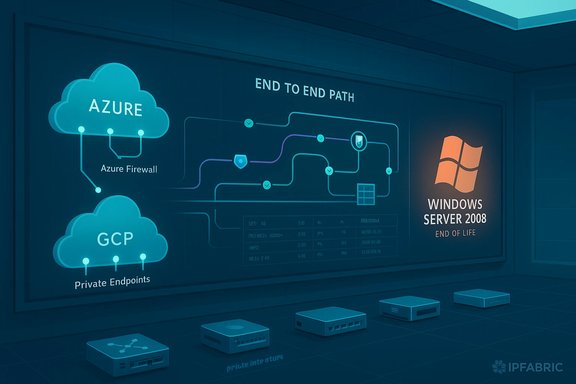
On January 14, 2026 IP Fabric announced a release that extends its automated network assurance model deeper into Microsoft Azure and Google Cloud Platform (GCP). The headline features are:- Expanded Azure interpretation — Azure Firewall, Private Link, and Private Endpoints are now modeled so they appear in diagrams and path simulations.
- Expanded GCP coverage — multi‑project discovery and GCP Interconnect support to correctly stitch hybrid paths when on‑prem networks attach via interconnect.
- Improved hybrid pathing and metadata — enriched cloud metadata, clearer path interpretation, and better IPv6 modeling across vendors.
- Usability and workflow improvements — CSV attribute import/export, simplified filters, and diagram interpretive text to speed troubleshooting.
Operational implications — beyond the press release
Cloud constructs like Private Endpoints or Private Link often alter traffic flows and enforcement in ways that are invisible if you only look at on‑prem routers and firewalls. Modeling those constructs inside a unified snapshot:- Reduces cross‑team handoffs during incidents (cloud vs. network vs. security).
- Produces auditable end‑to‑end diagrams for compliance and post‑incident reviews.
- Allows automated intent checks to surface misconfigurations that could silently bypass controls.
Technical depth: what an accurate hybrid path needs
Accurate hybrid path simulation requires more than a shallow inventory. It needs:- Configuration and state from network devices and cloud APIs.
- Normalized topology synthesis that accounts for control‑plane semantics (BGP advertisement behavior, cloud route propagation).
- Vendor metadata to model enforcement (Azure Firewall rules, Private Endpoint DNS resolution, GCP private services semantics).
- IPv6 handling consistent across vendor constructs when present.
Practical strengths and likely benefits
- Unified single source of truth: When cloud enforcement points appear in the same model as on‑prem devices, operations can rely on a single authoritative snapshot rather than fragmented consoles or ad‑hoc documentation.
- Faster MTTR: Clear diagrams and simulated paths reduce the time spent establishing ownership and dissecting paths across cloud and on‑prem teams.
- Compliance and audit readiness: Automated, versioned snapshots provide repeatable evidence of policy enforcement for auditors.
- Project acceleration: Migration, SD‑WAN rollouts, and M&A network consolidations are easier when you can validate end‑to‑end paths before change windows.
Caveats, limitations, and realistic validation steps
No third‑party tool can perfectly emulate every vendor internal behavior. Expect the following caveats:- API permission trade‑offs: Deep visibility requires broad read scopes in Azure and GCP APIs. Security and compliance teams must validate these scopes and implement least‑privilege service principals.
- Control‑plane blind spots: Proprietary internal routing inside hyperscaler backbones may not be fully visible externally; the model is only as accurate as the exposed control‑plane data.
- Scale and cost: High‑fidelity snapshots at enterprise scale increase compute, storage, and API‑rate considerations—plan cadence and retention to balance fidelity and cost.
- Integration overhead: Tools must be integrated into SIEM, ITSM, and runbooks to turn diagrams and checks into operational action.
- Run targeted test cases that reflect your real-world failure modes (Private Endpoint misroute, Interconnect failover).
- Compare simulated paths with live synthetic traffic or packet captures.
- Validate required cloud API roles with security and enable least‑privilege accounts.
- Measure snapshot processing times, storage use, and API rate‑limit behavior at expected cadence.
- Integrate outputs into ticketing and automation pipelines and run a tabletop exercise.
Windows Server 2008 — the final vendor lifeline is gone
The timeline and what ended
Microsoft’s public lifecycle records and recent KBs confirm that the extended, paid vendor lifelines for Windows Server 2008 have been exhausted. The important dates and facts:- Microsoft’s published lifecycle pages show Windows Server 2008’s mainstream and extended support timelines historically, and they document Extended Security Update (ESU) programs that provided a limited bridge in prior years.
- Certain paid programs and targeted “Premium Assurance” coverage continued for a small set of enterprise customers, but Microsoft’s customer advisories and KBs state that Premium Assurance for Server 2008 ended on January 13, 2026. That milestone removes the final vendor‑backed patching route for the Vista/Server 2008 codebase.
- Microsoft’s January 2026 cumulative servicing wave included updates that intentionally remove legacy modem drivers that shipped with NT 6.x images (agrsm64.sys, agrsm.sys, smserl64.sys, and smserial.sys), a hardening move that can break vintage hardware dependent on those drivers.
Why this matters now — security, compliance and operations
The end of vendor support has immediate, concrete consequences:- Security risk: Any newly discovered kernel‑level or platform vulnerability affecting NT 6.x will no longer be patched by Microsoft for Server 2008. Unsupported systems rapidly become high‑value targets.
- Compliance exposure: Regulations and contractual obligations (PCI‑DSS, HIPAA, SOC) often require vendor‑supported patching. Running unsupported OS instances can create audit failures and insurance complications.
- Operational compatibility risk: Microsoft’s hardening changes (the driver removals) can break legacy peripherals (modems, embedded serial devices), which still exist in industrial, medical, and retail environments. If such devices are present, there is a real risk of immediate operational outage.
What administrators should do now — prioritized remediation and mitigation
The window for passive planning has closed. Below is a prioritized, practical roadmap for IT teams still managing Server 2008 estates.First 72 hours — inventory and isolation
- Build a definitive inventory of all hosts running Server 2008 / Vista lineage code, including embedded devices and appliances.
- Identify externally facing systems and escalate them to high‑priority migration or isolation.
- Apply immediate network segmentation: isolate legacy systems behind strict VLANs, firewall rules, and jump hosts to minimize exposure.
Week 1–4 — fast mitigations and technical triage
- Validate backups and disaster recovery procedures for critical systems.
- Apply compensating controls: host‑based EDR, strict credential rotations, application allow‑listing, and virtual patching layers (WAF, reverse proxies).
- Reach out to hardware vendors for signed driver replacements if devices rely on removed modem drivers. Where drivers are not forthcoming, plan for hardware replacement or tightly controlled isolation.
30–180 days — migration execution
- Priority migrations: externally exposed services, authentication infrastructure, and compliance‑critical hosts.
- Migration patterns to evaluate:
- Lift‑and‑shift to cloud VMs (fast but keeps legacy OS).
- Replatform/refactor into supported Windows Server versions, containers, or Linux (longer, higher ROI).
- Replace appliances with vendor‑supported alternatives.
- For cloud migrations, consider Azure’s historical ESU incentives (noting those options previously existed and are now closed for this codebase). Use migration tooling and test thoroughly.
Business and compliance steps
- Document compensating controls, business justifications, and risk acceptance decisions for any remaining legacy systems.
- Engage legal and insurance teams to understand contractual and cyber‑insurance impacts.
- Communicate the migration timeline and risks to business stakeholders; retirement or isolation projects must be funded and prioritized.
Cross‑cutting implications: network teams, cloud teams and Windows admins must coordinate
The two news threads converge operationally:- Network and cloud teams are adopting tools (like IP Fabric’s enhanced cloud modeling) that can make hybrid enforcement visible and testable.
- Windows admins face hard timelines to eliminate or contain legacy Server 2008 endpoints that may be part of those hybrid paths.
- Include legacy host test cases in IP Fabric (or similar) pilots: verify how a path behaves when a Server 2008 host is isolated, migrated, or remains in situ behind a compensating control.
- Use the unified snapshots to produce migration impact diagrams for application owners and auditors.
- Add lifecycle and migration milestones to the network change calendar so that network modifications (routing, private connectivity changes) don’t accidentally expose unsupported hosts.
Risk matrix — what to expect if action is delayed
- High risk (likely severe impact): Internet‑facing Server 2008 instances, RDP‑exposed hosts, and legacy authentication servers—these can lead to immediate compromise and regulatory fallout.
- Medium risk (significant operational pain): Behind‑the‑scenes appliances (POS systems, embedded controllers) that require physical replacements or vendor driver support; these can cause service outages if updates like the modem driver removals are applied.
- Low risk (manageable): Isolated dev/test boxes or air‑gapped legacy lab systems — still not ideal, but lower immediate threat if kept offline and not trusted with production data.
Action plan template — a short, practical checklist (ready to use)
- Inventory → export authoritative list of Server 2008 hosts and their business owners.
- Triage → categorize by exposure and compliance criticality.
- Isolate → apply network segmentation for high‑risk hosts.
- Short‑term controls → EDR, virtual patching, credential rotation, strict firewall policies.
- Migration roadmap → assign migration owners, select pattern (rehost/replatform/replace), set milestones.
- Validate with hybrid modeling → include migration scenarios in IP Fabric snapshots to check for path changes or policy gaps.
- Document → keep evidence for auditors and insurers, and publish a clear sunset schedule internally.
Conclusion
Two co‑occurring shifts define this week’s operational landscape for Windows and cloud teams: automated network assurance tools are closing the gap between on‑prem and cloud enforcement modeling, while Microsoft has finally closed the final vendor lifeline for the Vista/Server 2008 lineage. The practical net effect is a clear imperative: use modern modeling and observability to reduce hybrid blind spots, and treat any remaining Server 2008 systems as urgent migration or isolation cases.IP Fabric’s release makes it easier to prove and simulate how private endpoints, cloud firewalls, and interconnects affect real flows—capabilities that will be especially valuable while teams execute migrations and audit compensating controls. At the same time, the Server 2008 sunset (and Microsoft’s January 2026 servicing changes) raises the stakes for those migrations by removing the last vendor‑backed safety net. These two realities should not be managed separately: converge cloud, network, and OS lifecycle programs into a single operational initiative that maps risk, automates verification, and forces execution.
Immediate next steps for organizations that operate both hybrid networks and legacy Windows estates: run a small‑scope pilot that pairs IP Fabric (or equivalent) snapshots with a prioritized migration of your highest‑exposure Server 2008 hosts. Validate simulated paths against live traffic, document compensating controls for auditors, and fund the migration projects that permanently eliminate the risk. The tools exist to see the problem; the remaining work is moving from awareness to execution.
Source: IT Brief Asia https://itbrief.asia/story/ip-fabri...y-gone-after-microsoft-pulls-support-at-last]
