

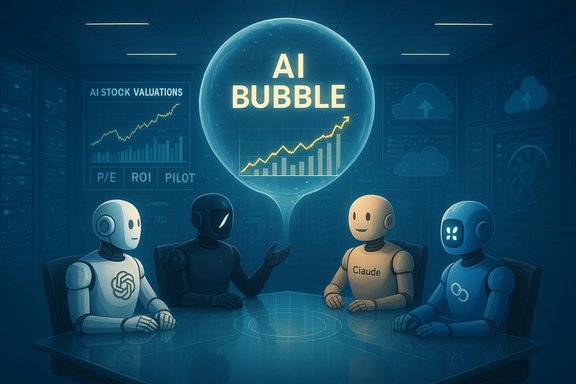
The AI debate that dominated headlines this month boiled down to a deceptively simple question: are sky-high prices for AI companies and startups a rational reflection of expected future profits, or are they the latest incarnation of a market bubble driven more by hype than fundamentals? Forbes’ experiment—asking seven major chatbots for short takes—captured the mood: a split verdict, with many chatbots admitting signs of a bubble while insisting the underlying technology is not to blame.
Background
The conversation about an “AI bubble” has three ingredients: massive capital flows into AI and related infrastructure, early-stage deployments that often fail to produce measurable returns, and warnings from economists and regulators that valuations may be detached from near-term profitability. Bank of America’s October Global Fund Manager Survey found that a record share of respondents—about 54%—now believe AI-related assets are in “bubble territory,” a sharp rise in concern that rippled through markets. At the same time, academic analysis has hardened the skepticism. A report from an MIT research initiative — covering roughly 300 public generative-AI deployments and hundreds of interviews and surveys — concluded that only about 5% of pilots produced material profit acceleration, with the vast majority delivering little to no measurable P&L impact. The study’s headline statistic (95% of deployments produced no measurable return) crystallized fears that money was piling into projects without clear business models. Regulators and macroeconomists have taken notice. The Bank of England warned that the risk of a “sharp market correction” had increased, pointing to concentration in a handful of large tech firms and valuations that look stretched versus historical norms. On the other side of the policy debate, some large financial firms argued that big-ticket AI investments are sustainable as a macro phenomenon, even if winners and losers remain uncertain.What the chatbots said — and why it matters
A snapshot of the experiment
Forbes (as reported in media summaries) posed the same short prompt to seven chatbots—ChatGPT, xAI Grok, Meta AI, Anthropic Claude, Perplexity, Microsoft Copilot, and Google Gemini—asking whether an “AI bubble” exists. Responses ranged from categorical (“Yes”) to nuanced (“Yes and no”) to cautious denial (“debatable”), reflecting the ambiguity in real-world opinion. Several chatbots said the problem is one of market expectations, not of AI’s technical promise.Why a chatbot’s answer is newsworthy (but limited)
Chatbots mirror the data they’re trained on: news articles, economic commentary, analyst notes, and policy pronouncements. When multiple independent LLMs converge on the same diagnosis—hype and froth in parts of the market—it’s a signal that public discourse and analyst reports are aligned in identifying risk hotspots. But chatbot outputs are descriptive, not prescriptive: they summarize prevailing narratives rather than produce original due diligence. Their consistency with human expert warnings makes them a useful barometer of market sentiment, not a substitute for valuation analysis.Hard data and market signals
Investor sentiment: Bank of America’s Fund Manager Survey
- 54% of fund managers flagged AI equities as being in bubble territory; 60% said global equities overall were overvalued.
- The AI equity bubble emerged as a top “tail risk” among surveyed managers, displacing inflation and other macro worries.
Deployment performance: MIT’s “GenAI” findings
- The MIT NANDA-affiliated study analyzed roughly 300 public GenAI deployments and interviewed hundreds of executives and employees.
- The study reported that only about 5% of integrated pilots were producing material value; the rest were stalled or offered negligible P&L effects.
- The researchers highlighted issues such as brittle workflows, poor integration, and misalignment between use cases and tool capabilities.
Macro and regulatory flags
- The Bank of England explicitly warned that equity markets are vulnerable to a sharp correction if optimism about AI wanes, pointing at valuation concentration among a few megacap stocks that have led market gains.
- Prominent economists and institutional investors have echoed the concern: Torsten Sløk (Apollo Global) argued that the top 10 companies in the S&P 500 are more overvalued today than in the late 1990s dot‑com peak, amplifying comparisons to 2000. Bryan Yeo (GIC) and others have warned that early-stage valuations in venture markets look frothy.
- At the same time, Goldman Sachs’ economist Joseph Briggs offered a counterbalance: large-scale AI investment can be macro-sustainable, but the identity of the ultimate winners remains uncertain. That nuance is crucial for assessing systemic risk.
Valuations vs. fundamentals: where the disconnect shows
The “concentration problem”
The current market rally has been heavily concentrated in a small group of tech firms—firms that also lead the AI hardware and platform ecosystems. When index returns are driven mainly by a handful of expensive names, overall market P/E ratios can mislead investors about broad market health. The Bank of England and others flagged that concentration as a vulnerability: if AI expectations recede, those few names could suffer outsized drawdowns.Early-stage froth
Venture capital numbers show an unprecedented flow into AI startups: quarterly funding rounds in 2025 hit record levels, and many early-stage companies receive valuations that far exceed current revenue and profitability signals. Institutional investors at conferences have described a “label premium” — the idea that an “AI” tag alone commands steep multiples irrespective of product-market fit. That is classic speculative behavior.Execution risk inside enterprises
Even where large companies deploy the best models, the real obstacle is integration. The MIT study’s finding—that most GenAI pilots stall—points to organizational frictions: process redesign is harder than model training. That means a lot of the capital is buying potential rather than demonstrated productivity gains. If markets priced companies on immediate revenue uplift rather than potential future efficiencies, the gap can look like a bubble.Historical parallels: dot-com vs. today
Similarities to 2000
- Hype and narrative-driven capital: Then it was “the internet will change everything”; now it’s “AI will multiply productivity and profits.”
- Plenty of unprofitable firms with high valuations: A large tranche of today’s AI-focused startups and even some public firms show weak or no profitability.
- Rapid investments in enabling infrastructure: Back then it was fiber and web services; now it’s data centers, GPUs, and custom accelerators.
Important differences
- Profitability among the largest players: Today, the biggest AI beneficiaries—cloud hyperscalers and chipmakers—are already profitable, with substantial cash flows, unlike many dot-com era “darlings” that had little to no earnings. That reduces systemic risk compared with 2000.
- Nature of capital deployment: Much AI spending is equity-funded capex rather than debt-fueled leverage, which reduces the risk of a credit-driven systemic crisis. Several economists and IMF commentators emphasize that while equity holders may take losses in a correction, banking systems are less likely to be the transmission channel this time.
Scenarios if the bubble narrative plays out
1) Soft correction and sectoral shakeout (the most likely)
- Overvalued startups and marginal projects retrench or fail. Investors rotate into survivors with durable business models. The broader economy feels localized pain, especially in venture and private equity returns, but real GDP growth is largely unaffected.
2) Concentration-driven pullback
- If investor disappointment clusters on a few megacaps, overall indices could correct materially. Market volatility would rise, but systemic banking stress would be limited because much of the exposure is equity-based rather than credit-based.
3) Hard crash (low probability, high impact)
- A rapid cascade of insolvencies among leveraged firms, or a sudden policy shock (e.g., aggressive rate rises or geopolitical events) that simultaneously undermines AI expectations and credit markets, could produce a broader macro shock. Most economists assess this as less likely today than during the 2000/2008 episodes, but not impossible.
Risk factors to watch now
- Valuation concentration: Monitor how much of the market’s cap gains are tied to a handful of names.
- Private-market entry multiples: If early-stage valuations keep climbing while revenue trajectories remain flat, that’s a red flag.
- Adoption-to-revenue conversion: Track whether enterprise GenAI pilots move from experiments to measurable revenue or cost-savings. The MIT study suggests that many will not without explicit integration strategies.
- Macro policy signals: Central bank credibility and rate paths materially affect whether froth can persist. Bank of England caution and other regulator statements matter for market psychology.
What investors and executives should do (practical checklist)
- Reassess exposures: quantify how much portfolio return depends on a small number of AI beneficiaries versus a diversified base.
- Demand metrics: for each AI investment, require concrete KPIs—revenue uplift, automation savings, unit economics—and timelines for realization.
- Distinguish narrative from moat: prioritize companies with defensible advantages (data, distribution, specialized models, locked-in customers).
- Stage capital: apply milestone-based funding for startups to avoid overcommitting to concept-stage teams.
- Prepare for volatility: increase liquidity buffers and hedge concentrations if index exposure becomes dependent on a few names.
Strengths and risks of the “AI bubble” narrative
Strengths (what the bubble thesis explains well)
- Explains why private-market valuations have surged despite weak short-term revenue signals.
- Matches investor sentiment metrics showing rising skepticism (Bank of America survey).
- Accounts for regulatory and macro warnings about concentrated valuations and potential market corrections.
Weaknesses (where the bubble thesis overreaches)
- It can underestimate durable value created by AI platforms in search, cloud services, enterprise automation, and semiconductor design—areas with real productivity gains and recurring revenue models.
- It often lumps profitable megacaps with speculative startups, obscuring the fact that the largest players have substantial cash flow and balance-sheet resilience. Goldman Sachs and others stress this nuance.
How to read conflicting expert views
Market commentary will split between alarmists and reassurers. Some figures liken the situation to the dot-com peak and warn of greater overvaluation; others say the scale of investment and profit-generating capacity of the largest players make a full-blown systemic crisis unlikely. Both views can be true simultaneously: a serious sector correction is plausible without necessarily triggering a broad financial collapse. Prudence, not panic, is the rational response.Final assessment: Is there an AI bubble?
- The evidence indicates a bubble in parts of the AI ecosystem—notably in speculative early-stage valuations and in markets where the “AI” label is being priced ahead of demonstrated revenue or integration success. Survey data (Bank of America) and deployment studies (MIT) make this point forcefully.
- At the same time, AI as a technology is real and productive in significant use cases; many large companies with robust cash flows are financing the buildout and absorbing risk. This reduces the likelihood of a 2008-style systemic crisis.
- The most likely outcome is a shakeout: a period of repricing that weeds out unviable startups, sharpens investor discipline, and leaves a smaller set of durable winners whose technologies and business models are proven. Chatbots that answered “yes, in parts” or “yes and no” captured that middle ground well.
Conclusion
The current moment is not a binary “bubble-or-not” choice but a spectrum of risk across an ecosystem. There are clear signs of speculative excess—especially in early-stage valuations and in corporate pilots that haven’t translated into earnings. At the same time, there are real, material returns being created in infrastructure, cloud platforms, and select applications. The sensible posture for boards, investors, and policymakers is to separate narrative from measurable outcomes: demand evidence, stage investments, reduce concentration risk, and prepare for volatility. If markets behave as they often do, the hype will recede, capital will be reallocated, and the most durable applications of AI will continue to reshape industries—without taking the global economy down with them.Source: The Zimbabwe Mail Is There An ‘AI Bubble’? We Asked The Experts: AI Chatbots. | The Zimbabwe Mail
