

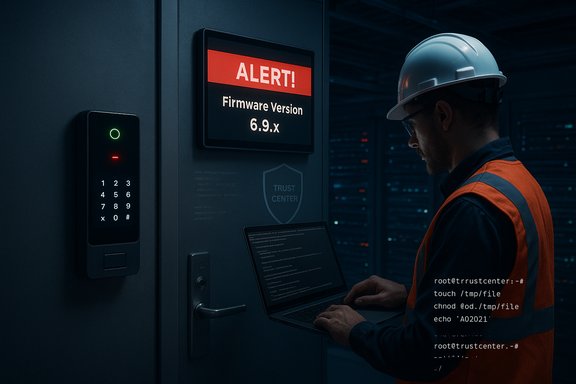
Johnson Controls’ iSTAR Ultra family has been the subject of coordinated security advisories after multiple remote OS command‑injection and related firmware‑integrity weaknesses were disclosed; attackers who successfully chain these issues could modify firmware, gain root access, and take full control of access‑control door controllers that are widely deployed in commercial, government and industrial facilities. The vendor and CISA have published remediation guidance that centers on immediate firmware upgrades and standard ICS‑level hardening, but defenders must treat this as more than a routine patch cycle: these devices sit on the border between physical security and IT, and compromise carries direct operational and safety consequences.
Background / Overview
Johnson Controls’ iSTAR line — marketed under the Software House brand and deployed as iSTAR Ultra, iSTAR Ultra SE, iSTAR Ultra LT, the G2 generation and iSTAR Edge — serves as the edge access controller for many C•CURE access‑control systems. These controllers maintain encrypted channels to host servers, manage door hardware, and host maintenance and diagnostic interfaces used by building operators and integrators. Issues in certificate handling, firmware verification and web/CLI interfaces are recurring themes in recent advisories and demand cross‑discipline coordination between IT, physical security and facilities teams. CISA’s ICS advisory packages emphasize the operational risk: successful exploitation of the disclosed weaknesses can let an attacker modify firmware and obtain complete control of the device, undermining both availability (loss of communications, local/remote management) and integrity/confidentiality (firmware tampering, data access) depending on the issue exploited. The advisory family released in mid‑2025 covers multiple iSTAR products and assigns high CVSS ratings to command‑injection and related firmware‑validation findings.What’s affected: products and version baselines
Affected families and baseline fixes
- iSTAR Ultra, iSTAR Ultra SE, iSTAR Ultra LT: multiple advisories indicate vulnerable firmware trains in the 6.9.x family. Vendor guidance in the coordinated advisories recommends upgrading Ultra‑class units to recent CU‑level releases (Ultra baselines vary across advisories—see the verification notes below).
- iSTAR Ultra G2, iSTAR Ultra G2 SE, iSTAR Edge G2: affected firmware versions are reported as prior to 6.9.3 in CISA’s iSTAR Ultra advisory; 6.9.3 and later contain fixes for the command‑injection class issues.
Which CVEs are in play
Coordinated disclosures covering the iSTAR family include CVE assignments for OS command injection and related weaknesses. Public advisory materials published by CISA and the vendor list multiple CVE identifiers tied to distinct issues (for example, CVE‑2025‑53695 and companion identifiers in the vendor package). Independent CSAF packages circulated by researchers and integrators may refer to alternate CVE numbers for specific subissues; this inconsistency is a tracking issue rather than a difference in technical impact, but it must be resolved for accurate asset inventory and compliance workflows. Always validate the CVE–firmware mapping against the vendor PSA for the exact model you operate.Technical details: how the flaws work
OS command injection (CWE‑78)
At the core of the most severe findings is OS command injection: parts of the iSTAR web/diagnostics stack accepted user‑controlled input that was concatenated into shell or system command invocations without sufficient sanitization or escaping. When such endpoints are reachable to an attacker with the necessary privileges (or when other logic errors lower that prerequisite), an adversary can append shell metacharacters or payload fragments that cause the device to execute arbitrary commands as the local process owner—often escalating to root or allowing subsequent privilege escalation. The recorded impact of successful exploitation is full device compromise, including the ability to overwrite firmware images and persist arbitrary payloads.Insufficient firmware verification and insecure update paths
Separate but related findings describe insufficient verification of firmware authenticity on boot‑time checks: certain parts of the firmware image were not verified, leaving room for crafted or malicious images to be accepted by the bootloader or runtime verifier. Where an attacker can inject a modified image (for example, through a prior command‑injection foothold or compromised update mechanism), they obtain a durable foothold that can survive reboots and evade naive integrity checks. Patching these weaknesses requires both software fixes and operational controls around how firmware images are staged and deployed.Default credentials and alternate hardware interfaces
Advisories also call out default/weak credentials and undocumented or poorly‑protected hardware interfaces (for example, serial console access to U‑Boot) that can be abused with physical access or by attackers who can trick maintenance processes. These findings raise the classic combination of remote exploitation (command injection) and local/physical escalation (console access, default root credentials) that magnifies operational risk in real deployments.Risk evaluation: why this is high priority
- High‑impact compromise: a compromised iSTAR controller can be used to open doors, disable alarms, erase central logs or block remote monitoring, creating both physical security and compliance implications.
- Scale and exposure: many iSTAR devices are deployed worldwide across critical manufacturing, commercial facilities, transportation hubs and government sites; wide deployment increases blast radius if automated scanning or mass exploitation appears.
- Edge‑to‑enterprise pivot: these controllers are frequently reachable from engineering subnets or vendor‑management networks. A compromised iSTAR may be a pivot into adjacent IT systems or jump hosts where Windows-based management consoles or integrator tools reside.
- Low attack complexity: the strongest of the discovered command‑injection variants are rated with low attack complexity and remote network attack vectors in CVSS recalculations—meaning that if interfaces remain exposed, exploitation is feasible for moderately skilled attackers.
Exploitation scenarios and practical attack chains
- Network‑accessible web/diagnostics UI + authenticated maintenance account: an attacker with access to a low‑privilege maintenance session sends crafted input that triggers command injection and spawns a shell, which is then escalated to root. From there the attacker modifies firmware or drops persistent payloads.
- Supply‑chain/firmware staging compromise: an attacker with access to the firmware distribution path or update servers places a tampered image that passes incomplete checks on the device and is accepted at boot. This yields persistent compromise without further network interaction.
- Physical reconfiguration plus hardware console: with physical access to the undocumented RJ11 or serial console users, an attacker re‑enables the bootloader console and obtains root‑level shell, circumventing network protections. This is a lower‑scale but high‑severity scenario for units in insecure closets.
What defenders should do now: triage and remediation checklist
The immediate orders of priority are: identify, isolate, patch, verify.- Inventory and prioritize (time‑boxed to hours):
- Enumerate every iSTAR controller model and firmware version across your estate. Treat any device whose firmware is earlier than the vendor‑recommended fixed baseline as in‑scope for emergency remediation. Use configuration management databases, network scans, and vendor management consoles to produce a short list of high‑exposure units.
- Isolate and protect (hours):
- Remove direct Internet exposure. Block management interfaces at the firewall edge; remove NAT‑forwarding rules that expose iSTAR HTTP/HTTPS or management ports. Place controllers on segmented VLANs firewalled from corporate networks. Use access control lists to permit only explicit management hosts. CISA’s guidance emphasizes minimizing network exposure as a first line of defense.
- Patch with vendor‑approved firmware (days):
- Upgrade iSTAR Ultra / SE / LT and G2 units to the vendor‑stated fixed firmware versions. Johnson Controls and coordinated advisories list upgrade baselines—confirm the exact mapping for your SKU on the vendor PSA and install the released firmware packages using the vendor‑documented updater procedures. Where advisory documents differ on exact CVE/version strings, follow the vendor PSA as authoritative for your product.
- Change credentials and rotate keys (days):
- Replace default or shared administrative passwords. Rotate any SSH keys, certificates, or management tokens that might have been exposed. If panels use host‑supplied TLS certificates, verify certificate chains and replace default certificates where recommended.
- Verify firmware integrity and detect tampering (days):
- Use vendor verification tools and build checksums for firmware images. Compare installed firmware checksums against vendor‑published hashes. Look for unexpected files, cron jobs, or persistent network connections from controllers that could indicate pre‑existing compromise.
- Monitor and hunt for indicators (weeks):
- Monitor for anomalous management login attempts, unexpected TLS certificate changes, and unusual outbound connections from controllers. Hunt for evidence of firmware replacement (sudden changes in version strings, reboots at odd times) and check central log servers for gaps that may indicate tampering.
- Coordinate and report (ongoing):
- If you observe suspected malicious activity, follow your incident response playbook and report the incident to relevant authorities (CISA or national CERT) for tracking and correlation. Johnson Controls also provides a Trust Center for coordination with its PSIRT.
Detection and response guidance — what to look for
- Unexpected firmware version banners returned by HTTP headers or SSH banners following a web exploit.
- New or unexpected management accounts, SSH keys, or user sessions.
- Outbound command‑and‑control‑style connections from controllers to unknown IPs.
- Sudden certificate or TLS changes on the panel’s host channel—particularly host cert swaps or reversion to default certs.
- Configuration changes that re‑enable maintenance or "Pro" modes; advisories specifically recommend disabling Pro Mode where present.
Hardening best practices beyond patching
- Network segmentation: isolate physical security devices in a dedicated VLAN and limit management to designated jump hosts that are tightly controlled, patched, and monitored.
- Least privilege: restrict who can perform firmware updates, change modes (Pro/Ultra), or access serial consoles. Require multi‑factor authentication for integrator accounts where supported.
- Certificate management: prefer host‑supplied certificates from managed PKI rather than device defaults. Ensure certificate lifecycles are tracked so that expirations do not inadvertently break controls.
- Physical security: lock controller enclosures and disable or protect serial console ports; document and enforce tamper‑resistant hardware installation procedures.
- Regular integrity checks: schedule periodic checksums of firmware and critical configuration files and log the results to a central, tamper‑resistant log collector.
Vendor coordination, disclosure timeline and verification issues
Johnson Controls has published product security advisories and updates for the iSTAR family; CISA has republished coordinated ICS advisories summarizing the impact and recommended mitigations. Independent researchers (coordination noted in advisory material) informed vendor and government channels and are named in some ICS advisories where credited. Both vendor PSAs and CISA emphasize that defenders must validate the exact firmware mapping and CVE assignments for their SKUs before declaring remediation complete. Caveat on CVE/version mapping: the disclosures coming through vendor CSAFs and third‑party trackers occasionally list different CVE identifiers or slightly different fixed‑version markers for overlapping issues. This is a procedural inconsistency (how problems are split across CVEs and how vendor firmware branches are named) rather than a contradiction about technical impact, but it does require defenders to perform a strict double‑check: confirm the device model, exact firmware build string, and the vendor PSA identifier before marking an asset as patched. Failing to do so can leave devices incorrectly categorized as fixed.Practical remediation playbook — step‑by‑step
- Within 24 hours, run discovery: map all IPs and MACs of iSTAR controllers (use network inventory, DHCP logs, and NMS).
- Immediately block public inbound access to controller management ports and restrict access to a known set of management hosts.
- Within 48–72 hours, schedule firmware upgrades in a controlled maintenance window. Obtain vendor PSAs and signed firmware images from Johnson Controls’ security advisories portal before applying.
- Post‑upgrade, perform integrity checks and baseline file‑system snapshots; compare against vendor images and recorded pre‑patch baselines.
- Rotate administrative credentials and update certificate material where panels use default TLS certs.
- Document every change and communicate status to facilities, integrators and executive leadership; run tabletop incident response exercises based on a controller compromise scenario.
- Where replacement is not possible, implement compensating controls (isolation appliances, strict ACLs, jump‑host hardening) until replacement or upgrade is feasible.
Final assessment — strengths, remaining risks and closing recommendations
- Notable strengths: Johnson Controls and CISA coordinated public advisories and released firmware updates and procedural guidance; this active vendor coordination materially reduces risk for organizations that apply updates promptly. The vendor’s Trust Center and PSA pages centralize fixes and advisories, enabling defenders to obtain canonical artifacts.
- Key risks that remain: the iSTAR family’s function as a physical‑security edge device means compromises carry immediate physical and reputational consequences; inconsistent CVE/version mapping across advisories can slow clear certification of remediation in large estates; and the presence of undocumented hardware interfaces and default credentials increases risk where physical protections are weak.
- Closing recommendations: treat iSTAR controller remediation as a cross‑functional program that requires operations, IT, physical security and integrators to act in lockstep. Apply vendor firmware updates as the primary corrective action, but pair them with network isolation, credential rotation, certificate‑management improvements and continuous monitoring. Verify remediation by checking device build strings against vendor PSAs and by scanning for indicators of prior compromise before returning devices to normal operations. Where operational constraints prevent immediate replacement, implement strict compensating controls and plan for prioritized hardware refresh.
Source: CISA Johnson Controls iSTAR Ultra | CISA
