

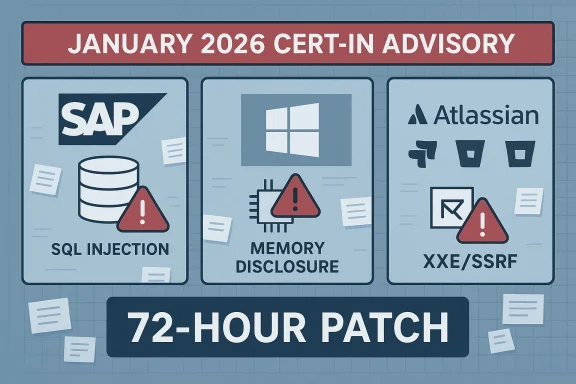
January’s CERT‑In advisories were a brutal reminder that the software stacks running our finance systems, identity fabrics, developer pipelines and collaboration platforms are prime targets — and that speed, not complacency, now separates a bulletin from a breach. In mid‑January 2026 India’s national CERT published three high‑severity advisories (CIAD‑2026‑0001, CIAD‑2026‑0002 and CIAD‑2026‑0003) that collectively touched SAP S/4HANA, Microsoft Windows and related services, and Atlassian Data Center / Server products — vulnerabilities that allow SQL injection, XXE/SSRF, remote code execution, privilege escalation and data theft. Security teams had to act fast: at least one Windows bug (Desktop Window Manager, CVE‑2026‑20805) was already being exploited in the wild. ttps://support.sap.com/en/my-support/knowledge-base/security-notes-news/january-2026.html)
CERT‑In’s January advisories consolidated vendor patch information and translated it into an urgent call to action for organisations with enterprise footprints. The three advisories cover:
The time to act was yesterday — the work to stay resilient is continuous.
Source: Security Boulevard https://securityboulevard.com/2026/...-sap-microsoft-and-atlassian-vulnerabilities/
 Background / Overview
CERT‑In’s January advisories consolidated vendor patch information and translated it into an urgent call to action for organisations with enterprise footprints. The three advisories cover:- CIAD‑2026‑0001 — Multiple vulnerabilities in SAP products, including critical SQL injection and remote code execution issues affecting S/4HANA, HANA, NetWeaver and other modules. SAP released 17 security notes on its January 2026 Security Patch Day; several were HotNews‑level fixes with CVSS scores near the top of the scale (for example, CVE‑2026‑0501, a SQL injection rated 9.9).
- CIAD‑2026‑0002 — Multiple Microsoft product vulnerabilities, mapped to Microsoft’s January 2026 Patch Tuesday. These include privilege escalations, remote code execution and information disclosure issues; CVE‑2026‑20805 (DWM) was observed in active exploitation. Microsoft shipped cumulative updates in mid‑January and then follow‑up out‑of‑band fixes to address regressions.
- CIAD‑2026‑0003 — Multiple vulnerabilities in Atlassian Data Center & Server (Jira, Confluence, Bitbucket, Bamboo, Crowd, JSM). Atlassian’s January 20, 2026 Security Bulletin described a table of fixed versions and dependency vulnerabilities (XXE, SSRF, RCE, DoS) that require immediate upgrades for on‑premise instances.
What was affected — the technical picture
SAP: critical injection and RCE in core ERP and HANA
SAP’s January 13, 2026 Security Patch Day released 17 notes, including several HotNews fixes. The most consequential technical themes were:- SQL injection in S/4HANA Financials (General Ledger) enabling arbitrary database queries and full compromise if exploited (CVE‑2026‑0501 reported with a near‑critical score).
- Remote code execution / code injection in Wily Introscope and other components allowing execution of attacker‑supplied payloads in application contexts.
- Privilege escalation and missing authorization checks across NetWeaver, HANA and ABAP components.
Microsoft: DWM information disclosure and a broad January rollup
Microsoft’s January 2026 rollup fixed well over a hundred CVEs across Windows, Office, Azure and developer tooling. The standout operational issue:- CVE‑2026‑20805 — Desktop Window Manager (DWM): an information disclosure flaw that leaks memory addresses (ALPC section addresses) from a privileged system process. While the bug itself doesn’t drop RCE, it lowers the bar for follow‑on exploitation by defeating Address Space Layout Randomisation (ASLR). Security vendors and CERTs reported active exploitation in the wild, so patching was elevated to emergency status. Microsoft pushed out the January update and then out‑of‑band (OOB) fixes after some deployments exposed regressions (Remote Desktop credential errors, Secure Launch shutdown regression).
Atlassian: dependency and application vulnerabilities in Data Center / Server
Atlassian’s monthly Security Bulletin (January 20, 2026) listed multiple fixed CVEs across Data Center and Server products. Key themes:- XML External Entity (XXE) and SSRF via third‑party libraries (tika, jackrabbit, axios) — can leak files or allow internal network pivoting.
- RCE possibilities either via vulnerable libraries or application logic.
- DoS and MITM risks arising from dependency issues or TLS config problems.
How attackers could chain these bugs (practical attack paths)
- Windows DWM memory leak → ASLR bypass → pair with a local or kernel privilege elevation exploit → SYSTEM privileges → deploy backdoor/ransomware. This is exactly why information‑disclosure bugs can be strategic even when their CVSS is moderate.
- SAP S/4HANA SQL injection → arbitrary DB queries → exfiltrate financial records or create fraudulent ledger entries → persistence via batch jobs or RFC points. On successful compromise attackers often extract credentials and service accounts from tables or configuration files.
- Atlassian XXE/SSRF → read /etc/passwd or other config files, or make server‑side requests into internal networks (CI environments, artifact stores) → abuse Jaupload vectors to achieve remote code execution. Because Atlassian tools often hold source code and credentials, they are high‑value targets for supply‑chain escalation.
Immediate remediation checklist — what to do in the next 72 hours
- Inventory and scope
- Identify all instances of SAP (S/4HANA, HANA, NetWeaver), Atlassian Data Center/Server products, and all Windows builds (clients, servers, VDI/AVD images). Use CMDB/asset feeds and vulnerability scanners to produce an authoritative list. Prioritise internet‑facing and admin/CI systems first.
- Patch priority
- Apply vendor patches in the following, urgent order:
- Any publicly exploited CVE (e.g., CVE‑2026‑20805 on Windows).
- SAP HotNews / critical notes (CVE‑2026‑0501, CVE‑2026‑0500, etc.).
- Atlassian fixed versions listed in the Jan‑20 bulletin for your product lines.
- Mitigations where patching is delayed
- Isolate vulnerable systems from untrusted networks (firewall rules, network ACLs).
- For Atlassian: disable or restrict plugins/features flagged in vendor guidance; limit external access; block unauthenticated endpoints.
- For SAP: restrict RFC/HTTP access, block untrusted inbound traffic to SAP Dispatcher/ICM, and tighten authorizations for ADBC/RFC interfaces.
- Emergency Windows actions
- Deploy Microsoft’s January security updates immediately and follow with the out‑of‑band packages if you observe RDP/Shutdown regressions. Confirm update KBs via your update management tools and Microsoft’s update guide before mass deployment. Validate VDI and AVD images in pilot rings prior to broad rollouts.
- Backups and rollback
- Before changing production SAP or Atlassian nodes, take verified backups (database + application config). Confirm disaster recovery playbooks and ensure backups are offline and immutable where possible.
- Credentials and secrets
- Rotate credentials for service accounts or API tokens stored in affected platforms if there’s any suspicion of compromise. Inspect and rotate keys found in build artifacts or repository attachments.
- Enhanced monitoring & detection
- Turn up logging on affected systems; enable audit trails in SAP, Windows event logging and Atlassian access logs. Hunt for suspicious process creations, unexpected JNLP downloads (Introscope RCE pattern), anomalous ALPC calls, or unusual outbound SSRF‑style requests.
Detection and hunting: concrete signals to look for
- Windows / Endpoint detections
- Unusual processes spawned from DWM or graphics stacks, or repeated DWM crashes and memory‑leaking behaviors. Monitor for suspicious local processes that create network connections soon after interacting with GUI components (indicator of exploit chains).
- Hunt for process creation events (Windows Event ID 4688) spawned by unexpected parents (e.g., explorer.exe launching PowerShell or cmd.exe), especially from users or service accounts that normally don’t initiate such flows.
- SAP
- Spike in ad‑hoc SQL executions or RFC calls from non‑standard users, creation of new ABAP programs or transports outside normal change windows, abnormal database queries that dump tables or export data. Search application logs for malformed SQL or unusual ADBC calls.
- Atlassian
- HTTP logs showing suspicious XML payloads, unexpected POSTs to endpoints that process uploaded content, or server‑side requests to internal IP spaces from applications (SSRF). Watch for sudden repository changes in Bitbucket by service accounts or new admin API tokens in Jira/Confluence.
- Network / Cloud
- Outbound connections from on‑prem Atlassian/SAP servers to unknown external IPs (possible exfiltration). Abnormal use of SSH, FTP, or cloud storage write operations. Correlate with DLP and egress logs.
Prioritization framework — patching with limited ops windows
When you can’t patch everything at once, use this triage ranking:- Internet‑facing control planes and servers (exposed SAP web ICM, public Jira/Confluence, Bitbucket).
- Identity and authentication systems (Atlassian Crowd, Windows domain controllers, AD FS/Entra connectors).
3(Bitbucket, Bamboo, developer workstations) — compromise here leads to supply‑chain escalation. - Finance and ERP servers (S/4HANA, HANA DB) — high data sensitivity and regulatory impact.
- VDI/virtualisation hosts and cloud control plane components (VDI, AVD, AVD images).
Why vendor advisories and CERT guidance must be cross‑checked (a cautionary note)
CERT‑In’s advisories provide a consolidated national‑level view and urgency, but operational teams must map vendor CVE→KB/Note entries to their own asset inventory before acting. Some third‑party summaries and media stories included specific CIVN tags or identifiers that could not be immediately verified on the CERT‑In portal; treat single identifiers as unconfirmed until you validate them against the official CERT or vendor index. Always save vendor advisory pages and KB numbers as your canonical source of truth for compliance records.Strengths and weaknesses of the January response cycle — a critical analysis
What worked- Vendors moved quickly: SAP, Microsoft andixes and guidance promptly, and Microsoft issued OOB fixes for regression fallout, showing an active engineering response. The pace reduced the window for opportunistic e
- National CERTs aggregated the information, elevating remediation urgency at a policy level and prompting organisations to reprioritise patches.
- Operational friction: Microsoft’s January rollup introduced regressions in some environments (RDP credential prompt failures, Secure Launch shutdown issues), forcing teams into the classic patch‑speed vs stability trade‑off and increasing patch hesitancy. This shows the fragile balance between rapid remediation and conservative change control in large fleets.
- Signal vs noise: National advisories aggregate many CVEs; without clear labelling of actively exploited vs theoretical vulnerabilities some organisations may be overwhelmed and misprioritise. The DWM case shows how a medium‑CVSS info‑disclosure can be a high tactical priority — but that nuance must be communicated better.
- Supply‑chain and CI exposure: Atlassian and Bitbucket compromise can produce long‑term, stealthy supply‑chain impacts that are harder to remediate than single host compromises.
- Legacy and unpatchable systems: Many enterprises still run ESU or custom appliance stacks where applying vendor patches is non‑trivial. These will remain attractive targets unless mitigated by network segmentation and compensating controls.
Playbook snapshots — step‑by‑step for SOC/IR teams
- Triage: Crosswalk CERT‑In CVEs to vendor KBs/notes → produce a prioritized patch list for the next 72 hours.
- Containment: For any exposed SAP/Atlassian host awaiting patch, block inbound management ports and restrict outbound to known artifact repositories.
- Hunt: Execute the detection queries described above. Capture memory from any suspicious Windows endpoint (DWM exploitation often precedes privilege escalation).
- Forensics: If compromise suspected, preserve logs and images, rotate secrets for affected services, and rebuild from known‑good images.
- Post‑incident: Conduct a root‑cause timeline, identify gaps in patch management or change control, and update playbooks and SLAs.
Long‑term lessons — hardening the enterprise for the next advisory
- Automate inventory and CVE mapping: Integration between CMDB, vulnerability scanner and patching tools shortens mean time to remediate.
- Run aggressive CI/CD and repository hygiene: protect build pipelines, restrict token lifetimes, and monitor for illicit pushes or new admin tokens. Atlassian ecosystems are prime vector for supply‑chain escalation.
- Harden privileged accounts and isolate application accounts: treat SAP and Atlassian service accounts as high‑value and enforce least privilege, MFA and credential rotation.
- Test updates in realistic pilot rings that include early‑boot and virtualization features (Secure Launch, VBS) to catch regressions before full deployment. Microsoft’s January cycle showed why this matters.
Final verdict: what security leaders must do now
January 2026’s CERT‑In advisories were not mere press releases — they were operational red lights. Organisations must treat these advisories as a coordinated, cross‑platform emergency: patch quickly, but intelligently; isolate and monitor vulnerable systems; and hunt for signs of abuse. Prioritise assets by exposure and criticality (identity, finance, CI/CD), verify vendor KBs and security notes against your inventory, and be prepared to enact incident response if your telemetry shows exploitation chains. The alternative is simple: leave trusted enterprise software unpatched and let attackers use those trusted channels to escalate from foothold to full breach.The time to act was yesterday — the work to stay resilient is continuous.
Source: Security Boulevard https://securityboulevard.com/2026/...-sap-microsoft-and-atlassian-vulnerabilities/
