

Valve’s January 2026 Steam Hardware & Software Survey paints a familiar picture at first glance — mid-range NVIDIA cards and Full HD monitors still dominate — but the detailed numbers reveal a clear, accelerated migration toward larger video memory and bigger system RAM footprints that will shape PC builds, game development, and the second‑hand market through 2026.
The Steam Hardware & Software Survey is Valve’s monthly snapshot of the hardware and software reported by Steam clients that opt in to the survey. It’s widely used as a proxy for the PC gaming installed base because Steam has an enormous active user pool, but it is a sampling rather than a census: Valve does not publish the exact sampling methodology, regional weighting, or the number of respondents for each month. That means the survey is best treated as a directional indicator — extremely useful for spotting short‑term trends, but imperfect as a substitute for global sales or shipment data. (store.steampowered.com)
Steam’s January 2026 tables show modest month‑to‑month movement in many categories, but several statistically large shifts — most notably in GPU VRAM capacity and system memory — stand out and deserve closer scrutiny. The following analysis verifies the key numbers against Valve’s published tables and independent coverage, and then explores what those numbers mean for builders, gamers, developers, and the component market. (store.steampowered.com)
Why this matters:
Practical takeaways:
Why this matters:
Market drivers worth noting:
Key recommendations:
A final caution: abrupt month‑to‑month changes in categories that historically move slowly are worth scrutiny. The January jump in 16 GB VRAM is large enough to warrant attention, but it could reflect a combination of new SKU shipments, OEM channel activity, and Steam’s sampling cadence. Expect follow‑up months to either confirm the new baseline or show reversion toward the previous trend. (tomshardware.com)
For buyers, the practical takeaway is straightforward: if you want longevity and headroom for modern games and asset packs, favor GPUs with larger VRAM buffers and treat 32 GB RAM as the realistic baseline for a versatile mid‑ to high‑end build. For developers, the message is to provide scalable asset paths that reward high‑end hardware while still supporting the sizable population on more modest systems. And for analysts, the Steam tables are a vital, timely indicator — but one that must be read in context and cross‑checked against shipping, retail, and manufacturer data before drawing market‑share conclusions. (store.steampowered.com)
Source: NEWS.am TECH The most popular PC builds among Steam users in January 2026 | NEWS.am TECH - Innovations and science
 Background
The Steam Hardware & Software Survey is Valve’s monthly snapshot of the hardware and software reported by Steam clients that opt in to the survey. It’s widely used as a proxy for the PC gaming installed base because Steam has an enormous active user pool, but it is a sampling rather than a census: Valve does not publish the exact sampling methodology, regional weighting, or the number of respondents for each month. That means the survey is best treated as a directional indicator — extremely useful for spotting short‑term trends, but imperfect as a substitute for global sales or shipment data. (store.steampowered.com)Steam’s January 2026 tables show modest month‑to‑month movement in many categories, but several statistically large shifts — most notably in GPU VRAM capacity and system memory — stand out and deserve closer scrutiny. The following analysis verifies the key numbers against Valve’s published tables and independent coverage, and then explores what those numbers mean for builders, gamers, developers, and the component market. (store.steampowered.com)
What the numbers say — headline findings
- The NVIDIA GeForce RTX 4060 (desktop SKU) remains the single most common discrete GPU on Steam’s January table, with Steam reporting it at 4.36% of surveyed systems and a monthly gain of +0.46 percentage points. The laptop (mobile) variant of the 4060 also ranks in the top positions. (store.steampowered.com)
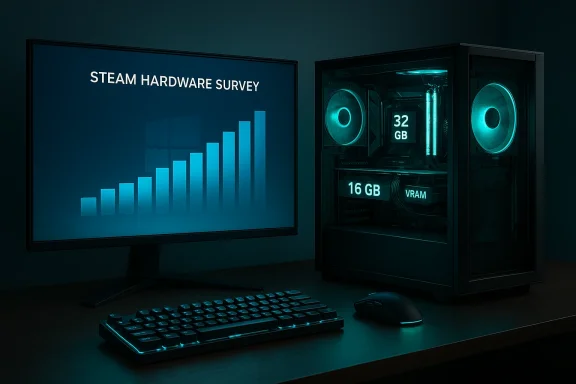
- GPUs with 16 GB of VRAM experienced a sharp increase in January, rising +5.85 percentage points to 14.55% of the sampled base — an acceleration that eclipses typical monthly swings seen in recent years. At the same time, 12 GB and 8 GB VRAM buckets contracted. (store.steampowered.com)
- System RAM shows a steady upward migration: 32 GB systems rose to roughly 38.02%, closing the gap on 16 GB systems (the most common at about 40.24% in January). This continues a trend observed throughout 2025 where 32 GB has been gradually gaining market share among Steam users. (store.steampowered.com)
- Windows 11 continues its slow-but-steady adoption, reported at 66.71% versus 27.79% for Windows 10 in January, underlining how the Steam base has largely migrated to Microsoft’s modern desktop OS. (store.steampowered.com)
- Display resolution trends tick higher: Full HD (1080p) remains the largest share at ~52.6%, but 1440p (2560×1440) grew to ~21.3%, confirming a gradual move toward mid‑range high‑resolution gaming monitors among Steam users. 4K remains niche at under 3% of users. (store.steampowered.com)
Why the RTX 4060 remains so common
A mid‑range sweet spot
The continued presence of the GeForce RTX 4060 near the top of Steam’s GPU list is not a surprise: since its launch the card has often occupied the sweet‑spot for mainstream gamers who prioritize 1080p competitive performance, low power draw, and modern feature sets (DLSS frame generation, ray tracing improvements relative to older generations). Steam’s January snapshot shows the desktop 4060 and its laptop counterpart occupying two of the top ranks in discrete GPU usage. This reflects a long‑running market reality: mid‑range SKUs sell in large volume and are commonly shipped in prebuilt systems and laptops, which amplifies their representation on Steam. (store.steampowered.com)Pricing, inventory, and prebuilts
Two structural factors inflate mid‑range penetration on Steam charts: (1) price sensitivity — many gamers prioritize cost per frame and buy where value peaks; and (2) prebuilt OEMs and laptop sales — when chip shortages ease or manufacturers refresh lines, a lot of mid‑range stock moves through OEM channels into mainstream users’ hands. News coverage of the January tables points to the 4060’s steady availability and price‑performance balance as reasons it remains so common in the installed base. (tomshardware.com)The sudden jump to 16 GB VRAM — what changed?
The numbers and their scale
Steam reports a +5.85 percentage point rise in GPUs with 16 GB VRAM, bringing that bucket to ~14.55% of the sample in January. That increase is large in relative terms (more than a one‑third jump from December) and significantly above typical month‑to‑month volatility for VRAM categories. Independent write‑ups highlight the same change and tie it to newer product introductions and a gradual buyer preference shift toward higher‑capacity models. (store.steampowered.com)Possible drivers
- Newer GPU SKUs with 16 GB (or refreshed SKUs that ship higher capacity variants) have matured through 2025 and continued shipping into late 2025 and early 2026. These cards are increasingly common in both discrete desktop parts and laptop SKUs. The appearance of AMD’s RDNA4‑based RX 9000 family (for example, the RX 9070 showing up in Steam’s January charts) contributes to the 16 GB class growth. (tomshardware.com)
- Developers and publishers are shipping games and texture packs that scale performance with VRAM. Modern engines and asset packs increasingly recommend larger video buffers for high‑resolution texture streaming, especially at 1440p and 4K. As more gamers aim for higher visual fidelity or hold onto GPUs longer, a tilt toward larger VRAM makes practical sense.
- Seasonal procurement and replacement cycles: buyers replacing older 8 GB or 12 GB cards may be choosing 16 GB models as a more future‑proof option, even if raw rasterization throughput is similar to lower‑VRAM parts. Real‑world usage habits — including streaming, content creation, and background tasks — make the extra buffer attractive.
Practical implications
For gamers, the shift to 16 GB VRAM means fewer VRAM‑related bottlenecks when using high‑resolution texture mods or running games at 1440p with ultra settings. For developers, the trend reduces the short‑term need to target worst‑case VRAM diets as aggressively as in 2018–2022; however, developers still must optimize for lower VRAM configurations because a substantial portion of the user base remains on 8–12 GB cards. (store.steampowered.com)System RAM: the rise of 32 GB as the mainstream "min spec"
The Steam tables show 32 GB systems closing in on 16 GB systems (roughly 38% vs ~40%), and press coverage has pointed to the same convergence. That shift has been underway for a year: as AAA titles, streaming workflows, and creative apps demand more memory, and as prices and DDR5 availability fluctuate, 32 GB has become the pragmatic choice for many new PC buyers. (store.steampowered.com)Why this matters:
- Multitasking and content creation: Gamers who stream, run background capture tools, or edit video alongside gaming benefit directly from 32 GB. This moves the perceived "minimum comfortable" RAM for many users upward.
- DDR5 adoption: The RAM migration also intersects with DDR5 adoption cycles. Where DDR5 pricing becomes favorable, buyers prefer the platform longevity of DDR5 + 32 GB. Conversely, in price‑constrained markets DDR4 32 GB kits still provide strong value. Industry coverage has noted that memory price dynamics remain an important factor in the pace of upgrades. (tomshardware.com)
- Longevity and resale: Systems with 32 GB age better without forcing a RAM upgrade, improving second‑hand values and reducing churn for OEMs that populate systems with higher base memory.
OS adoption: Windows 11 keeps climbing
Windows 11 passed two‑thirds of Steam users in January (reported at ~66.71%), with Windows 10 still at ~27.8%. The shift is incremental but persistent, and has implications for driver vendors, anti‑cheat tooling, and developers who must maintain compatibility across two OS generations. Steam’s OS numbers are a useful telemetry point for the Windows ecosystem’s installed base. (store.steampowered.com)Practical takeaways:
- Driver and middleware vendors should prioritize Windows 11 testing but maintain robust Windows 10 compatibility routines for the sizable minority still on the older OS.
- Enterprise and older hardware users remain on Windows 10 for a mix of validated legacy software and slow migration cycles, so broad compatibility remains important.
Resolution trends: 1440p is growing, 4K remains marginal
Steam’s January snapshot shows 1080p still as the dominant resolution (~52.6%), but 1440p increased to ~21.3%, a slow but steady rise. 4K usage is under 3%, demonstrating that while higher‑res adoption is real, it’s still concentrated among enthusiasts with higher‑end GPUs and displays. (store.steampowered.com)Why this matters:
- Game developers planning asset quality tiers should treat 1440p as an increasingly important target class. Delivering high‑res textures and options that scale to 1440p is becoming essential for high‑end PC builds but still optional for the mass market.
- Monitor manufacturers and retailers will find growth opportunity in 1440p panels (including high‑refresh panels), whereas ultra‑high‑end 4K remains a smaller niche.
The AMD question and market dynamics
Steam’s January data also shows RDNA4 AMD cards beginning to appear on the chart (for example, the RX 9070 non‑XT registering in the low tenths of a percent), but NVIDIA remains dominant in the Steam sample. Coverage emphasizes that AMD’s new SKUs are present but have yet to materially disrupt Nvidia’s mid‑range share. The arrival of AMD parts with 16 GB of VRAM contributes to the 16 GB bucket shift, but adoption remains slower than the manufacturers and reviewers might hope. (tomshardware.com)Market drivers worth noting:
- SKU mix — SKUs with larger VRAM or different BOMs can change the VRAM distribution independently of unit sales. If manufacturers deliberately ship more 16 GB variants to OEMs, the Steam VRAM buckets will reflect that quickly.
- Regional inventory differences can skew the survey month to month. Valve’s sampling opacity means that a shipment surge in a particular region can create abrupt shifts in the tables.
Interpreting the Steam survey — caveats and limitations
The Steam Hardware & Software Survey is a powerful tool, but it has important limitations that should temper interpretations:- Sampling opacity: Valve does not disclose the sample size, regional weighting, or exact methodology. That means sudden swings may reflect sampling changes as much as real market movement. Tom’s Hardware and other analysts have warned readers that the Steam survey is a monthly sampling and that certain small‑share SKUs can appear or disappear around the threshold for listing. (tomshardware.com)
- Prebuilt and laptop skew: Steam counts systems running the client, so prebuilt gaming laptops and OEM desktops — which tend to use mid‑range GPUs in volume — are disproportionately represented.
- Thresholds and rounding: Valve’s public tables often round to two decimal places and include only items above a visibility threshold; that can produce apparent volatility in small‑share buckets.
- Not a sales chart: The survey indicates prevalence among Steam users, not retail shipments or revenue. Analysts should avoid equating Steam percentages with market share for manufacturers without cross‑checking sales and shipment data from OEMs and distributors.
What builders and buyers should take from January 2026
If you’re planning a new build or shopping for upgrades, the January survey suggests practical choices that balance future‑proofing with value.Key recommendations:
- Choose a GPU with a comfortable VRAM cushion for your resolution.
- If you target 1080p and max settings, an 8–12 GB modern card may suffice; but if you plan to run high‑res textures, 1440p, or mods, favor 16 GB where possible. The Steam shift to 16 GB shows buyers are valuing that buffer. (store.steampowered.com)
- Make 32 GB your baseline if you stream, create content, or expect to keep the machine 3+ years.
- 32 GB adoption is growing and will extend the system’s usable lifetime before a memory upgrade is needed. (store.steampowered.com)
- For displays, 1440p is the best long‑term compromise for many gamers.
- The increase in 1440p adoption on Steam indicates people are upgrading monitors before they upgrade GPUs in some cases. A high‑refresh 1440p monitor paired with a mid‑ to upper‑mid GPU will deliver the best cost‑to‑experience ratio. (store.steampowered.com)
- Watch inventory channels and prebuilt deals.
- Mid‑range SKUs often show up in well‑priced prebuilt systems. If you find a 16 GB VRAM SKU bundled at an attractive price, it may offer immediate value even if the pure silicon performance is comparable to lower‑VRAM cards.
- Check driver and OS compatibility.
- With a two‑thirds Windows 11 installed base on Steam, make sure drivers, anti‑cheat, and capture utilities support both Windows 10 and 11 cleanly. (store.steampowered.com)
Risks for developers and publishers
The survey’s movement toward higher VRAM and more system RAM reduces some constraints for art asset budgets, but it does not eliminate the need for scalable content delivery:- Treat higher VRAM and RAM as opportunities to ship enhanced texture tiers and post‑processing effects for players with beefier hardware.
- Maintain robust fallbacks and streaming systems for lower‑VRAM users (a non‑trivial share of the base still runs 8–12 GB cards).
- Consider the economics of asset size: increased VRAM encourages larger texture sets, but larger downloads and storage requirements can raise friction for users on limited bandwidth or smaller SSDs.
Broader industry implications
- Component pricing: Memory and VRAM pricing remain a central variable. If spot prices for GDDR and DRAM rise, the migration to 16 GB VRAM and 32 GB system RAM could slow. Conversely, if component prices fall, these trends accelerate. Industry commentary tied to the January tables highlights price volatility as a key variable to watch. (tomshardware.com)
- Second‑hand market: As the mainstream migrates to 16 GB VRAM models and 32 GB RAM, the used market will see richer supply of 8–12 GB cards. That will be a boon for budget builders and for countries with lower new‑hardware penetration.
- Platform software: The Windows 11 majority on Steam signals continued alignment toward Microsoft’s modern platform, with implications for game launchers, anti‑cheat, and driver certification processes.
Methodological note and final caveats
This article cross‑checked Valve’s primary tables for January 2026 with contemporary reporting from hardware outlets that analyzed the same data. Valve’s tables remain the authoritative public source for the survey; independent outlets provide helpful interpretation and context. Where press reports transcribed Steam’s figures differently (for example, small rounding differences or transposition of decimal digits), the Steam page is the final arbiter. Analysts should always cite Valve’s published tables when making precise claims. (store.steampowered.com)A final caution: abrupt month‑to‑month changes in categories that historically move slowly are worth scrutiny. The January jump in 16 GB VRAM is large enough to warrant attention, but it could reflect a combination of new SKU shipments, OEM channel activity, and Steam’s sampling cadence. Expect follow‑up months to either confirm the new baseline or show reversion toward the previous trend. (tomshardware.com)
Conclusion
January 2026’s Steam Hardware & Software Survey keeps the mid‑range NVIDIA cards and Full HD displays as the platform’s backbone, but it also signals a meaningful shift: Steam users are adopting more VRAM and more system RAM, and a growing slice of the install base is moving to 1440p and Windows 11. Those shifts matter for PC builders, developers, OEMs, and the second‑hand market — they nudge baseline expectations upward for what constitutes a "comfortable" gaming rig in 2026.For buyers, the practical takeaway is straightforward: if you want longevity and headroom for modern games and asset packs, favor GPUs with larger VRAM buffers and treat 32 GB RAM as the realistic baseline for a versatile mid‑ to high‑end build. For developers, the message is to provide scalable asset paths that reward high‑end hardware while still supporting the sizable population on more modest systems. And for analysts, the Steam tables are a vital, timely indicator — but one that must be read in context and cross‑checked against shipping, retail, and manufacturer data before drawing market‑share conclusions. (store.steampowered.com)
Source: NEWS.am TECH The most popular PC builds among Steam users in January 2026 | NEWS.am TECH - Innovations and science
