Japan Probes Microsoft Cloud Practices: JFTC Antitrust Inquiry on Azure and Licensing

  • Thread Author
Japan’s competition watchdog has opened a formal probe of Microsoft’s cloud business, focusing on whether commercial and technical conditions tied to Microsoft 365, Windows Server and other key software steer customers toward Azure and disadvantage rival cloud platforms — and the agency has invited third‑party information and views as part of the inquiry.

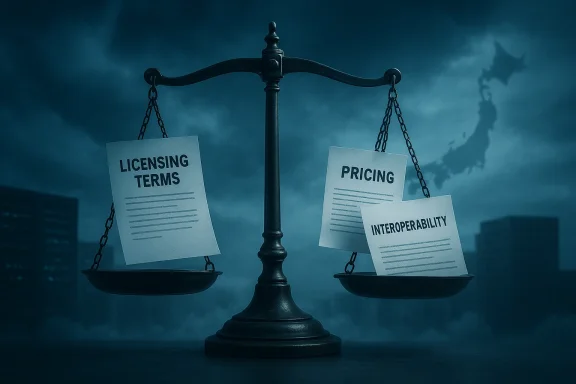
A balance scale compares licensing terms with pricing and interoperability.Background​

Japan’s Fair Trade Commission (JFTC) conducted an on‑site inspection of Microsoft’s Tokyo offices on February 25, 2026, marking the latest and most visible escalation in a wave of cross‑border regulatory scrutiny of hyperscale cloud vendors. Investigators are reported to be examining whether Microsoft used licensing terms, pricing differences or technical messaging to make its software harder or more expensive to run on competitor clouds such as Amazon Web Services (AWS) and Google Cloud.
The JFTC’s inquiry arrives amid a broader global pattern of enforcement and market investigations that have placed cloud competition front and center for regulators. The UK Competition and Markets Authority (CMA) earlier found that certain Microsoft licensing practices were adversely impacting cloud competition, and regulators in the EU, Brazil and the United States have been examining related issues for months. Those parallel proceedings — and public complaints from cloud rivals — create a context in which the JFTC’s action could produce ripple effects for enterprise contracting and cloud procurement worldwide.

What the JFTC is reportedly investigating​

Narrow question, broad implications​

At its core, the JFTC probe appears to be rooted in two related allegations:
  • That Microsoft’s commercial terms (pricing, license fees, service terms) create a de facto preference for Microsoft Azure by penalizing customers who run Microsoft software on competing cloud platforms; and
  • That Microsoft’s sales or technical messaging discouraged or misinformed customers about interoperability, availability, or support for Microsoft products on rival clouds.
Reports name specific software families — notably Microsoft 365 (Office apps and Teams) and Windows Server — as focal points because those products remain central to corporate productivity and infrastructure, and because small changes in licensing or activation rules can materially affect total cost of ownership when workloads move between clouds.

What regulators reportedly seized or sought​

While the JFTC has not publicly detailed exactly which contracts, emails or technical documents it took during the inspection, standard on‑site procedures typically target sales contracts, partner agreements, internal pricing guidelines, product roadmaps, and communications between account teams and customers. Investigators are also understood to be seeking clarifying information from Microsoft’s U.S. parent on how global licensing policies are applied in Japan. Microsoft Japan has said it will cooperate with the JFTC.

Why this matters: the mechanics of alleged cloud steering​

To non‑technical readers it can be hard to see how “licensing” becomes an antitrust issue. The mechanisms the JFTC is reportedly probing are straightforward in principle and potentially powerful in practice.

How commercial terms can nudge cloud choice​

  • Price differentials: If Microsoft charges higher per‑seat or per‑core licensing fees when a customer runs Microsoft software on non‑Azure infrastructure, that creates a direct economic penalty that favors Azure. Several reports cite concerns that licensing regimes deliver precisely this effect.
  • Support and maintenance conditions: Vendors can tie full product support or security updates to a particular hosting environment or to agreements with preferred partners, making it riskier for customers to choose other clouds.
  • License complexity and auditing risk: Complex cross‑cloud licensing rules increase the compliance burden for customers and their auditors, which advantages the incumbent cloud that simplifies or absorbs that complexity.

How product design and marketing can also steer customers​

Beyond pricing, technical design and commercial messaging can do the same work:
  • Feature differentials: If new capabilities, integrations or performance optimizations are initially or exclusively available in Azure — even for otherwise cross‑platform products — customers with tight timetables will favor Azure to access them. Regulatory scrutiny in the UK and EU has flagged these kinds of asymmetries previously.
  • Sales scripts and customer conversations: If field sales teams or channel partners implicitly or explicitly warn customers that certain software won’t run properly on other clouds, that can deter multi‑cloud deployments and shape purchasing decisions. JFTC investigators reportedly queried Microsoft’s local teams about such communications.

Legal and regulatory frame: Antimonopoly Act and JFTC powers​

The JFTC enforces Japan’s Antimonopoly Act, which prohibits abuse of dominant position and unfair trade practices. The agency has authority to conduct on‑site inspections, request documents and compel testimony in administrative investigations; if a violation is found it can issue cease‑and‑desist orders and, in some cases, impose surcharges or seek remedies. Recent precedent shows Japan is willing to use those tools in digital markets: the JFTC took action against Google over app pre‑installation practices and has inspected other major platforms in recent years.
That statutory framework gives the JFTC broad discretion to evaluate whether Microsoft’s conduct unreasonably restricts competition in the cloud services market. But administrative proceedings under the Antimonopoly Act often require detailed economic analysis and can take many months to resolve; the mere opening of a probe, however, is frequently enough to spur contractual and commercial changes.

How this fits into the global enforcement mosaic​

Japan’s action is not isolated. Regulators and competitors in other jurisdictions have already raised parallel concerns.
  • The Competition and Markets Authority (CMA) in the UK produced a finding that certain Microsoft software licensing practices have harmed rival cloud providers and distorted competition.
  • Google has lodged complaints in Europe alleging Microsoft used licensing to lock customers into Azure, a claim that directly mirrors the themes of the JFTC probe.
  • Other jurisdictions, including Brazil, have opened inquiries into Microsoft’s cloud operations, and EU market testing under the Digital Markets Act has put hyperscalers under sustained scrutiny.
That constellation of enforcement activity magnifies risk for Microsoft — and it increases the chance that remedies, if any, will be coordinated or conceptually consistent across borders. It also raises the probability that even non‑binding commitments negotiated in one region could shape policy or settlement expectations elsewhere.

Practical implications for enterprises and cloud customers​

For IT leaders, the JFTC probe is more than a regulatory story: it touches procurement, architecture and vendor risk. Companies should treat this moment as an opportunity to tighten governance around cloud licensing and vendor contracts.
Key immediate steps:
  • Audit existing Microsoft contracts and licensing terms. Identify clauses that link pricing, support, or feature availability to a particular cloud hosting environment.
  • Map workloads by portability. Determine which applications are technically tied to Azure‑only features and which can be moved without major rework.
  • Estimate switching cost. Calculate the licensing, migration and ongoing operational costs of running key workloads on alternative clouds to quantify vendor lock‑in risk.
  • Add contract protections. For new deals, insist on explicit portability clauses, price parity guarantees, or break‑clauses that reduce switching friction.
  • Document support expectations. Require contractual guarantees for security updates, interoperability and support irrespective of the chosen cloud provider.
  • Engage procurement and legal early. Cross‑functional review reduces surprises at renewal or in an enforcement event.
These are pragmatic, low‑cost steps that protect customers’ negotiating positions while the investigation runs its course.

What Microsoft stands to gain or lose​

Potential outcomes for Microsoft​

  • Administrative remedies: If the JFTC finds an Antimonopoly Act breach, it could issue orders requiring Microsoft to change licensing terms or sales practices in Japan; those remedies may be time‑limited or subject to compliance monitoring.
  • Fines and surcharges: While Japan’s administrative process often focuses on behavioral remedies, monetary penalties or surcharges can follow in specific circumstances — particularly where the conduct is repeated or egregious.
  • Reputational and commercial drag: Regulatory headlines and the prospect of pan‑jurisdictional remedies can slow enterprise sales cycles, increase contracting friction and motivate customers to test competitive alternatives.

What Microsoft can — and should — do now​

  • Cooperate, but document. Full cooperation with the JFTC is necessary; at the same time, Microsoft should maintain meticulous records of the information it provides and seek timely legal clarity on the scope of the inquiry.
  • Reassess commercial playbooks in Japan. Where the risk calculus shows exposure, consider ional clarifications to licensing, or publish clearer portability guidance for Japanese customers.
  • Proactive transparency. In markets under scrutiny, publishing plain‑language explanations of licensing and support policies reduces ambiguity and can improve regulators’ assessments.

How competitors and partners are positioned​

  • AWS and Google Cloud have a clear commercial incentive to amplify concerns about Microsoft’s licensing model; regulatory attention gives them procurement leverage with customers worried about vendor lock‑in. Public complaints from competitors in other jurisdictions already shaped investigations elsewhere.
  • Systems integrators and resellers must reassess recommendations they make to enterprise clients. Channel partners tied to a single hyperscaler may face conflicts as customers demand multi‑cloud options.
  • Customers with regulated workloads (financial services, healthcare, public sector) should be particularly vigilant: procurement rules and compliance obligations often favor demonstrable vendor neutrality and documented interoperability.

Scenarios and likely timelines​

Regulatory investigations of this type typically proceed through a sequence: on‑site inspection and document seizure; requests for additional information; economic and legal analysis by investigators; and, finally, a decision to close the probe, issue remedial orders, or escalate to formal enforcement. That process can take several months to more than a year, depending on complexity and cross‑border coordination. The JFTC’s early call for third‑party information indicates investigators plan to collect broader market evidence before reaching a view.
Three plausible scenarios:
  • No action after review. The JFTC may find insufficient evidence of anti‑competitive effect and close the inquiry; this would be the least disruptive outcome but still create short‑term procurement and PR headwinds.
  • Behavioral remedies only. The JFTC could require Microsoft to alter specific licensing clauses, provide price parity mechanisms, or publish clearer interoperability commitments. Such remedies are frequent in digital markets and can be tailored to Japan’s market.
  • Broader enforcement or coordination. If the investigation uncovers systemic, cross‑border practices that harm competition, the JFTC could coordinate with regulators elsewhere, potentially producing harmonized remedies or parallel orders with larger commercial impact.

What to watch next​

  • Official JFTC announcements and public comment windows. The JFTC’s solicitation of third‑party views is a pivotal stage; participants — competitors, customers, trade groups and academic experts — can shape the record by submitting evidence and economic analysis.
  • Microsoft’s public statements and contract amendments. Watch for policy clarifications, new license FAQs or explicit portability guarantees aimed at calming regulators and customers.
  • Parallel regulatory moves. Any activity from the CMA, European Commission, Brazil’s competition authoritys that references similar facts or ordering patterns will be a leading indicator of coordinated remedies.

Strengths and weaknesses in the JFTC’s case (analysis)​

Strengths​

  • Concrete, provable mechanics. Pricing differences, explicit contract clauses, emails and sales playbooks leave paper trails that are easier for enforcers to evaluate than abstract market effects. Reports indicate the JFTC is seeking precisely that documentary record.
  • Precedent and comparators. Prior regulatory actions in Japan and decisions elsewhere create a legal and evidentiary environment favorable to enforcement agencies that want to police digital market power.

Weaknesses and challenges​

  • Proving anticompetitive effect. Even if Microsoft’s practices nudge customers, regulators must show that those practices cause harm to competition (not merely to rivals) — an economic standard that requires careful market definition and counterfactual analysis.
  • Technical complexity. Distinguishing legitimate product differentiation (e.g., Azure‑first optimizations tied to engineering choices) from anticompetitive exclusion will require deep technical and economic expertise, and Microsoft will have plausible pro‑competitive justifications for many engineering choices.

Recommendations for enterprise IT and procurement teams​

  • Treat licensing risk as part of cloud risk management. Add a licensing‑portability review to formal vendor risk assessments.
  • Benchmark invoices and renewal quotes. If you operate hybrid or multi‑cloud estates, ask vendors to give line items showing how fees would change if an application runs on another cloud.
  • Insist on operational portability guarantees. Where mission‑critical workloads are concerned, make portability and vendor neutrality contractually enforceable.
  • Follow the evidence trail. If your organization is contacted by regulators seeking information, involve legal and compliance counsel immediately and preserve communications with vendors that may be relevant.

Conclusion​

Japan’s probe of Microsoft’s cloud practices elevates an already fraught policy debate about how dominant software vendors interact with hyperscale cloud markets. The JFTC’s on‑site inspection and its solicitation of third‑party views mean this is not a preliminary heads‑up but a full‑blown inquiry that could yield concrete remedies affecting contracts, pricing and technical roadmaps in one of the world’s largest cloud markets. For enterprises, the practical lesson is immediate: audit your Microsoft agreements, document portability and support expectations, and build contractual protections that reduce the financial and operational friction of choosing the cloud that best fits your needs. The outcome of the JFTC’s investigation will matter far beyond Japan — because in an interconnected market, regulatory answers here will shape negotiating leverage, product design and competitive dynamics across the global cloud ecosystem.

Source: MLex Japan opens Microsoft cloud probe, calls for public comments | MLex | Specialist news and analysis on legal risk and regulation
 

Japan’s competition authority has formally opened a review into Microsoft’s cloud and software practices and on March 4, 2026 publicly invited third‑party evidence and comments as part of an inquiry into whether contractual terms, pricing or technical configurations linked to Azure, Windows Server and Microsoft 365 may be disadvantaging rival cloud providers.

A regulatory document looms over a balance scale weighing cloud data icons against a city skyline.Background: what happened, and why it matters​

Japan’s Fair Trade Commission (JFTC) moved from investigative action to a public solicitation of information after an on‑site inspection of Microsoft Japan in late February, a step that signals the agency is treating the matter as a formal review under the Antimonopoly Act rather than mere fact‑finding. Media reports have linked the inspection to allegations that Microsoft set license terms or commercial conditions that make it harder, more expensive or technically constrained for customers to run Microsoft software on non‑Azure cloud platforms.
The JFTC’s March 4 announcement explicitly asks for third‑party perspectives and documents about suspected conduct, and the public notice itself lists the types of practices under review — including clauses or practices that would prevent customers from combining Microsoft‑licensed software with cloud services that compete with Azure. That public call for information frames the probe as a scrutiny of both contractual and technical impediments to multi‑cloud competition.
This is not an isolated development: regulators and competitors in Europe, the United States and elsewhere have already raised similar concerns in recent years about how dominant software vendors’ licensing and product configurations can shape cloud market outcomes. The European Commission’s market investigations under the Digital Markets Act and earlier complaints lodged by competitors have highlighted the same core questions around portability, conditional discounts and feature parity across clouds. The JFTC action therefore sits inside a global pattern of closer regulatory scrutiny of cloud competition.

What the JFTC said — the core allegations it wants evidence on​

The JFTC’s notice (in Japanese) sets out the alleged categories of conduct under review and asks for information and opinions from customers, cloud providers, system integrators and other third parties. Key items the agency lists include allegations that Microsoft or its affiliates may have done some combination of the following with respect to customers licensed for Microsoft products:
  • refused or limited permission to use Microsoft‑licensed software in combination with cloud services that compete with Azure;
  • imposed contractual conditions or fees that make running Microsoft software on rival clouds materially more expensive than running it on Azure; and
  • used technical configurations, support practices or product packaging in ways that disadvantaged rival cloud providers or made migration and interoperability more difficult.
The JFTC is careful to note that opening a review or soliciting information is not an expression of guilt — it is the procedural start of an administrative review under the Antimonopoly Act. But by going public and explicitly inviting third‑party submissions, the JFTC is widening the net for evidence and signalling it wants detailed, practical examples of how customers’ choices might be affected.

Why regulators focus on licensing and technical linkage​

There are several concrete mechanisms through which a dominant software vendor can influence cloud choices. Regulators typically look for both contractual and technical levers:
  • Contractual levers: licence clauses, price differentials, surcharge mechanisms or support‑eligibility rules that make the same software more expensive, or harder to support, when used on a rival cloud. These can include restrictions on license mobility, differential rates for license transfer, or conditions that make certain entitlements (patching, support, downgrade rights) contingent on using a specific cloud provider.
  • Commercial levers: marketing, sales incentives, or partner‑program rules that steer customers to one cloud provider over another, or that deny partners the ability to resell or bundle software alongside competing clouds.
  • Technical levers: product architecture, feature gating or support for cloud‑specific APIs that result in a meaningful performance, feature or manageability gap between deploying on the vendor’s cloud and deploying on a rival’s cloud.
All three categories matter because they affect the total cost of ownership, migration complexity and long‑term vendor lock‑in risks for enterprises. The Japanese notice explicitly links both contractual and technical possibilities to its inquiry, reflecting regulators’ understanding that anticompetitive effects can arise from complex, mixed commercial and engineering practices.

How this fits into the global regulatory landscape​

Microsoft has faced similar complaints and regulatory attention abroad. In 2024 Google filed an antitrust complaint in Brussels alleging Microsoft used licensing terms that effectively penalised customers who ran Microsoft software on non‑Azure clouds; that complaint and related industry lobbying fed into the European Commission’s market‑level DMA investigations into cloud computing. Separately, national agencies and competition bodies have conducted documentary seizures, requests for information, and negotiated remedies with cloud ecosystem actors.
Japan’s action follows that pattern but could be consequential in its own right. The JFTC has broad powers under the Antimonopoly Act — from ordering cessation of conduct to imposing administrative surcharges or, in serious cases, supporting criminal prosecution. Sanctions can range from remedial orders and surcharge payments to criminal fines or imprisonment in the most egregious statutory categories, though criminal prosecutions are relatively rare. The JFTC also has the latitude to issue specific behavioral remedies tailored to contractual clauses and commercial practices.

Microsoft’s position and industry reactions so far​

Microsoft Japan has said it is cooperating with the JFTC’s requests, and the company has publicly disputed broad characterisations that it locks customers into Azure. But the firm’s responses in prior regulatory settings underscore that it prefers negotiated settlements — Microsoft reached agreements with at least some European cloud providers previously — while also arguing that its licensing distinctions reflect legitimate product differences, not anticompetitive intent. The company’s public posture in Japan is consistent with these prior approaches: cooperate with investigators, engage industry stakeholders, and defend the commercial rationale behind product packaging and price points.
Industry reaction is mixed. Competitors and cloud trade bodies have argued that certain licensing practices raise switching costs and distort competition; cloud customers and system integrators are watching closely because any remedial changes could alter migration economics and contractual negotiations. At the same time, many enterprise customers choose cloud providers based on a complex combination of cost, latency, regulatory compliance and technical features — factors that make both the JFTC’s fact‑gathering and Microsoft’s defence likely to be highly technical and evidence‑heavy.

What the JFTC is asking for — and why third‑party input matters​

The JFTC’s public call requests submissions of information and opinions from parties with direct knowledge of contractual terms, migration experiences, pricing comparisons, or technical incompatibilities. That includes:
  • corporate IT buyers who have experienced switch costs or degraded service when moving Microsoft‑licenced workloads off Azure;
  • cloud service providers or system integrators who have faced contractual constraints or denied access to Microsoft functionality; and
  • legal or technical experts who can point to specific clauses, patches or product design choices that materially affect interoperability.
Third‑party evidence is crucial because the JFTC’s statutory mandate is forward‑looking and facts‑based: to determine whether concrete practices have the effect of obstructing competition in Japan’s markets. Anonymous submissions are possible, but named, documented evidence that can be tested — contracts, emails, deployment logs, pricing spreadsheets or technical test results — will have the most utility. The agency’s public solicitation widens its evidentiary base and reduces the probability that critical facts remain undisclosed until late in the process.

Potential legal theories the JFTC may explore​

Based on the notice and common enforcement theories used in similar cases, the JFTC is likely to evaluate whether Microsoft’s practices could constitute:
  • Unfair trade practices — contractual or commercial conduct that has the effect of impeding competitors’ access to customers or markets.
  • Abuse of superior bargaining position or private monopolisation — if Microsoft’s market position in operating systems or productivity software is used to leverage a dominant position in cloud services.
  • Tying or conditioning — where access to a favored product or price is made conditional on choosing a specific cloud service.
Each theory requires different evidence. For instance, showing abusive tying involves proof that two products are separate and that conditioning access to one product on purchase or use of another harms competition. Demonstrating an unfair trade practice often focuses on concrete examples of terms or operational conduct that materially alter marketplace incentives.

Practical implications for enterprises, partners and cloud providers​

Whatever the outcome, the inquiry has immediate practical implications:
  • For IT buyers: reassess and document any migration costs, feature limitations or contractual differentials you encountered when evaluating multi‑cloud deployments. Keep detailed records of proposals, license terms and vendor responses; these may be relevant to regulatory fact‑finding or commercial renegotiations.
  • For channel partners and system integrators: consider whether reseller or support agreements limit the ability to bundle Microsoft software with competing clouds, and whether partner program incentives favor Azure in ways that affect neutrality. Document conversations with Microsoft account teams around pricing or product eligibility.
  • For cloud rivals: collect concrete examples where customers were steered or where technical features were materially different or absent on non‑Azure platforms. Technical test results showing functional parity or parity gaps are especially powerful.
  • For Microsoft: expect a detailed, evidence‑based review and consider whether defensive technical or contractual clarifications — or remedial offers to neutralise particular pricing gaps — could resolve the agency’s concerns without lengthy enforcement. Microsoft’s prior willingness to settle certain European complaints indicates the company may pursue negotiated remedies if the facts permit.

What outcomes are realistically possible?​

Regulatory outcomes fall on a spectrum:
  • No action: the JFTC could conclude the evidence does not show unlawful conduct and close the inquiry.
  • Behavioral remedies: the JFTC could order Microsoft to remove or revise specific contractual clauses, clarify license portability terms, or publish interoperability commitments — remedies that aim to restore competitive choice without imposing fines.
  • Surcharge or financial penalties: in cases where the JFTC finds statutory violations and quantifies anticompetitive gains, administrative surcharge orders or fines are possible under the Antimonopoly Act. The statutory framework allows for remedy and surcharge orders, and in criminally serious cases, referral for prosecution can follow.
Any remedy will be shaped by the evidence’s technical detail. If the JFTC’s concerns are largely contractual (i.e., specific clause text), the agency may prefer targeted contractual fixes. If the concerns demonstrate systemic product design choices that exclude competitors, remedies could be broader and more intrusive.

What to watch next — milestones and timelines​

  • The JFTC has opened the solicitation period for third‑party submissions as of March 4, 2026; interested parties should consult the notice for submission mechanics and deadlines. Submissions that include verifiable documentary evidence will be most useful.
  • Expect follow‑up investigative steps: interviews, requests for documents to Microsoft and market participants, and technical testing if needed. The JFTC’s procedure can take months; complex digital markets investigations often span many months to a year or more, depending on cooperation and the volume of evidence.
  • Parallel actions: keep an eye on other jurisdictions (EU, UK, US, Brazil) for complementary inquiries or settlements that could influence the JFTC’s approach or provide comparative remedies. Past settlements and DMA market investigations will be important comparators.

Assessing the strengths and weaknesses of the JFTC’s approach​

Strengths
  • Fact‑gathering breadth: by publicly inviting third‑party submissions, the JFTC reduces the risk of missing evidence tucked away in corporate negotiations or confidential partner conversations. This approach increases transparency and widens the evidentiary record.
  • Technical and contractual focus: the JFTC’s explicit attention to both technical configurations and contractual terms recognises the mixed nature of modern exclusionary conduct in digital markets — an enforcement posture that is appropriately nuanced.
  • Global coordination potential: the JFTC can leverage information and precedents from EU and other jurisdictional inquiries to build a fuller picture of market practices; cross‑jurisdictional insights can be particularly useful when multinationals operate by regionally variable contracts.
Weaknesses and risks
  • Evidentiary complexity: proving that licensing or technical differences are anticompetitive — rather than legitimate product differentiation — can be technically demanding. Regulators must distinguish between lawful price discrimination and unlawful conditionality that restricts competition. That will likely require time‑consuming technical tests and careful economic analysis.
  • Risk of overreach or unintended consequences: poorly designed remedies could unintentionally dismantle legitimate product engineering choices or create regulatory obligations that chill innovation. The JFTC will need to calibrate remedies so they protect choice without forcing standardisation that reduces product quality.
  • Coordination challenges: similar probes in different jurisdictions can produce inconsistent demands or timelines, complicating compliance strategies for global vendors and customers. The JFTC’s actions will therefore play into a broader international enforcement mosaic that Microsoft and other stakeholders must navigate.

Practical checklist for affected stakeholders​

  • For corporate IT teams:
  • Assemble evidence of migration costs, feature regressions or price differences you experienced when evaluating non‑Azure deployments.
  • Preserve contract drafts, emails and account notes that show pricing offers or conditions.
  • If procurement is ongoing, request written clarifications from vendors on license portability and feature parity.
  • For systems integrators and partners:
  • Review partner agreements for explicit or implicit clauses that limit bundling with competing clouds.
  • Document rejected bids or partners’ explanations tied to Microsoft‑specific eligibility.
  • Where legal uncertainty exists, consider seeking commercial advice and consolidating incident reports for possible submission to regulators.
  • For cloud rivals:
  • Maintain test logs and technical comparatives showing parity or gaps in functionality when running Microsoft software on your platform.
  • Where customers report being steered, collect contemporaneous evidence (emails, meeting notes, quotes).
  • Coordinate with trade bodies if appropriate, while ensuring submissions to regulators are factual and evidence‑based.

Conclusion — a pivotal regulatory test for cloud competition​

Japan’s JFTC has stepped into a high‑stakes and technically intricate debate about the boundaries between legitimate product differentiation and anticompetitive foreclosure in cloud markets. By opening a public call for third‑party information on March 4, 2026, the agency is signalling that it expects detailed, documentary, and technical evidence rather than headline‑level claims.
For Microsoft, the inquiry is the latest regulatory front in a global contest over cloud market practices; for customers and rivals, it is a potential turning point that could reshape contract terms, migration economics and the practical feasibility of multi‑cloud strategies. What matters now is the evidence — supply chains of contracts, test data, and precise pricing records — because the JFTC’s eventual findings will rest on demonstrable, market‑level impacts rather than abstract market theory. The coming months will therefore be decisive for both market structure and how cloud competition is governed in Japan and beyond.

Source: MLex Japan watchdog calls for input on Microsoft cloud, software practices | MLex | Specialist news and analysis on legal risk and regulation
 

Japan’s Fair Trade Commission executed an on‑site inspection of Microsoft Japan in late February 2026, opening a formal probe into whether the company’s licensing, pricing, or technical arrangements steered enterprise customers toward Microsoft Azure and made it harder or more expensive to run Microsoft software on rival cloud platforms.

A businessman reviews cloud market reports in a Tokyo office.Background​

Japan’s investigation follows media reports and regulatory concern that dominant software providers can use licensing and commercial terms to shape cloud‑provider choice. The Japan Fair Trade Commission (JFTC) is reported to have carried out the inspection at Microsoft Japan’s Tokyo offices on February 25, 2026, collecting documents and interviewing staff as part of a wider review into cloud contracting and software compatibility claims. Microsoft Japan has said it is fully cooperating with investigators.
This is not an isolated event. Regulators in multiple jurisdictions have recently focused on the competitive dynamics of cloud markets — including customer lock‑in created by bundled products, differential pricing, and partner incentives. U.S. and European authorities have signalled interest in similar issues, and public reporting has noted ongoing scrutiny by authorities such as the U.S. Federal Trade Commission. The JFTC’s move represents a tangible escalation in that global regulatory narrative and, crucially, has become a public, formal review after the agency invited third‑party comments in early March 2026.

Why this matters: the intersection of cloud scale, contracts, and regulation​

Enterprise cloud buying is built on long‑term commercial commitments, technical migration costs, and broad vendor ecosystems. For dominant platform owners, the ability to structure contracts and licensing to favor an in‑house cloud can materially influence market share and future recurring revenue.
Microsoft is a case study in that dynamic. Azure is deeply entwined with Microsoft’s broader software stack — from desktop and productivity suites to server operating systems and developer tools. That integration gives Microsoft multiple levers to influence procurement decisions. At the same time, the company’s scale and the strategic importance of cloud and AI compute investments mean regulatory outcomes can have both operational and investor consequences. Analysts and market commentators have flagged how changes to contractual levers or partner incentives could affect Azure win‑rates, margin profiles on deals, and the shape of long‑duration cloud commitments.

What investigators appear to be looking at​

Based on reporting and the JFTC’s public engagement, investigators’ principal lines of inquiry appear to include:
  • Whether licensing or commercial terms associated with Microsoft software make it more costly to run that software on non‑Microsoft public clouds, thereby influencing provider choice. This includes alleged differences in support, pricing, or technical functionality tied to where the workloads run.
  • Whether sales incentives, partner rebates, or bundling practices tied to Azure created a competitive disadvantage for rival public clouds in the Japanese market. Regulators often scrutinize whether discounts or rebates effectively penalize customers for choosing competitors.
  • Whether Microsoft’s local sales practices departed from global policy or, if consistent, whether those global policies have anti‑competitive effects within Japan’s market context. The JFTC’s inspection looked to collect documents that would help answer these questions.
  • Broader technical and interoperability questions: whether configuration defaults, integration features, or documentation effectively lock workloads to Azure in ways that are not plainly technical but commercially significant.
All of the above remain allegations or investigatory lines — not findings. The JFTC has moved from inspection to a public solicitation of information in early March, indicating this is now a formal inquiry with an open comment period for third parties.

The legal theories regulators typically use (and how they map here)​

Regulators investigating cloud contracting commonly consider a handful of legal theories. Translating these into practical concerns helps explain what remedies might be sought and why the probe matters beyond headlines.
  • Tying / bundling — Regulators look at whether the sale of one product (for example, desktop or server software licenses) is conditioned on the purchase of another (cloud services), or whether the bundled arrangement forecloses competition. If Microsoft conditioned better terms on Azure consumption, that could be scrutinized under tying doctrines.
  • Price discrimination or margin squeezing — If terms make it materially more expensive to run Microsoft software on rival clouds (via higher license fees, restricted support, or less favorable discounting), regulators could see that as a means to disadvantage competitors.
  • Exclusive dealing or coercive partner programs — Investigators will probe whether partner incentive structures effectively discouraged partners or customers from adopting rival clouds, particularly in strategic enterprise deals.
  • Refusal to deal / interoperability limitations — Technical or contractual limits on inter‑cloud portability and interoperability can be framed as refusal to provide a level playing field for competitors. The JFTC’s interest in technical configuration and documentation speaks to this concern.
These are familiar legal frameworks. The critical facts for any enforcement decision are the magnitude of the effect, the intent behind the policies, the competitive context in Japan (market shares, switching costs), and whether Microsoft’s practices produced verifiable harm to competition.

Microsoft’s position and the investigatory posture so far​

Microsoft Japan’s publicly reported response has been that the company is cooperating with the JFTC. That cooperation is a normal step in such probes and does not signal guilt or innocence; it is procedural and allows the company to provide documents and explanations. The JFTC’s public call for submissions on March 4, 2026, converted the inspection into an open inquiry that invites views from customers, competitors, and other stakeholders.
Expect Microsoft to defend the competitive rationale for historically integrated commercial approaches: integration offers customer convenience, single‑vendor support, and engineering alignment that can lower operational complexity for many enterprise buyers. The company is also likely to argue that price or contract differentials reflect technical realities, licensing models, or legitimate volume discounts rather than anti‑competitive intent.

Potential outcomes and remedies (what could happen)​

Antitrust investigations produce a range of outcomes, and the JFTC has several remedial tools within its arsenal. In priority order from least to most consequential:
  • No action / no findings — The regulator could conclude there is insufficient evidence of anti‑competitive conduct; the market impact would be minimal beyond temporary news‑driven volatility.
  • Informal commitments / voluntary changes — Microsoft could agree to adjust contract templates, clarify documentation, or change partner incentives in Japan to avoid formal sanctions. These negotiated remedies are common and can be implemented relatively quickly.
  • Administrative remedies / fines — If the JFTC finds a breach of competition law, it can impose fines and order corrective measures. Fines in Japan vary by nature and severity, and the reputational impact can be material even when monetary penalties are modest.
  • Wider regulatory ripple effects — Perhaps most consequential is the possibility that remedies agreed to in Japan are cited or used as precedent by other regulators in Europe, the U.S., or elsewhere. That could force global contract rewrites, or at minimum, regionally differentiated terms with commercial consequences.
The investigatory process can take months or years. Even without punitive fines, forced contractual changes or commitments can alter commercial dynamics and product packaging in ways that influence Azure’s sales playbook and partner programs.

Practical implications for Azure, customers, and partners​

The precise commercial levers under review are nuanced, but the practical consequences map into several clear areas:
  • Deal pricing and discount calculus — If regulators force greater uniformity or transparency in how discounts are applied across hosting choices, Microsoft may lose some leverage in closing large, committed deals. That could reduce gross margins on major enterprise contracts and shift competitive dynamics with AWS and Google Cloud.
  • Contract templates and sales cadence — Changes to long‑duration commitment language, early termination terms, or partner rebates would alter how Microsoft structures enterprise offers. Sales cycles for large migrations could lengthen while customers renegotiate or seek clearer multicloud portability.
  • Partner economics and route‑to‑market — Many partners price and market services around Azure‑centric incentives. Remedies that reduce the attractiveness of Azure‑only economics could accelerate multi‑cloud positioning among systems integrators and managed service providers.
  • Technical roadmap and interoperability — Increased regulatory scrutiny may push Microsoft to document and deliver clearer interoperability features, or to support migration tooling that eases movement between clouds. That could be a net positive for customers seeking portability, but may reduce vendor lock‑in benefits historically enjoyed by Azure.
  • Investor narrative and valuations — For investors, the most important question is whether these changes materially affect Azure’s growth, margins, or durable competitive advantages. Even if revenue continues to grow, rule changes that reduce Azure’s edge in securing long‑duration, high‑commitment deals could lower the long‑term margin profile — a potential re‑rating risk for a company whose story rests in part on sticky, recurring cloud revenue.

Precedents and why Japan could matter beyond borders​

Regulatory actions in one jurisdiction can create templates for enforcement elsewhere. Over the last several years, Europe and the United States have increased scrutiny of cloud and platform conduct. The U.S. FTC and other agencies have pursued investigations and public inquiries into cloud contracting dynamics, and complaints between cloud vendors (for instance, Google’s public complaints about cloud bundling) have already surfaced in international forums.
If the JFTC imposes structural remedies — like requirements for clearer contract terms, non‑discriminatory discounting, or mandated interoperability support — other regulators could reference Japan’s findings in their own cases. That makes the Japanese probe a potential bellwether for how global policy converges on cloud contracting norms.

Risk assessment for investors and enterprise customers​

No single investigatory action should be treated in isolation. Assessing materiality requires a nuanced view of market exposure, contract concentration, and time horizons.
  • Short term (weeks to quarters) — Expect headline volatility and investor questions around management commentary. Commercially, large deals already in flight are unlikely to be immediately unwound; instead, customers and partners will watch carefully for guidance from Microsoft during sales cycles.
  • Medium term (several quarters to a year) — If remedies are negotiated or enforced, expect adjustments in contract language, partner incentive mechanics, and potentially the economics of large‑scale Azure migrations. That could modestly affect win rates or pricing on large enterprise deals.
  • Long term (multi‑year) — If regulatory convergence forces global changes to how cloud vendors structure commercial incentives, the competitive story for hyperscalers may shift. The net effect depends on whether customers value simpler, interoperable choices (a potential win for market competition) or whether reduced vendor‑specific incentives slow migration velocity (a potential dampener on hyperscaler growth narratives).
Importantly, Microsoft is not a single‑leverage business. Its scale across productivity software, developer tooling, enterprise agreements, and AI investments creates multiple revenue channels that can absorb regional commercial adjustments — a mitigating factor for investors.

What to watch next: an evidence‑first checklist​

Staying informed requires tracking both regulatory milestones and commercial signals. Here are the priority items to monitor:
  • Formal JFTC announcements and any published findings or commitments. The agency’s invitation for third‑party comments in early March 2026 indicates a public phase; formal findings would be the single most material catalyst.
  • Microsoft’s public statements and disclosures in earnings calls about whether the probe has affected win‑rates, contract mix, or partner economics. Management tone and concrete changes to contract templates are highly informative.
  • Third‑party submissions and industry responses filed with the JFTC. Customers and partners often provide contemporaneous accounts that reveal the nature and scale of the practices under scrutiny.
  • Parallel regulatory signals in Europe and the U.S., including any formal investigations or policy guidance that reference or mirror the JFTC’s issues. Regulatory alignment increases the likelihood of broader commercial change.
  • Changes in partner program literature, reseller agreements, or publicly posted pricing/discount matrices that indicate Microsoft’s operational response. These are practical markers of remedying or modifying commercial levers.

Strengths and weaknesses in the current narrative​

Strengths:
  • The JFTC action gives regulators a concrete mechanism (document collection, interviews) to assess claims and is a recognized tool for investigating competitive effects in complex technology markets. Public solicitation of comments increases transparency in the process.
  • Microsoft’s integrated product stack and scale give it multiple legitimate commercial rationales for product integration and bundled offers (customer convenience, single‑vendor support), which are defensible in many settings. That breadth also provides resilience against localized regulatory friction.
Weaknesses / Risks:
  • If the JFTC or another regulator concludes that Microsoft’s policies effectively foreclose rivals in important enterprise segments, remedies could require contract re‑writing or partner compensation changes that affect Azure’s competitiveness in the medium term.
  • Regulatory fragmentation — different remedies across jurisdictions — can increase compliance costs and create complex commercial workstreams for global sales teams. That distraction comes at a time when cloud providers are making heavy capex and AI investments, increasing the stakes of misaligned commercial outcomes.
Caveat: many claims about the precise mechanics of Microsoft’s local contracting (e.g., exact language in specific enterprise agreements, the size of discounts on particular deals) remain unverified in the public domain. These specifics are often confidential to customers and partners; regulators will rely on documentary evidence to establish causation. Where public accounts infer outcomes, treat them as allegations until formally substantiated.

Strategic takeaways for different audiences​

  • For investors: treat the JFTC action as a regulatory overhang that merits monitoring but not an immediate conviction. Focus on management commentary, explicit contract changes, and any quantifiable impact on Azure win‑rates or margins. Consider time horizon: short‑term volatility is likelier than permanent impairment absent expansive, cross‑jurisdictional remedies.
  • For enterprise customers: this inquiry could produce beneficial clarity. Regulatory pressure often forces greater transparency around contract terms and interoperability, which helps customers assess multicloud strategies. Until remedies appear, continue standard procurement diligence and request explicit contractual assurances about portability where that is important.
  • For partners and resellers: anticipate adjustments to incentive schemes and ensure you understand how any remedial commitments would change your economics. If you have multicloud practices, this could be an opportunity to broaden offerings; if you are heavily Azure‑dependent, prepare for renegotiation scenarios.

Conclusion​

The JFTC’s inspection of Microsoft Japan frames a wider conversation about how hyperscalers and legacy software vendors shape cloud markets through contracts, discounts, and integration. The immediate facts are straightforward: investigators entered Microsoft Japan’s offices on February 25, 2026, and the JFTC moved the matter into a formal public inquiry in early March 2026. Microsoft is cooperating, and the investigation’s final shape — from no action to binding remedies — will hinge on documentary evidence, third‑party input, and whether other jurisdictions adopt similar lines of inquiry.
For market participants, the prudent posture is evidence‑driven monitoring: watch the JFTC’s process, parse management disclosures for concrete contract or partner changes, and treat any cross‑jurisdiction regulatory momentum as the most material escalation scenario. Whatever the outcome, this probe will likely shape how cloud contracts are written and discussed — in Japan and, quite possibly, beyond.

Source: simplywall.st Japan Antitrust Raid Puts Azure Contracts And Growth Assumptions Under Review - Simply Wall St News
 

Back
Top