Japan’s competition watchdog has opened a formal probe of Microsoft’s cloud business, focusing on whether commercial and technical conditions tied to Microsoft 365, Windows Server and other key software steer customers toward Azure and disadvantage rival cloud platforms — and the agency has invited third‑party information and views as part of the inquiry.
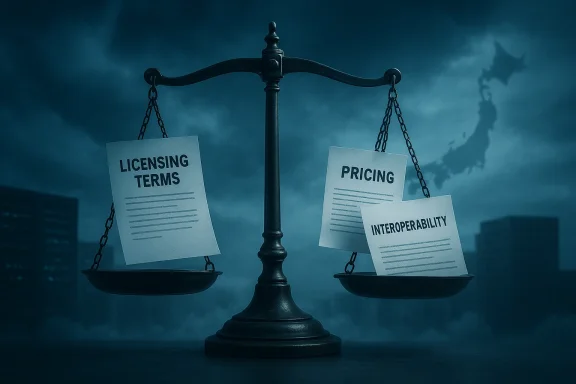
Japan’s Fair Trade Commission (JFTC) conducted an on‑site inspection of Microsoft’s Tokyo offices on February 25, 2026, marking the latest and most visible escalation in a wave of cross‑border regulatory scrutiny of hyperscale cloud vendors. Investigators are reported to be examining whether Microsoft used licensing terms, pricing differences or technical messaging to make its software harder or more expensive to run on competitor clouds such as Amazon Web Services (AWS) and Google Cloud.
The JFTC’s inquiry arrives amid a broader global pattern of enforcement and market investigations that have placed cloud competition front and center for regulators. The UK Competition and Markets Authority (CMA) earlier found that certain Microsoft licensing practices were adversely impacting cloud competition, and regulators in the EU, Brazil and the United States have been examining related issues for months. Those parallel proceedings — and public complaints from cloud rivals — create a context in which the JFTC’s action could produce ripple effects for enterprise contracting and cloud procurement worldwide.
That statutory framework gives the JFTC broad discretion to evaluate whether Microsoft’s conduct unreasonably restricts competition in the cloud services market. But administrative proceedings under the Antimonopoly Act often require detailed economic analysis and can take many months to resolve; the mere opening of a probe, however, is frequently enough to spur contractual and commercial changes.
Key immediate steps:
Three plausible scenarios:
Source: MLex Japan opens Microsoft cloud probe, calls for public comments | MLex | Specialist news and analysis on legal risk and regulation
 Background
Japan’s Fair Trade Commission (JFTC) conducted an on‑site inspection of Microsoft’s Tokyo offices on February 25, 2026, marking the latest and most visible escalation in a wave of cross‑border regulatory scrutiny of hyperscale cloud vendors. Investigators are reported to be examining whether Microsoft used licensing terms, pricing differences or technical messaging to make its software harder or more expensive to run on competitor clouds such as Amazon Web Services (AWS) and Google Cloud.The JFTC’s inquiry arrives amid a broader global pattern of enforcement and market investigations that have placed cloud competition front and center for regulators. The UK Competition and Markets Authority (CMA) earlier found that certain Microsoft licensing practices were adversely impacting cloud competition, and regulators in the EU, Brazil and the United States have been examining related issues for months. Those parallel proceedings — and public complaints from cloud rivals — create a context in which the JFTC’s action could produce ripple effects for enterprise contracting and cloud procurement worldwide.
What the JFTC is reportedly investigating
Narrow question, broad implications
At its core, the JFTC probe appears to be rooted in two related allegations:- That Microsoft’s commercial terms (pricing, license fees, service terms) create a de facto preference for Microsoft Azure by penalizing customers who run Microsoft software on competing cloud platforms; and
- That Microsoft’s sales or technical messaging discouraged or misinformed customers about interoperability, availability, or support for Microsoft products on rival clouds.
What regulators reportedly seized or sought
While the JFTC has not publicly detailed exactly which contracts, emails or technical documents it took during the inspection, standard on‑site procedures typically target sales contracts, partner agreements, internal pricing guidelines, product roadmaps, and communications between account teams and customers. Investigators are also understood to be seeking clarifying information from Microsoft’s U.S. parent on how global licensing policies are applied in Japan. Microsoft Japan has said it will cooperate with the JFTC.Why this matters: the mechanics of alleged cloud steering
To non‑technical readers it can be hard to see how “licensing” becomes an antitrust issue. The mechanisms the JFTC is reportedly probing are straightforward in principle and potentially powerful in practice.How commercial terms can nudge cloud choice
- Price differentials: If Microsoft charges higher per‑seat or per‑core licensing fees when a customer runs Microsoft software on non‑Azure infrastructure, that creates a direct economic penalty that favors Azure. Several reports cite concerns that licensing regimes deliver precisely this effect.
- Support and maintenance conditions: Vendors can tie full product support or security updates to a particular hosting environment or to agreements with preferred partners, making it riskier for customers to choose other clouds.
- License complexity and auditing risk: Complex cross‑cloud licensing rules increase the compliance burden for customers and their auditors, which advantages the incumbent cloud that simplifies or absorbs that complexity.
How product design and marketing can also steer customers
Beyond pricing, technical design and commercial messaging can do the same work:- Feature differentials: If new capabilities, integrations or performance optimizations are initially or exclusively available in Azure — even for otherwise cross‑platform products — customers with tight timetables will favor Azure to access them. Regulatory scrutiny in the UK and EU has flagged these kinds of asymmetries previously.
- Sales scripts and customer conversations: If field sales teams or channel partners implicitly or explicitly warn customers that certain software won’t run properly on other clouds, that can deter multi‑cloud deployments and shape purchasing decisions. JFTC investigators reportedly queried Microsoft’s local teams about such communications.
Legal and regulatory frame: Antimonopoly Act and JFTC powers
The JFTC enforces Japan’s Antimonopoly Act, which prohibits abuse of dominant position and unfair trade practices. The agency has authority to conduct on‑site inspections, request documents and compel testimony in administrative investigations; if a violation is found it can issue cease‑and‑desist orders and, in some cases, impose surcharges or seek remedies. Recent precedent shows Japan is willing to use those tools in digital markets: the JFTC took action against Google over app pre‑installation practices and has inspected other major platforms in recent years.That statutory framework gives the JFTC broad discretion to evaluate whether Microsoft’s conduct unreasonably restricts competition in the cloud services market. But administrative proceedings under the Antimonopoly Act often require detailed economic analysis and can take many months to resolve; the mere opening of a probe, however, is frequently enough to spur contractual and commercial changes.
How this fits into the global enforcement mosaic
Japan’s action is not isolated. Regulators and competitors in other jurisdictions have already raised parallel concerns.- The Competition and Markets Authority (CMA) in the UK produced a finding that certain Microsoft software licensing practices have harmed rival cloud providers and distorted competition.
- Google has lodged complaints in Europe alleging Microsoft used licensing to lock customers into Azure, a claim that directly mirrors the themes of the JFTC probe.
- Other jurisdictions, including Brazil, have opened inquiries into Microsoft’s cloud operations, and EU market testing under the Digital Markets Act has put hyperscalers under sustained scrutiny.
Practical implications for enterprises and cloud customers
For IT leaders, the JFTC probe is more than a regulatory story: it touches procurement, architecture and vendor risk. Companies should treat this moment as an opportunity to tighten governance around cloud licensing and vendor contracts.Key immediate steps:
- Audit existing Microsoft contracts and licensing terms. Identify clauses that link pricing, support, or feature availability to a particular cloud hosting environment.
- Map workloads by portability. Determine which applications are technically tied to Azure‑only features and which can be moved without major rework.
- Estimate switching cost. Calculate the licensing, migration and ongoing operational costs of running key workloads on alternative clouds to quantify vendor lock‑in risk.
- Add contract protections. For new deals, insist on explicit portability clauses, price parity guarantees, or break‑clauses that reduce switching friction.
- Document support expectations. Require contractual guarantees for security updates, interoperability and support irrespective of the chosen cloud provider.
- Engage procurement and legal early. Cross‑functional review reduces surprises at renewal or in an enforcement event.
What Microsoft stands to gain or lose
Potential outcomes for Microsoft
- Administrative remedies: If the JFTC finds an Antimonopoly Act breach, it could issue orders requiring Microsoft to change licensing terms or sales practices in Japan; those remedies may be time‑limited or subject to compliance monitoring.
- Fines and surcharges: While Japan’s administrative process often focuses on behavioral remedies, monetary penalties or surcharges can follow in specific circumstances — particularly where the conduct is repeated or egregious.
- Reputational and commercial drag: Regulatory headlines and the prospect of pan‑jurisdictional remedies can slow enterprise sales cycles, increase contracting friction and motivate customers to test competitive alternatives.
What Microsoft can — and should — do now
- Cooperate, but document. Full cooperation with the JFTC is necessary; at the same time, Microsoft should maintain meticulous records of the information it provides and seek timely legal clarity on the scope of the inquiry.
- Reassess commercial playbooks in Japan. Where the risk calculus shows exposure, consider ional clarifications to licensing, or publish clearer portability guidance for Japanese customers.
- Proactive transparency. In markets under scrutiny, publishing plain‑language explanations of licensing and support policies reduces ambiguity and can improve regulators’ assessments.
How competitors and partners are positioned
- AWS and Google Cloud have a clear commercial incentive to amplify concerns about Microsoft’s licensing model; regulatory attention gives them procurement leverage with customers worried about vendor lock‑in. Public complaints from competitors in other jurisdictions already shaped investigations elsewhere.
- Systems integrators and resellers must reassess recommendations they make to enterprise clients. Channel partners tied to a single hyperscaler may face conflicts as customers demand multi‑cloud options.
- Customers with regulated workloads (financial services, healthcare, public sector) should be particularly vigilant: procurement rules and compliance obligations often favor demonstrable vendor neutrality and documented interoperability.
Scenarios and likely timelines
Regulatory investigations of this type typically proceed through a sequence: on‑site inspection and document seizure; requests for additional information; economic and legal analysis by investigators; and, finally, a decision to close the probe, issue remedial orders, or escalate to formal enforcement. That process can take several months to more than a year, depending on complexity and cross‑border coordination. The JFTC’s early call for third‑party information indicates investigators plan to collect broader market evidence before reaching a view.Three plausible scenarios:
- No action after review. The JFTC may find insufficient evidence of anti‑competitive effect and close the inquiry; this would be the least disruptive outcome but still create short‑term procurement and PR headwinds.
- Behavioral remedies only. The JFTC could require Microsoft to alter specific licensing clauses, provide price parity mechanisms, or publish clearer interoperability commitments. Such remedies are frequent in digital markets and can be tailored to Japan’s market.
- Broader enforcement or coordination. If the investigation uncovers systemic, cross‑border practices that harm competition, the JFTC could coordinate with regulators elsewhere, potentially producing harmonized remedies or parallel orders with larger commercial impact.
What to watch next
- Official JFTC announcements and public comment windows. The JFTC’s solicitation of third‑party views is a pivotal stage; participants — competitors, customers, trade groups and academic experts — can shape the record by submitting evidence and economic analysis.
- Microsoft’s public statements and contract amendments. Watch for policy clarifications, new license FAQs or explicit portability guarantees aimed at calming regulators and customers.
- Parallel regulatory moves. Any activity from the CMA, European Commission, Brazil’s competition authoritys that references similar facts or ordering patterns will be a leading indicator of coordinated remedies.
Strengths and weaknesses in the JFTC’s case (analysis)
Strengths
- Concrete, provable mechanics. Pricing differences, explicit contract clauses, emails and sales playbooks leave paper trails that are easier for enforcers to evaluate than abstract market effects. Reports indicate the JFTC is seeking precisely that documentary record.
- Precedent and comparators. Prior regulatory actions in Japan and decisions elsewhere create a legal and evidentiary environment favorable to enforcement agencies that want to police digital market power.
Weaknesses and challenges
- Proving anticompetitive effect. Even if Microsoft’s practices nudge customers, regulators must show that those practices cause harm to competition (not merely to rivals) — an economic standard that requires careful market definition and counterfactual analysis.
- Technical complexity. Distinguishing legitimate product differentiation (e.g., Azure‑first optimizations tied to engineering choices) from anticompetitive exclusion will require deep technical and economic expertise, and Microsoft will have plausible pro‑competitive justifications for many engineering choices.
Recommendations for enterprise IT and procurement teams
- Treat licensing risk as part of cloud risk management. Add a licensing‑portability review to formal vendor risk assessments.
- Benchmark invoices and renewal quotes. If you operate hybrid or multi‑cloud estates, ask vendors to give line items showing how fees would change if an application runs on another cloud.
- Insist on operational portability guarantees. Where mission‑critical workloads are concerned, make portability and vendor neutrality contractually enforceable.
- Follow the evidence trail. If your organization is contacted by regulators seeking information, involve legal and compliance counsel immediately and preserve communications with vendors that may be relevant.
Conclusion
Japan’s probe of Microsoft’s cloud practices elevates an already fraught policy debate about how dominant software vendors interact with hyperscale cloud markets. The JFTC’s on‑site inspection and its solicitation of third‑party views mean this is not a preliminary heads‑up but a full‑blown inquiry that could yield concrete remedies affecting contracts, pricing and technical roadmaps in one of the world’s largest cloud markets. For enterprises, the practical lesson is immediate: audit your Microsoft agreements, document portability and support expectations, and build contractual protections that reduce the financial and operational friction of choosing the cloud that best fits your needs. The outcome of the JFTC’s investigation will matter far beyond Japan — because in an interconnected market, regulatory answers here will shape negotiating leverage, product design and competitive dynamics across the global cloud ecosystem.Source: MLex Japan opens Microsoft cloud probe, calls for public comments | MLex | Specialist news and analysis on legal risk and regulation