
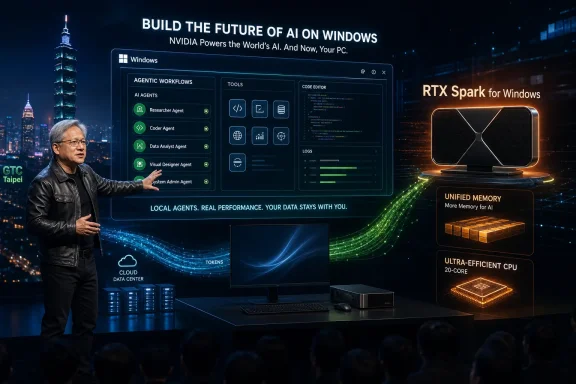
At Nvidia’s GTC Taipei keynote on June 1, 2026, CEO Jensen Huang rejected fears that artificial intelligence will reduce employment, arguing that AI is making software engineers more productive and therefore more valuable to companies, while unveiling RTX Spark for Windows PCs. It was classic Huang: part industrial forecast, part product launch, part leather-jacketed rebuttal to the idea that automation inevitably means fewer humans. But the interesting part was not the phrase “complete nonsense.” It was the economic bet behind it.
Huang’s argument is simple enough to sound self-evident and slippery enough to deserve scrutiny. If AI turns one software engineer into the productive equivalent of three, he says, the market will not fire two engineers; it will hire more because the return on each engineer has gone up. That is the optimistic version of the AI labor story, and it is also the version that happens to align perfectly with Nvidia’s need to keep the world building, buying, and justifying more compute.
The job-loss debate around AI is often framed as a substitution story. A model writes code, drafts copy, answers support tickets, or generates images; therefore, a manager eventually asks why the company needs as many coders, copywriters, agents, or designers as before. Huang wants to invert that logic.
In his telling, AI does not replace the software engineer so much as expand the surface area of what a software engineer can attempt. The developer is no longer only typing syntax into an editor. The developer becomes an orchestrator of tools, agents, compilers, tests, models, APIs, and domain-specific workflows. If the output of each engineer rises, the bottleneck shifts from typing speed to imagination, product judgment, integration skill, and the ability to turn business problems into systems.
That is not an absurd argument. Productivity improvements have often increased demand where markets were constrained by cost or difficulty. Cheaper computing created more software, not less. Better development tools did not end programming; they made larger applications possible, lowered the barrier to entry, and created sprawling ecosystems that needed even more specialists to maintain them.
But it is also not a universal law. Productivity gains can increase total demand while still displacing particular workers, compressing wages in some tiers, or changing the hiring profile so dramatically that the old career ladder breaks. The claim that “software engineers” are increasing can be true at the same time that junior developers, QA testers, contract coders, technical writers, and support staff feel squeezed.
Huang is arguing from the top of the value chain, where Nvidia sees customers with enormous appetite for AI infrastructure. Workers experience the transition from the ground level, where “AI makes us more productive” may arrive as higher expectations, smaller teams, fewer entry-level openings, or the quiet disappearance of tasks that once trained newcomers.
That makes software engineering both the best case for AI augmentation and a poor stand-in for the whole labor market. A senior engineer using Copilot, ChatGPT, Claude, Gemini, or a local model inside a carefully managed workflow is not the same as a call-center employee being measured against an automated ticket-resolution system. A developer with architectural authority is not in the same position as a contractor whose work has been reduced to promptable fragments.
Huang’s claim leans on the distinction between tasks and jobs. Coding is a task; building useful software is a job. If AI eats some of the coding, the job may become more valuable because more attention can go to design, testing, deployment, security, and product fit. That is plausible, and many developers already live this way.
The problem is that labor markets do not pay for philosophical distinctions. They pay for scarce value. If AI makes some parts of software work abundant, companies will stop paying premium rates for those parts. The question is whether the new high-value work grows fast enough, and broadly enough, to absorb the people whose old tasks are now cheaper.
That is why Huang’s “complete nonsense” line lands as both confidence and provocation. It reassures investors, developers, and governments that the AI boom is a growth story. It also risks sounding dismissive to workers in sectors where AI is already being used less as a productivity bonus than as a headcount argument.
That data matters because it suggests AI has not made software creation obsolete. If anything, the opposite is visible: more people are writing code, more repositories are being created, and more AI-assisted projects are entering the public and private development pipeline. The software world is becoming larger, not smaller.
But GitHub activity is not the same as full-time employment. A student in India, a hobbyist building an agent framework, a laid-off engineer contributing to open source, and a Fortune 500 employee shipping enterprise code all show up as developer activity in different ways. A commit is not a salary. A new account is not a job opening.
This distinction is especially important for WindowsForum readers because IT departments have lived through several waves of “more software” that did not always mean more stable work. Cloud migration created new jobs and killed old ones. SaaS reduced some internal maintenance while increasing integration headaches. DevOps made teams more capable but also loaded more responsibility onto fewer people.
AI-assisted coding may follow the same pattern. The amount of software will grow. The number of systems needing maintenance will grow. The security exposure will grow. But the distribution of that work may become harsher, with senior engineers and platform teams gaining leverage while entry-level workers face a more difficult path into the profession.
That shift matters because it turns AI from a text box into something closer to an operating layer. A chatbot can summarize a document. An agent can, in theory, read the document, update a spreadsheet, file a ticket, query a database, write code, run tests, and report back when the task is done. The commercial promise is not “better autocomplete.” It is software that does work across software.
For Nvidia, this is the bridge between the data center and the PC. If agents become a normal part of business workflows, then inference demand grows everywhere: in clouds, on workstations, in laptops, in robots, in factories, and eventually inside devices that do not look much like PCs at all. The GPU is no longer just a graphics engine or a training accelerator. It becomes the substrate for a new class of local and semi-local computing.
That is also why Huang talked about tokens as profitable units of revenue. The industry has spent several years trying to turn AI demos into margins. If every useful agentic task consumes tokens, and if businesses can charge for those tasks or reduce costs with them, then tokens become a measurable economic input. In that world, demand for compute does not depend on novelty. It depends on usage.
This is where Huang’s optimism becomes strategic. If AI is profitable, customers build more AI. If AI creates more valuable engineers, companies hire more engineers. If agents need local hardware, the PC market gets a new upgrade cycle. The story is coherent because every piece points toward more Nvidia silicon.
That is a serious claim for the PC market. For years, local AI has been boxed in by memory limits, GPU availability, thermal constraints, and the awkward split between CPU and GPU memory. Unified memory is not magic, but it matters because large models are often constrained less by raw compute than by the ability to keep enough of the model and context close to the processor.
Microsoft’s role is just as important as Nvidia’s. Windows has spent the last several years trying to define what an “AI PC” actually means beyond a marketing badge and a neural processing unit. Copilot+ PCs pushed the first version of that story, mostly around local inference for select features. RTX Spark is a more aggressive version: a Windows machine built not just to run AI features, but to host personal agents, developer workflows, creative workloads, and local large-model experimentation.
That puts Nvidia in a fascinating position. The company is not replacing the Windows PC ecosystem; it is trying to re-architect the high end of it around CUDA, RTX, and agentic workloads. If the PC becomes a local AI appliance, Nvidia wants its software stack to be the gravitational center.
The participating OEM list is broad enough to make the announcement more than a science project. Microsoft Surface, Dell, HP, ASUS, Lenovo, and MSI are expected to ship RTX Spark systems this fall, with Acer and GIGABYTE following later. That does not guarantee volume adoption, pricing discipline, or mainstream relevance, but it does mean the PC industry is willing to take the bet seriously.
That vision solves a real problem. Cloud AI is powerful, but it is also expensive, latency-sensitive, privacy-complicated, and dependent on network availability. A local model cannot match the largest frontier systems in every task, but it can provide persistence, privacy, responsiveness, and customization that cloud services struggle to offer at scale.
For developers, a machine that can run serious models locally is immediately useful. It means faster prototyping, lower cloud bills during experimentation, better offline capability, and fewer policy fights over whether sensitive code or data can be sent to a third-party model provider. For enterprises, local AI workstations could become a controlled middle ground between banning AI tools and spraying proprietary data into consumer services.
For consumers, the case is less settled. Most users do not need a 120-billion-parameter model running on a laptop today. They need battery life, reliability, privacy, good search, decent app integration, and agents that do not accidentally book the wrong flight or delete the wrong file. Hardware can make the future possible, but software determines whether anyone wants to live in it.
This is where Windows has both an advantage and a burden. The platform already sits at the center of productivity, gaming, development, and enterprise management. But Windows also carries decades of compatibility expectations, security complexity, background services, driver layers, and administrative policy. Turning that into a trustworthy agent platform is harder than putting a faster chip under the keyboard.
Agentic systems raise the stakes because they do not merely produce artifacts. They act. An agent that can use a browser, terminal, spreadsheet, ticketing system, or code repository must be authenticated, monitored, scoped, logged, and revoked like any other privileged actor. If enterprises struggled with service accounts and OAuth sprawl, they should not assume AI agents will be cleaner.
Microsoft and Nvidia appear aware of this, which is why the RTX Spark pitch includes secure local agents and Windows integration rather than just raw TOPS. But security primitives are only the start. Administrators will need policy controls for which agents can access which files, what tools they can invoke, what data they can retain, when they can run in the background, and how their actions can be audited after something goes wrong.
This is where the productivity story may collide with governance. The more useful agents become, the more permission they will request. The more permissions they receive, the more they resemble employees, scripts, malware, and interns at the same time. The enterprise challenge is not merely making AI work; it is making AI work within boundaries that survive contact with impatient users.
Windows shops should therefore hear two announcements in Huang’s keynote. One is that local AI hardware is getting serious. The other is that a new class of endpoint workload is coming, and it will have to be managed with the same seriousness as identity, patching, endpoint detection, and data loss prevention.
That matters because AI is often discussed as software eating the world, but the current boom is also hardware remaking parts of the world economy. Data centers need accelerators, networking, memory, cooling, power delivery, and supply chains that can actually ship the systems. PCs built around local AI need chips, boards, displays, batteries, firmware, drivers, and operating system support.
The result is a strange split-screen economy. In one frame, workers worry that models will automate their tasks. In another, companies and nations are racing to build the physical infrastructure those models require. Taiwan’s growth numbers capture the second frame: AI as industrial demand, not just workplace disruption.
Huang naturally emphasizes this side because it is Nvidia’s side. If AI becomes essential infrastructure, then Nvidia is selling the picks, shovels, maps, and some of the roads. The more the world believes in agentic AI, the more urgent the buildout becomes.
But a supply-chain boom does not settle the labor question. It redistributes it. Taiwan may see export growth while a U.S. marketing department cuts contractor budgets. A cloud provider may hire data-center engineers while a software startup delays junior hiring. Macro growth can coexist with local pain, and tech history is full of transitions that made the industry richer without making every worker safer.
AI is the most plausible candidate because it asks for capabilities that older machines genuinely lack. Local models need memory bandwidth, specialized compute, efficient inference, and software integration. If agents become sticky, the difference between a standard laptop and an AI-capable workstation could become visible in daily use.
That is the commercial dream behind RTX Spark. Nvidia and Microsoft are not merely selling performance; they are selling a new role for the PC. The machine stops being a passive endpoint and becomes an always-available collaborator. Apps become tools the agent can use. The operating system becomes a workspace the agent can traverse.
The risk is that “AI PC” becomes another label stretched across too many products with too little user benefit. The industry has already trained consumers to be skeptical of badges. If local agents are unreliable, invasive, confusing, or locked behind subscriptions, users will treat the hardware as an expensive promise.
For Windows enthusiasts, the interesting question is whether RTX Spark creates a high-end tier that feels meaningfully different. A laptop that can run serious local models, accelerate creative apps, handle AAA gaming, and serve as a developer workstation could be compelling even before the agent future fully arrives. The danger is that the mass-market pitch outruns the software.
He is also right that the best developers will become dramatically more capable. A strong engineer with AI assistance can move faster through unfamiliar codebases, test hypotheses quickly, generate scaffolding, and spend more time on architecture and judgment. In that sense, AI can make engineering talent more valuable, not less.
Where the argument becomes too neat is in its assumption that increased output automatically produces broad hiring. Companies may use AI productivity to expand roadmaps, or they may use it to hold headcount flat while demanding more from existing teams. They may hire more senior engineers and fewer juniors. They may shift work geographically. They may redefine “developer” to include people who assemble systems with prompts, templates, and low-code tools.
The labor market is not a spreadsheet where tripled output cleanly becomes tripled demand. It is a negotiation among budgets, managers, investors, deadlines, wages, skills, and fear. AI changes every variable at once.
That is why Huang’s statement should be read less as a settled truth than as a declaration of the world Nvidia is trying to build. In that world, AI is profitable, agents are everywhere, software demand explodes, PCs are reinvented, and developers become more valuable because they command fleets of tools. It is a powerful vision. It is not yet a guarantee.
The same is true for individual developers. AI coding tools are not a career moat by themselves because everyone can access them. The moat is knowing what to build, how to verify it, how to secure it, how to maintain it, and how to explain tradeoffs to the business. The value moves up the stack, but it does not disappear.
RTX Spark may accelerate that shift by making local AI more practical on Windows hardware. If serious models can run on desks and laptops without a cloud round trip, experimentation will spread. Some of that experimentation will be useful. Some of it will be expensive theater. IT departments will have to tell the difference.
The uncomfortable truth is that Huang’s optimism and worker anxiety can both be rational. AI can create more total software work while making certain career paths more unstable. It can increase productivity while raising expectations. It can make engineers more valuable while making it harder to become one.
Huang’s argument is simple enough to sound self-evident and slippery enough to deserve scrutiny. If AI turns one software engineer into the productive equivalent of three, he says, the market will not fire two engineers; it will hire more because the return on each engineer has gone up. That is the optimistic version of the AI labor story, and it is also the version that happens to align perfectly with Nvidia’s need to keep the world building, buying, and justifying more compute.
 Huang Turns the Jobs Panic Into a Demand-Side Story
The job-loss debate around AI is often framed as a substitution story. A model writes code, drafts copy, answers support tickets, or generates images; therefore, a manager eventually asks why the company needs as many coders, copywriters, agents, or designers as before. Huang wants to invert that logic.In his telling, AI does not replace the software engineer so much as expand the surface area of what a software engineer can attempt. The developer is no longer only typing syntax into an editor. The developer becomes an orchestrator of tools, agents, compilers, tests, models, APIs, and domain-specific workflows. If the output of each engineer rises, the bottleneck shifts from typing speed to imagination, product judgment, integration skill, and the ability to turn business problems into systems.
That is not an absurd argument. Productivity improvements have often increased demand where markets were constrained by cost or difficulty. Cheaper computing created more software, not less. Better development tools did not end programming; they made larger applications possible, lowered the barrier to entry, and created sprawling ecosystems that needed even more specialists to maintain them.
But it is also not a universal law. Productivity gains can increase total demand while still displacing particular workers, compressing wages in some tiers, or changing the hiring profile so dramatically that the old career ladder breaks. The claim that “software engineers” are increasing can be true at the same time that junior developers, QA testers, contract coders, technical writers, and support staff feel squeezed.
Huang is arguing from the top of the value chain, where Nvidia sees customers with enormous appetite for AI infrastructure. Workers experience the transition from the ground level, where “AI makes us more productive” may arrive as higher expectations, smaller teams, fewer entry-level openings, or the quiet disappearance of tasks that once trained newcomers.
The Software Engineer Is a Convenient Hero
It is telling that Huang’s example is the software engineer. The developer is the worker most likely to benefit from current AI systems because developers sit closest to the machinery. They can use AI to write boilerplate, generate tests, inspect logs, explore unfamiliar APIs, refactor code, produce documentation, and glue services together. They also understand enough of the output to reject nonsense when the machine confidently invents it.That makes software engineering both the best case for AI augmentation and a poor stand-in for the whole labor market. A senior engineer using Copilot, ChatGPT, Claude, Gemini, or a local model inside a carefully managed workflow is not the same as a call-center employee being measured against an automated ticket-resolution system. A developer with architectural authority is not in the same position as a contractor whose work has been reduced to promptable fragments.
Huang’s claim leans on the distinction between tasks and jobs. Coding is a task; building useful software is a job. If AI eats some of the coding, the job may become more valuable because more attention can go to design, testing, deployment, security, and product fit. That is plausible, and many developers already live this way.
The problem is that labor markets do not pay for philosophical distinctions. They pay for scarce value. If AI makes some parts of software work abundant, companies will stop paying premium rates for those parts. The question is whether the new high-value work grows fast enough, and broadly enough, to absorb the people whose old tasks are now cheaper.
That is why Huang’s “complete nonsense” line lands as both confidence and provocation. It reassures investors, developers, and governments that the AI boom is a growth story. It also risks sounding dismissive to workers in sectors where AI is already being used less as a productivity bonus than as a headcount argument.
GitHub’s Growth Proves Activity, Not Security
Huang pointed to GitHub’s surge as evidence that developers are not disappearing. The numbers are impressive: GitHub’s 2025 Octoverse report said more than 36 million new developers joined the platform in a year, developers pushed nearly 1 billion commits, and activity continued to rise sharply even as AI coding tools became mainstream.That data matters because it suggests AI has not made software creation obsolete. If anything, the opposite is visible: more people are writing code, more repositories are being created, and more AI-assisted projects are entering the public and private development pipeline. The software world is becoming larger, not smaller.
But GitHub activity is not the same as full-time employment. A student in India, a hobbyist building an agent framework, a laid-off engineer contributing to open source, and a Fortune 500 employee shipping enterprise code all show up as developer activity in different ways. A commit is not a salary. A new account is not a job opening.
This distinction is especially important for WindowsForum readers because IT departments have lived through several waves of “more software” that did not always mean more stable work. Cloud migration created new jobs and killed old ones. SaaS reduced some internal maintenance while increasing integration headaches. DevOps made teams more capable but also loaded more responsibility onto fewer people.
AI-assisted coding may follow the same pattern. The amount of software will grow. The number of systems needing maintenance will grow. The security exposure will grow. But the distribution of that work may become harsher, with senior engineers and platform teams gaining leverage while entry-level workers face a more difficult path into the profession.
Agentic AI Is the Real Product Being Sold
Huang’s jobs claim was wrapped around a broader declaration: agentic AI has arrived. That phrase has been used loosely across the industry, but the basic idea is clear. Instead of merely answering prompts, an agent observes a situation, plans a sequence of actions, uses tools, checks results, and iterates toward a goal.That shift matters because it turns AI from a text box into something closer to an operating layer. A chatbot can summarize a document. An agent can, in theory, read the document, update a spreadsheet, file a ticket, query a database, write code, run tests, and report back when the task is done. The commercial promise is not “better autocomplete.” It is software that does work across software.
For Nvidia, this is the bridge between the data center and the PC. If agents become a normal part of business workflows, then inference demand grows everywhere: in clouds, on workstations, in laptops, in robots, in factories, and eventually inside devices that do not look much like PCs at all. The GPU is no longer just a graphics engine or a training accelerator. It becomes the substrate for a new class of local and semi-local computing.
That is also why Huang talked about tokens as profitable units of revenue. The industry has spent several years trying to turn AI demos into margins. If every useful agentic task consumes tokens, and if businesses can charge for those tasks or reduce costs with them, then tokens become a measurable economic input. In that world, demand for compute does not depend on novelty. It depends on usage.
This is where Huang’s optimism becomes strategic. If AI is profitable, customers build more AI. If AI creates more valuable engineers, companies hire more engineers. If agents need local hardware, the PC market gets a new upgrade cycle. The story is coherent because every piece points toward more Nvidia silicon.
RTX Spark Is Nvidia’s Bid to Move the AI Factory Onto the Desk
The hardware reveal gave the keynote its Windows angle. Nvidia and Microsoft unveiled RTX Spark, a new superchip platform for Windows PCs that pairs a Blackwell RTX GPU with an ultra-efficient 20-core CPU and up to 128GB of unified memory. Nvidia says the platform can deliver up to one petaflop of FP4 AI performance and run 120-billion-parameter models locally with very large context windows.That is a serious claim for the PC market. For years, local AI has been boxed in by memory limits, GPU availability, thermal constraints, and the awkward split between CPU and GPU memory. Unified memory is not magic, but it matters because large models are often constrained less by raw compute than by the ability to keep enough of the model and context close to the processor.
Microsoft’s role is just as important as Nvidia’s. Windows has spent the last several years trying to define what an “AI PC” actually means beyond a marketing badge and a neural processing unit. Copilot+ PCs pushed the first version of that story, mostly around local inference for select features. RTX Spark is a more aggressive version: a Windows machine built not just to run AI features, but to host personal agents, developer workflows, creative workloads, and local large-model experimentation.
That puts Nvidia in a fascinating position. The company is not replacing the Windows PC ecosystem; it is trying to re-architect the high end of it around CUDA, RTX, and agentic workloads. If the PC becomes a local AI appliance, Nvidia wants its software stack to be the gravitational center.
The participating OEM list is broad enough to make the announcement more than a science project. Microsoft Surface, Dell, HP, ASUS, Lenovo, and MSI are expected to ship RTX Spark systems this fall, with Acer and GIGABYTE following later. That does not guarantee volume adoption, pricing discipline, or mainstream relevance, but it does mean the PC industry is willing to take the bet seriously.
The Personal AI Computer Is a Rebranding of the Workstation
Huang described a future in which an AI computer sits in the home like a television or game console, running personal agents around the clock. It manages calendars, books travel, watches over household systems, learns preferences, and becomes more like a companion than an application launcher. The R2-D2 analogy is cute, but the underlying architecture is more prosaic: a workstation with enough local compute to keep sensitive, persistent, personalized agents close to the user.That vision solves a real problem. Cloud AI is powerful, but it is also expensive, latency-sensitive, privacy-complicated, and dependent on network availability. A local model cannot match the largest frontier systems in every task, but it can provide persistence, privacy, responsiveness, and customization that cloud services struggle to offer at scale.
For developers, a machine that can run serious models locally is immediately useful. It means faster prototyping, lower cloud bills during experimentation, better offline capability, and fewer policy fights over whether sensitive code or data can be sent to a third-party model provider. For enterprises, local AI workstations could become a controlled middle ground between banning AI tools and spraying proprietary data into consumer services.
For consumers, the case is less settled. Most users do not need a 120-billion-parameter model running on a laptop today. They need battery life, reliability, privacy, good search, decent app integration, and agents that do not accidentally book the wrong flight or delete the wrong file. Hardware can make the future possible, but software determines whether anyone wants to live in it.
This is where Windows has both an advantage and a burden. The platform already sits at the center of productivity, gaming, development, and enterprise management. But Windows also carries decades of compatibility expectations, security complexity, background services, driver layers, and administrative policy. Turning that into a trustworthy agent platform is harder than putting a faster chip under the keyboard.
The Jobs Argument Looks Different From an IT Department
For sysadmins and IT pros, the immediate AI labor question is not whether humanity runs out of work. It is whether the next round of software becomes easier to manage or even more chaotic. More productive developers can be a blessing, but more code shipped faster can also mean more dependencies, more shadow IT, more secrets in repositories, more misconfigured services, and more incidents arriving at the help desk.Agentic systems raise the stakes because they do not merely produce artifacts. They act. An agent that can use a browser, terminal, spreadsheet, ticketing system, or code repository must be authenticated, monitored, scoped, logged, and revoked like any other privileged actor. If enterprises struggled with service accounts and OAuth sprawl, they should not assume AI agents will be cleaner.
Microsoft and Nvidia appear aware of this, which is why the RTX Spark pitch includes secure local agents and Windows integration rather than just raw TOPS. But security primitives are only the start. Administrators will need policy controls for which agents can access which files, what tools they can invoke, what data they can retain, when they can run in the background, and how their actions can be audited after something goes wrong.
This is where the productivity story may collide with governance. The more useful agents become, the more permission they will request. The more permissions they receive, the more they resemble employees, scripts, malware, and interns at the same time. The enterprise challenge is not merely making AI work; it is making AI work within boundaries that survive contact with impatient users.
Windows shops should therefore hear two announcements in Huang’s keynote. One is that local AI hardware is getting serious. The other is that a new class of endpoint workload is coming, and it will have to be managed with the same seriousness as identity, patching, endpoint detection, and data loss prevention.
Taiwan Shows the Boom Is Already Physical
Huang’s keynote took place in Taipei for a reason. Taiwan is not just a backdrop for the AI era; it is one of the places where the supposedly abstract AI boom becomes visible in factories, exports, wafers, boards, packaging, servers, and power demand. The country’s 2026 growth forecast was sharply raised after a huge first quarter, with AI infrastructure demand powering exports and investment.That matters because AI is often discussed as software eating the world, but the current boom is also hardware remaking parts of the world economy. Data centers need accelerators, networking, memory, cooling, power delivery, and supply chains that can actually ship the systems. PCs built around local AI need chips, boards, displays, batteries, firmware, drivers, and operating system support.
The result is a strange split-screen economy. In one frame, workers worry that models will automate their tasks. In another, companies and nations are racing to build the physical infrastructure those models require. Taiwan’s growth numbers capture the second frame: AI as industrial demand, not just workplace disruption.
Huang naturally emphasizes this side because it is Nvidia’s side. If AI becomes essential infrastructure, then Nvidia is selling the picks, shovels, maps, and some of the roads. The more the world believes in agentic AI, the more urgent the buildout becomes.
But a supply-chain boom does not settle the labor question. It redistributes it. Taiwan may see export growth while a U.S. marketing department cuts contractor budgets. A cloud provider may hire data-center engineers while a software startup delays junior hiring. Macro growth can coexist with local pain, and tech history is full of transitions that made the industry richer without making every worker safer.
The PC Industry Wants a New Upgrade Cycle, and AI Is the Best Candidate
The PC has been waiting for a compelling reason to feel new again. Faster CPUs and GPUs still matter, but for many mainstream users, the upgrade cycle has stretched because old machines remain good enough. Windows 11 requirements, hybrid work, gaming, and creator workloads have all helped, but none has fully restored the sense that a new PC enables a fundamentally new behavior.AI is the most plausible candidate because it asks for capabilities that older machines genuinely lack. Local models need memory bandwidth, specialized compute, efficient inference, and software integration. If agents become sticky, the difference between a standard laptop and an AI-capable workstation could become visible in daily use.
That is the commercial dream behind RTX Spark. Nvidia and Microsoft are not merely selling performance; they are selling a new role for the PC. The machine stops being a passive endpoint and becomes an always-available collaborator. Apps become tools the agent can use. The operating system becomes a workspace the agent can traverse.
The risk is that “AI PC” becomes another label stretched across too many products with too little user benefit. The industry has already trained consumers to be skeptical of badges. If local agents are unreliable, invasive, confusing, or locked behind subscriptions, users will treat the hardware as an expensive promise.
For Windows enthusiasts, the interesting question is whether RTX Spark creates a high-end tier that feels meaningfully different. A laptop that can run serious local models, accelerate creative apps, handle AAA gaming, and serve as a developer workstation could be compelling even before the agent future fully arrives. The danger is that the mass-market pitch outruns the software.
Huang Is Right About Direction and Too Certain About Distribution
The fairest reading of Huang’s argument is that he is probably right about the direction of software demand. AI will make it easier to build software, which means more software will be attempted. More companies will want internal tools, custom agents, automated workflows, domain-specific copilots, and integration layers that connect old systems to new models. That work does not happen by itself.He is also right that the best developers will become dramatically more capable. A strong engineer with AI assistance can move faster through unfamiliar codebases, test hypotheses quickly, generate scaffolding, and spend more time on architecture and judgment. In that sense, AI can make engineering talent more valuable, not less.
Where the argument becomes too neat is in its assumption that increased output automatically produces broad hiring. Companies may use AI productivity to expand roadmaps, or they may use it to hold headcount flat while demanding more from existing teams. They may hire more senior engineers and fewer juniors. They may shift work geographically. They may redefine “developer” to include people who assemble systems with prompts, templates, and low-code tools.
The labor market is not a spreadsheet where tripled output cleanly becomes tripled demand. It is a negotiation among budgets, managers, investors, deadlines, wages, skills, and fear. AI changes every variable at once.
That is why Huang’s statement should be read less as a settled truth than as a declaration of the world Nvidia is trying to build. In that world, AI is profitable, agents are everywhere, software demand explodes, PCs are reinvented, and developers become more valuable because they command fleets of tools. It is a powerful vision. It is not yet a guarantee.
The RTX Spark Era Will Reward the Prepared and Punish the Passive
For Windows users and administrators, the practical lesson is not to choose between panic and hype. It is to assume that AI-assisted work will become normal and to prepare for the consequences. The organizations that benefit will be the ones that pair productivity tools with training, security controls, procurement discipline, and a clear view of which workflows actually improve.The same is true for individual developers. AI coding tools are not a career moat by themselves because everyone can access them. The moat is knowing what to build, how to verify it, how to secure it, how to maintain it, and how to explain tradeoffs to the business. The value moves up the stack, but it does not disappear.
RTX Spark may accelerate that shift by making local AI more practical on Windows hardware. If serious models can run on desks and laptops without a cloud round trip, experimentation will spread. Some of that experimentation will be useful. Some of it will be expensive theater. IT departments will have to tell the difference.
The uncomfortable truth is that Huang’s optimism and worker anxiety can both be rational. AI can create more total software work while making certain career paths more unstable. It can increase productivity while raising expectations. It can make engineers more valuable while making it harder to become one.
The Signal Inside Huang’s Leather-Jacketed Certainty
Huang’s keynote is best understood as a map of where Nvidia wants the industry to go next: from cloud training to profitable inference, from chatbots to agents, from AI servers to AI PCs, and from human output to human-plus-machine output. Strip away the showmanship, and several concrete points remain.- Nvidia is arguing that AI will expand software demand because higher developer productivity makes more projects economically viable.
- GitHub’s 2025 growth supports the idea that software activity is rising, but it does not prove that every class of software job is secure.
- RTX Spark is Nvidia and Microsoft’s attempt to turn Windows PCs into local AI-agent machines, not merely faster laptops.
- Local AI could matter most for developers, creators, and enterprises that need privacy, low latency, and control over sensitive workflows.
- IT departments should treat agents as manageable actors with permissions, logs, policies, and risks, not as harmless productivity features.
- The biggest uncertainty is distribution: AI may create more total work while still disrupting entry-level hiring, routine tasks, and adjacent professions.
References
- Primary source: Vulcan Post
Published: 2026-06-22T15:20:41.470950
Loading…
vulcanpost.com - Related coverage: moneycontrol.com
Loading…
www.moneycontrol.com - Related coverage: pcgamer.com
Loading…
www.pcgamer.com - Related coverage: digitalapplied.com
NVIDIA RTX Spark: 1-Petaflop Local AI Agent Box Guide
NVIDIA's RTX Spark superchip runs 120B-parameter agents on-device with 128GB unified memory. Inside the silicon, the bandwidth math, and OpenShell security.www.digitalapplied.com
- Related coverage: pcguide.com
Loading…
www.pcguide.com - Related coverage: semicurrent.com
Nvidia's RTX Spark brings a Blackwell GPU and on-device AI to laptops - Semi-Current
Nvidia RTX Spark is a Windows laptop/desktop chip with a Blackwell GPU that handles 1440p gaming or on-device 120B AI, with machines from six OEMs due this fall.www.semicurrent.com
- Related coverage: techradar.com
Nvidia Computex 2026 keynote as it happened: RTX Spark announced to take on Apple, Intel, and Qualcomm | TechRadar
CEO Jensen Huang takes to the stagewww.techradar.com - Related coverage: nvidia.com
NVIDIA RTX Spark — Slim Laptops & Small Desktops
The fusion of NVIDIA AI and RTX graphics.www.nvidia.com - Related coverage: investor.nvidia.com
NVIDIA Corporation - NVIDIA and Microsoft Reinvent Windows PCs for the Age of Personal AI
RTX Spark — a 1-Petaflop Superchip, the Full CUDA and RTX Ecosystem, and Windows-Native Agents — a New Beginning for Personal Computers News Summary: NVIDIA RTX Spark powers the world’s first Windows PCs purpose-built for personal agents, featuring 1 petaflop of AI performance, industry-leading...investor.nvidia.com - Related coverage: docs.nvidia.com
- Related coverage: nvidianews.nvidia.com
NVIDIA CEO Jensen Huang and Global Technology Leaders to Showcase Age of AI at GTC 2026
NVIDIA today announced that GTC, the world’s premier conference on AI and accelerated computing, will take place March 16-19 this year in San Jose, California.nvidianews.nvidia.com