

Japan’s Maritime Self-Defense Force commissioned JS Nagara, the 10th Mogami-class frigate, on June 29, 2026, during a flag-raising ceremony at Mitsubishi Heavy Industries’ Nagasaki shipyard, before assigning the new warship to the 2nd Patrol Division at Kure Naval Base in Hiroshima Prefecture. The event looks, at first glance, like another orderly handover in a disciplined naval procurement program. It is more than that. Nagara shows how Japan is turning shipbuilding tempo, automation, and missile-cell politics into a practical answer to a deteriorating security environment.
The commissioning of JS Nagara matters because it is not an isolated naval milestone. It is the 10th hull in a 12-ship class that began construction in 2019 and has since moved from experimental promise to production rhythm. In a region where naval power is measured not only in exquisite destroyers but in how many hulls can be built, crewed, upgraded, and kept at sea, that rhythm is the message.
Japan has long operated sophisticated destroyers, Aegis ships, submarines, and maritime patrol aircraft. What the Mogami class adds is a different kind of capability: a smaller, more automated, multi-role combatant that can take on patrol, mine warfare, anti-submarine, surface warfare, and local defense missions without consuming the manpower of a larger destroyer. For an island nation facing a shrinking workforce and expanding maritime obligations, that is not a design flourish. It is the central bargain.
Nagara’s arrival also underlines a quiet shift in Japanese defense planning. Tokyo is no longer content to buy limited numbers of high-end platforms and assume peacetime availability will carry the burden. The modern JMSDF needs distributed capacity: ships that can be built fast enough to matter, deployed widely enough to complicate an adversary’s planning, and upgraded over time as missile inventories and combat systems mature.
That is why a 133-meter frigate with a crew of roughly 90 people deserves more attention than its tonnage might suggest. The Mogami class is Japan’s bet that automation and modularity can help square a hard triangle: more missions, fewer sailors, and less time.
Nagara was laid down on July 6, 2023, launched on December 19, 2024, and commissioned on June 29, 2026. That is roughly a three-year construction cycle from keel-laying to active service, a pace many Western navies would envy for a modern surface combatant. The program’s use of simultaneous hull construction has helped Mitsubishi Heavy Industries keep output moving, even as earlier ships encountered delays and supply chain complications.
The ship will join the 2nd Patrol Division at Kure, one of Japan’s most important naval bases and a location with deep historical and operational significance. Kure’s geography matters: it sits on the Seto Inland Sea, with access to Japan’s southwestern approaches and the broader maritime lanes that tie the home islands to the East China Sea and Western Pacific. A frigate based there is not merely filling out an organizational chart.
Nagara’s commissioning also comes after JS Natori, the ninth ship, entered service in May 2026. The spacing between those handovers reinforces the impression that Japan’s frigate pipeline has moved past the unevenness typical of early production. The last of the original 12, JS Yoshii, has already been launched, which means the baseline Mogami program is approaching completion even as Japan moves toward upgraded follow-on designs.
This is how a navy changes its posture without a single dramatic announcement. One ship arrives, then another, then another. Eventually, what looked like incremental procurement becomes a new operating reality.
A crew of approximately 90 for a modern frigate is therefore a major design statement. Traditional surface combatants can require far larger crews, particularly when they carry complex combat systems, aviation facilities, and damage-control requirements. Reducing crew size is not simply about saving money on salaries. It affects training pipelines, endurance, habitability, personnel rotation, and the number of ships a navy can realistically operate.
Automation does not remove the need for sailors; it changes what those sailors must be able to do. Smaller crews mean each person carries more responsibility, cross-training becomes more important, and the ship’s systems must be more reliable because there are fewer hands available when things go wrong. The risk is that a lean crew can become a fragile crew under battle damage or prolonged high-tempo operations.
Japan appears to have accepted that tradeoff because the alternative is worse. A navy that designs every combatant around old manpower assumptions may end up with ships it cannot crew in sufficient numbers. The Mogami class reflects a more realistic view: the JMSDF needs ships that fit the human resources it actually has, not the navy it might have preferred in a different demographic era.
This is also where the class’s multi-mission nature becomes relevant. A smaller frigate that can conduct patrol, surveillance, mine countermeasures support, and anti-submarine tasks allows larger destroyers to focus on air defense, ballistic missile defense, and strike-related missions. In a crisis, that separation of labor becomes essential.
Earlier Mogami-class ships were delivered without the Mk 41 installed, with retrofits planned afterward. That was never ideal. A vertical launch system is structurally and operationally central to a modern combatant’s flexibility, and sending ships to sea without it meant accepting a gap between hull delivery and full combat potential.
The reasons were familiar to anyone who has watched defense procurement since 2020: pandemic disruption, semiconductor shortages, constrained manufacturing capacity, and the fragility of specialized supply chains. Mitsubishi Heavy Industries manufactures the Mk 41 system under license in Japan, but domestic production does not magically eliminate bottlenecks. It merely moves some of the risk closer to home.
The Japanese Ministry of Defense’s order for 12 Mk 41 systems points to the intended end state. Newer ships can receive the launcher during construction, while earlier ships can be brought up to standard through retrofit. That makes Nagara part of a transition from “fitted for but not with” to “delivered with,” a small phrase that carries large operational consequences.
The Mk 41 also gives Japan future options. The exact loadout can vary by mission and by what missiles Japan chooses to integrate, but the system is widely used among allied navies and supports a range of air-defense, anti-submarine, and strike weapons depending on configuration. For the JMSDF, the value is not merely what Nagara carries on day one. It is what the ship can plausibly carry over a service life measured in decades.
Mitsubishi Heavy Industries’ ability to construct two hulls simultaneously helped the program move quickly after early delays. The first two ships, Mogami and Kumano, were laid down on consecutive days in October 2019. Kumano launched first in November 2020, while the lead ship Mogami followed in March 2021 after a delay tied to damage involving a Rolls-Royce MT30 gas turbine during bench testing.
That early disruption could have defined the program. Instead, the following ships proceeded with fewer visible interruptions, and the class became one of the largest Japanese naval shipbuilding series since the end of World War II. That fact carries political weight as well as industrial meaning. Postwar Japan has historically framed its naval expansion carefully, but the scale of this program reflects a more assertive understanding of maritime defense.
Production tempo is especially important because Japan’s threat environment is not theoretical. China’s naval expansion, North Korea’s missile development, and Russia’s continued Pacific presence all put pressure on Japanese planners. A navy cannot answer that environment with a handful of showpiece vessels alone. It needs repeatable platforms.
The Mogami class is not Japan’s most powerful surface combatant, and it is not meant to be. Its strategic value lies in being capable enough, numerous enough, and producible enough to change the fleet’s day-to-day geometry. That is a different kind of deterrence: not a single overwhelming punch, but the steady accumulation of credible, deployable hulls.
The United States has wrestled for years with the consequences of getting this balance wrong, from the troubled Littoral Combat Ship program to the delayed promise of the Constellation-class frigate. European navies have their own debates over general-purpose frigates, air-defense destroyers, and offshore patrol vessels. Japan’s Mogami program stands out because it has actually produced hulls at scale.
That does not mean the ship is perfect. A 16-cell VLS on the baseline Mogami is modest compared with larger destroyers or upgraded follow-on frigates expected to carry more cells. The smaller crew may create resilience questions under combat damage. The class’s exact air-defense role depends on sensors, missile integration, doctrine, and how the ships operate with larger JMSDF and allied assets.
But those caveats should not obscure the point. The Mogami class is not trying to be an Aegis destroyer in miniature. It is trying to be a flexible, lower-crewed, lower-signature platform that can take on missions that would otherwise consume scarce destroyer capacity. In that role, a good-enough frigate available in numbers may be more valuable than a perfect ship that arrives too late.
Nagara’s commissioning also reinforces Japan’s preference for evolutionary capability. The class began with gaps, most visibly the delayed VLS installation, but the program did not stall while waiting for the ideal configuration. Japan built the hulls, learned from the early ships, and is now folding improved systems into later vessels and planned retrofits.
That matters because warship exports are not merely commercial. They create long-term relationships around training, maintenance, weapons integration, software updates, and industrial cooperation. If Japan can prove that the Mogami lineage is buildable, modern, and adaptable, it gains influence in a market where allied navies are urgently looking for ships that can be delivered before the strategic environment worsens further.
The Australian connection also reframes the baseline Mogami class. Nagara is not the export variant, and the upgraded design is expected to carry more missile cells and other changes. But the credibility of the upgraded ship depends partly on the performance of the original production line. Every Japanese commissioning ceremony becomes a data point for foreign customers watching whether MHI can deliver.
This is one reason the speed of Nagara’s construction matters beyond the JMSDF. Naval procurement programs often collapse under the weight of bespoke requirements, shifting budgets, and industrial bottlenecks. A shipyard that can demonstrate serial production of a modern frigate has something rare to sell: not just a design, but confidence.
Japan’s challenge will be sustaining that confidence as the design evolves. Export customers will want local industry participation, customized weapons, and integration with their own combat systems. Those demands can erode the simplicity that made a production line attractive in the first place. The Mogami story is therefore entering a harder phase, where success abroad depends on preserving the discipline that made the domestic program work.
Gray-zone operations are exhausting by design. They force defenders to respond repeatedly without crossing the threshold into armed conflict. They consume readiness, fuel, maintenance hours, and crew time. A navy that relies only on its highest-end destroyers for such work risks wearing out the very assets it needs for the most dangerous scenarios.
The Mogami class provides a more sustainable tool. Its stealth shaping, sensors, aviation capability, and multi-role systems allow it to perform useful work without being overqualified for every mission. It can show the flag, monitor activity, support mine warfare, and contribute to anti-submarine operations, all while leaving more specialized ships available for tasks that require their full capabilities.
Kure is also a reminder that Japan’s naval problem is geographically complex. The JMSDF must think about the Sea of Japan, the Pacific approaches, the East China Sea, and the sea lanes that connect Japan to energy and trade. A distributed fleet of frigates helps cover that map. No single ship changes the balance, but the 10th ship in a class begins to change the pattern of coverage.
Nagara’s arrival should therefore be read less as a ceremonial endpoint and more as a deployment enabler. The ship gives commanders another hull to assign, another sensor platform to position, and another missile-capable combatant to integrate into fleet planning.
That is a healthy sign, provided the navy manages the transition carefully. Warship classes often suffer when navies either freeze a design too long or revise it so aggressively that production continuity collapses. Japan appears to be trying a middle path: complete the original class, retrofit key missing capabilities, and then move to an improved variant rather than endlessly tinkering with the baseline hull.
The risk is fleet fragmentation. If early Mogami ships, later Mogami ships, retrofitted ships, and upgraded follow-on frigates all carry different systems, maintenance and training complexity can grow. That is manageable if the navy plans for it, but it cannot be ignored. Standardization is one of the hidden currencies of naval readiness.
The benefit is that Japan avoids waiting for a perfect ship while regional naval competition accelerates. The JMSDF gets usable hulls now and better-armed hulls later. In a less forgiving security environment, that is a rational trade.
Nagara sits at the hinge point of that strategy. It belongs to the original class, but it arrives as the class’s early omissions are being addressed and as the follow-on design is gaining momentum. In that sense, the ship is both a continuation and a transition marker.
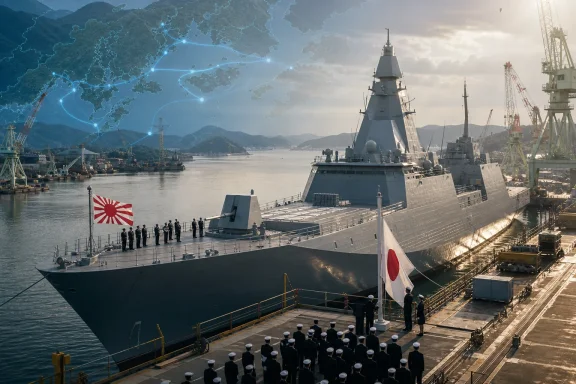 Japan’s Frigate Line Has Become a Strategic Signal
The commissioning of JS Nagara matters because it is not an isolated naval milestone. It is the 10th hull in a 12-ship class that began construction in 2019 and has since moved from experimental promise to production rhythm. In a region where naval power is measured not only in exquisite destroyers but in how many hulls can be built, crewed, upgraded, and kept at sea, that rhythm is the message.Japan has long operated sophisticated destroyers, Aegis ships, submarines, and maritime patrol aircraft. What the Mogami class adds is a different kind of capability: a smaller, more automated, multi-role combatant that can take on patrol, mine warfare, anti-submarine, surface warfare, and local defense missions without consuming the manpower of a larger destroyer. For an island nation facing a shrinking workforce and expanding maritime obligations, that is not a design flourish. It is the central bargain.
Nagara’s arrival also underlines a quiet shift in Japanese defense planning. Tokyo is no longer content to buy limited numbers of high-end platforms and assume peacetime availability will carry the burden. The modern JMSDF needs distributed capacity: ships that can be built fast enough to matter, deployed widely enough to complicate an adversary’s planning, and upgraded over time as missile inventories and combat systems mature.
That is why a 133-meter frigate with a crew of roughly 90 people deserves more attention than its tonnage might suggest. The Mogami class is Japan’s bet that automation and modularity can help square a hard triangle: more missions, fewer sailors, and less time.
Nagara Arrives as the Class Stops Being a Prototype Story
The most important thing about the 10th Mogami-class frigate is that it is the 10th. Early ships in a new class invite scrutiny over design choices, teething problems, delayed systems, and the inevitable compromises that happen when naval ambition meets industrial reality. By the time a class reaches double digits, the story changes. The question is no longer whether the concept works on paper, but whether the production system can sustain it.Nagara was laid down on July 6, 2023, launched on December 19, 2024, and commissioned on June 29, 2026. That is roughly a three-year construction cycle from keel-laying to active service, a pace many Western navies would envy for a modern surface combatant. The program’s use of simultaneous hull construction has helped Mitsubishi Heavy Industries keep output moving, even as earlier ships encountered delays and supply chain complications.
The ship will join the 2nd Patrol Division at Kure, one of Japan’s most important naval bases and a location with deep historical and operational significance. Kure’s geography matters: it sits on the Seto Inland Sea, with access to Japan’s southwestern approaches and the broader maritime lanes that tie the home islands to the East China Sea and Western Pacific. A frigate based there is not merely filling out an organizational chart.
Nagara’s commissioning also comes after JS Natori, the ninth ship, entered service in May 2026. The spacing between those handovers reinforces the impression that Japan’s frigate pipeline has moved past the unevenness typical of early production. The last of the original 12, JS Yoshii, has already been launched, which means the baseline Mogami program is approaching completion even as Japan moves toward upgraded follow-on designs.
This is how a navy changes its posture without a single dramatic announcement. One ship arrives, then another, then another. Eventually, what looked like incremental procurement becomes a new operating reality.
The 90-Sailor Warship Is Japan’s Answer to a Demographic Problem
The Mogami class is often described as highly automated, and that phrase can sound like brochure language until placed against Japan’s demographic and defense realities. Japan does not have an unlimited pool of sailors. Its population is aging, recruitment is difficult, and the JMSDF must compete with civilian industry for technically skilled personnel.A crew of approximately 90 for a modern frigate is therefore a major design statement. Traditional surface combatants can require far larger crews, particularly when they carry complex combat systems, aviation facilities, and damage-control requirements. Reducing crew size is not simply about saving money on salaries. It affects training pipelines, endurance, habitability, personnel rotation, and the number of ships a navy can realistically operate.
Automation does not remove the need for sailors; it changes what those sailors must be able to do. Smaller crews mean each person carries more responsibility, cross-training becomes more important, and the ship’s systems must be more reliable because there are fewer hands available when things go wrong. The risk is that a lean crew can become a fragile crew under battle damage or prolonged high-tempo operations.
Japan appears to have accepted that tradeoff because the alternative is worse. A navy that designs every combatant around old manpower assumptions may end up with ships it cannot crew in sufficient numbers. The Mogami class reflects a more realistic view: the JMSDF needs ships that fit the human resources it actually has, not the navy it might have preferred in a different demographic era.
This is also where the class’s multi-mission nature becomes relevant. A smaller frigate that can conduct patrol, surveillance, mine countermeasures support, and anti-submarine tasks allows larger destroyers to focus on air defense, ballistic missile defense, and strike-related missions. In a crisis, that separation of labor becomes essential.
The Mk 41 Cells Are the Real Upgrade Story
Nagara’s most consequential feature may be one that earlier Mogami-class ships lacked when they first entered service: the Mk 41 Vertical Launching System. The VLS is not just another weapon mount. It is the difference between a ship that has limited point-defense and surface-strike options and one that can be integrated more fully into a missile-centric fleet architecture.Earlier Mogami-class ships were delivered without the Mk 41 installed, with retrofits planned afterward. That was never ideal. A vertical launch system is structurally and operationally central to a modern combatant’s flexibility, and sending ships to sea without it meant accepting a gap between hull delivery and full combat potential.
The reasons were familiar to anyone who has watched defense procurement since 2020: pandemic disruption, semiconductor shortages, constrained manufacturing capacity, and the fragility of specialized supply chains. Mitsubishi Heavy Industries manufactures the Mk 41 system under license in Japan, but domestic production does not magically eliminate bottlenecks. It merely moves some of the risk closer to home.
The Japanese Ministry of Defense’s order for 12 Mk 41 systems points to the intended end state. Newer ships can receive the launcher during construction, while earlier ships can be brought up to standard through retrofit. That makes Nagara part of a transition from “fitted for but not with” to “delivered with,” a small phrase that carries large operational consequences.
The Mk 41 also gives Japan future options. The exact loadout can vary by mission and by what missiles Japan chooses to integrate, but the system is widely used among allied navies and supports a range of air-defense, anti-submarine, and strike weapons depending on configuration. For the JMSDF, the value is not merely what Nagara carries on day one. It is what the ship can plausibly carry over a service life measured in decades.
Production Tempo Is Becoming a Form of Deterrence
Modern naval deterrence is often discussed in terms of missile ranges, radar performance, and exquisite combat systems. Those matter, but they can obscure a more basic question: can a country build enough ships quickly enough to replace losses, cover sea lanes, and sustain presence across multiple theaters? Japan’s Mogami program is notable because it offers a credible answer.Mitsubishi Heavy Industries’ ability to construct two hulls simultaneously helped the program move quickly after early delays. The first two ships, Mogami and Kumano, were laid down on consecutive days in October 2019. Kumano launched first in November 2020, while the lead ship Mogami followed in March 2021 after a delay tied to damage involving a Rolls-Royce MT30 gas turbine during bench testing.
That early disruption could have defined the program. Instead, the following ships proceeded with fewer visible interruptions, and the class became one of the largest Japanese naval shipbuilding series since the end of World War II. That fact carries political weight as well as industrial meaning. Postwar Japan has historically framed its naval expansion carefully, but the scale of this program reflects a more assertive understanding of maritime defense.
Production tempo is especially important because Japan’s threat environment is not theoretical. China’s naval expansion, North Korea’s missile development, and Russia’s continued Pacific presence all put pressure on Japanese planners. A navy cannot answer that environment with a handful of showpiece vessels alone. It needs repeatable platforms.
The Mogami class is not Japan’s most powerful surface combatant, and it is not meant to be. Its strategic value lies in being capable enough, numerous enough, and producible enough to change the fleet’s day-to-day geometry. That is a different kind of deterrence: not a single overwhelming punch, but the steady accumulation of credible, deployable hulls.
The Frigate Is Smaller Than the Strategic Job It Has Been Given
At 133 meters long and 16.3 meters wide, Nagara sits in the modern middleweight category: larger and more capable than a patrol vessel, smaller than a full-size air-defense destroyer, and designed to take on a broad mix of missions. That middle space is becoming crowded across allied navies because the demand for ships has outgrown the supply of high-end combatants.The United States has wrestled for years with the consequences of getting this balance wrong, from the troubled Littoral Combat Ship program to the delayed promise of the Constellation-class frigate. European navies have their own debates over general-purpose frigates, air-defense destroyers, and offshore patrol vessels. Japan’s Mogami program stands out because it has actually produced hulls at scale.
That does not mean the ship is perfect. A 16-cell VLS on the baseline Mogami is modest compared with larger destroyers or upgraded follow-on frigates expected to carry more cells. The smaller crew may create resilience questions under combat damage. The class’s exact air-defense role depends on sensors, missile integration, doctrine, and how the ships operate with larger JMSDF and allied assets.
But those caveats should not obscure the point. The Mogami class is not trying to be an Aegis destroyer in miniature. It is trying to be a flexible, lower-crewed, lower-signature platform that can take on missions that would otherwise consume scarce destroyer capacity. In that role, a good-enough frigate available in numbers may be more valuable than a perfect ship that arrives too late.
Nagara’s commissioning also reinforces Japan’s preference for evolutionary capability. The class began with gaps, most visibly the delayed VLS installation, but the program did not stall while waiting for the ideal configuration. Japan built the hulls, learned from the early ships, and is now folding improved systems into later vessels and planned retrofits.
The Mogami Class Is Also an Export Argument
Japan’s postwar defense industry has historically been constrained by policy, cost, and limited export experience. The Mogami family is changing that. Australia’s selection of an upgraded Mogami-class design for its future general-purpose frigate program turned a domestic Japanese shipbuilding project into an international credibility test.That matters because warship exports are not merely commercial. They create long-term relationships around training, maintenance, weapons integration, software updates, and industrial cooperation. If Japan can prove that the Mogami lineage is buildable, modern, and adaptable, it gains influence in a market where allied navies are urgently looking for ships that can be delivered before the strategic environment worsens further.
The Australian connection also reframes the baseline Mogami class. Nagara is not the export variant, and the upgraded design is expected to carry more missile cells and other changes. But the credibility of the upgraded ship depends partly on the performance of the original production line. Every Japanese commissioning ceremony becomes a data point for foreign customers watching whether MHI can deliver.
This is one reason the speed of Nagara’s construction matters beyond the JMSDF. Naval procurement programs often collapse under the weight of bespoke requirements, shifting budgets, and industrial bottlenecks. A shipyard that can demonstrate serial production of a modern frigate has something rare to sell: not just a design, but confidence.
Japan’s challenge will be sustaining that confidence as the design evolves. Export customers will want local industry participation, customized weapons, and integration with their own combat systems. Those demands can erode the simplicity that made a production line attractive in the first place. The Mogami story is therefore entering a harder phase, where success abroad depends on preserving the discipline that made the domestic program work.
Kure Gains a Ship Built for the Gray Zone
Nagara’s assignment to the 2nd Patrol Division at Kure places the ship within the operational reality that defines much of Japan’s maritime security: not open war, but constant pressure. The East China Sea, the waters around the Ryukyu Islands, and the approaches to Japan’s main islands are arenas of surveillance, shadowing, presence operations, and political signaling. A frigate suited to patrol and multi-role missions is built for that gray zone.Gray-zone operations are exhausting by design. They force defenders to respond repeatedly without crossing the threshold into armed conflict. They consume readiness, fuel, maintenance hours, and crew time. A navy that relies only on its highest-end destroyers for such work risks wearing out the very assets it needs for the most dangerous scenarios.
The Mogami class provides a more sustainable tool. Its stealth shaping, sensors, aviation capability, and multi-role systems allow it to perform useful work without being overqualified for every mission. It can show the flag, monitor activity, support mine warfare, and contribute to anti-submarine operations, all while leaving more specialized ships available for tasks that require their full capabilities.
Kure is also a reminder that Japan’s naval problem is geographically complex. The JMSDF must think about the Sea of Japan, the Pacific approaches, the East China Sea, and the sea lanes that connect Japan to energy and trade. A distributed fleet of frigates helps cover that map. No single ship changes the balance, but the 10th ship in a class begins to change the pattern of coverage.
Nagara’s arrival should therefore be read less as a ceremonial endpoint and more as a deployment enabler. The ship gives commanders another hull to assign, another sensor platform to position, and another missile-capable combatant to integrate into fleet planning.
Japan Is Learning to Modernize Before the Shipyard Cools
One of the more interesting features of the Mogami program is that modernization is already baked into the story before the original 12-ship run is complete. The VLS retrofit issue is the clearest example, but it is not the only one. The upgraded Mogami design suggests Japan is already moving from first-generation production lessons to a more heavily armed successor.That is a healthy sign, provided the navy manages the transition carefully. Warship classes often suffer when navies either freeze a design too long or revise it so aggressively that production continuity collapses. Japan appears to be trying a middle path: complete the original class, retrofit key missing capabilities, and then move to an improved variant rather than endlessly tinkering with the baseline hull.
The risk is fleet fragmentation. If early Mogami ships, later Mogami ships, retrofitted ships, and upgraded follow-on frigates all carry different systems, maintenance and training complexity can grow. That is manageable if the navy plans for it, but it cannot be ignored. Standardization is one of the hidden currencies of naval readiness.
The benefit is that Japan avoids waiting for a perfect ship while regional naval competition accelerates. The JMSDF gets usable hulls now and better-armed hulls later. In a less forgiving security environment, that is a rational trade.
Nagara sits at the hinge point of that strategy. It belongs to the original class, but it arrives as the class’s early omissions are being addressed and as the follow-on design is gaining momentum. In that sense, the ship is both a continuation and a transition marker.
The Lesson From Nagara Is That Japan Has Chosen Momentum
The commissioning of Nagara offers a compact view of where Japan’s naval modernization is headed. It is not just buying capability; it is building a cycle of production, deployment, retrofit, and redesign. That cycle may prove more important than any single sensor or weapon.- JS Nagara entered JMSDF service on June 29, 2026, as the 10th of 12 planned baseline Mogami-class frigates.
- The ship was built by Mitsubishi Heavy Industries in Nagasaki and will serve with the 2nd Patrol Division at Kure Naval Base.
- The Mogami class uses heavy automation to keep crew size to roughly 90 personnel, a design choice shaped by Japan’s manpower constraints.
- The installation of Mk 41 vertical launch systems on newer and retrofitted ships is turning the class into a more credible missile-capable platform.
- The program’s pace strengthens Japan’s industrial credibility at home and supports the export case for upgraded Mogami-derived frigates abroad.
- The class is best understood as a distributed fleet asset, not a replacement for Japan’s larger air-defense destroyers.
References
- Primary source: Militarnyi
Published: 2026-06-29T10:30:51.217210
Japan Commissions 10th Mogami-Class Frigate, JS Nagara
The Japan Maritime Self-Defense Force (JMSDF) has officially commissioned its 10th Mogami-class frigate, JS Nagara, into active service following a commissioning and flag-raising ceremony.The JMSDF announced the milestone in an […] militarnyi.com
- Related coverage: navyleaders.com
Japanese Navy Takes Delivery Of New Mogami-Class Frigate - Navy Leaders
Mitsubishi Heavy Industries (MHI) has handed over its latest Mogami-class frigate to the Japanese Maritime Self-Defense Force (JMSDF).navyleaders.com - Related coverage: congly.vn
Nhật Bản biên chế tàu hộ vệ lớp Mogami thứ 10
Nhật Bản vừa biên chế tàu hộ vệ JS Nagara, chiến hạm thứ 10 thuộc lớp Mogami, sau lễ thượng cờ tại nhà máy đóng tàu Mitsubishi Heavy Industries ở Nagasaki.congly.vn
- Related coverage: giaoducthoidai.vn
Nhật Bản đã đưa tàu khu trục lớp Mogami thứ 10 vào biên chế
Nhật Bản đã đưa tàu khu trục lớp Mogami thứ 10 vào biên chế, con tàu mới nhất mang tên JS Nagara.giaoducthoidai.vn
- Related coverage: navaltoday.com
Japan receives ninth Mogami-class frigate Natori - Naval Today
Japan has received frigate Natori from local shipbuilder Mitsubishi Heavy Industries (MHI), marking the delivery of the ninth vessel in the Japan Maritime Self-Defense Force’s (JMSDF) Mogami-class program.www.navaltoday.com - Related coverage: armyrecognition.com
Mogami-class
Mogami-class multi-mission stealth frigate Japan technical data fact sheet pictures video www.armyrecognition.com
- Related coverage: janes.com
Japan commissions sixth Mogami-class frigate
Japan has commissioned its sixth Mogami-class guided-missile frigate.www.janes.com
- Related coverage: thedefensenews.com
Japan Maritime Self-Defense Force Commissions Ninth Mogami-class Frigate JS Natori- The Defense News
NAGASAKI / ŌMINATO, Japan, — May 22, 2026 : The Japan Maritime Self-Defense Force (JMSDF) officially commissioned JS Natori (FFM-9), the ninth vessel of www.thedefensenews.com