

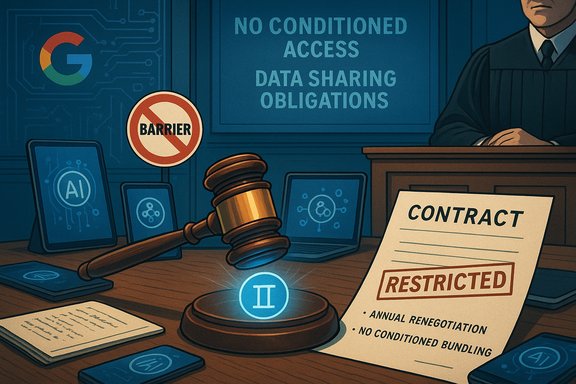
A federal judge has barred Google from forcing device makers and partners to distribute or bundle its Gemini generative-AI products as a condition of licensing other Google apps, a remedies decision that extends the court’s earlier finding that Google illegally maintained a search monopoly and that now explicitly prevents Google from using the same playbook to cement dominance in generative AI.
Background
The antitrust litigation that produced this remedies order began with a DOJ-led suit accusing Google of using exclusive distribution deals and massive default payments to lock in its dominance of search. In August 2024, U.S. District Judge Amit P. Mehta found Google had unlawfully maintained monopoly power in search through those arrangements; the remedies phase that followed considered how to prevent recurrence without causing undue disruption across the broader internet ecosystem. Judge Mehta’s final remedies ruling — which avoids the most extreme structural remedies such as forcing Google to divest Chrome or Android, but tightly restricts exclusive distribution practices — explicitly addresses generative AI. The judge concluded Google “cannot be permitted to replay its illegal conduct with its GenAI products,” and barred conditioning access to Google Maps, YouTube, the Play Store or other apps on the distribution of Gemini. That prohibition is the focal point of the newest phase of the case.What the Ruling Actually Does
The core prohibitions (simple)
- No conditioned bundling: Google may not require partners to distribute Gemini or other Google generative-AI apps as a precondition to licensing other Google products (Search, Maps, YouTube, Play Store licensing, etc..
- No exclusivity for AI defaults: Contracts that prevent a partner from distributing rival AI assistants, browsers or search engines are barred. Google may still pay for placement, but those payments cannot create exclusivity or multi-year lock-ins.
- Annual renegotiation requirement: Default or placement agreements for search or generative-AI defaults must be renewable at most once per year and can be negotiated on a device-by-device, access-point-by-access-point basis.
What the court leaves intact (and why it matters)
- No forced divestiture of Chrome or Android: The court declined to require Google to sell Chrome or Android, reasoning that divestiture would be disruptive and exceed the case’s focus on search distribution. That preserves Google’s integrated product architecture while imposing behavioral limits on exclusivity and data practices.
- Payments permitted, with limits: Google can continue to compensate partners for placement but cannot structure revenue-sharing, bonuses, or multi-product incentives to effectively lock partners into exclusive arrangements. The judge underscored that payments alone are not the core harm — it is the conditioning of other services on exclusivity that replicates the illegal conduct found earlier.
Why the Judge Targeted AI Bundling
Judge Mehta’s remedies reflect a broader legal and practical insight: distribution channels matter enormously in software and platforms. In the search era, Google used exclusive default deals to keep rivals out of the discovery pathway; in the AI era, distribution of assistants and embedded models through smartphones, browsers and OS hooks can act as the modern equivalent of “default placement.” The remedies aim to prevent a near-term consolidation of power while giving market competition time to play out among generative-AI providers. This is not a theoretical concern. During the trial, evidence showed Google negotiated large payments to partners like Apple and Samsung to secure default positions for search and, later, to place Gemini as a preinstalled assistant on flagship devices. Courts and regulators fear a repeat of that pattern: if a dominant search firm can compel wide preinstallation of its AI assistant, it could quickly capture usage signals, eyeballs and enterprise customers in a way that becomes self-reinforcing. The remedies are designed to interrupt that feedback loop.How This Changes the Competitive Landscape
For Google: constraints that force strategic pivots
- Slower distribution-led scale: Without the ability to condition access to Maps, YouTube, Play or search on Gemini distribution, Google loses a shortcut to broad, preinstalled reach. Device partners can still preinstall or promote Gemini, but they must be free to offer alternatives. That increases the friction to capturing native device usage.
- More incentives to invest product-side: Analysts expect Google to redirect funds that previously underwrote exclusivity into product improvement, cloud infrastructure and developer tooling for Gemini and Vertex AI. That’s a permitted commercial response: win users through product and pricing rather than contractual leverage.
- Regulatory overhead and compliance costs: The remedies create a compliance regime — including a special technical committee and data-sharing obligations — that will increase operational complexity and monitoring costs for Google for the remedies’ duration.
For device makers and platforms (Apple, Samsung, others)
- Greater negotiating freedom: Apple, Samsung and other OEMs can now integrate or promote non-Google AI solutions without risking breach of a conditioned agreement tied to other Google services. The ruling gives them leverage to pursue multiple AI suppliers.
- Commercial options open for rivals: With exclusivity off the table, OEMs can test or run multiple assistants — for example, Apple could continue to explore third-party models or host a custom Gemini instance without making Google the only pipeline. That creates openings for competitors like OpenAI, Anthropic, Microsoft, and others.
For AI competitors and enterprise customers
- Lower distribution barrier: The court order increases the odds that alternative AI products can negotiate placements with OEMs or browsers. That can accelerate competition in model quality and pricing.
- Incentive to focus on integration and partnerships: Rivals will emphasize compelling device-tailored integrations, privacy posture and cost-effectiveness to win placements on merit, not contractual advantage.
The Apple Angle: A Reported Billion-Dollar Quiet Deal
Multiple outlets report Apple negotiated a near-$1 billion per year arrangement to license a custom Gemini variant to power next-generation Siri summarization and planning functions — with the model running on Apple’s Private Cloud Compute (PCC) so Apple retains control over customer data. Reporting indicates Apple evaluated multiple vendors (Anthropic, OpenAI, Google) and chose a bespoke Gemini variant for pragmatic reasons, while still intending to continue building its own models long-term. Important caveats: the dollar figure and contract terms have not been disclosed by the companies; major outlets cite unnamed sources. Treat the $1 billion number as a reported industry estimate rather than a public, audited contractual disclosure. Independent reporting does, however, converge on the same structural facts: Apple is pursuing external AI horsepower for some Siri components, and a Google-supplied, Apple-hosted Gemini variant is the widely reported frontrunner.Legal and Regulatory Significance
A new template for nascent technology markets
Judge Mehta’s order is noteworthy because it applies antitrust remedies not just to the historical misconduct (search defaults) but proactively to prevent similar conduct in an emerging market (generative AI). That sets a precedent: courts can and will extend behavioral remedies to new technology domains where distribution control can entrench market power quickly.Data-sharing and technical oversight
The remedies also require Google to make portions of its search index and certain user-interaction signals available to “qualified competitors” and to allow annual renegotiation of placement deals. These obligations are designed to lower the barrier for rivals to produce high-quality results and to avoid long-run lock-in. Expect operational complexity as Google and rivals implement practical APIs, access controls and privacy safeguards under court supervision.Global regulatory echoes
The U.S. ruling will be watched by regulators in Europe and Asia considering how to police AI-era tying and bundling. The European Digital Markets Act and other local frameworks already target self-preferencing; this decision reinforces the international trend toward preventing platform owners from using distribution levers to advantage their own AI services.Strategic Responses: What Each Player Is Likely to Do
Google — three pragmatic pivots
- Invest in product differentiation: Prioritize Gemini quality, latency, multimodality and integration with Workspace and cloud services to attract users organically.
- Revise commercial deals: Shift from long-term exclusivity payments to shorter, non-exclusive placement agreements and explore volume-based or performance-oriented compensation that complies with the one-year renewal rule.
- Defend and appeal selectively: Expect Google to continue appealing parts of the decision while complying with the immediate behavioral orders; litigation and regulatory negotiation will persist.
Apple
- Leverage control, not coercion: Apple can host a custom Gemini variant under PCC and still remain free to negotiate with other model vendors or to expand its own models. The ruling preserves Apple’s commercial freedom to choose.
- Prioritize privacy optics: If Apple adopts a third-party model, it will emphasize the PCC architecture and non-training guarantees to maintain its privacy brand advantage. Independent audits and clear consumer disclosures will be central to public acceptance.
Samsung and other OEMs
- Test multi-vendor strategies: Samsung can negotiate with Google, Microsoft, Meta and other AI providers without being locked into an exclusive bundle; expect device makers to experiment with multiple assistants and white-label integrations.
Competitors (OpenAI, Anthropic, Microsoft, Meta)
- Double down on device and enterprise partnerships: With exclusivity limited, rivals have renewed windows to secure placements and enterprise contracts that feed usage and training signals. They will emphasize pricing, latency, safety and enterprise controls.
Practical Risks and Uncertainties
- Enforcement friction: Behavioral remedies require active enforcement. Measuring whether a contract effectively conditions distribution or merely compensates for placement can be legally subtle, opening room for dispute and litigation.
- Data privacy trade-offs: Requirements that Google share certain search data with rivals raise real privacy and security concerns; regulators and Google itself have signaled worries about user privacy and the mechanics of safe data-sharing. The court limited but did not eliminate data-sharing obligations; the details will shape the scope of competitor gains.
- Market consolidation via other channels: If distribution channels are closed, dominant firms may pursue alternative leverage — for example, exclusive cloud contracts, proprietary developer tooling, or content partnerships — that can have similar exclusionary effects. Regulators will need to remain vigilant across multiple vectors.
- Unverifiable reporting: Several high-profile commercial figures reported in the press (notably the ~$1 billion Apple–Google figure) are based on anonymous sources and have not been confirmed by contract filings. Those numbers are useful for market context but should be labeled as reported estimates.
What This Means for Consumers and IT Professionals
- Consumers: Expect broader choice in assistants and a greater chance that device makers will offer multiple AI defaults. That should yield more innovation and potentially faster improvements in assistant quality. However, features that depend on cloud-scale inference may remain gated behind subscriptions or vendor-specific pricing.
- IT professionals and procurement teams: Negotiate explicit terms for model usage, data residency, non-training guarantees and audit rights when contracting for AI services. Prepare for annual renegotiations in device-level default arrangements and evaluate multi-vendor strategies to reduce operational risk.
Longer-Term Implications: Antitrust Meets AI
This ruling is an early indicator of how courts will treat platform power in the AI era. It blends traditional antitrust reasoning about distribution and exclusivity with an appreciation of how rapidly AI can shift market dynamics. By prohibiting conditioned bundling for generative AI, the court aims to preserve an open competitive field at a pivotal point in the technology’s adoption curve.Two structural outcomes are possible over the next several years:
- Competition wins by product: Rivals use open placement opportunities and data-sharing improvements to build competitive AI offerings; consumers benefit from diverse, choice-driven innovation.
- Dominance shifts form: If the dominant firms pivot successfully to alternative exclusionary levers (cloud lock-in, content deals, developer platform control), competitive pressures will re-emerge on new fronts — and regulators will have to adapt.
Conclusion
Judge Mehta’s decision to bar forced Gemini bundling is a decisive application of antitrust remedies to a nascent technology: it prevents an immediate replication of search-era lock-in tactics while preserving core commercial structures. The ruling forces Google to compete for AI adoption on product merit and cloud performance rather than through conditioned commercial power, and it hands device makers and rival AI providers room to negotiate and innovate.The practical upshot for the industry is twofold. First, expect a scramble to convert freed-up capital and distribution energy into product upgrades, bespoke partner models and developer tooling. Second, expect continued legal and regulatory tension: firms will test the line between permissible placement payments and prohibited conditioning, and regulators will watch to ensure the remedies produce the intended competitive effects. For consumers and enterprises, the ruling should translate into more choices — but not instant parity — as the market reconfigures around product quality, privacy assurances and flexible commercial terms.
Source: WebProNews Judge Blocks Google’s Forced Gemini AI Bundles in Antitrust Case
