

X Corp’s bid to curtail the Indian government’s power to issue content-blocking orders was turned back by the Karnataka High Court, a decision that sharpens the legal obligations for social platforms and crystallises a fraught tension between platform liability, government oversight, and free-expression protections in India. The court refused to grant the declaratory and interim relief X sought against the use of Section 79(3)(b) of the Information Technology Act and the government's Sahyog portal, signalling that India’s regulatory posture favors broad takedown powers for authorities where they are claimed to be necessary for public order and protection of vulnerable groups.
Strengths:
Strengths:
Operationally, platforms must double down on provenance, logging, and human review to navigate the evolving legal landscape. At the same time, governments should consider reforms that formalise officer authorisations, provide public reporting, and create independent review mechanisms. Without such calibration, the current mix of administrative speed and limited procedural visibility risks leaving both free expression and platform accountability poorer for it.
This dispute will almost certainly continue — likely to India’s highest court — and its outcome will shape how platforms, users, and regulators interact in one of the world’s largest digital markets.
Source: Storyboard18 X Corp challenges govt’s content blocking power in Karnataka High Court
 Background
What X challenged, in plain terms
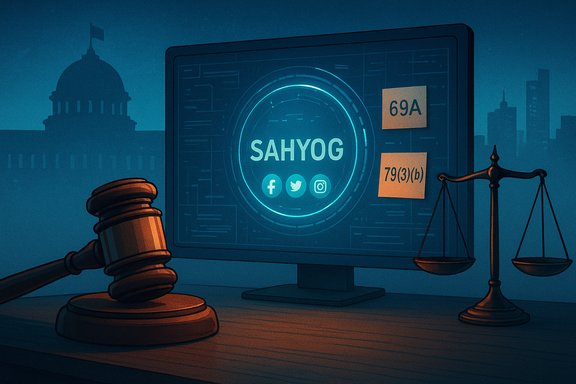
X Corp (formerly Twitter) filed a petition in the Karnataka High Court arguing that the statutory scheme for blocking access to online content is codified in Section 69A of the Information Technology Act, 2000 and the Blocking Rules of 2009 — a process that includes defined procedures and committee-based oversight. X’s lawyers contended that Section 79(3)(b) — a provision that affects intermediary safe‑harbour — does not itself authorise government officers to issue blocking orders. The company argued that the widespread use of Section 79 notices, and the Sahyog portal set up by ministries, created an ad hoc parallel mechanism that permits individual officers to demand content removals without the safeguards Section 69A prescribes.What the government said
The Union government replied that X’s framing was misconceived: blocking powers and the duties on intermediaries arise across the IT Act’s scheme, and the issuance of notices or directions under Section 79(3)(b) read with rules and notifications falls squarely within the legislative regime that limits intermediary immunity where they fail to comply. Government counsel described the Sahyog portal as an operational tool for agencies — a channel for identifying potentially unlawful content and ensuring quick action to protect public order and other state interests. The government argued platforms must be bound by Indian law and cannot treat the Sahyog portal as a form of censorship outside statutory competence.The court’s disposition
The Karnataka High Court declined to restrain the government from issuing such orders and rejected the petition’s claim for a declaration excluding Section 79(3)(b) from content-blocking powers. In its reasoning, the court emphasised that social media platforms cannot operate in a legal vacuum: freedom of expression coexists with regulatory obligations, particularly when authorities assert the need to protect dignity, public order, or offences against women. The bench thus signalled deference to the government’s position on why swift takedowns may be required in certain cases.Overview: Law, portals and process — Section 69A vs Section 79(3)(b)
Section 69A — the formal blocking route
Section 69A of the IT Act establishes a structured process for blocking access to information in the interest of sovereignty, security, public order, and similar grounds. The Blocking Rules (2009) set out procedures including reasons in writing and a committee-based review mechanism designed to provide a measure of institutional oversight before content is blocked at scale.Section 79(3)(b) — intermediary safe‑harbour and notices
Section 79 is the cornerstone of intermediary immunity: intermediaries are sheltered from third‑party content liability if they follow due care and act on lawful government orders or court directions. Subsection (3)(b) can, effectively, remove safe-harbour protection if an intermediary fails to take down content after a government order or a complaint pointing to unlawful material. X’s central legal complaint was that the practical effect of drafting and administrative practice has allowed a parallel takedown path under Section 79(3)(b) that bypasses the procedural safeguards of Section 69A.The Sahyog portal
The Sahyog portal — created by Indian authorities to coordinate takedown requests from different agencies and officers — sits at the heart of the dispute. X argued the portal operationalises a system whereby numerous government officers can trigger takedown directions, creating what the company described in court filings as a “censorship portal” lacking the checks Section 69A requires. Authorities and some courts, however, have characterised the portal as an administrative mechanism to expedite legitimate law‑enforcement reporting and protective action in sensitive cases. Coverage and filings show both sides pitched strongly on the portal’s function and legal effect.What the court’s ruling means — immediate practical consequences
- Compliance pressure on platforms: Companies operating in India must treat takedown notices and ministerial directives seriously. The decision underscores the operational reality that Indian authorities expect rapid action from intermediaries and that legal challenges to administrative tools like Sahyog will be difficult to win at the High Court stage.
- Risk of coercive action: X sought restraint against coercive steps to enforce takedown orders; the court refused. Platforms remain exposed to enforcement actions for non‑compliance — a significant operational and legal risk in a market of India’s scale.
- Appeals and further litigation likely: Reporting shows X may appeal to India’s Supreme Court; litigation is expected to continue because the constitutional free expression questions and statutory-interpretation issues remain live. A higher court will have the final word on whether the scheme as practised is constitutional and consistent with legislative text.
Legal analysis — strengths and weaknesses of both sides
X’s arguments — credible but burdened by facts and public policy
X’s core legal claim — that Section 69A is the exclusive route for blocking content and that Section 79 cannot be used by thousands of officers to issue takedown orders — is a principled statutory interpretation argument. It raises important constitutional questions about prior restraint and administrative overreach, and it highlights the need for clear procedural safeguards when speech is removed.Strengths:
- Focuses on due process: X’s argument presses for a predictable, committee-based decision-making process rather than scattered, officer-by-officer judgments.
- Highlights scale and automation risks: The Sahyog portal, by empowering many officials, raises concerns about arbitrary or inconsistent removal requests and a chilling effect on speech.
- Public-interest counterweight: Courts have repeatedly emphasised that the right to free speech is not absolute and may be curtailed for compelling state interests like public order and the protection of vulnerable groups.
- Deference to operational governance: In scenarios involving offences against women or incitement to violence, courts and governments tend to prioritise fast intervention over prolonged procedural formality.
Government’s position — broad, pragmatic, politically supportable
The Union’s posture — that the broader IT Act framework authorises administrative mechanisms to prompt quick takedowns and that platforms must obey Indian law — aligns with a long-running global trend of governments asserting direct powers to regulate online content.Strengths:
- Protects state capacity to act quickly where harm is claimed.
- Courts are sensitive to the practicalities of enforcement in an environment where delay can mean real-world harm.
- The approach risks inconsistent decisions, lack of transparency, and the perception of overreach.
- Without clear, enforceable safeguards (appeal pathways, audit trails, public reporting), the system can be weaponised for political or reputational ends.
Broader context: Why the dispute matters beyond X
This case is not an isolated administrative squabble. It sits at the intersection of several systemic trends:- Governments worldwide are sharpening their tools to demand rapid takedowns and impose duties on platforms — from notice-and-takedown regimes to criminal sanctions for non‑compliance.
- Platforms face an increasingly fractured global compliance landscape: the cost of non‑compliance (reputational damage, criminal liability, market exclusion) is rising.
- The architecture of content moderation is shifting from internal policy to statutory duty, increasing the need for predictable legal frameworks and auditable processes. Industry litigation about takedowns and training data has repeatedly shown that the lack of provenance and procedural clarity invites conflict.
The policy tradeoffs: safety, due process, and transparency
Public safety vs. speech certainty
Regulatory actors argue that allowing more officers or agencies to flag and remove content is necessary to respond swiftly to hate speech, sexual offences, or content that threatens communal harmony. The counterargument is that speed without safeguards undermines accountability and can chill legitimate expression.Institutional safeguards that matter
If policymakers insist on operational channels like Sahyog, the following safeguards would materially reduce overreach risk:- Recordkeeping & auditability: Every takedown request should include a written rationale, timestamps, and a clear chain of authority. Logs should be auditable by an independent body.
- Transparent appeal process: Platform users must have access to rapid, independent appeal routes reviewed by judicial or quasi‑judicial authorities.
- Role‑based authorisation: Only officers above a certain delegated grade with documented legal authority should be able to trigger content-blocking notices.
- Public reporting: Aggregate takedown data (number of requests, categories, reversal rates) should be published periodically to enable public scrutiny.
Practical steps for platforms and IT teams (actionable checklist)
For technology and compliance teams operating in India or advising platforms, immediate steps to manage operational and legal risk include:- Strengthen legal intake and logging: Implement a dedicated takedown compliance engine that timestamps, stores provenance, and links each request to statutory authority and the officer’s credentials.
- Enforce role-based validation: Require documentation for each request and conduct automated vetting to ensure only authorised officials’ notices are actioned without higher-level review.
- Maintain appeal workflows: Provide end-users clear notice and expedited appeal channels; ensure appeals are escalated to human reviewers before permanent removal where feasible.
- Retain forensic records: Preserve content snapshots and decision records in immutable storage for potential judicial review or discovery.
- Negotiate governance arrangements: Where possible, seek contractual or policy accommodations with governments — e.g., clarifying what constitutes a lawful request, SLAs, and liability allocation.
- Engage in public transparency: Publish a regular report on government requests, compliance rates, and the portal’s functioning to reduce reputational risk.
Political and business implications
- Market access and strategic risk: India is a major strategic market for global platforms. A legal environment perceived as hostile to platform autonomy forces companies to choose between compliance and costly litigation or reduced service availability.
- Investment and innovation: Uncertainty over core operational duties (e.g., takedown compliance, user data handling) raises costs for product launches and regional investments.
- Public trust vs. regulatory compliance: Platforms that adopt a cooperative posture (transparent compliance, public reporting) may reduce friction but risk being seen as collaborators in censorship if safeguards are weak.
What to watch next
- Supreme Court appeal: X has indicated the possibility of appealing to the Supreme Court; a higher‑court ruling could set binding precedent on the interplay between Sections 69A and 79(3)(b) and the constitutional limits on administrative takedown schemes.
- Parliamentary or rule changes: Legislatures may respond to litigation and operational critiques by refining the statutory framework — clarifying delegation, authorisation, and oversight mechanisms.
- Operational tweaks to Sahyog: Governments may adjust portal governance (adding audit trails, officer vetting) either in response to litigation or as a policy concession to platforms and civil‑society concerns.
Critical assessment — strengths and risks of the court’s outcome
Notable strengths
- The judgment reinforces state capacity to act quickly in the face of tweets or posts that, authorities claim, threaten public safety or dignity.
- It sends a clear message that platforms cannot treat India as a jurisdiction of convenience — they must comply with local law or litigate at the risk of adverse outcomes.
Material risks
- The ruling risks normalising a takedown ecosystem where scale (many officers issuing notices) can outpace process (judicial or committee review), leading to inconsistent removals and potential misuse.
- Lack of transparent metrics and appeal options may produce a chilling effect, especially for journalists, activists, and marginalised voices.
- Platforms may adopt pre-emptive, overbroad moderation to avoid liability, diminishing the diversity of public discourse online.
Conclusion
The Karnataka High Court’s refusal to bar government use of Section 79(3)(b) avenues and its tacit endorsement of tools like the Sahyog portal mark a consequential moment in India’s digital governance. For platforms, the ruling crystallises a compliance-first reality: statutory duties and the state’s interest in rapid enforcement will shape product behaviour and legal strategy in India. For policymakers and civil society, the decision amplifies an urgent policy task — to embed transparent, auditable safeguards and robust appeal routes into operational takedown systems so the state’s legitimate interest in preventing harm does not come at the cost of arbitrary or opaque censorship.Operationally, platforms must double down on provenance, logging, and human review to navigate the evolving legal landscape. At the same time, governments should consider reforms that formalise officer authorisations, provide public reporting, and create independent review mechanisms. Without such calibration, the current mix of administrative speed and limited procedural visibility risks leaving both free expression and platform accountability poorer for it.
This dispute will almost certainly continue — likely to India’s highest court — and its outcome will shape how platforms, users, and regulators interact in one of the world’s largest digital markets.
Source: Storyboard18 X Corp challenges govt’s content blocking power in Karnataka High Court


