

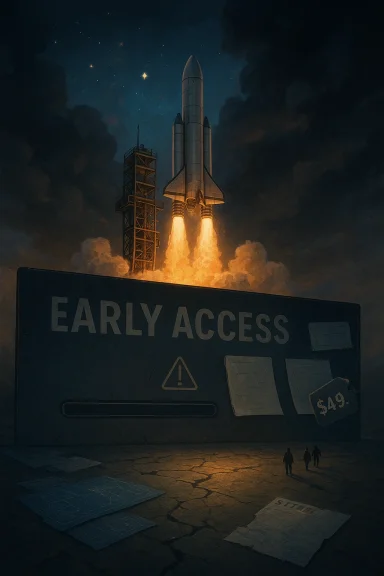
Kerbal Space Program 2 remains a cautionary tale about the gap between marketing ambition and actual game development. What began as a high-profile sequel to one of PC gaming’s most beloved physics sandboxes launched into Early Access in February 2023 at $49.99, but the project has since become defined less by exploration than by silence, restructuring, and broken expectations. Steam’s own Early Access rules make clear that the label is meant to communicate active development and ongoing feedback, not a substitute for shipping a finished product or a placeholder for indefinite limbo.
The story of Kerbal Space Program 2 is not just about one troubled sequel. It is about how a publisher-managed restart, a pandemic-disrupted production cycle, and an overly ambitious feature set collided with the realities of modern game development. The original KSP earned a reputation for emergent storytelling, engineering creativity, and a passionate modding community, which meant the sequel arrived under unusually intense scrutiny. When a game inherits that kind of legacy, it is judged not only on what it does well, but on whether it preserves the spirit that made the original matter in the first place.
Take-Two and Private Division publicly framed the sequel as an expansion of that legacy, promising more parts, more systems, interstellar travel, colonies, multiplayer, and improved quality of life. That pitch mattered because it set expectations far beyond a small indie follow-up. By the time the game reached Early Access, the messaging implied a live roadmap and a development cadence that would let players watch the sequel grow over time. In theory, that is exactly what Early Access is for; in practice, it only works if the cadence actually exists.
Instead, the launch became synonymous with instability. The game arrived with performance issues, missing major promised features, and enough rough edges to turn the sequel into a warning sign rather than a celebration. Over time, the situation worsened as studio changes, including the closure of Intercept Games in 2024, raised obvious questions about who was actually steering the ship. By the time ownership moved again, the product had already accumulated a reputational deficit that no press release could easily erase.
The most frustrating part for players is that the current sales pitch has not meaningfully caught up with the reality of the game’s status. Steam still lists the title as Early Access and the store price remains $49.99, but the community has been left to infer what, if anything, remains in motion behind the scenes. In a healthy Early Access ecosystem, customers can see progress, even if it is slow. Here, the absence of visible movement is what fuels the suspicion that the label has become a shield rather than a promise.
The move created an organizational split that likely affected the sequel’s trajectory for years. Complex simulation games depend on systems that are tightly interdependent, which means even a small misunderstanding in one subsystem can ripple outward into physics, UI, progression, and performance. When you also factor in remote work disruption and staffing churn, the result is a project that can lose coherence long before it reaches the player.
What happened with KSP2 strained that model. The launch price was premium, the feature list was expansive, and the technical foundation was clearly immature. That does not automatically make a game a scam, but it does mean the burden of proof shifts heavily toward the publisher and studio. If you ask people to pay full launch-adjacent pricing for an unfinished game, the pace and transparency of development matter immensely.
The problem is that sequels to cult favorites often fail when they attempt to become everything at once. KSP2 was supposed to improve onboarding, add colonies, add interstellar travel, and modernize visuals without losing the sandbox’s soul. That is a huge ask for any studio; it becomes even harder when the codebase is inherited, the team is reshuffled, and the publisher’s commercial expectations remain high. Ambition is not the issue; unmanaged ambition is.
This matters because the label can otherwise become a permanent loophole. If a game can remain Early Access for years without visible progress, then the promise made at purchase time becomes more marketing language than a developmental status. That ambiguity is especially troubling for a premium-priced title because the buyer is paying for access to a moving target without any practical guarantee that the target is still being aimed at.
That does not mean every dormant Early Access title is unethical by default. Some small teams genuinely need long gaps between major patches. But a game with a major publisher, a premium price, and a franchise pedigree creates a different expectation. In that context, a two-year silence looks less like a normal development pause and more like a failure of stewardship. The optics are brutal because the facts are brutal.
That is why the debate around Steam’s policies extends beyond one game. If Early Access becomes a status that publishers can leave untouched while continuing to sell a title, then the category stops functioning as a meaningful signal. The risk is not just that one game disappoints buyers; it is that the entire storefront category loses informational value.
By the time Take-Two shut the studio down in 2024, the message to the market was unmistakable. When a parent company closes the team that is supposed to finish a game, the label “Early Access” starts to sound less like a production phase and more like a technicality. Players do not need inside information to understand what that implies.
That is where KSP2 became part of a larger industry trend. Publishers increasingly treat mid-tier and specialty labels as portfolio assets, not long-term brand commitments. If a project underperforms, it can be rehomed, written down, or orphaned. The result is a product that may still exist on store shelves even when the organization that conceived it has already moved on.
That is especially true when no visible development follows the transfer. Ownership change alone does not produce patches, features, or bug fixes. It just changes who gets blamed if nothing happens next, which is hardly the sort of reassurance players hoped for. A new mailbox is not the same thing as a new addressable team.
This is why “just fix the bugs” is such an unfair simplification. When the underlying architecture is not yet mature, bug fixing can become a temporary patch over a deeper structural problem. The game may look closer to completion after each visible fix, while the engineering debt underneath continues to grow.
That is why the early backlash was so severe. Fans were not merely complaining about cosmetic roughness. They were reacting to a release that seemed to fail at the foundational experience the sequel was supposed to protect. When the core loop feels compromised, the rest of the roadmap becomes harder to believe.
That matters because fans often assume legacy developers are a safety net. In a complex sequel, they are more like a diagnostic tool than a cure. They can identify what used to work, but they cannot conjure missing production bandwidth, restore lost schedule time, or reverse a mismanaged launch. Nostalgia is not a development strategy.
This kind of reaction is rarely just about one bad patch. It is about a perceived breach of social contract. Players expect Early Access to mean that they are participating in a collaborative process, not underwriting a project that may no longer have a meaningful path to completion.
That uncertainty creates a uniquely bad user experience because it forces customers to interpret absence. Is the project dormant, canceled, restructured, or quietly under new management? Each interpretation leads to a different consumer decision, but the store listing itself does not help answer the question. Ambiguity is the product here, and that is exactly why trust erodes.
It also feeds the perception that AAA-adjacent labels can misuse indie-style release models without adopting indie-style transparency. That perception may be unfair to some teams, but it becomes harder to dismiss when a premium-priced sequel sits untouched for long stretches while still being sold as a work in progress.
The strongest version of the complaint is that a game without visible development momentum should not keep the same status indefinitely. That does not necessarily require immediate delisting, but it does suggest a need for stricter review, clearer status labels, or mandatory disclosure about development inactivity. The marketplace needs a language for dormancy.
This is where KSP2 becomes a case study in storefront ethics. A store page is not just an advertisement; it is a disclosure document of sorts. If the disclosure no longer matches the product’s real-world status, the platform risks becoming complicit in confusion.
A stronger approach would not punish unfinished games that are genuinely being built. Instead, it would distinguish between active Early Access, paused Early Access, and effectively abandoned titles. That sort of clarity would help serious buyers and honest developers alike.
The broader industry should also learn from this episode. Early Access works when it is used as a transparent collaboration tool, not a permanent holding pattern. The label becomes meaningless if a premium game can continue to sell without meaningful updates or visible stewardship, because then the promise to players is no longer about development at all; it is about inertia.
Source: Windows Central Kerbal Space Program 2 is the scam that won't die
 Overview
The story of Kerbal Space Program 2 is not just about one troubled sequel. It is about how a publisher-managed restart, a pandemic-disrupted production cycle, and an overly ambitious feature set collided with the realities of modern game development. The original KSP earned a reputation for emergent storytelling, engineering creativity, and a passionate modding community, which meant the sequel arrived under unusually intense scrutiny. When a game inherits that kind of legacy, it is judged not only on what it does well, but on whether it preserves the spirit that made the original matter in the first place.Take-Two and Private Division publicly framed the sequel as an expansion of that legacy, promising more parts, more systems, interstellar travel, colonies, multiplayer, and improved quality of life. That pitch mattered because it set expectations far beyond a small indie follow-up. By the time the game reached Early Access, the messaging implied a live roadmap and a development cadence that would let players watch the sequel grow over time. In theory, that is exactly what Early Access is for; in practice, it only works if the cadence actually exists.
Instead, the launch became synonymous with instability. The game arrived with performance issues, missing major promised features, and enough rough edges to turn the sequel into a warning sign rather than a celebration. Over time, the situation worsened as studio changes, including the closure of Intercept Games in 2024, raised obvious questions about who was actually steering the ship. By the time ownership moved again, the product had already accumulated a reputational deficit that no press release could easily erase.
The most frustrating part for players is that the current sales pitch has not meaningfully caught up with the reality of the game’s status. Steam still lists the title as Early Access and the store price remains $49.99, but the community has been left to infer what, if anything, remains in motion behind the scenes. In a healthy Early Access ecosystem, customers can see progress, even if it is slow. Here, the absence of visible movement is what fuels the suspicion that the label has become a shield rather than a promise.
How Kerbal Space Program 2 Got Here
The sequel was first announced by Take-Two’s Private Division label as a modern continuation of the original spaceflight sim, with Early Access intended to help shape the game during development. The public story sounded straightforward: launch early, gather feedback, and build toward a more complete experience over time. That model can work, but only when the studio has a realistic technical plan and enough organizational stability to execute it.From Star Theory to Intercept Games
One of the less-discussed parts of the saga is how the project changed hands before release. Development began under Star Theory Games, then moved to Intercept Games after the relationship with the original studio broke down. That transition alone would have been risky, even before the turbulence of the pandemic, because restarting a complex simulation project means inheriting code, design assumptions, and institutional knowledge that are hard to recreate.The move created an organizational split that likely affected the sequel’s trajectory for years. Complex simulation games depend on systems that are tightly interdependent, which means even a small misunderstanding in one subsystem can ripple outward into physics, UI, progression, and performance. When you also factor in remote work disruption and staffing churn, the result is a project that can lose coherence long before it reaches the player.
Early Access Became a Public Contract
Steam’s Early Access documentation is especially relevant here because it explains the basic trust model. Valve says Early Access is meant to give customers context about a game’s current state and let them participate in finishing it; it also warns developers not to make specific promises about future events or use Early Access merely to fund development. That is a useful standard because it clarifies what players should reasonably expect: visible progress, honest scope, and no magical thinking.What happened with KSP2 strained that model. The launch price was premium, the feature list was expansive, and the technical foundation was clearly immature. That does not automatically make a game a scam, but it does mean the burden of proof shifts heavily toward the publisher and studio. If you ask people to pay full launch-adjacent pricing for an unfinished game, the pace and transparency of development matter immensely.
Why the Original Game Matters
The original Kerbal Space Program created unusually deep goodwill because it was both educational and comedic, both technically rich and wonderfully chaotic. The sequel had to match not only the mechanics but the emotional texture of that experience. That kind of legacy can become a trap: the audience wants the sequel to be bigger, prettier, and more ambitious, but it also wants the same playful clarity that made the first game approachable.The problem is that sequels to cult favorites often fail when they attempt to become everything at once. KSP2 was supposed to improve onboarding, add colonies, add interstellar travel, and modernize visuals without losing the sandbox’s soul. That is a huge ask for any studio; it becomes even harder when the codebase is inherited, the team is reshuffled, and the publisher’s commercial expectations remain high. Ambition is not the issue; unmanaged ambition is.
The Early Access Debate
The strongest criticism aimed at KSP2 now is not simply that it launched unfinished. Plenty of Early Access games do. The real criticism is that the title appears to have moved from “unfinished but evolving” into “unfinished and functionally abandoned,” while still being sold under a label that implies active participation in development. That is where trust begins to break down.What Steam’s Rules Actually Say
Valve’s documentation is not ambiguous about the purpose of Early Access. It says developers should include current-state information, should not use the program solely to fund development, and should avoid promising specific future milestones with certainty. Those are not just administrative rules; they are a consumer-protection framework for a category of product that has no fixed finish line.This matters because the label can otherwise become a permanent loophole. If a game can remain Early Access for years without visible progress, then the promise made at purchase time becomes more marketing language than a developmental status. That ambiguity is especially troubling for a premium-priced title because the buyer is paying for access to a moving target without any practical guarantee that the target is still being aimed at.
The Price Makes the Silence Worse
At $49.99, KSP2 is not a cheap curiosity. That price places it in direct competition with finished premium games, not bargain-bin experiments, so the tolerance for prolonged inactivity is much lower. Consumers can forgive rough edges if they can see consistent improvement, but they become far less forgiving when updates stop and the store page keeps taking money anyway.That does not mean every dormant Early Access title is unethical by default. Some small teams genuinely need long gaps between major patches. But a game with a major publisher, a premium price, and a franchise pedigree creates a different expectation. In that context, a two-year silence looks less like a normal development pause and more like a failure of stewardship. The optics are brutal because the facts are brutal.
Consumer Trust Is the Real Asset
The hardest thing to rebuild after this kind of episode is not code. It is trust. Players can accept delays, feature cuts, and re-scoped roadmaps if they believe someone is still driving. Once they conclude that development has evaporated, every remaining sale becomes suspect, and every promise looks retroactively cynical.That is why the debate around Steam’s policies extends beyond one game. If Early Access becomes a status that publishers can leave untouched while continuing to sell a title, then the category stops functioning as a meaningful signal. The risk is not just that one game disappoints buyers; it is that the entire storefront category loses informational value.
Studio Turbulence and Publisher Strategy
A major reason KSP2 feels like a slow-motion collapse is that it was never just a studio problem. It was also a publisher strategy problem, and those are often harder to fix because they are built into budgets, timelines, and portfolio decisions. When a publisher repeatedly reshapes a project, the game can become a hostage to internal expectations that players never see.Intercept Games Had a Narrow Path
Intercept Games inherited a difficult mandate: stabilize the sequel, modernize the experience, and deliver features that would justify a premium Early Access launch. That would have been difficult under ideal conditions, but the studio was operating with the burden of expectations inherited from a previous development setup. In practice, the team needed to repair not just the product but the perception of the product.By the time Take-Two shut the studio down in 2024, the message to the market was unmistakable. When a parent company closes the team that is supposed to finish a game, the label “Early Access” starts to sound less like a production phase and more like a technicality. Players do not need inside information to understand what that implies.
The Private Division Sale Changed the Frame
Take-Two’s sale of Private Division in October 2024 further complicated the picture. The label had been the public face of the game’s support, and once it was sold, the responsibility chain became harder for outsiders to follow. From a business standpoint, asset sales can be rational; from a consumer standpoint, they can look like a way to pass along a problem rather than solve it.That is where KSP2 became part of a larger industry trend. Publishers increasingly treat mid-tier and specialty labels as portfolio assets, not long-term brand commitments. If a project underperforms, it can be rehomed, written down, or orphaned. The result is a product that may still exist on store shelves even when the organization that conceived it has already moved on.
What the Sale Does Not Solve
The sale of a franchise or publishing rights is not the same thing as a rescue. Unless the new owner commits capital and personnel, the game remains in suspended animation. For fans, that means every acquisition rumor can feel like a false dawn: interesting on paper, immaterial in practice.That is especially true when no visible development follows the transfer. Ownership change alone does not produce patches, features, or bug fixes. It just changes who gets blamed if nothing happens next, which is hardly the sort of reassurance players hoped for. A new mailbox is not the same thing as a new addressable team.
Why the Technical Problem Was So Hard
Simulation games are unforgiving because they expose every assumption the developers make. In a shooter, a missing feature might feel like a content gap. In a rocket simulator, a missing or broken subsystem can undermine the entire experience because the game’s appeal depends on systems behaving consistently across many hours of experimentation.Complexity Multiplies Every Mistake
KSP2 had to handle rockets, staging, aerodynamics, orbital mechanics, user interface, progression, and future systems like colonies and multiplayer. Each one is difficult on its own. Together they form a design stack where changes in one layer can destabilize the others, particularly if the team is forced to inherit or refactor large chunks of preexisting code.This is why “just fix the bugs” is such an unfair simplification. When the underlying architecture is not yet mature, bug fixing can become a temporary patch over a deeper structural problem. The game may look closer to completion after each visible fix, while the engineering debt underneath continues to grow.
Performance Is Part of the Product
For a game like KSP2, performance is not a side issue. Poor frame rates, long loading times, and unstable simulation are not just inconveniences; they directly interfere with the core fantasy of designing and flying complex vehicles. If the player cannot trust the sim to stay stable, then the entire trial-and-error loop—the thing that makes KSP special—starts to collapse.That is why the early backlash was so severe. Fans were not merely complaining about cosmetic roughness. They were reacting to a release that seemed to fail at the foundational experience the sequel was supposed to protect. When the core loop feels compromised, the rest of the roadmap becomes harder to believe.
The Original Team Didn’t Magic Away the Problems
The involvement of the original Squad team was supposed to reassure fans, but it could not solve the underlying production reality. Institutional knowledge helps, but it does not automatically rebuild a broken roadmap or an unstable codebase. If anything, the need to bring in familiar veterans can be read as a sign that the project had lost too much continuity to stand on its own.That matters because fans often assume legacy developers are a safety net. In a complex sequel, they are more like a diagnostic tool than a cure. They can identify what used to work, but they cannot conjure missing production bandwidth, restore lost schedule time, or reverse a mismanaged launch. Nostalgia is not a development strategy.
The Community Reaction
The community response to KSP2 has been shaped by disappointment, exhaustion, and a sense of betrayal that goes beyond ordinary review-bombing. People who loved the first game expected a sequel that respected the original’s tone and depth. Instead, many felt they were watching a franchise become a cautionary tale in real time.Reviews Became a Public Archive of Frustration
Steam reviews and forum discussions have functioned as a kind of living record of what went wrong. Some players describe refunds, others point to the lack of updates, and many note the uncomfortable fact that support for the sequel seemed to cannibalize confidence in the original franchise rather than extend it. The emotional tone matters here because it shows how far the game drifted from its original goodwill.This kind of reaction is rarely just about one bad patch. It is about a perceived breach of social contract. Players expect Early Access to mean that they are participating in a collaborative process, not underwriting a project that may no longer have a meaningful path to completion.
Why Fans Feel Stuck
One reason the frustration persists is that the game still exists in a semi-supported state, which keeps hope alive just enough to make the silence sting. If the title had been formally withdrawn, at least the situation would be legible. Instead, buyers are left with a storefront page, a premium price, and a development narrative that has become nearly invisible.That uncertainty creates a uniquely bad user experience because it forces customers to interpret absence. Is the project dormant, canceled, restructured, or quietly under new management? Each interpretation leads to a different consumer decision, but the store listing itself does not help answer the question. Ambiguity is the product here, and that is exactly why trust erodes.
The Broader Reputation Cost
For the broader industry, the damage is not confined to one publisher or franchise. Every high-profile Early Access failure makes players more skeptical of the entire model, which in turn hurts smaller studios that genuinely rely on community-driven development. That collateral damage is easy to miss, but it is one of the most important consequences of a collapse like this.It also feeds the perception that AAA-adjacent labels can misuse indie-style release models without adopting indie-style transparency. That perception may be unfair to some teams, but it becomes harder to dismiss when a premium-priced sequel sits untouched for long stretches while still being sold as a work in progress.
The Storefront Problem
A game can be dead in practice but alive in the store. That uncomfortable disconnect is central to the criticism surrounding KSP2, because storefronts are where abstract corporate decisions become concrete consumer choices. If a title remains on sale, buyers assume somebody is responsible for it.Selling an Abandoned Early Access Game
The ethical issue is not simply that the title is unfinished. It is that the act of selling implies active participation in the future of the game. Steam’s own guidelines stress that Early Access should provide context about current status and planned development, which means the storefront description must remain tethered to reality. When reality changes and the page does not, the problem becomes one of misrepresentation, even if nobody intends it that way.The strongest version of the complaint is that a game without visible development momentum should not keep the same status indefinitely. That does not necessarily require immediate delisting, but it does suggest a need for stricter review, clearer status labels, or mandatory disclosure about development inactivity. The marketplace needs a language for dormancy.
What Consumers Can Reasonably Expect
Buyers cannot reasonably expect perfection from Early Access. They can, however, expect evidence that the game is evolving. That may include patch notes, developer updates, roadmap changes, or even candid explanations for delays. What they should not have to do is infer, from silence alone, whether the game is still alive.This is where KSP2 becomes a case study in storefront ethics. A store page is not just an advertisement; it is a disclosure document of sorts. If the disclosure no longer matches the product’s real-world status, the platform risks becoming complicit in confusion.
Why Platform Accountability Matters
Steam is not responsible for every troubled game on its platform, but it does control the labeling system that gives Early Access meaning. If a title can remain flagged as active development regardless of whether development is visibly ongoing, then the platform’s own consumer protections become toothless. That is not a trivial issue; it affects how players interpret risk across the entire catalog.A stronger approach would not punish unfinished games that are genuinely being built. Instead, it would distinguish between active Early Access, paused Early Access, and effectively abandoned titles. That sort of clarity would help serious buyers and honest developers alike.
Strengths and Opportunities
Even now, the story is not entirely hopeless. The franchise still has brand recognition, the underlying concept remains compelling, and the original game proved that there is real demand for a thoughtful, moddable rocket simulator. If handled correctly, the series could still be redeemed—but only if the next step is accompanied by transparency, investment, and a realistic scope. That is a big if, but it is not nothing.- Strong franchise identity gives the property a foundation that most troubled sequels do not have.
- A passionate audience still exists, which means a credible recovery plan could gain traction.
- The core concept is evergreen, because engineering sandboxes age well when supported properly.
- Steam visibility keeps the game discoverable, which matters if development resumes in earnest.
- A smaller, focused roadmap could rebuild confidence faster than another grandiose feature list.
- Clearer communication would do immediate reputational damage control.
- A real rescue by committed owners could still turn the title into a redemption story.
Risks and Concerns
The risks are bigger than the technical state of the game. The deeper danger is that KSP2 has become a symbol of what happens when publisher ambition, studio churn, and consumer-facing uncertainty all stack on top of one another. If that pattern is not corrected, the sequel will keep serving as an example of how not to manage an Early Access franchise.- Ongoing silence makes the game appear abandoned, even if legal ownership still exists.
- Premium pricing without progress undermines the credibility of the Early Access label.
- Consumer trust erosion may outlast the game itself and affect future launches.
- Platform reputation damage could make players more skeptical of all Early Access titles.
- Potential legal or regulatory scrutiny could grow if storefront labeling is seen as misleading.
- A broken recovery cycle may leave the game in permanent limbo.
- Franchise stigma could make future Kerbal projects harder to market.
Looking Ahead
The next chapter for Kerbal Space Program 2 depends on whether anyone is willing to treat it as a product that still needs rebuilding rather than a liability that still needs listing. The difference matters because consumers can forgive a weak launch if they can see a credible path forward, but they are far less forgiving when a title sits in silence after a high-profile collapse. If the game is going to survive, it needs more than a new owner or a new corporate structure; it needs evidence of life.The broader industry should also learn from this episode. Early Access works when it is used as a transparent collaboration tool, not a permanent holding pattern. The label becomes meaningless if a premium game can continue to sell without meaningful updates or visible stewardship, because then the promise to players is no longer about development at all; it is about inertia.
- Watch for any official development statement that clarifies ownership, staffing, or roadmap intent.
- Watch the Steam store listing for changes in pricing, labeling, or description language.
- Watch for patch notes or branch activity, which would be the clearest sign of renewed effort.
- Watch for community management changes, since outreach often precedes real development.
- Watch for platform policy shifts that could force clearer Early Access status categories.
Source: Windows Central Kerbal Space Program 2 is the scam that won't die
