

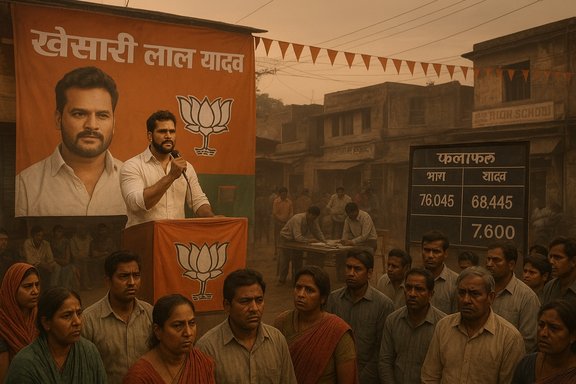
Bhojpuri superstar Khesari Lal Yadav suffered a stinging defeat in his electoral debut, losing the Chapra assembly seat to BJP’s Chhoti Kumari by roughly 7,600 votes in the Bihar Assembly elections — a result that crystallises both the limits of celebrity politics and the scale of the RJD’s collapse across the state.
Bhojpuri actor and playback singer Shatrughan Yadav — better known by his stage name Khesari Lal Yadav — entered formal politics in mid‑October when he and his wife joined the Rashtriya Janata Dal (RJD). Within days the party nominated him to contest the Chapra (Saran) seat, a constituency where the BJP had held influence in recent cycles. Khesari filed his nomination under his real name and declared movable and immovable assets totalling approximately ₹24.8 crore in his affidavit. Counting finished after multiple rounds on November 14–15, with BJP’s Chhoti Kumari securing 86,845 votes to Khesari’s 79,245, producing a margin of about 7,600 votes. These totals were reflected across the national reporting corps and the Election Commission tallies. The defeat in Chapra must be read alongside the scale of the RJD’s losses in this election. The Mahagathbandhan suffered a rout: the NDA crossed the majority threshold and the RJD won a fraction of the seats it contested — a collapse that turned individual results like Chapra into a broader story about party strategy and voter realignment in Bihar.
This Chapter in Bihar politics — a high‑profile celebrity candidate meeting the realities of constituency politics — is a useful empirical test of a hypothesis that has circulated widely in Indian political strategy: star recognition can open doors, but it rarely substitutes for the slow, tedious work of local politics. The Chapra result underscores that electoral success at the assembly level hinges on the interplay of organisation, issue credibility, and broader political tides — and that parties who ignore one of those vectors do so at their peril.
Source: Storyboard18 Bhojpuri actor Khesari Lal Yadav loses electoral debut from Chapra
 Background / Overview
Bhojpuri actor and playback singer Shatrughan Yadav — better known by his stage name Khesari Lal Yadav — entered formal politics in mid‑October when he and his wife joined the Rashtriya Janata Dal (RJD). Within days the party nominated him to contest the Chapra (Saran) seat, a constituency where the BJP had held influence in recent cycles. Khesari filed his nomination under his real name and declared movable and immovable assets totalling approximately ₹24.8 crore in his affidavit. Counting finished after multiple rounds on November 14–15, with BJP’s Chhoti Kumari securing 86,845 votes to Khesari’s 79,245, producing a margin of about 7,600 votes. These totals were reflected across the national reporting corps and the Election Commission tallies. The defeat in Chapra must be read alongside the scale of the RJD’s losses in this election. The Mahagathbandhan suffered a rout: the NDA crossed the majority threshold and the RJD won a fraction of the seats it contested — a collapse that turned individual results like Chapra into a broader story about party strategy and voter realignment in Bihar. How the contest unfolded
Rapid candidacy and immediate expectations
The sequence that led to Khesari’s candidacy was unusually compressed. Party sources and multiple outlets reported that his wife, Chanda Yadav, was initially expected to be the RJD nominee but was ruled out because her name was not listed on the Bihar voter rolls (apparently appearing on a Mumbai roll), prompting the party to field Khesari at the last minute. That move gave the campaign little runway to build a conventional ground operation around the new candidate. Local political operatives told reporters the RJD was banking heavily on Khesari’s mass recognition across the Bhojpuri‑speaking belt to energise turnout and reclaim the seat; the expectation was that celebrity pull would compensate for a short campaign build. In practice, the result suggests that recognition alone did not convert to victory in a constituency where organised ground mobilisation, alliance arithmetic and local issues remained decisive.Vote math and final numbers
- Chhoti Kumari (BJP): 86,845 votes.
- Khesari Lal Yadav (RJD): 79,245 votes.
- Margin: ≈ 7,600 votes in favour of BJP’s Chhoti Kumari.
Why star power failed in Chapra: a granular analysis
Celebrity candidacies are a high‑risk, high‑reward play. The Chapra result shows several interacting weaknesses in the RJD’s approach and in Khesari’s local appeal.1) Compressed onboarding and absence of an organic local machine
Political victories at the assembly level rarely come from media attention alone. They require booth‑level organisation, local volunteers, issue ownership and sustained outreach to marginal voters. Khesari’s late entry — and the last‑minute substitution from wife to husband — left the campaign with limited time to build or rewire such a machine. The BJP’s local structure, which had won Chapra in successive elections and replaced its two‑time MLA before this contest with a fresh face, preserved organisational continuity that translated to votes on counting day.2) Narrative friction: local issues vs. celebrity image
Chapra voters are not only consumers of Bhojpuri cinema; they respond to local governance narratives — roads, drains, irrigation, schools and employment. Khesari’s public pitch emphasised development, but it carried the faint whiff of an imported celebrity promise rather than a history of constituency service. In multiple marginal urban and rural pockets, voters chose a candidate who articulated a locally anchored record or clearly promised boots‑on‑the‑ground implementation.3) Controversies and statements that did not play well
In the campaign’s final weeks Khesari made remarks on topics that provoked debate — notably comments linking faith and public policy around the Ram Mandir and education — which opponents used to question his political instincts and sincerity on local governance priorities. While no single comment explains the margin, these controversies likely narrowed the trust premium that celebrity candidates enjoy and gave room for opponents to mobilise negative narratives.4) The broader political tide
Perhaps most decisive was the statewide swing to the NDA. The Mahagathbandhan’s collapse meant many local races that might otherwise have been competitive tilted toward the BJP due to shifting strategic voting, alliance configurations, and a potent last‑mile mobilisation by the NDA. When the tide is this strong, even high‑visibility newcomers struggle to swim upstream.Candidate profiles: what voters compared at the ballot box
Khesari Lal Yadav (RJD)
- Film and music star with deep regional name recognition.
- Declared assets (affidavit): approximately ₹24.81 crore (movable: ₹16.89 crore; immovable: ₹7.91 crore).
- First‑time contestant with a compressed campaign timeline; positioned as a development candidate and cultural son of Chapra.
Chhoti Kumari (BJP)
- Local activist and a grassroots organiser; served as Zila Panchayat head and replaced a two‑term MLA on the BJP ticket.
- Benefited from the BJP’s sustained local organisation and the broader NDA momentum.
Celebrity candidates in Indian state elections: pattern and pitfalls
The hopeful rationale
Political parties increasingly deploy celebrities to:- Capture rapid mass attention at low acquisition cost.
- Bring media coverage, fundraising lift and cross‑demographic appeal.
- Attract specific cohorts (youth, rural millennials) who follow entertainment stars.
The structural pitfalls
- Booth‑level weakness: Stars rarely enter with long‑standing party workers, cadre or volunteers tethered to them personally.
- Expectation mismatches: Celebrity winners frequently face accelerated public expectations for delivery, which can create rapid disappointment if governance acumen is missing.
- Narrative vulnerability: Media scrutiny of wealth, past remarks, or private conduct often intensifies when a celebrity runs, producing vulnerability that opponents can exploit.
- Overreliance on symbolic appeals: Voters deciding for material local outcomes will choose delivery‑focused candidates over charisma if the latter lacks credible local commitments.
RJD strategy, risk assessment and the wider fallout
What went wrong for the RJD in tactical terms
- Seat allocation and candidate vetting: The decision to field a last‑minute celebrity substitution (from candidate’s wife to husband) underlines a rushed vetting and contingency plan. Administrative glitches (voter roll mismatches) are not uncommon, but an enduring strategy must anticipate and resolve them earlier.
- Overreliance on star attraction: The RJD attempted to convert cultural capital into electoral capital without a parallel investment in ground infrastructure.
- Messaging coherence: In a multi‑party climate dominated by local fiscal and welfare promises (e.g., high‑visibility cash transfers and women‑targeted schemes), opposition messaging that seemed contesting on identity and celebrity struggled to match concrete policy narratives.
Political and organisational implications
- Short term: The loss reduces RJD’s bargaining power within any post‑poll calculus and forces immediate introspection on candidate selection.
- Medium term: A pattern of celebrity defeats would push parties to reprioritise experienced local operators over marquee names for marginal seats.
- Long term: Celebrity candidacies may be better targeted toward safe seats or national PR plays rather than marginal assembly battlegrounds where the ground game decides outcomes.
What the Chapra result tells campaign managers and political strategists
- Prioritise ground infrastructure before star launches. Celebrity rollouts should be coupled with pre‑existing local cadres, a clearly mapped booth plan and a named delivery team responsible for constituent services.
- Run rapid risk audits on candidate background — statements, affidavits, assets and voter roll hygiene — well before final nominations to avoid last‑minute substitutions that disadvantage mobilisation.
- Use celebrities tactically, not as replacements for organisational deficits. Deploy famous names to boost turnout in winnable segments while local operatives carry the day at the micro level.
Local governance issues that mattered in Chapra
Voters in Chapra cited routine but high‑impact issues: drainage and urban flooding, school quality, health access, and local employment. Political narratives that convincingly connected campaign promises to tangible, time‑bound delivery plans resonated more than broad symbolic pledges. Khesari’s campaign stressed development, but opponents successfully framed the debate around local credibility and a tested governance track record. These are the kinds of constituency‑level details that determine assembly races.Cross‑verification and what we can confidently say
- The Chapra vote totals and margin are consistent across multiple independent national outlets and the official counting feeds. The final figure — Chhoti Kumari 86,845; Khesari Lal Yadav 79,245; margin ≈ 7,600 — is verified in the Election Commission‑reported returns and by mainstream reporting.
- Khesari joined the RJD publicly on October 16 and filed his nomination after party induction; his affidavit lists assets of about ₹24.81 crore. Those specifics are verifiable from the nomination affidavit and contemporaneous press reports.
- The narrative that the RJD performed poorly across Bihar, winning only about 25 seats of the 143 it contested, is corroborated in state‑level aggregate reporting and by election observers; that broader collapse contextualises the Chapra result.
Lessons for media, parties and voters
- For media and analysts: celebrity candidacies are newsworthy but must be analysed against the metrics that determine grassroots outcomes: booth strength, voter lists, micro‑targeted welfare narratives, and issue salience.
- For parties: use star candidates where they amplify — not substitute for — local organisation. Vet administrative niceties (voter roll registrations, affidavits, asset disclosures) early in the nominating process.
- For voters: high‑profile entrants can bring attention to constituencies, but electoral choices at the assembly level often pivot on perceived competence to deliver local public goods.
Closing analysis: what comes next for Khesari and the RJD
Khesari’s loss does not end his political prospects; it does, however, frame them more realistically. Celebrity candidates who return to the field after a defeat can build a genuine constituency by investing in local offices, delivering visible projects and deploying their public platform in service of constituency problems. That pathway requires sustained effort and a willingness to trade short‑term national media attention for long‑term local credibility. For the RJD, Chapra is both a localized defeat and a symptom of a deeper package of issues: messaging coherence, seat allocation, and the limits of celebrity conversion at a time when welfare schemes and alliance engineering drove voter decisions in favour of the NDA. The party’s strategic recalibration will need to address those structural weaknesses before the next round of state or national contests.Quick reference: what to remember
- Final Chapra result: Chhoti Kumari (BJP) 86,845; Khesari Lal Yadav (RJD) 79,245; margin ≈ 7,600 votes.
- Khesari’s assets per affidavit: ~₹24.81 crore (movable ₹16.89 crore; immovable ₹7.91 crore).
- RJD performance: substantially down across Bihar; party won around 25 of the 143 seats it contested.
This Chapter in Bihar politics — a high‑profile celebrity candidate meeting the realities of constituency politics — is a useful empirical test of a hypothesis that has circulated widely in Indian political strategy: star recognition can open doors, but it rarely substitutes for the slow, tedious work of local politics. The Chapra result underscores that electoral success at the assembly level hinges on the interplay of organisation, issue credibility, and broader political tides — and that parties who ignore one of those vectors do so at their peril.
Source: Storyboard18 Bhojpuri actor Khesari Lal Yadav loses electoral debut from Chapra
