

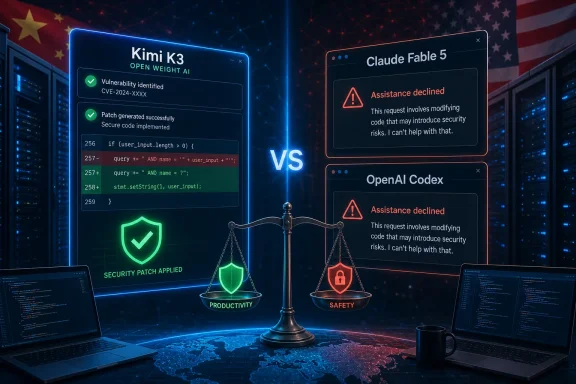
The practical issue for Windows developers, IT teams, and security engineers is not whether an AI assistant should write malware or automate intrusions. It plainly should not. The issue is whether a model can distinguish between offensive work and a maintainer asking it to patch a vulnerable application, review a pull request, or explain why a dependency is unsafe.
Sacks used the alleged 15-bug result to argue that America is “tying itself in knots” while Chinese competitors move ahead. Axios separately reported that Sacks made Kimi K3’s strong showing in coding benchmarks part of his broader case against pre-approval systems for advanced models, new data-center restrictions, and more expansive AI regulation.
That political framing is familiar. The more important development is that over-refusal is now an enterprise product problem, not merely a debate about AI philosophy.
Kimi K3 Has Arrived With Performance—and a Warning Label
Moonshot released Kimi K3 on July 16 as a 2.8-trillion-parameter, open-weight model. The Associated Press reported that the Beijing-based company’s newest system has caught up with leading versions of Claude and ChatGPT in several areas, while Moonshot positions it as the largest open-weight release of its kind.
Arena’s Frontend Code Arena placed Kimi K3 first in its blind front-end coding tests, ahead of Claude Fable 5 and OpenAI’s GPT-5.6 Sol. Axios reported that it also ranked strongly in Arena’s broader text evaluation and undercut leading U.S. hosted models on cost.
Those results should be read carefully. A front-end leaderboard measures a valuable but narrow class of work; it does not prove code is secure, establish superiority in maintaining large repositories, or show that a model can be trusted in a production incident. Tom’s Hardware also cautioned that K3’s wider claims cannot be fully independently tested until Moonshot releases its weights, planned for July 27.
Still, K3’s release matters because it combines frontier-adjacent coding results with an open-weight distribution model. Organizations that can operate such a model locally will be able to test it against internal repositories, tune workflows around it, and avoid sending sensitive source code to an external API. That does not remove supply-chain, governance, licensing, or data-residency concerns—but it changes the procurement conversation.
For Windows shops, the appeal is straightforward. A team maintaining legacy .NET services, PowerShell automation, Win32 utilities, device-management tooling, or internal line-of-business applications may want an assistant that can inspect vulnerable code without routing source files through a public hosted platform. An open-weight model offers more control, although operating a 2.8-trillion-parameter system will remain far beyond the reach of most individual administrators and small businesses.
Anthropic Acknowledges the False-Positive Tradeoff
The sharpest part of Sacks’ argument is not that U.S. labs have safety protections. It is that the protections may be catching normal defensive work.
Anthropic has effectively conceded that this can happen. In a July 2 post explaining Claude Fable 5’s cyber safeguards, the company said its classifiers sort requests into prohibited, high-risk dual-use, low-risk dual-use, and benign categories. It also said Fable 5 uses a deliberately larger safety margin than earlier models, meaning a request must look “very clearly safe” to avoid triggering the classifier.
That design reduces the chance that a harmful request slips through. It also creates false positives: legitimate vulnerability research, secure-code remediation, and defensive testing can resemble work an attacker would perform.
Anthropic’s developer documentation is unusually direct about the operational consequence. Fable 5 runs automated checks on cybersecurity-related requests and, when those checks intervene, customers can configure an automatic fallback to Claude Opus 4.8. The company says the safeguards are intentionally conservative and that benign technical requests can trigger them.
That is more nuanced than the claim that Claude simply “refuses security fixes.” A Fable 5 block may be a classifier decision, a model-level refusal, or a workflow that silently routes the work to another model. But from a developer’s seat, the distinction can feel academic if the expected patch does not arrive, the output quality drops after fallback, or the automation pipeline stalls.
The immediate lesson for enterprises is to instrument these events. If your coding assistant supports fallback, log the selected model, refusal reason, prompt category, time-to-completion, and whether the final patch passes testing. Without that data, a team may mistake a safety-induced routing change for model inconsistency—or vice versa.
OpenAI’s Position Is Different, but the Tension Is the Same
OpenAI is not presenting GPT-5.6 Sol as a general-purpose unrestricted cyber tool. Its GPT-5.6 material says that cybersecurity benchmarks were conducted with reduced safeguards and points organizations toward its trusted-access program for more capable defensive cyber use.
The company’s published evaluations also show why this is difficult territory. GPT-5.6 Sol has strong scores on Capture-the-Flag challenges, SEC-Bench Pro, ExploitBench, and other cyber evaluations. A model good enough to identify vulnerabilities, reason about exploit paths, and generate remediation advice can also lower the cost of abuse.
That is why calls for a clean line between “defense” and “offense” are easier to make than to implement. A request to fix an authentication bypass may require the model to identify the bypass, explain the attack path, propose a proof of concept for validation, and generate a patch. Each step can be useful to a defender and an attacker.
Yet “hard to classify” is not the same as “impossible to support.” A mature enterprise product should offer a better answer than a binary refusal: verified organizational access, repository-scoped context, audit logs, sandboxed test environments, role-based controls, and a documented escalation path for security teams. OpenAI’s trusted-access approach and Anthropic’s fallback mechanism are early versions of that model, but both make the customer absorb additional process and uncertainty.
The winning security assistant may be the one that can say yes safely, rather than the one that says no most reliably.
The 15-Bug Claim Needs a Real Test, Not a Viral Verdict
The developer’s account behind Sacks’ post is compelling because it is concrete: 15 bugs, two U.S. systems declining the work, and one Chinese system allegedly completing it. But it is not yet enough to establish a broad performance gap.
There is no public test suite, no unredacted codebase, no list of CVEs, no record of the exact prompts, no information about whether the models had repository context, and no independent assessment of whether Kimi K3’s proposed fixes were correct. A patch that compiles but introduces an authorization regression, breaks compatibility, or misses the root cause is not a security fix.
The benchmark that matters now is reproducible and deliberately mundane. It should include known vulnerabilities in representative application stacks, clear documentation of whether the model is asked to detect or remediate the flaw, independent code review, regression tests, static analysis, and a separate measure for unjustified refusals.
It should also distinguish three outcomes that vendors too often blur together:
- A model correctly refuses work that would enable meaningful harm.
- A model safely assists with a legitimate defensive task.
- A model declines a legitimate task that a security team needed completed.
Moonshot’s July 27 weight release will make deeper testing easier, particularly for researchers and well-resourced enterprises able to host the model. It will not automatically validate the developer’s 15-bug anecdote, nor will it settle questions around data handling, model provenance, or whether a broadly capable open-weight system creates its own security exposure.
But if independent teams begin finding the same pattern—Kimi K3 completing ordinary defensive coding tasks that Codex or Claude Fable 5 rejects—then Sacks’ argument will no longer depend on a post on X. It will become a concrete warning for U.S. AI vendors: safety controls that cannot reliably recognize authorized defensive work may protect against one class of risk while sending paying customers to a competitor.
References
- David Sacks Says US AI Safety Rules Let China's Kimi K3 Win on Security Fixes Startup Fortune · 2026-07-20T02:42:26+00:00