

KION Group’s decision to migrate SAP and critical applications to Microsoft Azure, executed with DXC Technology as lead integrator, is a textbook example of how manufacturers can convert data-centre sprawl into operational agility and measurable cost savings—while also exposing the trade-offs that come with hyperscaler dependence and rapid cloud-driven change. The move consolidated disparate systems, accelerated provisioning and deployment pipelines, and unlocked a cloud-native analytics runway; KION and DXC report a roughly 25% reduction in IT infrastructure costs and a dramatic speed-up in delivering fleet-management environments—claims documented in DXC’s customer story and reinforced in independent reporting.
Faced with the need to reduce operating costs, scale services quickly, and create a platform for advanced analytics, KION opted to migrate SAP and additional application workloads to Microsoft Azure. DXC Technology — a long-time partner already supporting KION’s IT and fleet-management systems — led the program, applying a lift‑and‑shift approach for a rapid and controlled cloud transition. The migration was preceded by a six‑month assessment phase with KION, DXC and Microsoft engineers to size compute and storage and to define security and licensing strategies.
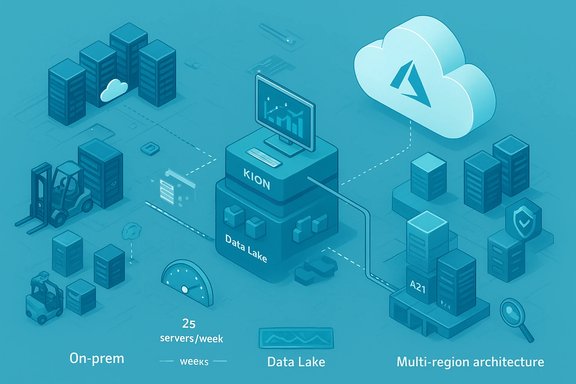
Delivery used a pragmatic lift-and-shift model: DXC migrated application workloads (including SAP) at a reported pace of roughly 25 servers per week, leveraging DXC’s Platform-as-a-Service offering for SAP on Azure and its managed services for ongoing 24x7 monitoring. DXC also advised on Microsoft licensing strategies and managed consumption billing to streamline cost governance. These operational details are described in DXC’s customer narrative and echoed by third-party summaries.
However, the move also underscores the need for rigorous vendor management, disciplined cost governance, and an explicit roadmap for security and portability. Cloud transforms both the delivery model and the risk profile; KION’s partnered approach (DXC + Microsoft) reduced in‑house operational friction but recentered governance around external contracts and cloud financial operations.
These are the contours of modern SAP cloud adoption: compelling operational gains married to a new set of organizational responsibilities. KION’s program shows what’s possible when planning, automation, platform choice and managed services align—but it also reminds IT leaders that the work of transformation continues long after the last VM is migrated.
Source: DXC Technology KION Group lowers costs and improves scalability with SAP applications on Microsoft Azure cloud
 Background
Why a forklift and warehouse OEM moved SAP to the cloud
KION Group, one of the world’s largest manufacturers of forklifts and warehouse automation systems, runs complex global operations that combine manufacturing, field service, and large-scale fleet management. Historically, those operations lived in many country- and business-unit-specific data centres, creating data silos and long provisioning cycles that hampered automation and modernisation.Faced with the need to reduce operating costs, scale services quickly, and create a platform for advanced analytics, KION opted to migrate SAP and additional application workloads to Microsoft Azure. DXC Technology — a long-time partner already supporting KION’s IT and fleet-management systems — led the program, applying a lift‑and‑shift approach for a rapid and controlled cloud transition. The migration was preceded by a six‑month assessment phase with KION, DXC and Microsoft engineers to size compute and storage and to define security and licensing strategies.
What the migration aimed to solve
- Fragmented infrastructure and isolated data sets that impeded automation and analytics.
- Long hardware procurement and deployment cycles (measured in weeks).
- The need for flexible consumption pricing and the ability to scale resources up and down on demand.
- Faster time-to-value for customer services and the ability to pass efficiency gains to KION’s customers.
The migration in practice
Planning, partner model and execution
KION’s planning phase brought together internal teams plus engineers from DXC and Microsoft for a deliberate discovery and sizing process that lasted approximately six months. That timeframe is consistent with enterprise best practice—mapping dependencies, cataloguing integrations and designing DR and HA postures before moving critical SAP workloads.Delivery used a pragmatic lift-and-shift model: DXC migrated application workloads (including SAP) at a reported pace of roughly 25 servers per week, leveraging DXC’s Platform-as-a-Service offering for SAP on Azure and its managed services for ongoing 24x7 monitoring. DXC also advised on Microsoft licensing strategies and managed consumption billing to streamline cost governance. These operational details are described in DXC’s customer narrative and echoed by third-party summaries.
Automation and provisioning: from eight weeks to hours
One of the standout operational gains KION reports is dramatic acceleration in provisioning. Pre-migration, hardware procurement and commissioning for scale-up events could take up to 12 weeks; in Azure, KION says a triple‑CPU scale can be achieved within 12 hours. Likewise, delivery of KION’s fleet-management landscapes—previously an eight‑week effort—was reduced to less than a day via scripted automated builds in Azure. These are project‑level outcomes reported by KION and DXC; they align with the cloud principle of infrastructure as code and are supported by Azure’s automation and resource-manager tooling.Technical foundation: SAP on Azure and KION’s analytics stack
SAP and high‑availability on Azure
Running mission‑critical SAP workloads on Azure is a well-established architectural pattern. Microsoft and partners provide validated reference architectures for SAP HANA and NetWeaver, availability-zone deployments, database replication patterns, and guidance for using Azure Site Recovery for orchestration. KION’s migration leveraged those platform capabilities to balance availability, performance and cost. Microsoft documentation and community guidance lay out the same HA approaches DXC implemented: Availability Zones for regional resiliency, DB-level replication for transactional consistency, and VM/cluster patterns for SAP central services.The KION Analytics Platform (KAP)
KION’s post-migration roadmap moves beyond pure hosting: the company built the KION Analytics Platform (KAP) on Azure, using Azure Data Factory and Databricks to land data in ADLS Gen2 and selecting Dremio as the data lakehouse engine to enable live querying. The result: previously 30-minute Power BI refreshes now run in seconds for many operational queries, letting product owners and service leads run near‑real‑time analyses on warranty, fleet and production telemetry. Dremio, KION and other press coverage independently confirm the analytics migration and the performance improvement.Business outcomes KION reports
- Estimated 25% reduction in IT infrastructure costs. KION’s VP of infrastructure attributes this both to consumption-based pricing and the ability to shut down non-production or off‑shift environments. This is a company-reported figure in the DXC case narrative and picked up by trade coverage.
- Faster scaling and provisioning. CPU upgrades, reprovisioning and fleet-management deployments became faster and repeatable—measured in hours or days rather than weeks.
- Operational resilience during crisis. The cloud platform enabled a rapid Microsoft 365 and Teams rollout for 22,000 employees during the pandemic, a concrete demonstration of elastic capacity and managed collaboration services being available on demand.
- Analytics and decision speed. KION’s KAP now supports tens of operational use cases with sub‑second to second query responses against large datasets.
Critical analysis: strengths, trade‑offs and risks
Strengths — what KION gained
- Speed-to-business: Automating infrastructure provisioning and using platform-level services materially shortened timelines for rollouts and scale-ups. That’s a direct competitive enabler in logistics and services where capacity and response times matter.
- Cost flexibility: Consumption models and the ability to turn off non-essential resources delivered immediate TCO levers that KION has quantified and intends to pass to customers as improved pricing.
- Modern analytics posture: Centralising data on ADLS Gen2 and adopting a lakehouse engine enabled KION to operationalise telemetry and warranty analytics—a stepping stone to predictive maintenance and AI-assisted services.
- Operational simplicity for global teams: A managed service model with DXC covering 24x7 operations reduced the in-house burden for running base infrastructure and SAP day‑to‑day tasks.
Trade‑offs and risks — what to watch
- Vendor and operational dependency. Moving SAP and critical workloads to Azure and relying on DXC for managed services concentrates operational responsibility with a small set of external providers. That reduces internal operational load but increases strategic vendor risk that must be managed through contracts, SLAs and clear runbooks.
- Metered‑cost surprises. Consumption billing can create unexpected monthly variability. Without disciplined tagging, budgeting and governance, “cloud waste” can erode the reported infrastructure savings. DXC’s managed billing services help, but enterprises must maintain chargeback/finops discipline.
- Data gravity and integration complexity. While analytics benefits are immediate, integrating SAP, telemetry from 1.7 million vehicles and historical on‑prem systems can create complex dependency trees. Effective observability, robust CI/CD for data pipelines, and automated testing are required to keep the platform stable.
- Security and compliance posture. Moving to Azure shifts some control layers to the provider. KION must maintain identity governance, network segmentation, encryption and incident response capability. Microsoft’s Well‑Architected and SAP on Azure guidance provide blueprints, but human discipline wins in security.
- Potential lock‑in concerns. KION’s use of Azure-specific services and DXC-managed tooling creates an ecosystem that is efficient but not trivially portable. For many enterprises this trade-off is acceptable, but it should be acknowledged and mitigated with escape plans and interoperability strategies.
- Unverifiable project metrics. Several headline figures—25% infrastructure cost reduction, 25 servers per week migration rate, “triple CPU in 12 hours”, and “fleet management from 8 weeks to <1 day”—are company-reported project outcomes in DXC’s case study and in subsequent coverage. While plausible and consistent with known cloud advantages, these numbers are not independently audited public metrics and should be treated as vendor/customer statements rather than universal guarantees.
Verifying the claims: what’s validated and what needs caution
To maintain journalistic rigor, these key claims were cross‑checked against independent materials:- KION’s move to Azure and DXC’s role are documented in DXC’s customer story and replicated by DXC’s regional pages. Those project details are corroborated by trade reporting summarising the same case study.
- KION’s analytics platform and the move to Dremio on Azure are independently announced by Dremio (press release) and by KION’s own communications about the KION Analytics Platform. The Dremio press release confirms the architecture and the substantial performance gains on analytics queries.
- Technical capabilities claimed as part of the project—rapid VM resizing, high availability patterns, DR via Azure Site Recovery, and platform automation—are all supported by Microsoft’s official guidance for SAP on Azure and Azure automation/VM guidance. Microsoft docs confirm the viability of the architectural choices DXC and KION describe, although platform behaviour (for example, the exact time to change VM sizes) depends on instance families, region capacity and whether a VM must be deallocated.
Practical lessons and recommended practices for SAP migrations to Azure
- Plan for discovery and dependency mapping. Spend the time to catalogue integrations, batch windows, and network/security requirements—KION’s six‑month assessment phase is a model to emulate.
- Choose the right migration pattern. Lift‑and‑shift accelerates time‑to‑cloud and reduces near-term risk; replatforming or refactoring can follow when the business wants to capture cloud‑native gains.
- Build automation from day one.
- Infrastructure as Code (ARM/Bicep/Terraform) to standardise builds.
- Automated provisioning scripts for consistent fleet or environment delivery—KION moved from multi‑week builds to scripted, rapid deployments.
- Use database‑native replication for SAP HANA or SQL Server. It preserves transactional consistency and makes DR/RPO planning simpler than block‑level VM replication. Microsoft’s SAP guidance recommends DB-level replication alongside VM orchestration for app servers.
- Adopt FinOps discipline. Tag resources, implement budget alerts, and continuously rightsise. Consumption-driven savings require governance to prevent long‑tail costs.
- Address security and compliance as integrated controls. Identity, key management, private endpoints, and continuous monitoring via tools like Microsoft Sentinel should be part of the migration scope.
- Run realistic validation and performance tests. Cloud scale behaviour depends on the VM family, storage performance and network topology. Tests should simulate end‑of‑month loads and peak service periods.
What this means for manufacturers and SAP customers
KION’s program is a strong case that legacy, distributed infrastructure need not be a permanent drag on competitiveness. For manufacturers—where telemetry, warranty data and field operations create vast data volumes—moving SAP and operational data into a unified cloud platform creates both tactical cost wins and a strategic analytics foundation. KION’s adoption of a lakehouse architecture and a high‑velocity provisioning approach demonstrates how operational teams can shift their focus from infrastructure mechanics to business outcomes.However, the move also underscores the need for rigorous vendor management, disciplined cost governance, and an explicit roadmap for security and portability. Cloud transforms both the delivery model and the risk profile; KION’s partnered approach (DXC + Microsoft) reduced in‑house operational friction but recentered governance around external contracts and cloud financial operations.
Conclusion
KION Group’s migration of SAP and application workloads to Microsoft Azure—delivered by DXC and paired with a modern analytics stack—illustrates the practical, near-term benefits that public cloud can deliver for manufacturers: lower operating costs, far faster provisioning cycles, and a data platform that accelerates decision-making across operations and service lines. Those benefits are real and corroborated by multiple sources including the DXC case narrative, KION’s own communications and independent vendor press for the analytics implementation. At the same time, the project brings into focus the essential caveats: vendor concentration, the need for disciplined FinOps, and the contextual nature of reported savings and timelines. Organizations planning similar moves should treat published customer numbers as directional evidence—use them to model scenarios, but validate outcomes through careful discovery, pilot testing and governance.These are the contours of modern SAP cloud adoption: compelling operational gains married to a new set of organizational responsibilities. KION’s program shows what’s possible when planning, automation, platform choice and managed services align—but it also reminds IT leaders that the work of transformation continues long after the last VM is migrated.
Source: DXC Technology KION Group lowers costs and improves scalability with SAP applications on Microsoft Azure cloud
