

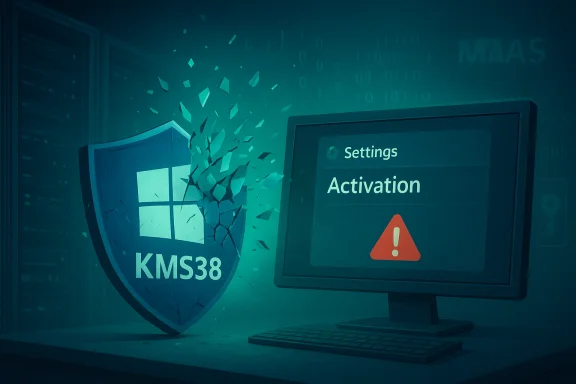
Microsoft’s November Patch Tuesday appears to have closed one of the most convenient loopholes used by the activation‑circumvention community: the long‑running “KMS38” trick — widely circulated via the Microsoft Activation Scripts (MAS / Massgrave) project — stopped working for systems updated with the November 11, 2025 cumulative rollups, and the MAS maintainers have removed KMS38 from their active script in the v3.8 release.
The activation landscape for Windows has long contained two parallel threads: legitimate enterprise volume licensing (KMS, MAK, HWID and other sanctioned flows), and a large gray‑market ecosystem of scripts, emulators, and key‑resellers that attempt to obtain or simulate activation without an authorized license. One of the more technically subtle tricks to emerge in recent years was KMS38 — a method that produced or injected a crafted “GenuineTicket” artifact and used Windows’ upgrade/migration helper logic to make a retail or consumer machine behave like it had a long‑duration KMS lease (effectively extending activation toward the 2038 Unix timestamp boundary). That made offline, long‑duration activation possible without a periodic connection to an official KMS host.
MAS (often called Massgrave) is the open‑source project that packaged several of these techniques into a widely distributed PowerShell batch-based activator. MAS provided multiple methods — KMS38, HWID, TSforge, and various KMS emulation routes — and shipped documentation and scripts on GitHub and related mirrors. The project’s public changelog and repositories show active maintenance and frequent tactical changes as Microsoft hardened various internal behaviors.
The episode also reinforces three durable principles for Windows administrators and users: do not rely on brittle, undocumented internal behaviors for activation; avoid running elevated scripts from untrusted sources; and prefer legitimate licensing channels or authorized discounts to protect security, operational stability, and compliance.
If activation status changed after recent updates, start with Settings → System → Activation and run slmgr /xpr (elevated) — treat any device that has run third‑party activators as a potential security incident and audit or reimage as required.
Source: TechSpot Your pirated copy of Windows might have just stopped working
 Background / Overview
The activation landscape for Windows has long contained two parallel threads: legitimate enterprise volume licensing (KMS, MAK, HWID and other sanctioned flows), and a large gray‑market ecosystem of scripts, emulators, and key‑resellers that attempt to obtain or simulate activation without an authorized license. One of the more technically subtle tricks to emerge in recent years was KMS38 — a method that produced or injected a crafted “GenuineTicket” artifact and used Windows’ upgrade/migration helper logic to make a retail or consumer machine behave like it had a long‑duration KMS lease (effectively extending activation toward the 2038 Unix timestamp boundary). That made offline, long‑duration activation possible without a periodic connection to an official KMS host.MAS (often called Massgrave) is the open‑source project that packaged several of these techniques into a widely distributed PowerShell batch-based activator. MAS provided multiple methods — KMS38, HWID, TSforge, and various KMS emulation routes — and shipped documentation and scripts on GitHub and related mirrors. The project’s public changelog and repositories show active maintenance and frequent tactical changes as Microsoft hardened various internal behaviors.
How KMS38 actually worked — a short technical primer
- Windows setup and upgrade flows historically included a helper binary (commonly referenced as gatherosstate.exe) that collected pre‑upgrade activation/eligibility state or produced a GenuineTicket during particular upgrade scenarios.
- KMS38 implementations created or manufactured a GenuineTicket‑style XML artifact that, when placed and processed by the upgrade/servicing stack, was accepted by the Software Protection Platform (SPP) in a way that extended the perceived activation period up to the 2038 timestamp limit — hence the name KMS38.
- The method’s appeal was threefold: offline operation, minimal persistent footprint (no visible long‑running illicit service), and a long activation lifetime without a visible product key or periodic KMS host contact.
What changed in November 2025 (the technical facts)
Multiple pieces converged in late 2024–2025 that undermined KMS38’s assumptions; the November 11, 2025 cumulative updates were the practical tipping point for many users.The vendor hardening timeline (short)
- Community researchers and MAS maintainers trace the first practical removals of gatherosstate behavior to earlier builds (notably Windows 11 build lines in 2024). Over time Microsoft shifted what shipping install images and servicing stacks include, reducing the presence and effect of gatherosstate‑style helpers.
- Microsoft’s October preview rollups consolidated changes and the November cumulative (reported under KB5068861 for the current Windows 11 channels, plus companion KBs for other SKUs) folded in additional servicing fixes and upgrade flow adjustments. Those updates changed how upgrade helpers process migration artifacts, and observers found the clip‑based migration behavior KMS38 relied on had been deprecated or removed.
- The MAS maintainers’ public changelog for v3.8 explicitly states: “Beginning with build 26100.7019, Microsoft fully deprecated clip‑based KMS license migration functionality. As a result, KMS38 has stopped working. KMS38 has now been removed from the MAS script. Users are advised to use HWID or TSforge activation instead.” That changelog entry is the clearest, authoritative admission from the project itself that the KMS38 flow no longer works on updated builds.
What users and admins are reporting in the field
- Machines that were previously “activated” via KMS38 and that installed the November cumulative updates are reporting lost activation and showing reminders to acquire legitimate product keys or licenses. Some community posts indicate that uninstalling the November KB restores the prior activation state, which aligns with the conclusion that the update altered activation‑preservation behavior.
Massgrave / MAS response: remove, pivot, repeat
The MAS project reacted quickly: v3.8 of the scripts removed the KMS38 option and flagged the change in its changelog with the line “R.I.P. KMS38.” That release also points MAS users to two alternative — but still unauthorized — methods: HWID (digital license bound to hardware) and TSforge. MAS maintainers note that these alternatives continue to function for now, and they indicate hope that future technique changes might restore additional options, but they no longer advertise KMS38 as viable on current builds. This reaction is textbook for the gray‑market activation ecosystem: when a vendor hardens, maintainers remove broken code paths and emphasize alternatives. The broader community then engages in a cat‑and‑mouse exchange — new techniques surface, vendors close them, and so on — but each iteration increases legal and supply‑chain risk for end users.Security, legal and operational implications — what matters to readers
Security and supply‑chain risk
- Popular activation tools are frequently mirrored and repackaged. Even if the upstream MAS code is open and inspectable, downstream copies commonly appear on forums, torrents, or reseller sites where maintainers do not control changes. Those repackaged versions are a prime vector for trojanized installers, backdoors, and persistent malware. Running an activator with administrative privileges gives any malicious fork elevated execution scope on a victim machine. Numerous security teams flag unauthorized activators as a supply‑chain red flag.
Compliance and legal exposure
- Using MAS and similar tools violates Microsoft’s license terms and can put organizations at risk during audits. For businesses, the compliance exposure is not theoretical: license audits, procurement reviews, and vendor contracts frequently forbid non‑authorized licensing methods. The operational cost of remediation (forensic review, reimaging, key procurement) often exceeds the upfront cost of legitimate licensing.
Operational fragility
- Activation hacks that piggyback on upgrade helpers are brittle by design. A cumulative update or a rebuild of install media can change a single file or manifest and undo the entire trick. That makes relying on such workarounds fundamentally unsustainable for imaging pipelines or fleet management. If a single monthly Patch Tuesday causes activation loss across thousands of endpoints, the operational fallout is significant.
Practical checklist — how to verify and remediate now
If you manage or use Windows devices, these are the immediate, practical steps to take.1. Check update history and installed KBs
- Settings → Windows Update → Update history. Look specifically for the November 11, 2025 cumulative updates (reported under KB5068861 for recent Windows 11 channels) and companion rollups. If those are installed, KMS38 behavior is likely unreliable on that device.
2. Verify activation state
- GUI: Settings → System → Activation to see activation status and the license type.
- CLI: open an elevated command prompt and run:
- slmgr /xpr — shows whether activation is permanent or time‑limited.
- slmgr /dli and slmgr /dlv — more detail on the licensing channel and state.
If activation recently changed after applying updates, the device likely relied on a now‑broken ticket‑carry flow.
3. Audit for unauthorized activators
- Check common places:
- Scheduled tasks, startup entries, Program Files folders,
%TEMP%, and last‑modified system paths. - Recent PowerShell or batch invocations in event logs (Event Viewer → Windows PowerShell / System).
- If unauthorized activation tools are present, treat the endpoint as higher‑risk: run full AV/endpoint scans, collect indicators, and consider reimaging if tainted.
4. For imaging pipelines and ISOs
- Rebuild install media from official Microsoft ISOs and apply servicing stack updates and cumulative patches in controlled, documented order.
- Test in a lab environment to verify activation and upgrade paths before broad roll‑outs.
5. Replace unauthorized methods with legitimate licensing
- For single devices or small fleets, the durable and supportable path is to procure proper Retail, OEM, or Volume licensing appropriate to your environment.
- If budget is a concern, rely on authorized discounts (student/education programs, volume agreements, OEM bundles), not gray‑market resellers.
About cheap license claims and the gray market
Several news pieces and forum posts note bargain prices for Windows and Office licenses (for example, listings advertising Windows 11 licenses for as low as $10 and Office 2021 Pro for around $39). These prices typically originate from third‑party gray‑market resellers that re‑sell OEM, volume, or otherwise non‑retail keys. While such low prices exist online, they carry well‑documented risks:- Keys may be revoked or deactivated when Microsoft identifies improper sourcing.
- Many low‑cost sellers resell volume / OEM keys not intended for retail single‑device activation.
- Buyer protection, warranty, and support are often absent; refunds or remediation may be impossible.
Security and community guidance strongly warn that anything drastically below standard retail pricing is high‑risk and may not be a sustainable or legal solution. If legitimate, authorized discounts (e.g., student discounts, refurbished OEM bundles from reputable retailers) are the only secure routes to lower costs.
The cat‑and‑mouse reality: what to expect next
- This is not the end of activation‑circumvention. Historically, maintainers adapt quickly, and forks or new techniques (some noisier or riskier) will surface. MAS itself pivoted to alternatives like HWID and TSforge and will continue to evolve.
- Microsoft’s practical options are also wide: vendor hardening can continue (removing helpers, tightening validation, or detecting tampered activation stores) and will likely prioritize reducing exploitability and supply‑chain risk.
- For defenders and admins, the safe assumption is that unauthorized activation routes are a transient and unreliable dependency; treat them as an immediate remediation target rather than a long‑term strategy.
Why this matters beyond piracy headlines
There are three pragmatic reasons the mainstream Windows community should pay attention:- Security posture — machines using unauthorized activators frequently run code with elevated privileges from untrusted sources. This introduces real supply‑chain risks and complicates incident response.
- Operational continuity — relying on brittle, undocumented internals of the OS for licensing exposes imaging pipelines and fleets to catastrophic simultaneous activation loss after routine updates.
- Policy and compliance — organizations that permit or tolerate gray‑market activation risk legal and contractual exposure that can manifest during audits, procurement reviews, or incident investigations.
Final assessment — strengths and risks of Microsoft’s move
- Notable strengths
- Improved system integrity: Closing unintended uses of upgrade helpers reduces a class of abuse that could be leveraged for forged activation or covert persistence.
- Reduced supply‑chain exposure: Removing an easy, widely abused activation shortcut makes it harder for attackers to hide persistence under the guise of an activator.
- Operational consistency: Enterprises and imaging teams benefit from predictable servicing and activation behavior — when upgrade flows are not manipulated by third‑party tricks, images behave more consistently across updates.
- Potential risks and downsides
- Collateral pain for end users: Home users who relied on tools like KMS38 will see activation loss and may be forced to decide between paying for a license, buying risky cheap keys, or living with unactivated Windows.
- Drive to riskier alternatives: As easy tricks are closed, some users may flock to more opaque or malicious forks, increasing exposure to malware.
- Perception and migration pressure: A small subset of users may view tighter enforcement as a reason to explore alternative OSes (Linux, ChromeOS Flex) or to seek other unsupported workarounds — potentially fragmenting the user base and increasing help‑desk burden.
Conclusion
The November 2025 Patch Tuesday updates materially altered the activation landscape by removing the internal behaviors KMS38 relied on; MAS — the project that propagated KMS38 widely — has acknowledged the change and removed KMS38 from its mainstream release. The practical result: systems updated with the November rollups that had been “activated” by the KMS38 trick may now show unactivated status, and administrators and home users should audit devices, verify activation, and remediate using supported licensing options.The episode also reinforces three durable principles for Windows administrators and users: do not rely on brittle, undocumented internal behaviors for activation; avoid running elevated scripts from untrusted sources; and prefer legitimate licensing channels or authorized discounts to protect security, operational stability, and compliance.
If activation status changed after recent updates, start with Settings → System → Activation and run slmgr /xpr (elevated) — treat any device that has run third‑party activators as a potential security incident and audit or reimage as required.
Source: TechSpot Your pirated copy of Windows might have just stopped working
