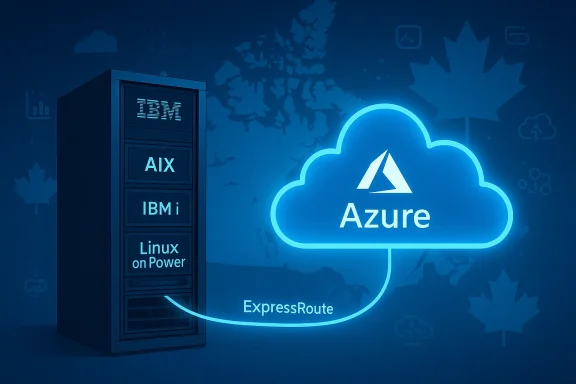
Kyndryl’s new availability of Cloud Uplift inside Microsoft’s Canadian datacentre regions delivers a practical, low‑risk route for Canadian enterprises to lift, run, and begin modernizing mission‑critical IBM Power workloads on Microsoft Azure while keeping data and primary compute inside Canada.
Kyndryl announced on March 11, 2026 that Kyndryl Cloud Uplift (the rebranded Skytap offering) is now offered in Microsoft Azure’s Canadian datacentre regions, positioning the service as a fast, self‑serve way to move as‑is IBM Power workloads (AIX, IBM i, Linux) to Azure without the mandatory re‑architecture or code rewrite that typically stalls modernization projects. The company frames the capability as a way to preserve operational continuity while giving organizations a controlled path to modern cloud services and AI.
This launch follows Kyndryl’s acquisition of Skytap in May 2024, a move the company has used to build a managed offering that places Power‑class hardware and partitioning (LPAR) support into hyperscaler datacentres. Kyndryl says Canada is the fifth geographic region to receive Cloud Uplift since the acquisition and the fourteenth Microsoft datacentre region where the solution is available.
Why this matters now: Kyndryl’s recent Readiness Report and associated market messaging highlight two persistent constraints in enterprise cloud adoption—foundational technical debt that delays innovation, and rising concerns about geopolitical and regulatory risk tied to where data and compute live. These pressures make a “sovereign‑region” hybrid option attractive for regulated workloads that are expensive or risky to refactor all at once. That broader context underpins Kyndryl’s Canada push. (kyndryl.com)
Competitors and adjacent options include:
The key risks remain operational cost, licensing complexity, performance validation, and the political‑commercial dance between Kyndryl, Microsoft, IBM and ISVs. Most importantly, the offering shifts the decision‑point from “how to refactor now” to “how to govern modernization over time.” Without disciplined governance, lift‑and‑shift can become an indefinite state rather than a staging ground for true modernization.
Who should care most:
Kyndryl’s Canadian Cloud Uplift is not a silver bullet for legacy modernization, but it is a pragmatic engineering pathway that reframes a stubborn enterprise problem: how to unlock cloud innovation while preserving the integrity of decades‑old, business‑critical systems. For many Canadian organizations the decision will come down to governance: use Cloud Uplift as a controlled runway to modernize and innovate, or let it become a comfortable island that delays the hard work of transforming application logic for the cloud era.
Source: Morningstar https://www.morningstar.com/news/pr...n-critical-legacy-systems-on-microsoft-azure/
 Background / Overview
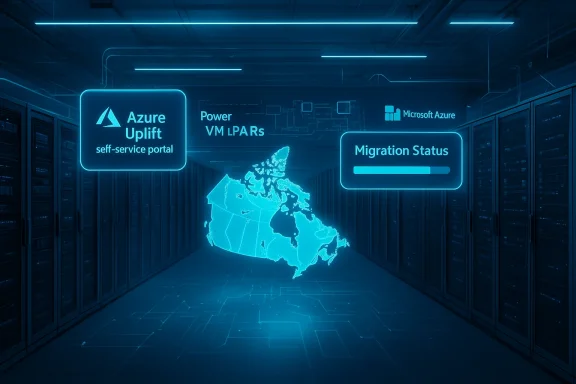
Kyndryl announced on March 11, 2026 that Kyndryl Cloud Uplift (the rebranded Skytap offering) is now offered in Microsoft Azure’s Canadian datacentre regions, positioning the service as a fast, self‑serve way to move as‑is IBM Power workloads (AIX, IBM i, Linux) to Azure without the mandatory re‑architecture or code rewrite that typically stalls modernization projects. The company frames the capability as a way to preserve operational continuity while giving organizations a controlled path to modern cloud services and AI.This launch follows Kyndryl’s acquisition of Skytap in May 2024, a move the company has used to build a managed offering that places Power‑class hardware and partitioning (LPAR) support into hyperscaler datacentres. Kyndryl says Canada is the fifth geographic region to receive Cloud Uplift since the acquisition and the fourteenth Microsoft datacentre region where the solution is available.
Why this matters now: Kyndryl’s recent Readiness Report and associated market messaging highlight two persistent constraints in enterprise cloud adoption—foundational technical debt that delays innovation, and rising concerns about geopolitical and regulatory risk tied to where data and compute live. These pressures make a “sovereign‑region” hybrid option attractive for regulated workloads that are expensive or risky to refactor all at once. That broader context underpins Kyndryl’s Canada push. (kyndryl.com)
What Kyndryl Cloud Uplift actually offers
Core capabilities, in plain terms
- Run IBM Power workloads on Azure without rewriting: Customers can replicate and run existing AIX, IBM i and Power Linux LPARs inside Azure, preserving binaries, middleware and operational procedures.
- Local data residency in Canada: Primary compute and storage can remain within Microsoft Canadian datacentre regions to meet legal and procurement requirements.
- Self‑service, metered consumption backed by Kyndryl: The offering is presented as a self‑service platform with managed options and a 99.95% availability SLA where supported.
- Bridge to Azure PaaS and AI services: Once workloads are running in Azure regions, teams can incrementally access analytics, AI/ML, and modern database services without wholesale migration of the legacy app stack.
How it compares with the alternatives
The important distinction is that Cloud Uplift aims to place native Power hardware and PowerVM capabilities into the hyperscaler fabric so that LPARs can be managed in ways that closely resemble on‑prem operations. That is different from full refactors, containerization strategies, or rehosting on non‑Power platforms where significant code changes are usually required. Industry materials and IBM technical guidance indicate that running AIX/IBM i on actual Power hardware preserves expected behavior (PowerVM, LPAR, live mobility, PowerHA), which is central to the Cloud Uplift proposition.Technical mechanics — what’s happening under the hood
Hardware and virtualization model
Cloud Uplift places IBM Power servers (Power10 and related platforms in modern deployments) into Azure racks and exposes partitioning and virtualization layers (PowerVM / PHYP) to Kyndryl tenants. That allows:- familiar LPAR management (creation, sizing, Live Partition Mobility),
- standard Power virtualization features (SPPs, VIOS) and
- binary compatibility for heavyweight workloads that expect Power architecture.
Networking, storage and integration
Kyndryl integrates Power LPARs with Azure networking fabrics and storage primitives. Expect secure overlay connectivity to tenant VNets, private link or ExpressRoute equivalents for on‑prem connectivity, and block/file storage mapped to Azure storage backends. The success of high‑IO workloads will hinge on careful architecture to guarantee IOPS, throughput and latency comparable to on‑prem designs.Identity, monitoring and operational tooling
The managed platform ties legacy admin models into Azure’s monitoring, backup and identity systems, enabling operators to retain established processes while granting product teams gradual access to Azure observability and governance tooling. The degree of integration—how far identity bridges, API mappings, and operational runbooks are automated—will materially affect cutover complexity.Business case for Canadian enterprises
Immediate benefits
- Reduced migration risk — moving as‑is minimizes functional regressions, shortens migration timelines and avoids expensive, error‑prone code rewrites.
- Regulatory alignment — keeping compute and primary data inside Canada eases compliance for federal/provincial rules and procurement contracts that require local hosting or restrict foreign data flows.
- Operational continuity — existing OS images, batch jobs and scheduled windows can be preserved, reducing retraining and operational churn.
- Faster access to cloud services — once hosted in Azure Canada, teams can incrementally adopt cloud‑native services and AI capabilities without wholesale refactoring.
Where value compounds over time
- Decommissioning on‑prem datacentres and related capital/operational costs.
- Phased modernization: technical debt reduction can proceed module by module while production stays stable.
- New analytics and AI opportunities: secure pathways to combine legacy data with Azure ML and analytics in a controlled way.
Compliance, data residency and the regulatory calculus
Canada’s evolving privacy and procurement landscape makes regional hosting attractive for many sectors—financial services, health, utilities and government—where data residency directly impacts legal compliance and vendor selection.- Data residency reduces one class of regulatory risk (location), but does not eliminate responsibilities around access controls, encryption, audit trails, and cross‑border replication choices. Kyndryl’s messaging emphasizes in‑country hosting as a differentiator but customers must still validate controls and contractual terms.
- For some organizations, secondary copies (backups, DR replicas) or integration points that touch non‑Canadian services may still raise sovereignty questions and require additional mitigations or contractual clauses.
Risks, caveats and the hidden costs
No single migration path is free from tradeoffs. IT leaders should weigh these practical and strategic risks before committing to Cloud Uplift.1) Time and cost of running specialized hardware in a hyperscaler
While lift‑and‑shift avoids immediate refactoring costs, specialized Power hardware in a managed hyperscaler footprint carries a higher unit compute cost than commodity x86 instances. Over time, these operating costs can outpace the benefits if modernization stalls. Organizations should run a multi‑year TCO analysis that explicitly models sustained Power capacity needs versus eventual refactor savings.2) Licensing complexity and vendor interop
Running IBM software (AIX, IBM i, DB2, PowerVM features) in a hyperscaler may trigger complex licensing or support conversations with IBM and other ISVs. While many customers rehost to IBM’s own Power Virtual Server on IBM Cloud, third‑party managed arrangements require explicit license compliance and vendor support agreements. This is an area that must be validated contractually before go‑live.3) Potential vendor lock‑in and migration inertia
Preserving legacy stacks as‑is is valuable for risk reduction, but it can also entrench legacy architecture and delay long‑term modernization. Success requires a governance model that mandates staged refactor or replacement, not indefinite permanence in the managed Power environment.4) Performance and operational SLAs
Mission‑critical workloads demand predictable performance (IOPS, latency) and HA semantics. Kyndryl advertises availability SLAs, but customers must validate performance envelopes with production‑like load tests and ensure runbooks for incident management align with existing RTO/RPO expectations.5) Security posture and shared responsibility
A managed service in a hyperscaler still requires careful configuration: network segmentation, identity governance, privileged access controls, and monitoring need to be explicitly documented. Any misalignment between Kyndryl, Microsoft, and the customer on responsibilities creates gaps that adversaries can exploit.How to evaluate Cloud Uplift: a practical checklist for IT leaders
Use this numbered checklist as a pragmatic decision tool when assessing Cloud Uplift for IBM Power workloads.- Define the scope: list applications, integrations, data flows, and compliance controls that must remain in‑country.
- Confirm licensing & support: obtain written confirmation from IBM (or relevant ISVs) on support and licensing when running in Kyndryl’s managed environment.
- Run a performance validation: execute production‑scale load tests for CPU, memory, I/O and network from the Azure Canada target region.
- Map backup & DR strategy: confirm RTO/RPO guarantees and the geography of replicas—ensure secondaries don’t violate residency requirements.
- Security review: perform a joint architecture review (customer, Kyndryl, Microsoft) focused on identity, encryption, segmentation and incident response.
- TCO over 3–5 years: model managed Power costs, network egress, modernization staffing and eventual replacement costs.
- Modernization roadmap: establish phased refactor goals (what to replace, when) with measurable milestones to avoid indefinite rehosting.
- Contractual SLAs: codify operational, compliance and support SLAs, with remedies and audit rights.
- Skills & runbooks: ensure administrators retain required Power skills or arrange for Kyndryl‑delivered runbook transitions.
- Pilot: start with a non‑mission‑critical but representative LPAR to validate the entire stack end‑to‑end before broad migration.
Market context and competitive landscape
Kyndryl’s move to localize Cloud Uplift in Canada is part of a wider industry shift where hyperscalers and large integrators respond to sovereign‑region demand. Similar patterns exist across other cloud providers—offering localized instances, hybrid options, or managed infrastructure that preserves sensitive workloads while exposing cloud innovation.Competitors and adjacent options include:
- IBM Power Virtual Server on IBM Cloud — IBM’s own public offering for Power workloads, often the default for organizations seeking vendor‑native support.
- Custom colocation + Azure connectivity — organizations sometimes co‑locate Power hardware in a Canadian co‑location facility and connect to Azure for PaaS services.
- Full refactor / modernization — to cloud‑native architectures on x86 and containers, which is often highest‑value long term but carries immediate risk and cost.
Verifications, inconsistencies and cautions on public claims
- Kyndryl’s press release and corporate materials assert specific survey statistics about readiness and geopolitical concerns. The March 11 press release cites certain percentages (for example, claims about the share of leaders concerned about geopolitical risks and those changing strategies). Readers should note that the underlying Kyndryl Readiness Report PDF and other Kyndryl materials show closely related but not always identical figures, suggesting numbers may differ across summaries or editions. Always verify the exact phrasing and data source before referencing the statistics in procurement or governance materials.
- The acquisition of Skytap in May 2024 and the subsequent evolution of the product into Kyndryl Cloud Uplift is documented in multiple filings and press statements (Kyndryl press materials, Skytap announcement and SEC filings). These provide the provenance for the product and help explain its technical lineage.
- Technical feasibility of running AIX/IBM i on Power hardware in a managed cloud context is supported by IBM technical guidance and Redbooks describing PowerVM, LPAR mobility and Power Virtual Server patterns; these artifacts demonstrate that the architecture Kyndryl describes is feasible and consistent with IBM’s approach to Power modernization. Still, customers must validate specific firmware, OS and VIOS/PowerVM levels for compatibility with hosted platforms.
Practical migration pattern: a recommended phased approach
- Discovery & profiling (2–6 weeks): inventory Power LPARs, CPU/memory/IO profiles, and integration touchpoints.
- Pilot migration (1–2 months): move a representative non‑critical LPAR to Cloud Uplift Canada to validate connectivity, performance and backup.
- Operational run & modernization plan (3–12 months): run production slices in Cloud Uplift while incrementally extracting services to Azure PaaS when safe.
- Optimization & cost review (ongoing): after initial moves, tune capacity, look for rightsizing or subcapacity licensing opportunities, and commit to modernization milestones.
- Long‑term refactor or replacement (multi‑year): define targeted refactor projects driven by business value, not just technical debt remediation.
Closing assessment — strengths, risks, and who should care most
Kyndryl Cloud Uplift’s availability in Canadian Azure regions is a meaningful development for organizations wrestling with the twin problems of legacy dependence and regulatory constraints. The offering’s big strength is pragmatic: it allows organizations to retire datacentre burdens, maintain in‑country residency, and start consuming cloud services without rewriting mission‑critical applications overnight. That pragmatism is precisely why many large enterprises will take notice.The key risks remain operational cost, licensing complexity, performance validation, and the political‑commercial dance between Kyndryl, Microsoft, IBM and ISVs. Most importantly, the offering shifts the decision‑point from “how to refactor now” to “how to govern modernization over time.” Without disciplined governance, lift‑and‑shift can become an indefinite state rather than a staging ground for true modernization.
Who should care most:
- CIOs and CTOs in regulated industries (financial services, healthcare, public sector) who need in‑country hosting options now.
- Infrastructure and platform teams managing large IBM Power estates who must reduce datacentre costs while avoiding application risk.
- Procurement and legal teams that must validate licensing and vendor support models before contract commitments.
Kyndryl’s Canadian Cloud Uplift is not a silver bullet for legacy modernization, but it is a pragmatic engineering pathway that reframes a stubborn enterprise problem: how to unlock cloud innovation while preserving the integrity of decades‑old, business‑critical systems. For many Canadian organizations the decision will come down to governance: use Cloud Uplift as a controlled runway to modernize and innovate, or let it become a comfortable island that delays the hard work of transforming application logic for the cloud era.
Source: Morningstar https://www.morningstar.com/news/pr...n-critical-legacy-systems-on-microsoft-azure/