What counts as the “largest” cloud provider depends on the lens you use, but the market’s center of gravity remains remarkably stable: Amazon Web Services, Microsoft Azure, and Google Cloud still dominate global cloud infrastructure spending, while a second tier of providers competes on geography, compliance, databases, or developer simplicity. That basic hierarchy is not just a ranking exercise; it explains why enterprises keep adopting multi-cloud and why smaller players still matter in specialized workloads. The cloud market in 2026 is less about a single winner and more about a layered ecosystem shaped by scale, AI, regulation, and switching costs.
The modern cloud market was built around the idea that compute, storage, and networking could be consumed as utilities rather than bought as fixed infrastructure. AWS pioneered that model at scale, and it still benefits from the deepest service catalog, the broadest partner ecosystem, and the strongest mindshare among developers. In practical terms, that early lead created a flywheel: more services attracted more customers, and more customers justified more services.
Over time, Microsoft Azure turned the cloud race into a broader enterprise platform contest. Microsoft’s advantage has always been its installed base in corporate IT, especially Windows, Active Directory, Microsoft 365, and enterprise licensing relationships, and that advantage has only grown as organizations blend on-premises systems with public cloud. Azure’s current pitch is not merely “cloud hosting,” but a continuum from identity to productivity to AI-enabled operations.
Google Cloud entered from a different angle, emphasizing data analytics, Kubernetes, and AI-first infrastructure rather than the broadest enterprise sales footprint. That strategy has made it especially credible with data-heavy organizations and cloud-native engineering teams. It also gives Google a narrative advantage in the age of generative AI, where the value proposition increasingly centers on model access, data orchestration, and machine learning tooling.
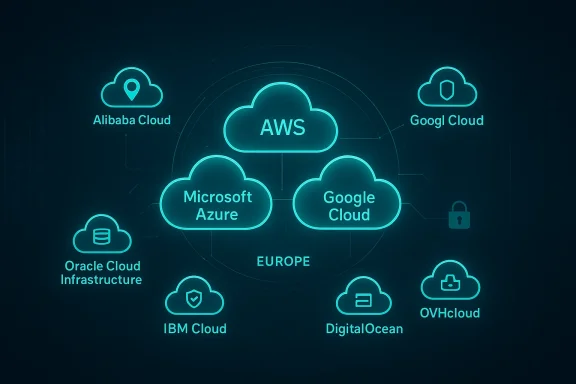
At the same time, the market has never been purely a three-horse race. Providers such as Alibaba Cloud, Oracle Cloud Infrastructure, IBM Cloud, DigitalOcean, and OVHcloud serve narrower but commercially important segments. Their value is often not total scale but fit: regional sovereignty, database performance, regulated-industry controls, startup simplicity, or cost predictability. That is why analyses of “largest cloud providers” need to separate global scale from strategic relevance.
Recent market estimates continue to show concentration at the top. By late 2025, the big three held roughly two-thirds of global cloud infrastructure spending, with AWS still first, Azure second, and Google Cloud third. That concentration matters because it shapes procurement behavior, partner strategy, and even regulatory scrutiny in the U.S., Europe, and the U.K.
The strategic significance of AWS is not simply that it is large, but that it remains the provider against which everyone else is measured. If a company can run efficiently on AWS, it often becomes easier to justify future migration, DevOps standardization, and third-party tooling investment. That self-reinforcing pattern is the reason AWS continues to matter even when competitors post faster growth rates.
Azure’s AI positioning has become a major differentiator. Microsoft is pushing Azure Copilot and related agentic cloud tools as operational accelerators for deployment, optimization, and troubleshooting. In market terms, that matters because enterprises rarely buy cloud capacity in isolation anymore; they buy a workflow, an operating model, and a governance framework.
The broader implication is that Google Cloud often wins on technical affinity rather than blanket enterprise standardization. For organizations building AI products or modern analytics platforms, Google’s stack can look more coherent than a generic infrastructure offering. That is a significant advantage in 2026 because AI buyers increasingly want more than raw virtual machines; they want an integrated path from data to inference to deployment.
The cloud market is often described as global, but in practice it is a patchwork of regional economies. Alibaba Cloud’s advantage is that it understands that fragmentation and has built around it. That matters for retail, logistics, fintech, and cross-border business models that need local presence rather than just generic scale.
OCI’s importance is often underestimated because its brand is associated with databases rather than cloud narrative hype. Yet that is exactly why it persists: it solves a very expensive problem for a class of enterprises that value determinism over novelty. In a market obsessed with AI branding, predictability is still a powerful selling point.
The key point is that IBM Cloud competes differently. It is not trying to out-AWS AWS; it is trying to integrate cloud adoption into broader transformation programs. That can be less visible in market-share charts, but it remains commercially meaningful in large regulated accounts.
OVHcloud plays a different game, emphasizing sovereignty, European compliance, and energy-conscious infrastructure. Its message resonates with buyers who care about where data resides and how infrastructure aligns with environmental or regulatory expectations. In a world of geopolitical uncertainty, that positioning is not a niche afterthought; it is a business case.
This also explains why growth rates can be more important than absolute size in some comparisons. A smaller provider may grow quickly, but if it is starting from a low base, it still has a long way to go before it challenges the leaders in overall strategic leverage. The gap can close in specific segments, though, which is why niche winners keep appearing.
Google Cloud’s analytics strengths, Azure’s enterprise AI integration, and AWS’s broad AI services each translate differently into buyer behavior. The common thread is that AI raises switching costs, because once teams build around a provider’s data and model tools, moving becomes more difficult. That is one reason cloud concentration may persist even as the market grows.
Hybrid and multi-cloud adoption also reflects organizational reality. Most companies cannot move every system, database, and compliance boundary at once, so they layer platforms over time. Azure has benefited here because Microsoft’s stack fits naturally into environments that straddle on-premises and public cloud.
That tension explains why the largest providers remain so influential. Even when buyers pursue diversification, they usually concentrate spending in a handful of ecosystems. The cloud market is therefore fragmented at the margin but concentrated at the center.
This is especially important in the AI era because buyers are not just migrating systems; they are rethinking how applications are built. If a cloud provider can shorten the distance between data, AI, and production deployment, it can capture new workloads before rivals even enter the evaluation process.
That scrutiny is not necessarily a threat to the leaders’ business models, but it can shape procurement expectations and pricing behavior. It also gives smaller providers a rhetorical opening to position themselves as more open, more local, or more customer-friendly alternatives.
What to watch next is not whether the leaders remain leaders, but how they defend those positions while AI reshapes demand. The market may stay concentrated, but the basis of competition is changing fast, and providers that cannot connect cloud infrastructure to real operational value will struggle to stay differentiated. In that sense, the future of cloud is less about who has the most servers and more about who turns infrastructure into an operating advantage.
Source: Analytics Insight What Are the Largest Cloud Providers?
 Background
The modern cloud market was built around the idea that compute, storage, and networking could be consumed as utilities rather than bought as fixed infrastructure. AWS pioneered that model at scale, and it still benefits from the deepest service catalog, the broadest partner ecosystem, and the strongest mindshare among developers. In practical terms, that early lead created a flywheel: more services attracted more customers, and more customers justified more services.Over time, Microsoft Azure turned the cloud race into a broader enterprise platform contest. Microsoft’s advantage has always been its installed base in corporate IT, especially Windows, Active Directory, Microsoft 365, and enterprise licensing relationships, and that advantage has only grown as organizations blend on-premises systems with public cloud. Azure’s current pitch is not merely “cloud hosting,” but a continuum from identity to productivity to AI-enabled operations.
Google Cloud entered from a different angle, emphasizing data analytics, Kubernetes, and AI-first infrastructure rather than the broadest enterprise sales footprint. That strategy has made it especially credible with data-heavy organizations and cloud-native engineering teams. It also gives Google a narrative advantage in the age of generative AI, where the value proposition increasingly centers on model access, data orchestration, and machine learning tooling.
At the same time, the market has never been purely a three-horse race. Providers such as Alibaba Cloud, Oracle Cloud Infrastructure, IBM Cloud, DigitalOcean, and OVHcloud serve narrower but commercially important segments. Their value is often not total scale but fit: regional sovereignty, database performance, regulated-industry controls, startup simplicity, or cost predictability. That is why analyses of “largest cloud providers” need to separate global scale from strategic relevance.
Recent market estimates continue to show concentration at the top. By late 2025, the big three held roughly two-thirds of global cloud infrastructure spending, with AWS still first, Azure second, and Google Cloud third. That concentration matters because it shapes procurement behavior, partner strategy, and even regulatory scrutiny in the U.S., Europe, and the U.K.
The Cloud Market Leaders
The most widely recognized answer to “Who are the largest cloud providers?” begins with the big three. AWS remains the benchmark for breadth, Azure is the enterprise integration champion, and Google Cloud is the fastest-rising platform in the data-and-AI conversation. Together, they define the mainstream market and set pricing, service expectations, and architectural norms.AWS: The default reference point
AWS is still the provider most people mean when they say “the cloud.” Its long-running leadership stems from the combination of early entry, massive global infrastructure, and an unusually rich developer ecosystem. AWS also keeps expanding into AI services and agentic workflows, which helps it defend its installed base while adding higher-value workloads.The strategic significance of AWS is not simply that it is large, but that it remains the provider against which everyone else is measured. If a company can run efficiently on AWS, it often becomes easier to justify future migration, DevOps standardization, and third-party tooling investment. That self-reinforcing pattern is the reason AWS continues to matter even when competitors post faster growth rates.
Azure: Enterprise gravity at work
Azure’s edge is not always raw technical superiority; it is context. Microsoft ties cloud, identity, productivity, security, developer tools, and AI assistants into a single enterprise story, which lowers the friction of adoption for large organizations already living inside the Microsoft stack. That makes Azure especially powerful in hybrid environments where companies cannot or do not want to move everything at once.Azure’s AI positioning has become a major differentiator. Microsoft is pushing Azure Copilot and related agentic cloud tools as operational accelerators for deployment, optimization, and troubleshooting. In market terms, that matters because enterprises rarely buy cloud capacity in isolation anymore; they buy a workflow, an operating model, and a governance framework.
Google Cloud: Data and AI credibility
Google Cloud has carved out a distinct identity by focusing on analytics, AI infrastructure, and Kubernetes leadership. The company’s positioning around BigQuery, GKE, and generative AI tooling makes it especially attractive to teams that think in terms of data pipelines, machine learning, and distributed applications. That focus has produced faster growth than some incumbents in certain periods, even if Google Cloud still trails AWS and Azure in total share.The broader implication is that Google Cloud often wins on technical affinity rather than blanket enterprise standardization. For organizations building AI products or modern analytics platforms, Google’s stack can look more coherent than a generic infrastructure offering. That is a significant advantage in 2026 because AI buyers increasingly want more than raw virtual machines; they want an integrated path from data to inference to deployment.
The Strong Second Tier
Below the hyperscalers sits a group of providers that matter enormously in specific markets. Alibaba Cloud, Oracle Cloud Infrastructure, IBM Cloud, DigitalOcean, and OVHcloud are not interchangeable, and they rarely compete head-to-head for the same enterprise brief. Their importance lies in specialization, where a clear niche can be more valuable than global sprawl.Alibaba Cloud’s regional strength
Alibaba Cloud remains deeply relevant in Asia-Pacific, particularly where local infrastructure, regulatory familiarity, and ecommerce-adjacent services matter. Its ongoing investments in availability zones and international expansion signal that it wants to be seen as more than a domestic Chinese champion. For multinational firms doing business in the region, that makes it strategically important even if it is not a Western default.The cloud market is often described as global, but in practice it is a patchwork of regional economies. Alibaba Cloud’s advantage is that it understands that fragmentation and has built around it. That matters for retail, logistics, fintech, and cross-border business models that need local presence rather than just generic scale.
Oracle Cloud Infrastructure and the database play
Oracle Cloud Infrastructure, or OCI, has built its case on predictable pricing, performance tuning, and deep database heritage. That combination makes OCI attractive to organizations whose workloads are tightly coupled to Oracle databases or legacy enterprise systems. In many migration deals, Oracle is less a broad cloud alternative than a financially and operationally rational landing zone.OCI’s importance is often underestimated because its brand is associated with databases rather than cloud narrative hype. Yet that is exactly why it persists: it solves a very expensive problem for a class of enterprises that value determinism over novelty. In a market obsessed with AI branding, predictability is still a powerful selling point.
IBM Cloud for regulated workloads
IBM Cloud tends to appeal where governance, security, consulting, and industry specialization matter more than sheer platform breadth. That makes it relevant in regulated sectors such as finance, government, and healthcare, where the cloud conversation is rarely just about instance types or storage tiers. IBM’s consulting-heavy model can also help enterprise buyers bridge architecture and compliance at the same time.The key point is that IBM Cloud competes differently. It is not trying to out-AWS AWS; it is trying to integrate cloud adoption into broader transformation programs. That can be less visible in market-share charts, but it remains commercially meaningful in large regulated accounts.
DigitalOcean and OVHcloud in the specialist lane
DigitalOcean has built a loyal audience by making cloud infrastructure feel approachable. Startups and developers often prefer its simpler pricing and cleaner interface because they do not need the complexity that hyperscalers bring. That simplicity is not a weakness; it is a product strategy aimed at reducing time-to-value.OVHcloud plays a different game, emphasizing sovereignty, European compliance, and energy-conscious infrastructure. Its message resonates with buyers who care about where data resides and how infrastructure aligns with environmental or regulatory expectations. In a world of geopolitical uncertainty, that positioning is not a niche afterthought; it is a business case.
Why Market Share Still Matters
Cloud rankings are not vanity metrics. In practice, market share influences partner ecosystems, hardware supply, talent availability, and the long-term confidence enterprises place in a platform. A provider with massive scale can afford more regions, more specialized services, and more aggressive AI investment, which in turn attracts more workloads.The economics of scale
At hyperscale, the economics become self-reinforcing. Bigger providers can spread capital expenditure across a larger customer base, negotiate better hardware terms, and amortize research and product development over more revenue. That is one reason the top three have maintained such a durable lead even as dozens of competitors have emerged.This also explains why growth rates can be more important than absolute size in some comparisons. A smaller provider may grow quickly, but if it is starting from a low base, it still has a long way to go before it challenges the leaders in overall strategic leverage. The gap can close in specific segments, though, which is why niche winners keep appearing.
The AI acceleration effect
AI has changed cloud competition because inference and training workloads are compute-hungry, sticky, and highly strategic. Cloud providers are no longer just selling infrastructure; they are selling the platform layer for model hosting, agent orchestration, security, and governance. That makes AI a multiplier for cloud growth rather than just a new feature category.Google Cloud’s analytics strengths, Azure’s enterprise AI integration, and AWS’s broad AI services each translate differently into buyer behavior. The common thread is that AI raises switching costs, because once teams build around a provider’s data and model tools, moving becomes more difficult. That is one reason cloud concentration may persist even as the market grows.
Multi-Cloud Is Now a Default Strategy
Modern organizations increasingly treat cloud as a portfolio rather than a singular destination. The main motivation is to avoid vendor lock-in, spread risk, and match each workload to the provider that best fits performance, cost, compliance, or geography needs. That is why the phrase multi-cloud has moved from architecture buzzword to board-level planning term.Enterprise pragmatism
For enterprises, multi-cloud is often less about ideological independence and more about negotiation leverage. Large buyers want to preserve optionality, especially when they know one provider may be better for AI, another for identity, and another for legacy migration. In this sense, multi-cloud is a procurement strategy as much as a technical architecture.Hybrid and multi-cloud adoption also reflects organizational reality. Most companies cannot move every system, database, and compliance boundary at once, so they layer platforms over time. Azure has benefited here because Microsoft’s stack fits naturally into environments that straddle on-premises and public cloud.
Technical trade-offs
Multi-cloud, however, is not free. It adds operational complexity, requires deeper platform engineering talent, and can fragment observability and security models. The result is that many organizations say they want multi-cloud flexibility but only implement it selectively where the business case is strongest.That tension explains why the largest providers remain so influential. Even when buyers pursue diversification, they usually concentrate spending in a handful of ecosystems. The cloud market is therefore fragmented at the margin but concentrated at the center.
Competitive Implications for Rivals
The top cloud providers do not merely compete on infrastructure; they compete on ecosystem capture. Whoever owns the developer workflow, the data layer, or the AI toolchain can shape future demand more effectively than whoever simply offers the cheapest virtual machine. That is why AWS, Azure, and Google keep investing in higher-level services rather than only raw compute.The race for platform stickiness
Stickiness is now built through services that reduce complexity, not just through capacity. Azure’s Copilot-oriented operating model, Google’s analytics and AI stack, and AWS’s agentic infrastructure all serve the same underlying goal: make the cloud more indispensable after the first migration. The provider that becomes embedded in workflows wins more than infrastructure spend; it wins organizational inertia.This is especially important in the AI era because buyers are not just migrating systems; they are rethinking how applications are built. If a cloud provider can shorten the distance between data, AI, and production deployment, it can capture new workloads before rivals even enter the evaluation process.
Regulatory and antitrust pressure
Dominance also invites scrutiny. The concentration of cloud infrastructure spending in a few providers has drawn attention from regulators and competition authorities, particularly where licensing practices or interoperability concerns may limit customer choice. In plain terms, the bigger the clouds get, the more they resemble utilities that governments may feel compelled to examine.That scrutiny is not necessarily a threat to the leaders’ business models, but it can shape procurement expectations and pricing behavior. It also gives smaller providers a rhetorical opening to position themselves as more open, more local, or more customer-friendly alternatives.
How the Ranking Changes by Use Case
The largest cloud provider for one workload is not always the largest provider for another. AI development, enterprise productivity, regional compliance, startup hosting, and database-heavy migration all reward different strengths. A useful cloud ranking therefore has to be contextual rather than absolute.Enterprise buyers
For enterprise buyers, Azure often looks strongest when Microsoft identity, endpoint management, security, and productivity are already in the environment. Oracle becomes more compelling when database modernization or pricing predictability matters, while IBM can be relevant when consulting, compliance, and sector specialization dominate the discussion. That is why enterprise cloud procurement is usually a portfolio decision, not a popularity contest.Developers and startups
For developers and startups, AWS and Google Cloud often dominate mindshare, but DigitalOcean remains powerful in the easy-to-start category. Google’s appeal is strongest where Kubernetes, analytics, and AI tooling matter, while AWS’s appeal is breadth and ecosystem density. DigitalOcean wins when teams want fewer layers between idea and deployment.Regional and sovereignty-driven buyers
In Asia-Pacific, Alibaba Cloud remains a major force because local presence matters more than global fame. In Europe, OVHcloud’s sovereignty and sustainability message can resonate with public-sector and regulated buyers. These providers may not dominate worldwide charts, but they dominate certain procurement conversations.Strengths and Opportunities
The cloud market’s concentration at the top is not just a competitive moat; it also creates space for innovation below the surface. The largest providers have the capital to invest in AI, security, and global infrastructure, while smaller platforms can win on simplicity, specialization, and sovereignty. That combination keeps the market dynamic even when the headline rankings barely move.- AWS benefits from unmatched breadth and a massive developer ecosystem.
- Azure gains from Microsoft’s enterprise footprint and hybrid-cloud credibility.
- Google Cloud has a strong opening in analytics, Kubernetes, and generative AI.
- Alibaba Cloud has durable regional relevance across Asia-Pacific.
- Oracle Cloud Infrastructure can monetize database gravity and migration demand.
- OVHcloud and DigitalOcean have clear positioning in sovereignty and simplicity.
- Multi-cloud adoption gives customers more bargaining power and architectural resilience.
Risks and Concerns
The biggest risk in the cloud market is not a lack of growth; it is concentration. When a small number of providers control most of the market, customers become more exposed to pricing changes, service disruptions, and ecosystem lock-in. That is why cloud procurement now involves not just performance analysis but strategic risk management.- Vendor lock-in can raise long-term switching costs.
- Price opacity can make cost forecasting difficult at scale.
- Regulatory scrutiny may intensify around competition and licensing.
- Operational complexity increases when multi-cloud is implemented badly.
- Regional fragmentation can complicate global application design.
- AI dependency may deepen concentration around a few model-rich platforms.
- Compliance pressure can force organizations into slower, more expensive architectures.
Looking Ahead
The next phase of cloud competition will likely be defined less by raw capacity and more by control points: AI orchestration, enterprise workflows, governance, and regional trust. AWS, Azure, and Google Cloud are best positioned to shape that future because they already own the platforms where those control points are being built. Still, niche providers will remain relevant where local rules, sector needs, or pricing models favor specialization.What to watch next is not whether the leaders remain leaders, but how they defend those positions while AI reshapes demand. The market may stay concentrated, but the basis of competition is changing fast, and providers that cannot connect cloud infrastructure to real operational value will struggle to stay differentiated. In that sense, the future of cloud is less about who has the most servers and more about who turns infrastructure into an operating advantage.
- AI-native cloud services that make model deployment and governance easier.
- Hybrid-cloud tooling that reduces friction between on-premises and public cloud.
- Regional expansion by providers targeting sovereignty-sensitive buyers.
- Database modernization as a continued driver for OCI and similar specialists.
- Regulatory action that could influence pricing, portability, or licensing.
- Startup-friendly alternatives that compete on simplicity and time-to-value.
Source: Analytics Insight What Are the Largest Cloud Providers?