

Latin American counsel are facing the familiar two‑edged reality of generative AI: a tangible lift in routine productivity alongside acute risks that threaten professional duties, client confidentiality, and reputations if systems are used without firm governance. The recent Law.com dispatch — which framed the region’s debate as one of both “perks and perils” — echoes conversations happening across global legal markets: pilots, selective rollouts and a growing insistence that AI must be used with human oversight and contractual controls. This feature examines what Latin American lawyers are doing now, why the choices matter, and how firms and in‑house teams can capture value without trading away ethical, security or regulatory obligations.
Source: Law.com Latin American Lawyers See Perks and Perils of AI Use| Law.com
 Background / Overview
The global context: from pilots to production
Generative AI has moved from experimental pilots into enterprise deployments across jurisdictions, driven by big‑vendor copilots and specialized legal models. Firms in many markets now run multi‑tool stacks combining enterprise copilots, retrieval‑augmented generation (RAG) indexes and vertical legal LLMs — a pattern that is beginning to appear in Latin America as well. This shift is not purely technological: it reshapes procurement, staffing, and professional compliance obligations, requiring coordinated policy, procurement and IT controls before matter‑level data is ingested.Where Latin America sits in that arc
Adoption in Latin America is best described as selective and cautious. Large firms and some corporates are running pilots or adopting verticalized tools for discrete, high‑volume tasks (NDA triage, transcript summarization, AML signals), while many practices remain at proof‑of‑concept stage because of language diversity, civil‑law data fragmentation and regulatory uncertainty. Latin American general counsel and firm partners repeatedly report the same calculus seen globally: efficiency gains are real, but so are the governance costs.What the recent reporting shows
The headline: benefits and immediate use cases
Reporting from the region highlights a set of near‑term, low‑risk uses where AI delivers measurable time savings:- First‑draft memos and correspondence — speeding initial drafting and iteration.
- NDA and routine contract triage — automated flagging of problematic clauses.
- Transcription and summarization — arbitration and deposition transcript condensation.
- Large‑scale AML or fraud triage — pattern detection for fintech platforms.
The darker side: hallucinations, sanctions and client risk
Generative models sometimes produce plausible‑sounding but false outputs — hallucinations — and the legal profession has already seen sanctions and serious remediation when fabricated authorities were filed. That reality drives a universal conclusion among regulators and senior partners: AI can assist but cannot replace lawyer verification. Latin American practitioners share the cautionary posture voiced elsewhere: human oversight is mandatory, especially for court filings, client advice and any work that will be relied upon externally.Why the region’s legal ecosystem is uniquely challenged
Language and legal system fragmentation
Latin America’s multiplicity of languages (Spanish, Portuguese, indigenous languages in some areas) and the diversity of civil‑law codes complicate off‑the‑shelf model performance. Models trained primarily on English common‑law materials will underperform in Latin American contexts unless retrained or augmented with regional corpora and terminologies. Localized datasets and legal benchmarks are needed to improve accuracy and reduce hallucination risk.Data sovereignty and cross‑border work
Many corporate matters involve data that must remain in a specific jurisdiction for privacy or evidentiary reasons. Vendor platforms that retain or use matter data for model retraining raise contractual and regulatory red flags. Argentine, Brazilian and Mexican privacy regimes (and general cross‑border compliance considerations) push firms to insist on no‑retrain, deletion guarantees and residency clauses during procurement. These are non‑trivial negotiation points with large platform vendors.Skills and apprenticeship concerns
Junior lawyers traditionally learn by drafting and redlining. If AI performs that routine work without training safeguards, the apprenticeship ladder can fray. Firms that want to scale AI but preserve future talent pipelines must redesign training programs to pair automation with supervised learning and competency milestones. That work increases upfront human capital cost even as unit drafting time falls.Governance and procurement: what Latin American firms must demand
Essential contractual protections
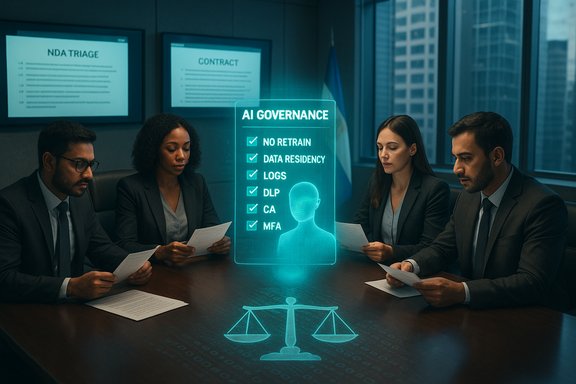
Procurement teams should not treat AI vendors as ordinary SaaS vendors; they must extract specific AI‑era clauses:- No‑retrain/no‑use of matter data without express consent.
- Deletion guarantees with audit evidence.
- Exportable logs of prompts/responses and model versions.
- SLAs for incident response, and SOC 2 / ISO 27001 attestations.
- Clear data‑residency options (on‑prem or private cloud where required).
Technical controls and tenant grounding
Before matter ingestion, IT must enforce tenant grounding and endpoint protections:- Tenant grounding to confine RAG indices and connectors to firm‑owned infrastructure.
- Endpoint DLP to prevent copy/paste into public chatbots.
- Conditional Access and MFA for AI invocation.
- Immutable logging for audit and eDiscovery.
Human‑in‑the‑loop and sign‑off policies
Any AI‑assisted output intended for court, client delivery or public dissemination must pass a documented verification workflow that records who checked the output and what sources were confirmed. Human verification is not a checkbox — it is the legal profession’s duty of competence. Firms should embed sign‑off templates into matter management systems, linking verified outputs to audit trails.Practical use cases & pilot design (a step‑by‑step playbook)
- Start with low‑risk, high‑volume tasks: NDAs, discovery triage, deposition transcription summarization. Measure time saved and error rate.
- Run parallel vendors in blind tests. Validate outputs against gold‑standard human work and record hallucination rates.
- Negotiate procurement redlines (no‑retrain, deletion, logs) before enabling connectors to firm mailboxes or drives.
- Implement tenant grounding, Endpoint DLP and Conditional Access before matter injection. Log model version and prompt/response for every AI invocation.
- Create mandatory training and micro‑certifications in “prompt hygiene,” hallucination detection and verification workflows. Pair automation with rotational assignments to preserve learning.
- Define KPIs that measure both efficiency and quality: error rate, verification time per document, partner review time, and client satisfaction. Track these monthly and adjust governance thresholds accordingly.
Regional examples and vendor landscape
Who is already moving
Reports show Latin American firms and corporate legal teams are piloting or adopting enterprise and specialist tools. Examples include Harvey AI deployments across firm offices in multiple Latin American countries and banks using ML for AML triage on customer platforms. These deployments underscore both the utility and the need for local tuning.The multi‑vendor reality
No single product covers every workflow. Large productivity copilots integrate tightly with document workflows, while specialist legal LLMs and RAG solutions provide better provenance and fine‑tuned legal outputs. Firms typically adopt a multi‑vendor stack, balancing integration convenience against the need for specialized accuracy and contractual protections. A best‑of‑breed approach reduces single‑vendor lock‑in but increases procurement and governance complexity.Regulatory and professional oversight — what to expect next
Bar associations and judges are paying attention
Bar regulators and courts in various jurisdictions have already taken positions or issued guidance stressing that lawyers must verify AI outputs, preserve auditable logs, and disclose material AI use when required. Expect more formalized rules and possible reporting requirements in the next 12–24 months as high‑profile incidents shape policy.Data protection enforcement and contracts
Privacy authorities will scrutinize cross‑border transfers and vendor retraining practices. Contracts that merely rely on vendor statements will not suffice; firms should require enforceable deletion and non‑training clauses and technical attestations that can be audited during incident response.Standards and provenance work
Standards bodies (e.g., NIST and regional equivalents) are advancing detection and provenance frameworks that will increasingly inform court practices and procurement norms. Firms that build machine‑readable provenance into their AI processes will be better positioned in adversarial settings and regulatory reviews.Risks that deserve special emphasis
- Hallucinations with legal consequences — fabricated cases or mischaracterized holdings have led to show‑cause orders and sanctions in multiple jurisdictions; this risk is not theoretical and demands policy responses.
- Data leakage and model retraining — matter text routed into vendor models without explicit contract protection can be retained and used to retrain models, exposing client secrets.
- Deskilling and apprenticeship loss — if automation replaces formative tasks without redesigned learning pathways, firms risk producing lawyers who can verify but not reason from first principles.
- Vendor lock‑in and exit fragility — deep integration with one vendor’s copilot can create switching costs and operational fragility; firms must negotiate exit and data egress rights.
Critical analysis: strengths, blind spots and tradeoffs
Strengths — what’s genuinely promising
- Productivity gains are real and measurable. Early adopters consistently report time savings on routine tasks and faster client turnaround. When combined with robust verification, these gains can improve competitiveness and client value.
- Operational re‑engineering potential. AI forces firms to codify precedent, standardize templates and invest in knowledge engineering — improvements that have long‑term benefits for quality and reuse.
- New career pathways. Roles such as AI verifiers, knowledge managers and prompt engineers expand the profession’s skill base rather than simply eliminating roles.
Blind spots and overclaims to watch for
- Headline productivity numbers often omit verification overhead. A quoted “hours saved” metric is meaningless unless it accounts for the time spent checking, correcting and documenting AI outputs. Treat vendor ROI claims as directional until verified in local pilots.
- Underestimating legal/regulatory friction. Local data‑protection law and court expectations about provenance can materially constrain matter‑level use — firms must stress‑test pilot assumptions against worst‑case regulatory scenarios.
- Assuming uniform model performance across languages and systems. Off‑the‑shelf English‑centric models will not reliably handle civil‑law nuance or Spanish/Portuguese variants without localized training or vetted RAG indexes.
A practical risk‑reward stance
For Latin American firms the pragmatic posture is to adopt selectively and govern strictly. That means starting with workflows that yield a high return and low litigation/regulatory exposure, while building the procurement and technical framework needed before scaling. Firms that rush to blanket adoption will face the twin costs of compliance remediation and reputational damage.Cross‑checking notable claims and a note on verifiability
The Law.com piece that sparked this coverage summarizes regional sentiment and quotes practitioners about cautious adoption and governance. Several independent outlets and trade reports corroborate the broader claims — pilots, targeted use cases, and governance demands are visible across Global Legal Post and regional reporting. However, specific quotations attributed to individual partners or exact statistics reported in a paywalled piece should be treated cautiously until independently verified; journalists and procurement teams should obtain the original text or contact the quoted firms for confirmation before relying on a single published line. Where public court orders or regulatory statements exist (e.g., show‑cause orders involving AI‑tainted filings), those are verifiable and already inform firm policies.Recommended playbook for Latin American law firms and legal departments
- Establish a cross‑functional AI governance committee: partners, IT/security, procurement, knowledge managers and compliance officers.
- Run short redacted pilots in a single practice group with blind validation against human gold standards. Record time‑savings, error rates and verification burdens.
- Negotiate procurement redlines before enabling connectors: no‑retrain, deletion guarantees, exportable prompt/response logs and data residency.
- Lock technical controls first: tenant grounding, Endpoint DLP, Conditional Access, and mandatory logging. Do not permit matter ingestion until these are in place.
- Require human sign‑off and document verification steps for any externally relied output; link verification proofs to the matter file.
- Protect training and apprenticeship: redesign rotations to ensure junior lawyers still do substantive drafting, or certify verification competence through micro‑credentials.
Conclusion
Latin American legal markets stand at a pragmatic crossroads. Generative AI delivers demonstrable productivity improvements in standardized, high‑volume workflows, and regional firms are beginning to capture those gains. But the legal profession’s duty of competence, combined with data‑protection realities and language/system fragmentation, demands that adoption be disciplined: pilot, measure, govern, and only then scale. Firms that build rigorous procurement controls, tenant‑level protections and documented human‑in‑the‑loop workflows will realize sustainable competitive advantage. Those that treat AI as a convenience and skip the governance will risk the very reputational and regulatory harms that the profession exists to avoid.Source: Law.com Latin American Lawyers See Perks and Perils of AI Use| Law.com
