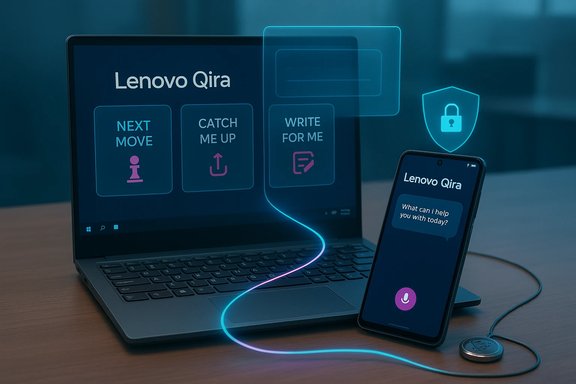
Lenovo’s Qira arrives as a new kind of personal AI: not a standalone chatbot but a system-level, cross-device “personal ambient intelligence” that follows you from phone to PC to future wearables, promises to reduce the costly friction of context switching, and orchestrates when and where AI work runs—on-device or in the cloud—based on intent, privacy, and performance.
Lenovo announced Qira at CES 2026 as a unified intelligence that appears as Lenovo Qira on Lenovo products and Motorola Qira on Motorola phones. Built as an ambient, persistent layer rather than an app you open, Qira is designed to maintain a private, user-permissioned memory of what you’re doing and to anticipate your next move. Key capabilities shown at the reveal and in early hands‑on coverage include context-aware handoffs across devices (the “Next Move” experience), integrated writing/summary tools, hybrid on-device/cloud routing for AI tasks, and exploratory proof‑of‑concept wearables such as a neck pendant and smart glasses.
This is a strategic play on several fronts: it leans into the industry shift toward AI-capable PCs built around Neural Processing Units (NPUs), positions Lenovo as an orchestration layer that can cooperate with platform services (notably Microsoft Copilot), and reframes productivity problems—like the real-world cost of task switching—as solvable through persistent context and intelligent handoffs.
Qira reframes the assistant as a continuous personal memory and orchestration system. Instead of asking you to summon an app, Qira remains present, infers intent from recent activity, time, and location, and proactively surfaces the right content or next action on whichever device you’re using. That ambition targets a clear pain point: research on interruptions and attention suggests returning to deep work after an interruption can take tens of minutes, a drain that compounds across a workweek. Lenovo positions Qira as a practical way to preserve flow by minimizing those small, frequent context switches.
This hybrid approach is designed to balance three competing demands:
For users and enterprises that have already invested in Copilot and Windows AI tooling, this cooperative model reduces duplication and increases value: Qira preserves personal context across devices and then invokes Copilot’s capabilities on demand. For developers and IT teams, Qira’s orchestration model suggests a future where different agents and models are composed dynamically across local and cloud resources, which changes how we think about integration and data governance.
A few important hardware realities:
Notable design commitments announced:
Reality check: privacy promises are necessary but not sufficient. Implementation details matter: where encryption keys are stored, what telemetry Lenovo collects, how long context memories persist, how enterprise data is segmented, and what legal safeguards apply across jurisdictions are all operational questions that will determine whether Qira earns trust.
Practical UX considerations that will determine success:
If Lenovo executes on its privacy commitments, provides transparent controls, and solves the thorny UX problems that make proactive AI feel helpful rather than intrusive, Qira could become the connective tissue many multi-device users have long wanted. But the company must also navigate hard trade-offs: battery and thermal constraints, privacy and regulatory scrutiny, cross-device standardization, and the inevitable variability of user expectations across platforms.
Qira’s success will be judged not by the novelty of its demos, but by whether it reduces the daily cognitive load of switching between devices and tasks—returning minutes to people’s workdays and, more importantly, preserving the deeper flow states that lead to sustained productivity. The technical pieces—NPUs in the 40–50 TOPS class, hybrid orchestration, and OTA expansion paths—are aligning. The human pieces—trust, control, subtle UX, and cross‑vendor cooperation—are where the heavyweight work begins.
Source: findarticles.com Lenovo unveils Qira, a cross-device personal AI platform
 Overview
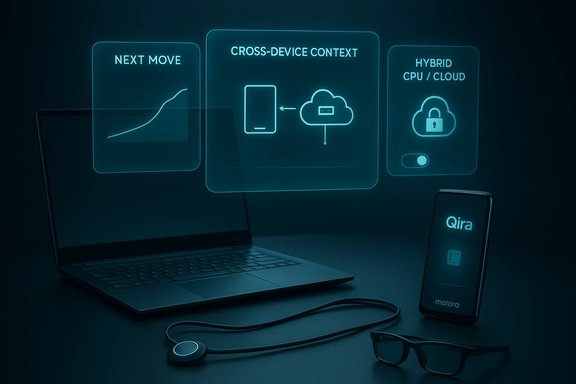
Lenovo announced Qira at CES 2026 as a unified intelligence that appears as Lenovo Qira on Lenovo products and Motorola Qira on Motorola phones. Built as an ambient, persistent layer rather than an app you open, Qira is designed to maintain a private, user-permissioned memory of what you’re doing and to anticipate your next move. Key capabilities shown at the reveal and in early hands‑on coverage include context-aware handoffs across devices (the “Next Move” experience), integrated writing/summary tools, hybrid on-device/cloud routing for AI tasks, and exploratory proof‑of‑concept wearables such as a neck pendant and smart glasses.This is a strategic play on several fronts: it leans into the industry shift toward AI-capable PCs built around Neural Processing Units (NPUs), positions Lenovo as an orchestration layer that can cooperate with platform services (notably Microsoft Copilot), and reframes productivity problems—like the real-world cost of task switching—as solvable through persistent context and intelligent handoffs.
Background: why Lenovo is betting on a “personal AI twin”
For years the PC market has been moving beyond raw CPU/GPU metrics toward specialized AI acceleration. Device makers and platform companies are now competing on how intelligence appears to the user: single‑device assistants (phone or laptop), cloud-only models, and emergent hybrid approaches that mix local inference with cloud-based models. Lenovo’s bet is that the real user problem is continuity: people move between devices constantly and lose context—tabs, open documents, notes, and partially completed tasks—when they switch.Qira reframes the assistant as a continuous personal memory and orchestration system. Instead of asking you to summon an app, Qira remains present, infers intent from recent activity, time, and location, and proactively surfaces the right content or next action on whichever device you’re using. That ambition targets a clear pain point: research on interruptions and attention suggests returning to deep work after an interruption can take tens of minutes, a drain that compounds across a workweek. Lenovo positions Qira as a practical way to preserve flow by minimizing those small, frequent context switches.
How Qira works across devices
Next Move: intent-aware handoffs
At the core of the demo is Next Move—an intent-aware handoff that uses your recent activity, device state, time of day, and location to infer what you want to do next. Examples shown include:- Research on a Motorola Razr during a commute, then opening a Lenovo Yoga to find the same browser pages, notes, and documents already queued.
- A “Catch Me Up” or “Write For Me” prompt that summarizes missed conversations, recent edits, or inbox items, surfaced when you return to your laptop after being away.
Orchestration, not replacement
Lenovo positions Qira as an orchestration layer that doesn’t replace third‑party assistants or models. Instead, it decides which compute and model best serve the task. For light, latency-sensitive tasks, Qira will run locally on NPUs. For heavy multimodal reasoning or long-form summarization, it will dispatch work to cloud models such as Copilot or other third‑party services. The idea is to route work like a conductor assigning parts to instruments—local NPUs for snappy, private work; cloud models for heavy lifting.This hybrid approach is designed to balance three competing demands:
- Latency: local inference reduces round trips.
- Privacy: sensitive context can be kept on-device.
- Capability: cloud models remain available when bigger model muscle is needed.
Hybrid AI orchestration and Microsoft Copilot
One of Qira’s most consequential design choices is that it will cooperate with Microsoft’s Copilot rather than compete head-on. Lenovo has signaled close alignment with Microsoft’s platform strategy: Qira can dispatch tasks to Copilot and other models when appropriate, acting as the persistent context layer that supplies the right data and instructions.For users and enterprises that have already invested in Copilot and Windows AI tooling, this cooperative model reduces duplication and increases value: Qira preserves personal context across devices and then invokes Copilot’s capabilities on demand. For developers and IT teams, Qira’s orchestration model suggests a future where different agents and models are composed dynamically across local and cloud resources, which changes how we think about integration and data governance.
Hardware and NPU readiness: why the silicon matters
Qira’s effectiveness depends on on-device AI hardware—NPUs—and Lenovo is explicit that Qira will initially ship on devices with sufficient NPU performance and memory. The rollout starts on select new Lenovo and Motorola systems in Q1 2026, with OTA updates expanding support over time as silicon improves.A few important hardware realities:
- Early AI PCs tended to have relatively modest NPUs, in the ~10–11 TOPS range, which supports basic features but isn’t enough for many on-device generative or multimodal tasks.
- Industry thresholds have coalesced around 40 TOPS of NPU performance for richer on-device AI experiences (often referenced with Microsoft Copilot+ requirements).
- Current higher-end mobile and AI-focused chips now ship with NPUs in the 40–50 TOPS range—enough to run many modern on-device models with acceptable responsiveness.
- Vendors and startups are working toward 100 TOPS‑class NPUs, which would materially expand what can be run entirely on device; those parts are described as “on the horizon” rather than broadly available today.
Extending Qira into wearables and ambient sensing
Lenovo demonstrated several proofs of concept that show how Qira could live beyond laptops and phones:- A Motorola pendant concept (codenamed Project Maxwell), shown as a neck-worn amulet with voice and environmental sensing.
- Concept smart glasses that could surface short content snippets and notifications tied to context.
- Ambient desk and wall sensors that detect presence and meeting context.
- Tiny form factors are severely compute‑ and battery‑constrained. Rings and small pins today lack the power budgets for sustained NPU use.
- Connectivity is viable—Bluetooth and Wi‑Fi can move context between devices—but the real challenge is getting useful, private processing in tiny packages without frequent charging.
- The user experience risk is high: always‑listening or sensing devices trigger privacy, social, and regulatory concerns that must be handled delicately.
Privacy, permissions, and the “permission bubble”
Qira’s value is deeply tied to sensitive personal context: what you’re looking at, where you are, meeting content, and your activity timeline. Lenovo presents privacy as a core principle—data use will be explicit and permission-based, with controls over what stays local and what may be sent to the cloud.Notable design commitments announced:
- A bias toward on‑device processing where feasible.
- Explicit, granular toggles so users can control which contexts Qira stores and shares.
- Transparency about data flows and user consent prompts.
Reality check: privacy promises are necessary but not sufficient. Implementation details matter: where encryption keys are stored, what telemetry Lenovo collects, how long context memories persist, how enterprise data is segmented, and what legal safeguards apply across jurisdictions are all operational questions that will determine whether Qira earns trust.
Competition and ecosystem dynamics
Qira launches into a crowded landscape where Apple, Google, Microsoft, and Samsung are all building their own assistant or ecosystem-level intelligence. Each competitor has a unique advantage:- Apple: deep hardware-software integration across iPhone, iPad, and Mac; strong privacy messaging.
- Google: cloud scale, search integration, and strength in multimodal models.
- Microsoft: Windows platform reach and Copilot ecosystem for enterprise workflows.
- Samsung: tight integration with Galaxy devices and wearables.
- Cross‑platform breadth—a deliberate play to unify Windows laptops, Android phones, and third‑party wearables under one persistent personal AI experience.
- Ecosystem openness—Lenovo emphasizes cooperation with Microsoft Copilot and third-party model partners, and shows integrations with services like Expedia and Perplexity.
Strengths: where Qira could genuinely help
- Real productivity gain: By minimizing manual reconstruction of context—reopening tabs, hunting for files, or recreating where you left off—Qira could reclaim the minutes and hours lost to context switching.
- Hybrid routing: Automated routing of tasks to local NPUs or cloud models promises better latency, privacy, and cost control.
- Platform-agnostic continuity: If the cross-device handoff experience is smooth and reliable, Qira addresses a long-standing UX gap between mobile and PC workflows.
- Enterprise potential: For organizations that standardize on Lenovo hardware and Microsoft services, Qira could meaningfully reduce friction in hybrid work scenarios.
- OTA expansion: Rolling out capabilities via over-the-air updates lets Lenovo broaden device support as NPUs and optimizations improve.
Risks and open questions
- Privacy and trust: Persistent device memories mean sensitive profiles will be built. Implementation details (local encryption, retention policies, telemetry opt‑in, enterprise controls) will determine acceptance.
- Overreach and intrusiveness: Proactive suggestions are useful only if they’re accurate and non-intrusive. Poor suggestions or frequent false positives will erode trust quickly.
- Battery life and thermal trade-offs: Sustained on-device inference can drain batteries. Users will disable features that significantly impact runtime.
- Fragmentation and inconsistent UX: With a range of NPUs and power envelopes across devices, Qira experiences may vary widely, complicating user expectations.
- Regulatory scrutiny and bystander privacy: Always‑on sensing devices will attract regulatory attention; cross-border privacy requirements create compliance complexity.
- Vendor lock and data portability: If the “personal memory” is deeply tied to Lenovo’s cloud or formats, users may face lock-in; clear export controls and standards are essential.
What enterprise IT and privacy teams should watch for
- Data governance controls: How does Qira segment corporate context from personal data? Can enterprise admins control retention, export, and model access?
- Encryption and key management: Are keys held on-device, and can enterprises enforce hardware-backed key policies?
- Auditability: Will Qira provide logs and audit trails for actions—especially when it automates tasks across cloud services?
- Compliance: How does Qira handle regulated data (health, finance) and cross-jurisdictional rules like GDPR or sectoral requirements?
- Onboarding and opt-in: Enterprises will need clear deployment modes: per-user opt-in, admin-managed provisioning, and policies for BYOD scenarios.
UX realities: subtlety matters
Qira’s promise rests as much on nuance as technical capability. Predicting a user’s “next move” requires not only accurate sensors and models but good timing and subtlety of presentation. The difference between a helpful suggestion and an intrusive interruption is often tone and frequency.Practical UX considerations that will determine success:
- Lightweight, skippable suggestions rather than modal interruptions.
- Clear, reversible actions: easy ways to “undo” automated moves.
- A transparent memory dashboard where users can see, edit, and delete Qira’s stored context.
- Per-app and per-device toggles so users can limit Qira’s scope in high-security workflows.
Ecosystem requirements: standards, APIs, and "permission bubbles"
For Qira to deliver cross-vendor continuity at scale, several ecosystem advances are necessary:- Standardized permission signaling: Ideas such as a “permission bubble” for bystander sensors will only work if devices across brands honor a common protocol.
- Interoperable context APIs: Third‑party apps need safe, consistent APIs to share state with Qira without exposing private data to other apps.
- Developer tools and SDKs: To make Qira useful across apps, Lenovo will need mature SDKs and documentation for app integration, with clear privacy guardrails.
- Enterprise management APIs: IT teams require APIs to integrate Qira with device management platforms and security controls.
The competition: where Qira fits in the market
- Apple’s ecosystem offers deep continuity across native devices—Qira’s advantage is breadth across multiple vendors and OSes.
- Google and Samsung are both pushing ambient intelligence on Android devices—Lenovo’s differentiator is system-level integration across Windows laptops and Motorola phones.
- Microsoft’s Copilot provides strong cloud/OS integration—Qira aims to complement Copilot by supplying persistent personal context and choosing when to call Copilot.
Practical advice for early adopters
- Expect Qira to be a staged rollout. Early devices will expose core features, while richer wearables and ambient experiences will be proofs of concept for the mid-term.
- Try Qira in a controlled fashion: enable context syncing for categories you trust first (documents, browser tabs) and keep highly sensitive data local until you confirm retention and access policies.
- Watch battery impact on devices with active NPUs—turn off proactive features if runtime suffers.
- For enterprises, pilot Qira in non‑sensitive groups and insist on audit logs and exportable policies before broad deployment.
Final appraisal: an ambitious connective tissue with real promise—and real responsibility
Lenovo Qira is a credible, pragmatic attempt to solve a familiar and expensive human problem: context switching. Its strength comes from a patient engineering approach that unifies system-level context across devices, makes measured use of local NPUs, and explicitly chooses cooperation over competition with existing platform services.If Lenovo executes on its privacy commitments, provides transparent controls, and solves the thorny UX problems that make proactive AI feel helpful rather than intrusive, Qira could become the connective tissue many multi-device users have long wanted. But the company must also navigate hard trade-offs: battery and thermal constraints, privacy and regulatory scrutiny, cross-device standardization, and the inevitable variability of user expectations across platforms.
Qira’s success will be judged not by the novelty of its demos, but by whether it reduces the daily cognitive load of switching between devices and tasks—returning minutes to people’s workdays and, more importantly, preserving the deeper flow states that lead to sustained productivity. The technical pieces—NPUs in the 40–50 TOPS class, hybrid orchestration, and OTA expansion paths—are aligning. The human pieces—trust, control, subtle UX, and cross‑vendor cooperation—are where the heavyweight work begins.
Source: findarticles.com Lenovo unveils Qira, a cross-device personal AI platform