

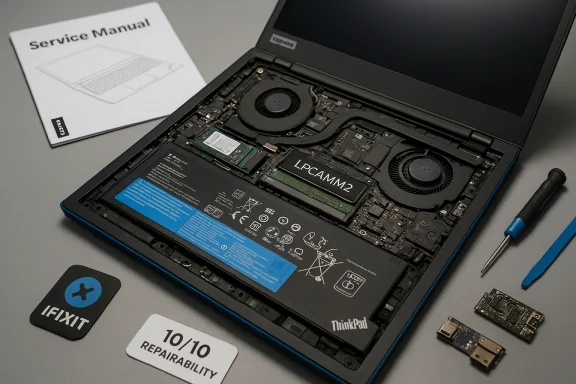
Lenovo’s newest ThinkPad lineup just did something most OEMs only talk about: it made repairability a first-class design goal—and iFixit’s teardown team thinks the result deserves the highest possible score. The ThinkPad T14 (Gen 7) and ThinkPad T16 (Gen 5) earned a provisional 10/10 repairability from iFixit after a teardown that highlighted modular components, intentionally serviceable layouts, and a return of upgradeable memory in important SKUs. This isn’t an incremental step for Lenovo; it’s a shift in priorities that could alter fleet procurement, device lifecycle economics, and the broader market conversation about repairability and sustainability. (ifixit.com)
Lenovo revealed the refreshed ThinkPad T-series at Mobile World Congress (MWC) 2026 as part of a wider set of Copilot+ business devices. The key talking points from Lenovo were consistent: platform choice (Intel Core Ultra Series 3, AMD Ryzen AI Pro 400 Series, and Qualcomm Snapdragon X2 variants), improved collaboration hardware (optional 5MP camera, larger speakers), and—crucially—serviceability by design. Lenovo’s own announcement frames the new T-series as explicitly engineered for easier maintenance, longer lifecycles, and lower total cost of ownership for enterprise customers. (news.lenovo.com)
Independent teardown specialists at iFixit—who helped consult with Lenovo during the development cycle—published a detailed breakdown and awarded the T14 Gen 7 and T16 Gen 5 a provisional 10/10 repairability score, noting that this is the first time a T‑series ThinkPad has reached iFixit’s top rating. iFixit stresses that the score is provisional pending availability of official replacement parts and documentation, but their analysis points to concrete design decisions that make service and upgrades much more practical than on previous generations. (ifixit.com)
Industry press picked this up widely: hands-on coverage and launch roundups from outlets such as Tom’s Hardware and NotebookCheck reinforced the narrative that Lenovo prioritized modular parts and easier access in this generation. Those writeups echoed Lenovo’s message that the T-series remains the commercial “workhorse” line—now with a stronger emphasis on repairability.
Why this matters:
That said, the headline score doesn’t erase practical questions: official parts availability, documentation, actual module pricing, and the scope of modularity across SKU variants will determine whether the theoretical benefits translate into operational value. iFixit’s provisional caveat is important: a perfect teardown matters far less than a complete, well-supported repair ecosystem. Enterprises should validate spare-part pipelines and regional support before assuming lifecycle benefits. (ifixit.com)
If Lenovo follows through on parts availability and documentation—making 10/10 the new baseline across more of its portfolio—this generation could accelerate an industry-wide correction: repairability ceases to be an anomaly and becomes a procurement expectation. That would be a win for IT departments, consumers, and the planet. For now, the T14 Gen 7 and T16 Gen 5 are an exciting proof point: mainstream repairability is real, measurable, and finally present in the machines that run most corporate desks. (ifixit.com)
Source: Windows Central This new ThinkPad is so repairable it shocked iFixit
 Background / Overview
Lenovo revealed the refreshed ThinkPad T-series at Mobile World Congress (MWC) 2026 as part of a wider set of Copilot+ business devices. The key talking points from Lenovo were consistent: platform choice (Intel Core Ultra Series 3, AMD Ryzen AI Pro 400 Series, and Qualcomm Snapdragon X2 variants), improved collaboration hardware (optional 5MP camera, larger speakers), and—crucially—serviceability by design. Lenovo’s own announcement frames the new T-series as explicitly engineered for easier maintenance, longer lifecycles, and lower total cost of ownership for enterprise customers. (news.lenovo.com)Independent teardown specialists at iFixit—who helped consult with Lenovo during the development cycle—published a detailed breakdown and awarded the T14 Gen 7 and T16 Gen 5 a provisional 10/10 repairability score, noting that this is the first time a T‑series ThinkPad has reached iFixit’s top rating. iFixit stresses that the score is provisional pending availability of official replacement parts and documentation, but their analysis points to concrete design decisions that make service and upgrades much more practical than on previous generations. (ifixit.com)
Industry press picked this up widely: hands-on coverage and launch roundups from outlets such as Tom’s Hardware and NotebookCheck reinforced the narrative that Lenovo prioritized modular parts and easier access in this generation. Those writeups echoed Lenovo’s message that the T-series remains the commercial “workhorse” line—now with a stronger emphasis on repairability.
What Changed: The Engineering Moves That Delivered Repairability
iFixit laid out a set of tangible, repeatable design choices that pushed the T14/T16 to the top of their scoring rubric. These aren’t marketing platitudes—these are component-level, process-level, and documentation decisions that affect whether a repair is practical for in-house IT, independent service centers, or end-users.Key repairable areas called out by iFixit
- Nearly tool-free battery removal: the battery can be accessed and removed with minimal tooling, lowering downtime for a common wear item. (ifixit.com)
- Industry-standard M.2 SSD: maintaining a user‑serviceable M.2 slot ensures storage upgrades and replacements are straightforward. (ifixit.com)
- One of the easiest keyboard replacements iFixit has seen: Lenovo reworked the keyboard access path so that keyboard swaps don’t require a near-total teardown. (ifixit.com)
- LPCAMM2 memory on supported Intel SKUs: the reintroduction of modular LPDDR-style CAMM2 modules (LPCAMM2) brings upgradeability to architectures that previously relied on soldered-down memory. (ifixit.com)
- Streamlined display repairs: display assembly swaps are more accessible than in recent generations, though iFixit notes there’s still some adhesive to contend with on panel-level repairs. (ifixit.com)
- Modular cooling and replaceable fan: cooling assemblies and fans can be serviced separately, which simplifies fixes for thermal wear and noisy fans. (ifixit.com)
- Fully modular Thunderbolt / USB‑C ports: high-wear USB‑C/Thunderbolt components are modular and individually replaceable—an important win for real-world serviceability. (ifixit.com)
Technical Deep Dive: LPCAMM2 and Why It Matters
One of the most consequential technical moves in the new T14 (on certain Intel SKUs) is the use of LPCAMM2 memory—LPDDR in a modular CAMM2 form factor. CAMM2 is a JEDEC-backed module standard designed to replace traditional SO‑DIMMs in thin devices; LPCAMM2 is the low-power variant that allows LPDDR5/LPDDR5X to be packaged as a removable module instead of being soldered to the motherboard. That makes upgradeability feasible again for thin-and-light business machines that want LPDDR power-efficiency advantages without sacrificing serviceability.Why this matters:
- LPDDR historically offered lower power draw and better thermals but was typically soldered, preventing post‑purchase upgrades.
- CAMM2 flips the form factor: a thin, flat module secured by compression and screws, parallel to the PCB. LPCAMM2 allows vendors to offer LPDDR performance with replaceable/upgradable modules.
- For enterprise fleets, LPCAMM2 means IT managers can spec devices for power efficiency and still maintain upgrade paths for higher capacity down the line—potentially reducing early obsolescence and lowering lifecycle costs.
The Enterprise Case: Procurement, TCO, and Fleet Management
For organizations buying by the pallet, repairability is a financial lever. A machine that is cheaper to service reduces mean time to repair (MTTR), lowers spare-part inventories, and extends replacement cycles.- Lower repair costs: modular parts and fewer adhesive-heavy assemblies mean quicker repairs and less expensive labor per incident.
- Reduced downtime: nearly tool‑free swaps and modular high-wear parts (battery, Thunderbolt ports, fan) minimize time a device spends in the repair queue.
- Longer useful life: upgradeable storage and memory (where available) increase resellable value and delay full device replacement, reducing depreciation and e-waste.
- Procurement shift: iFixit and Lenovo both emphasize that repairability should be a procurement checklist item, not a fringe specification. A high repairability score from a recognized third party like iFixit can be persuasive in RFPs. (ifixit.com)
- Are OEM spare parts available globally and at scale?
- Are official service manuals and step-by-step repair documents published quickly and kept current?
- Does warranty/policy allow in-house repairs or only OEM-authorized centers?
- Are critical parts (LPCAMM2 modules, replacement display panels, Thunderbolt assemblies) stocked or easy to source from third parties?
Strengths: Where Lenovo Earned Praise
- Mainstreaming repairability: this is a ThinkPad T-series laptop—a high-volume, enterprise-focused product line. Making those machines highly repairable shifts expectations industry-wide. iFixit emphasized that repairability has to reach the mainstream to create systemic change. (ifixit.com)
- Preserves core ThinkPad qualities: Lenovo aimed to keep thermal performance, keyboard feel, and durability while still improving serviceability. The engineering trade-offs look intentional rather than accidental. (news.lenovo.com)
- Modularity where it matters: modular Thunderbolt/USB‑C, fan, battery, M.2 SSD—these are realistic, high-value wins that match real-world failure modes. (ifixit.com)
- Memory upgrade path reintroduced: LPCAMM2 on Intel SKUs restores an upgrade option that power users and corporate IT have long demanded. (news.lenovo.com)
Risks, Limitations, and Open Questions
No design is perfect. iFixit itself and independent reviewers flagged several caveats that buyers and IT teams need to weigh.1) Provisional nature of the score — parts and manuals still pending
iFixit explicitly labeled its 10/10 as provisional until Lenovo publishes official replacement parts and documentation at scale. That matters—a great design on paper still needs a supply pipeline and published repair guides to deliver real-world benefit. Enterprise procurement teams should confirm Lenovo’s parts catalogue, S/N lookup for compatibility, and regional parts availability timelines. (ifixit.com)2) Not every port or module is modular
iFixit praised the modular Thunderbolt ports, but also pointed out that some less-used I/O remains on the main board or on smaller breakout boards, meaning you could still replace multiple ports as a unit rather than a single broken jack. The Wi‑Fi module, for example, may not be modular on all SKUs—making wireless repairs or upgrades impractical without mainboard service. In short: modularity is targeted, not universal. (ifixit.com)3) Display and camera repairs still require care
While whole-display assemblies are more accessible, internal panel-level work (webcam swaps, panel-to-panel repairs) can still involve adhesive and delicate steps. That increases repair time and risk compared with a truly adhesive-free assembly. (ifixit.com)4) CAMM2 supply and cost uncertainty
CAMM2/LPCAMM2 is still a nascent ecosystem. Memory manufacturers have demonstrated modules and JEDEC standardized CAMM2, but wide availability, price competitiveness, and third-party support will take time. Early adopters may face higher module costs and limited choices. Procurement spreadsheets should model module pricing sensitivity.5) Regional pricing and availability variations
Lenovo’s press material lists EMEA pricing in euros; many outlets quoted USD starting prices in the $1,799–$1,899 band for different T-series SKUs, but those are regionally converted estimates or journalist price tables rather than formal US MSRP from Lenovo. Buyers should treat introductory prices as regional estimates and confirm exact SKUs, configurations, and US/MSRP availability with Lenovo or authorized resellers. (news.lenovo.com)Broader Context: Market, Policy, and Repairability Momentum
Lenovo’s moves don’t exist in a vacuum. Two industry-level forces are converging:- Hardware vendors are reacting to regulatory pressure and corporate sustainability goals. The European Union has advanced right-to-repair and ecodesign measures that push manufacturers toward repairable designs and clearer repairability information for consumers and businesses. Laws and directives passed or proposed across 2024–2026 create timelines for spare-part availability, repair documentation, and repairability labeling that OEMs must consider, especially for devices sold in Europe. Lenovo’s messaging makes clear it expects repairability to be a baseline feature going forward—consistent with the regulatory trend.
- The industry is watching ‘what works’. Framework’s modular laptop approach proved there’s a niche demand for highly repairable machines. Lenovo bringing repairability to a mainstream, high-volume enterprise line changes the calculus: procurement teams can now demand repairability without sacrificing a recognized brand or corporate features like TrackPoint and enterprise security. If other OEMs follow, repairability will cease to be an optional checkbox and become a competitive baseline. iFixit and trade press have framed Lenovo’s shift as potential market-moving behavior. (ifixit.com)
What IT Teams Should Do Next (Practical Checklist)
If you manage a fleet or advise procurement, here’s a concise action plan to capture the repairability opportunity while avoiding common pitfalls:- Request Lenovo’s official parts catalog and service manuals for the exact T14/T16 SKUs you plan to buy; confirm part numbers for batteries, Thunderbolt assemblies, fans, displays, and LPCAMM2 modules. (news.lenovo.com)
- Verify spare-part SLAs and regional stocking commitments with Lenovo or your distributor—ask about minimum stock levels for common failure parts and estimated lead times. (ifixit.com)
- Pilot a small fleet with in-house repair capability to measure MTTR and parts consumption; use pilot results to build a cost model against OEM depot repair options. (ifixit.com)
- Model LPCAMM2 module cost scenarios: working with suppliers, estimate the cost to upgrade memory vs. the value of delayed replacement cycles. Factor in module price volatility in the first 12–18 months.
- Update procurement language to require documented repairability, spare-part availability, and published repair guides as part of contract terms for future refresh cycles. (ifixit.com)
Final Assessment: A Meaningful Shift with Real-World Caveats
Lenovo’s ThinkPad T14 (Gen 7) and T16 (Gen 5) mark a notable, concrete pivot toward repairability in mainstream enterprise laptops. The provisional 10/10 iFixit score is not just a headline—it’s a map of engineering choices that materially reduce repair friction: modular high-wear parts, industry-standard storage, an easier keyboard swap, and the reintroduction of LPCAMM2 memory on supported Intel configurations. For fleet managers, these are the kinds of improvements that lower total cost of ownership and reduce e-waste over the long term. (ifixit.com)That said, the headline score doesn’t erase practical questions: official parts availability, documentation, actual module pricing, and the scope of modularity across SKU variants will determine whether the theoretical benefits translate into operational value. iFixit’s provisional caveat is important: a perfect teardown matters far less than a complete, well-supported repair ecosystem. Enterprises should validate spare-part pipelines and regional support before assuming lifecycle benefits. (ifixit.com)
If Lenovo follows through on parts availability and documentation—making 10/10 the new baseline across more of its portfolio—this generation could accelerate an industry-wide correction: repairability ceases to be an anomaly and becomes a procurement expectation. That would be a win for IT departments, consumers, and the planet. For now, the T14 Gen 7 and T16 Gen 5 are an exciting proof point: mainstream repairability is real, measurable, and finally present in the machines that run most corporate desks. (ifixit.com)
Conclusion
The ThinkPad T14 (Gen 7) and T16 (Gen 5) represent a rare alignment of corporate pragmatism and repair-friendly design. Lenovo’s collaboration with iFixit and its explicit emphasis on serviceability early in the development cycle are tangible signs that repairability has moved from ethical talking point to competitive feature. For IT leaders, the promise is straightforward: if Lenovo’s parts, support, and documentation follow the teardown, these devices will lower repair costs, simplify maintenance, and extend device lifetimes. But the promise is conditional—real gains depend on supply-chain execution and transparent service ecosystems. That’s the metric enterprise buyers should watch closely as Q2 availability approaches. (ifixit.com)Source: Windows Central This new ThinkPad is so repairable it shocked iFixit