

The Press Democrat’s daily roundup of Letters to the Editor for Sunday, Dec. 28 arrives as more than a collection of opinions — it’s a compact mirror of civic life in Sonoma County and a reminder that the mechanics of local conversation are shifting underfoot as newsrooms retool their digital footprints and content policies.
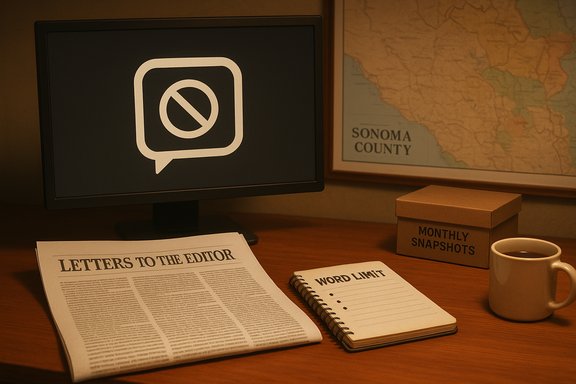
Local newspapers have long treated the letter to the editor as a curated public square: short, attributable, and edited. In recent months The Press Democrat announced a deliberate change to how community feedback is hosted online, moving away from open website comment threads and urging readers to channel strong opinions into formal letters — a policy change publicly announced by the paper and picked up across local outlets. That change frames the broader context for any daily letters page. The physical layout of a letters page — the selection process, word limits, verification requirements, and rotation — matters because it shapes whose voices are amplified and how readers interpret editorial choices. Independent reporting and media research reinforce the idea that opinion pages and moderated letters remain a valuable civic institution in local newsrooms if given resources and editorial intent.
Ultimately, letters to the editor remain an important civic instrument — but only if newsrooms treat them as part of an intentional ecosystem of community engagement, transparency, and digital stewardship. Research and industry best practice point toward a balanced approach: preserve the moderated, archival strength of letters while exploring targeted, moderated spaces that restore some of the immediacy lost when open comment threads are removed.
Source: The Press Democrat Letters to the Editor, Sunday Dec. 28
 Background
Local newspapers have long treated the letter to the editor as a curated public square: short, attributable, and edited. In recent months The Press Democrat announced a deliberate change to how community feedback is hosted online, moving away from open website comment threads and urging readers to channel strong opinions into formal letters — a policy change publicly announced by the paper and picked up across local outlets. That change frames the broader context for any daily letters page. The physical layout of a letters page — the selection process, word limits, verification requirements, and rotation — matters because it shapes whose voices are amplified and how readers interpret editorial choices. Independent reporting and media research reinforce the idea that opinion pages and moderated letters remain a valuable civic institution in local newsrooms if given resources and editorial intent. What the Dec. 28 letters package delivers
The Press Democrat’s Dec. 28 Letters to the Editor installment is consistent with the outlet’s daily practice of publishing a short, curated set of reader submissions that reflect local concerns, praise for community programs, and critiques of policy or civic leaders. Typical elements across these packages include:- A mix of civic topics (schools, land use, public safety) and human-interest notes (gratitude for a nonprofit, local business shout-outs).
- Short, punchy pieces limited by a word cap, often edited for clarity and space.
- An editorial note on how to submit letters (email address and submission rules) and a reminder about verification requirements.
Why letters to the editor still matter — and how they differ from comments
Letters as moderated civic exchange
Letters to the editor are not simply an artifact of print nostalgia. They are a moderated forum that can:- Encourage turn-taking and accountability: writers provide an attributable view tied to a real name and city, and editors enforce caps on frequency and length.
- Surface local priorities: research shows letters often mirror the newspaper’s coverage and disproportionately focus on local governance and services.
- Provide a persistent, archivable record: unlike social posts or transient comment threads, published letters are retained in searchable archives that preserve local debate.
Comments vs. letters: trade-offs
Open comment threads offer immediacy and breadth but carry costs: moderation burden, toxicity risk, and an often-noisy surface that can drown out constructive contributions. The Press Democrat’s decision to disable direct website comments and redirect strong opinions to letters reflects a calculation familiar across local newsrooms: limited staff and the need for civil, verifiable discourse make curated letters a preferable channel for many editorial teams. Research also shows that journalist involvement in comment spaces — when feasible — can improve civility and usefulness, but that requires staff time most local outlets no longer have in abundance. The trade-off is operational: more curated avenues mean better quality at the expense of immediacy and raw breadth.The technology and operational side: what newsrooms must manage
Local opinion pages and associated digital workflows are modest in scope but delicate in practice. Key operational demands include:- Submission intake and verification: collecting email and phone contacts, limiting frequency per writer, and triaging potential legal or factual risks.
- Editing and fact-checking: brief corrections for clarity without changing the writer’s voice, and flagging factual claims that require verification.
- Archiving and discovery: maintaining HTML snapshots, searchable metadata, and durable archives that don’t rely solely on third-party platforms.
- Scheduled CMS exports and encrypted offsite backups to preserve contributor archives.
- Automated image optimization and templated social cards to streamline publication.
- PowerShell scripts or light automation to produce monthly static snapshots for legal retention and search indexing.
The editorial calculus: selection, fairness, and amplification
Editors who curate letters perform an invisible but vital civic role: they are gatekeepers of airtime in their community’s conversation. That role raises three core questions:- Selection criteria: How do editors ensure balance across topics, geography, and ideological lean? Many local papers limit one published letter per writer per 90 days to avoid dominance by a vocal few.
- Transparency and fairness: Are selection decisions explained? Does the paper publish a short note about edits or reasons for non-publication?
- Amplification: Which letters get repurposed to social platforms and newsletters, and how does that change the footprint of the published opinion?
Moderation policy: a modern balancing act
The Press Democrat’s public guidance on comment policy emphasizes civility and family-friendly tone — a typical approach rooted in legal and community concerns. But implementing that policy raises operational and reputational choices:- Automated filtering vs. human moderation: automation cuts volume but can generate false positives; humans offer nuance but cost staff hours.
- Scope of moderation: some outlets restrict comments on national stories while permitting local discussion — a tactic that preserves local civic debate while reducing moderation burden on outside or polarizing content.
- Integration with letters: routing substantive, verified viewpoints into formal letters both improves quality and reduces noisy on-site threads.
Technology risks and digital archiving: protecting local memory
Local letters are civic artifacts. Their preservation is technical work that needs policies and tools:- Durable snapshots: monthly static exports of front pages and letters reduce reliance on active CMS and make legal retention straightforward. Simple scripts or off-the-shelf archiving services can generate compressed archives on a schedule.
- Metadata and provenance: when letters or opinion pieces are shared or syndicated, carrying clear attribution and timestamp metadata preserves context for readers beyond the county. Failure to preserve provenance risks misinterpretation when content is republished.
- Platform dependency: over-reliance on social networks for distribution can expose small outlets to algorithm shifts that harm discoverability and subscription funnels. Diversifying with newsletters, direct email, and durable archives mitigates that risk.
- Automate CMS backups daily and push encrypted archives offsite.
- Generate monthly static HTML snapshots and store them for five years.
- Implement image optimization and caching to lower hosting costs and speed pages.
- Add author and timestamp metadata to every published letter and include a short editorial note when content is edited for length or clarity.
- Maintain a public, short-form submissions policy page that details how letters are selected, edited, and retained.
The civic implications: who benefits and who might be left out
Letters pages are valuable but imperfect civic tools. Benefits include a moderated, attributable community forum and a channel for civic accountability. Potential downsides include:- Uneven access: older residents or those without reliable internet may still prefer print; digital-first channels can inadvertently favor younger, online-savvy contributors.
- Gatekeeping risk: editorial discretion can become perceived or real bias if selection criteria aren’t transparent.
- Misinformation: letters sometimes contain factual errors or unverified claims; editorial checks are necessary to avoid amplifying inaccuracies. Research shows a nontrivial fraction of reader submissions across outlets contain inaccuracies, especially on politically charged topics. Editors must weigh the public interest in publishing a perspective against the risk of perpetuating falsehoods.
Recommendations for The Press Democrat and similar local outlets
- Publish a compact transparency note with each letters package explaining selection criteria, the number of submissions received, and why chosen letters were selected. This reduces perceptions of arbitrary gatekeeping.
- Maintain an accessible archive and provide a simple search tool for letters; make metadata (author city, published date) visible.
- Offer periodic “letters roundtable” features where staff respond with short explainers about factual claims raised in letters. This both corrects misinformation and elevates civic literacy.
- Partner with local IT volunteers for routine backups and incremental automation tasks. Simple Windows PowerShell scripts and standard archival routines can be templated and shared among regional outlets.
- Where feasible, pilot journalist engagement in targeted comment spaces (e.g., dedicated threads for community meetings) to improve civility and relevance; evidence shows reporter involvement can raise the quality of conversation.
What readers should know about contributing effectively
If you plan to write a letter:- Follow the outlet’s submission rules: word limits, contact info for verification, and frequency caps.
- Keep claims specific and local when possible; local officials and budgets are easier for journalists to verify.
- Provide sources for factual claims or offer to provide documentation to the newsroom on request.
- Expect concise edits for space: editors routinely trim for clarity while preserving the sender’s intent.
Conclusion
The Press Democrat’s Dec. 28 Letters to the Editor package is a snapshot of local life and a reminder that, even in an era of social media and instant reaction, curated public forums matter. The paper’s broader decision to disable open website comments and steer readers toward formal letters reflects a common newsroom calculus: with limited moderation resources, curated letters provide civility, provenance, and archiveable civic record. Sustaining that value requires both editorial clarity and modest technical investment: predictable backups, durable archives, and small automations that protect content and reduce staff friction. Windows-savvy volunteers and IT teams can deliver outsized value with straightforward scripts and hosting hygiene.Ultimately, letters to the editor remain an important civic instrument — but only if newsrooms treat them as part of an intentional ecosystem of community engagement, transparency, and digital stewardship. Research and industry best practice point toward a balanced approach: preserve the moderated, archival strength of letters while exploring targeted, moderated spaces that restore some of the immediacy lost when open comment threads are removed.
Source: The Press Democrat Letters to the Editor, Sunday Dec. 28